Where Parasha Ha'azinu sang the Song that called heaven and earth as witnesses (Deut. 32:1), the final parasha of the Torah opens with the words Moses speaks over the tribes just before his death. Here — for the first and only time in the Torah — he is called Ish ha-Elohim, אִישׁ הָאֱלֹהִים "the man of God" (Deut. 33:1). Just as Jacob blessed his sons before he was gathered to his people (Gen. 49), Moses blesses the twelve tribes before he dies on Mount Nebo.
"There is none like God, O Jeshurun, who rides through the heavens to your help, and in His majesty on the clouds. The God of old is a dwelling place (me'onah), and underneath are the everlasting arms (zero'ot olam)." — Deuteronomy 33:26-27a (central text)
Scope and framework: the parasha has four major thematic movements: the theophany and the inheritance of Jacob (Deut. 33:1-5) — YHWH appears from Sinai, Seir and Paran with myriads of holy ones, and the Torah becomes a morashah, an inheritance of the qehillat Ya'akov; the blessings over the tribes (Deut. 33:6-25) — each tribe receives its own word, fitted to its character and calling, while Simeon is not named separately (cf. Gen. 49:5-7; Josh. 19:1,9); the praise of the God of Jeshurun (Deut. 33:26-29) — "Happy are you, O Israel! Who is like you, a people saved by YHWH?"; and the death of the servant and the epilogue of the Torah (Deut. 34:1-12) — Moses climbs to the top of Pisgah, sees the whole land, dies there as eved YHWH at the word of YHWH, is buried by Him, and the Torah closes with the testimony that no prophet arose again like Moses, "whom YHWH knew face to face".
Devar Emet · Zadok calendar On the Devar Emet parasha calendar, V'Zot HaBerachah falls in 2026 on Shabbat, October 3 (month 7, day 11), following the priestly order of time of the Zadok calendar. The canonical seed of reading the Torah aloud in the seventh month lies in Deut. 31:10-13 (Hakhel at Sukkot) and Neh. 8:1-18. Rabbinic-Traditional In rabbinic practice this parasha is not read on a regular Shabbat but on Simchat Torah ("Rejoicing of the Torah"), following Shemini Atzeret: the scroll is closed and immediately reopened at Genesis 1. The name and form of that feast are post-Talmudic; Shemini Atzeret itself is canonical (Lev. 23:36; Num. 29:35).
V'Zot HaBerachah is the capstone of the last four parashot: in Nitsavim Moses set blessing and curse before the people and called them to choose life (Deut. 30:19); in Parasha VaYelech he handed over leadership and wrote down the Torah; in Parasha Ha'azinu he sang the Song as a lasting witness. Now comes the last word — and it is not a curse, not a warning, but berakhah.
Note: Rabbinic-Traditional the haftarah for V'Zot HaBerachah is Joshua 1 — in Ashkenazi tradition 1:1-18, in Sephardi tradition 1:1-9. On Simchat Torah the synagogue reading continues immediately with a second Torah reading from Genesis 1:1-2:3 (the restart of the cycle) and a maftir from Numbers 29:35-30:1 (the offerings of Shemini Atzeret). Genesis 1 is therefore not a haftarah, but the new opening of the Torah.
"Moses My servant is dead. Now therefore arise, cross over this Jordan, you and all this people, to the land that I am giving to them — to the children of Israel." — Joshua 1:2
"This book of the Torah shall not depart from your mouth; meditate on it day and night, so that you may be careful to do according to all that is written in it." — Joshua 1:8
Remez — the seam between Torah and Prophets: the canon has no pause. Deuteronomy 34 ends with the death of the eved YHWH; Joshua 1:1 opens with exactly that title: "After the death of Moses, the servant of YHWH". The human instrument falls away, but "this book of the Torah" passes into the mouth of the next generation (Josh. 1:8 — hagah, H1897, to meditate in a murmur). The threefold chazak ve'ematz of Parasha VaYelech (Deut. 31:6,7,23) sounds again in Joshua 1 — four times (Josh. 1:6,7,9,18), the last time from the mouth of the people themselves. See The Crossing for the Jordan that is now actually crossed.
Echo: "As I was with Moses, so I will be with you; I will not leave you nor forsake you" (Josh. 1:5) repeats word for word the promise of Deut. 31:6,8. The Greek name of Joshua, Iēsous (Heb. 4:8), is the same as that of Yeshua: the leader who brings in where Moses could not enter.
Face to face — Moses and Yeshua
"For the Torah was given through Moses; grace and truth came through Yeshua the Messiah. No one has ever seen God; the only begotten Son, who is in the bosom of the Father, He has made Him known." — John 1:17-18 (cf. Deut. 34:10)
The Greek nomos here renders the Hebrew Torah (H8451): instruction and direction, not a law code. The original has no contrasting "but" between the two halves of verse 17 — some translations add it and turn Torah and grace into opposites. John sets them side by side. "Grace and truth" (charis kai alētheia) is the Greek rendering of chesed ve'emet from the character proclamation of Exodus 34:6 — received by Moses when YHWH passed by him. John 1:14-18 reads as a midrash on Exodus 33-34: the Son "tabernacled" among us (eskēnōsen), "full of grace and truth" (rav-chesed ve'emet). See Emet — Truth and Faithfulness, Channun and Panim — His Face Passes By.
The epilogue of the Torah calls Moses unique: YHWH knew him panim el-panim. Yet Moses also heard: "you cannot see My face" (Ex. 33:20). John 1:18 resolves that tension: the Son who is in the bosom of the Father has "made Him known" — literally "exegeted" Him (exēgēsato). What Moses saw from outside and wrote down, Yeshua revealed from within — He is "the radiance of His glory and the exact imprint of His nature" (Heb. 1:3).
The Prophet like Moses — an open seat
"For Moses truly said to the fathers, YHWH your God will raise up for you a Prophet like me from your brothers; Him you shall hear in all things, whatever He says to you." — Acts 3:22 (quoting Deut. 18:15; the Greek Kyrios here renders the Name YHWH)
In Parasha Shoftim Moses promises: "YHWH your God will raise up for you a prophet like me" (Deut. 18:15,18). The final verses of the Torah deliberately keep that promise open: "there has not arisen a prophet since in Israel like Moses" (Deut. 34:10). The Torah closes not with a fulfilment but with a waiting seat. Peter (Acts 3:22-23) and Stephen (Acts 7:37) assign that seat to Yeshua. Hebrews 3:5-6 draws the distinction sharply: Moses was faithful "in all His house as a servant" (therapōn, the Greek rendering of avdi Moshe in Num. 12:7); the Messiah is faithful "as a Son over His house". Not a replacement of Moses, but the Son of the house in which Moses served. See Messianic Prophecies.
Moses in the land after all
"And behold, two men were talking with Him, Moses and Elijah, who appeared in glory and spoke of His departure (exodos), which He was about to accomplish at Jerusalem." — Luke 9:30-31 (cf. Matt. 17:1-3)
"I have let you see it with your eyes, but you shall not cross over there" (Deut. 34:4). The man who had to stop at Nebo stands on the mountain of transfiguration in the land, beside the Messiah — and the conversation is about a new exodos. What Moses pleaded for in Va'etchanan ("please let me cross over", Deut. 3:25) is answered not by his own right but in the nearness of the Son. The shining face of Moses (Ex. 34:29) is surpassed by the face of Yeshua that "shone like the sun" (Matt. 17:2).
Departing while blessing
"And He led them out as far as Bethany, and lifting up His hands He blessed them. While He blessed them, He parted from them and was carried up into heaven." — Luke 24:50-51
Moses' last act before his death is blessing (Deut. 33:1). Yeshua's last act before His ascension is blessing — with lifted hands, the priestly posture of Aaron who "lifted up his hands toward the people and blessed them" (Lev. 9:22). Neither leaves a void behind, but a blessed people. See Parasha Naso for the priestly blessing (Num. 6:22-27).
The God of the bush is a God of the living
"But that the dead are raised, even Moses showed at the bush, where he calls the Lord (Kyrios, rendering YHWH in Ex. 3:6,15) the God of Abraham and the God of Isaac and the God of Jacob. Now He is not God of the dead, but of the living, for all live to Him." — Luke 20:37-38 (cf. Deut. 33:16; Ex. 3:2-6)
In the blessing over Joseph, Moses calls YHWH shokhni seneh, "Him who dwelt in the bush" (Deut. 33:16) — a reference to his own calling (Ex. 3). Yeshua uses precisely that bush text to ground the resurrection. In the parasha in which Moses dies, the Name sounds that relativizes death: the God of the bush is a God of the living. See Life & Death — Chaim & Mawet and Undone and Reunited — Body, Soul and Spirit.
The man of God, thoroughly equipped
"All Scripture is breathed out by God and profitable for teaching, for reproof, for correction, and for training in righteousness, that the man of God may be complete, thoroughly equipped for every good work." — 2 Timothy 3:16-17
Paul uses for Timothy the same title Moses bears in Deut. 33:1: "man of God" (ho tou theou anthrōpos; cf. 1 Tim. 6:11). And he connects that title with Scripture — first of all the Tanakh, which Timothy had known "from childhood" (2 Tim. 3:15). The Ish ha-Elohim is formed not by position but by the inheritance of the Torah that he receives and passes on (Deut. 33:4).
Michael and the body of Moses
"But when the archangel Michael, contending with the devil, was disputing about the body of Moses, he did not presume to pronounce a blasphemous judgment, but said, The Lord rebuke you!" — the same formula as "YHWH rebuke you" in Zech. 3:2 — Jude 9 (cf. Deut. 34:6; Zech. 3:2)
Canonical verse Underlying tradition extra-biblical Deut. 34:6 reports that YHWH buried Moses and that "no one knows his grave to this day". Jude refers to a tradition about a dispute over that body which is not in the Tanakh. The canonical anchor of his point lies in Zechariah 3:2, where the same formula is heard: "YHWH rebuke you, satan". Jude's lesson is reverence and restraint: even an archangel does not pronounce his own judgment but leaves it to YHWH. The explanation that the hidden grave prevented veneration of the man Moses is a traditional explanation, not a textual claim — though it fits the direction of the text: the gaze is turned from the servant to the God of the servant.
From Sinai to Zion: Moses' blessing opens with YHWH who comes "from myriads of holiness" (merivevot qodesh, Deut. 33:2). Hebrews 12:22 takes up that image: "you have come to Mount Zion … and to innumerable (myriasin) angels". Hebrews 12 contrasts the fearful appearance at Sinai with the festal gathering at Zion, but it is the same God and the same voice (Heb. 12:25-26) — the renewed covenant deepens the Sinai covenant; it does not replace it. See Second Coming for Dan. 7:10 and the coming with the holy ones (Zech. 14:5).
The Torah does not end with curse, exile or a grave, but with berakhah: the servant departs, the inheritance remains, and underneath everything are the everlasting arms.
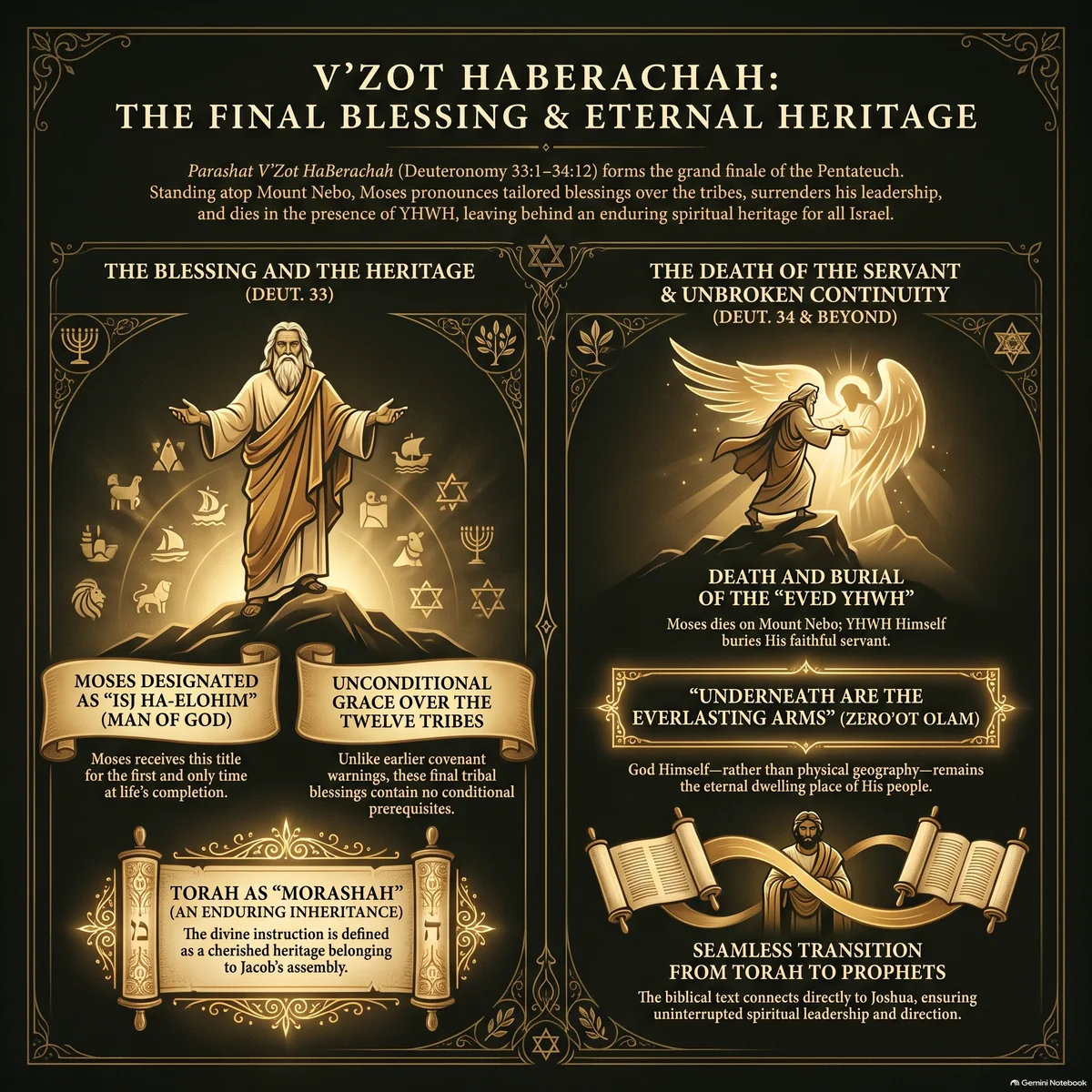
V'Zot HaBerachah is the finale of the Pentateuch. The greatest fruit of Moses' life is not that he himself enters the land, but that he leaves behind a blessed, taught and equipped people. He dies on the mountaintop with eyes that had not grown dim and vigor that had not abated (Deut. 34:7) — looking toward the promise.
The Torah closes with blessing and continuity: Moses rests in the hand of YHWH who buries him Himself, Joshua is filled with the spirit of wisdom (Deut. 34:9), and the people stand at the Jordan with the Torah as their inheritance. The final words of the Torah — "in the sight of all Israel" (Deut. 34:12) — place the testimony not with one man but with the whole people.
In Ki Tavo blessing and curse stood side by side, and the blessing was introduced with "if you diligently listen" (Deut. 28:1-2). In Deuteronomy 33 the word "if" does not occur: Moses addresses the tribes as a father, not as a contracting party. That does not abolish the Torah instruction — the tribe of Levi is blessed precisely because they "guarded" God's word and "cherished" His covenant (Deut. 33:9) — but the last word over the people lies with the grace of YHWH, who "turned the curse into a blessing for you, because YHWH your God loved you" (Deut. 23:6). See Connections §E.
A — Word study: berakhah (בְּרָכָה) — blessing as the first and last word
The verb barach appears for the first time in Genesis 1:22: "God blessed them" — the fish and the birds. Then in Gen. 1:28 over humankind and in Gen. 2:3 over the seventh day. The first mention sets the weight: blessing is the divine word that makes life fruitful, brings the human being to his calling, and hallows time. In Genesis 12:2 blessing becomes a commission: "be a berakhah". In the Tanakh a blessing is not a wish but a spoken transfer — spoken by God, or by the one He appoints: the patriarch (Gen. 27; 48-49), the priest (Num. 6:23-27), the man of God (Deut. 33:1).
Contrast: berakhah differs from ashrei (H835), the word with which the parasha ends: "Happy (ashrecha) are you, O Israel" (Deut. 33:29). Ashrei describes the state of one who walks the right path (cf. Ps. 1:1); berakhah is the gift that makes that state possible. Nor is berakhah a reward for performance: see Core above. Lexical BDB also lists berekh (knee, H1290) under the same root; whether "to bless" is etymologically related to "to kneel" is debated in the scholarly literature and is not presented here as fact.
Paleo-Hebrew layer (illustrative, not proof): Remez ב (house/tent) — ר (head) — כ (open palm): the head of the house with an open hand. The image fits strikingly with the concrete act of blessing: Jacob laying his hands on the heads of Ephraim and Manasseh (Gen. 48:14), Aaron lifting his hands (Lev. 9:22), Yeshua blessing with lifted hands (Luke 24:50).
Remez בְּרָכָה = ב(2) + ר(200) + כ(20) + ה(5) = 227. זָכַר (zachar, to remember, H2142) = ז(7) + כ(20) + ר(200) = 227. The numerical match has an independent canonical anchor: "In every place where I cause My Name to be remembered (azkir), I will come to you and bless you (uverakhticha)" (Ex. 20:24). Remembering and blessing stand in one verse as cause and effect. See Remember — The Hem of His Garment.
B — Ish ha-Elohim and the dwelling (ma'on) — Deuteronomy 33:1,27 and Psalm 90
"A prayer of Moses, the man of God. Adonai, You have been our dwelling place (ma'on) in all generations." — Psalm 90:1
The title Ish ha-Elohim (Deut. 33:1) returns for Moses in Josh. 14:6, 1 Chron. 23:14, 2 Chron. 30:16, Ezra 3:2 — and in the superscription of Psalm 90, the only prayer in the Psalter attributed to Moses. That psalm opens with exactly the image with which Moses' blessing closes: ma'on (H4583), dwelling. Deut. 33:27 has the related form me'onah (H4585), from the same root. The closing word of Moses' blessing and the opening line of his prayer confess the same thing: not the land, not the tent, but YHWH Himself is the dwelling place of His people — "in all generations". The same psalm prays: "So teach us to number our days" (Ps. 90:12) — prayed by the man who at 120 went to meet his last day.
Drash: Moses receives this title only at the end of his life. Spiritual greatness is not measured at the beginning of the road but by faithfulness to the end. The one who prays in Psalm 90 for a heart of wisdom receives in Deut. 33 the name that belongs to such a heart.
C — Morashah (מוֹרָשָׁה) — the Torah as inheritance of the qehillat Ya'akov
"Moses commanded us a Torah, an inheritance (morashah) for the assembly (qehillat) of Jacob." — Deuteronomy 33:4
Everywhere else morashah occurs, it refers to the land: "I will give it to you as a possession (morashah)" (Ex. 6:8; cf. Ezek. 11:15; 33:24). Only here is the Torah called so. Land and Torah are Israel's two inheritances: the one is the place, the other the structure of life within that place. See Territory of Israel and Torah — Instruction of the Father.
"Moses commanded us a law" activates a juridical-hierarchical frame. The text says Torah tsivah-lanu Moshe: Torah (H8451) is instruction, and tsivah (H6680) is to charge from within relationship — the verb of the mitzvot. And what is entrusted is called not a burden but an inheritance. A possession can be sold; a heritage is guarded with reverence and passed on.
Qehillat Ya'akov: the recipient of the inheritance is the qahal (H6951), the assembly of Israel — the same qahal that the Septuagint calls ekklēsia and that Stephen names "the congregation in the wilderness" (Acts 7:38). See The Assembly of Israel — Qahal and Ekklesia. Believers from the nations are grafted into that assembly, not set beside it: they become "fellow citizens" (sympolitai) of the commonwealth (politeia) of Israel (Eph. 2:12,19) and "heirs according to the promise" (Gal. 3:29). See Graft In — The Wild Olive Branch and The Word "Christian".
Rabbinic-Traditional The Talmud (b. Pesachim 49b) plays on the sound: "do not read morashah (inheritance) but me'orasah (betrothed)" — the Torah as Israel's bride. That is wordplay, not etymology, but it connects with the canonical image of the Sinai covenant as betrothal (Jer. 2:2). See The Heavenly Wedding — From Erusin to Nissuin.
D — The tribes: each its own word
Judah — the Shema reversed (Deut. 33:7). The blessing for Judah opens with Shema YHWH qol Yehudah: "Hear, YHWH, the voice of Judah". Where Deut. 6:4 calls Israel to hear, Deut. 33:7 promises that YHWH Himself will hear. Hearing is mutual: the covenant is a relationship from two sides. See Shema Yisrael and Glorify — The Halacha of Judah. The petition "bring him to his people" (ve'el-ammo tevi'enu) points forward to the split between Judah and Israel after Solomon (1 Kings 11-12) and to the prophecy of the two sticks that become one in God's hand, under one king (Ezek. 37:15-22).
Levi — guarding and teaching (Deut. 33:8-11). The Urim and Thummim are given to "Your chasid" — the man of chesed. Levi was tested at Massah and Meribah (Ex. 17:7; Num. 20:13) — the place where Moses and Aaron themselves fell short (Num. 20:12; Deut. 32:51; see Parasha Chukat). At the golden calf Levi chose YHWH above father, brother and child (Ex. 32:26-29) — a line Yeshua extends: whoever loves father or mother more than Him is not worthy of Him (Matt. 10:37; Luke 14:26).
"They guarded (shamru, H8104) Your word and cherished (yintsoru, H5341) Your covenant." Western translations often render these as "observed" and "kept". Both verbs, however, describe an attitude of watching over and cherishing — as a watchman guards a city and a mother protects a child — not juridical compliance under sanction.
The continuation gives Levi its task: "they shall teach (yoru) Jacob Your judgments and Israel Your Torah" (Deut. 33:10). Yoru comes from yarah (H3384), the same root as Torah: to aim, to teach. Malachi describes the covenant with Levi as "a covenant of life and peace", with "the Torah of truth (torat emet) in his mouth" (Mal. 2:5-7). This is the Priestly covenant — one of the seven covenants. See Parasha Pinchas — The Covenant of Peace and Emet.
Benjamin — between his shoulders (Deut. 33:12). "The beloved (yedid) of YHWH shall dwell in safety by Him … and He dwells between his shoulders." Jerusalem lay on Benjamin's border (Josh. 18:16,28); the place of the sanctuary rests, as it were, on Benjamin's shoulders. The word yedid returns in the name YHWH gave to Solomon: Jedidiah, "beloved of YHWH" (2 Sam. 12:25) — the king who would build the house there.
Joseph — dew, depth and the bush (Deut. 33:13-17). The blessing repeats and deepens Jacob's blessing (Gen. 49:22-26): the best of heaven and the dew, of the deep beneath, of sun and months, of the ancient mountains. Joseph is called "the one set apart (nezir) among his brothers" — the same words as in Gen. 49:26. The birthright went to the sons of Joseph (1 Chron. 5:1-2), and YHWH Himself calls Ephraim "My firstborn" (Jer. 31:9). See Drawn — the Position of the Soul for Deut. 33:17.
Zebulun and Issachar — the nations to the mountain (Deut. 33:18-19). "They call peoples to the mountain; there they offer sacrifices of righteousness, for they draw (yinaku, suck) the abundance of the seas." Two canonical lines meet here: the nations who say "Come, let us go up to the mountain of YHWH" (Isa. 2:2-3), and the same verb yanak (H3243) in Isaiah 60:16 and 66:11-12, where Zion "sucks the milk of the nations" and the wealth of the sea flows to Jerusalem (Isa. 60:5). The "sacrifice of righteousness" (zivchei-tsedek) recurs in Ps. 4:6(5) and 51:21(19).
Gad, Dan, Naphtali and Asher (Deut. 33:20-25) close the series with images of strength, satisfaction and peace — Asher's "as your days, so your strength" (v. 25). Rabbinic-Traditional Rashi reads "the lawgiver's portion, hidden" (v. 21) as an allusion to Moses' grave in the territory of Gad; the Torah itself lists Nebo among the cities Reuben rebuilt (Num. 32:37-38).
E — The Balaam mirror: blessing from the same summit
Three verbal links connect Moses' blessing with Balaam's in Parasha Balak — The Curse That Became a Blessing:
Canonical 1. The same summit: Balaam was brought to rosh haPisgah to curse Israel (Num. 23:14); Moses climbs rosh haPisgah to die (Deut. 34:1; cf. Deut. 3:27 in Va'etchanan). 2. Dwelling alone: "behold, a people dwelling alone" (levadad yishkon, Num. 23:9) — "so Israel dwells in safety, alone" (vayishkon … badad, Deut. 33:28). 3. The king: "the shout of a king is among them" (Num. 23:21) — "there was a king in Jeshurun" (Deut. 33:5). Where the hireling blessed against his will, the man of God blesses out of love.
Deuteronomy itself gives the key: "YHWH your God turned the curse into a blessing for you, because YHWH your God loved you" (Deut. 23:6). The same arc runs through the last parashot: in Ki Tavo six tribes stood on Gerizim for blessing and six on Ebal for the curse (Deut. 27:12-13); in Nitsavim blessing and curse were set before the people with the call to choose life (Deut. 30:19). In V'Zot HaBerachah all the tribes stand under one word — and that word is blessing.
F — "Who is like You?" — "Who is like you?" — the Jeshurun arc
"Who is like You among the gods, YHWH? Who is like You, majestic in holiness?" — Exodus 15:11 — the Song at the Sea
"Happy are you, O Israel! Who is like you, a people saved by YHWH, the shield of your help and the sword of your majesty?" — Deuteronomy 33:29 — the end of the blessing
At the start of the wilderness journey Israel sings mi chamocha of YHWH; at the end Moses says mi chamocha of Israel. That is no deification of the people: Israel's incomparability is wholly derived — "a people saved (nosha, from yasha, H3467) by YHWH". The people reflect the God who saved them. Here the parasha touches the heart of the study path Being Conformed to YHWH's Character: "those whom He foreknew He also predestined to be conformed to the image of His Son" (Rom. 8:29).
The arc of Jeshurun (יְשֻׁרוּן, from yashar, H3474, "straight, upright"): the name occurs only four times. In Parasha Ha'azinu Jeshurun grew fat and forsook the Rock (Deut. 32:15). In this parasha there is "a king in Jeshurun" (33:5) and there is "none like the God of Jeshurun" (33:26). Isaiah takes up the name with a promise: "Fear not, Jacob My servant, Jeshurun whom I have chosen" (Isa. 44:2). The fall is not the last word over the name. Interpretation varies Who "the king in Jeshurun" is, is read differently: Rashi and Ibn Ezra think of Moses; the context (vv. 2-5) and Num. 23:21 point rather to YHWH Himself as King (cf. Judg. 8:23; 1 Sam. 8:7). See King of Israel.
G — The death of the servant (Deuteronomy 34:1-12)
Moses dies "according to the word of YHWH" (al-pi YHWH, Deut. 34:5) — literally "at the mouth of YHWH". Rabbinic-Traditional The Talmud (b. Bava Batra 17a) reads this as a death "by a kiss". The text itself says: his dying was no accident and no defeat, but happened at God's own word. He dies as eved YHWH — the title already developed in Parasha VaYelech (eved/doulos, Ex. 21:2-6; Rom. 1:1). "And He buried him" (34:6): YHWH Himself cares for the body of His servant. See Walking for Deut. 34:6.
His eye was not dim and his vigor had not abated (34:7) — the opposite of what Moses himself had said about his strength (Deut. 31:2): he did not stop because he could no longer go on, but because his time was complete. Israel wept for him thirty days (34:8), and Joshua was "full of the spirit of wisdom, for Moses had laid his hands on him" (34:9; cf. Num. 27:18-23). The transfer is personal, with laying on of hands (semikhah), not merely institutional.
Many renderings say that Moses knew YHWH face to face. The text says asher yeda'o YHWH panim el-panim: "whom YHWH knew face to face". YHWH is the subject; Moses is the one known. What made Moses unique lies not in his knowledge of God but in God's knowing of him — exactly the pattern of Know — First Known, Then Knowing (Jer. 1:5; cf. Ex. 33:12,17: "I know you by name"). See also Panim for panim el-panim (Ex. 33:11) and peh el-peh, "mouth to mouth" (Num. 12:8).
H — Zero'ot olam — the everlasting arms and the revealed Arm
In Deuteronomy the arm of YHWH is the image of the exodus: "with a mighty hand and an outstretched arm" (Deut. 4:34; 5:15; 26:8). In Moses' last blessing that arm is no longer stretched out toward Egypt but spread out beneath the people: "underneath are the everlasting arms". The arm that delivered is the arm that carries. However deep a person or a people falls, beneath the bottom lie those arms.
Messianic · Sod The prophets make the arm of YHWH a person. "Behold, Adonai YHWH comes … His arm rules for Him … He will gather the lambs in His arm" (Isa. 40:10-11); "YHWH has bared His holy arm before the eyes of all the nations" (Isa. 52:10); "to whom has the arm of YHWH been revealed?" (Isa. 53:1). John applies that last question directly to the unbelief toward Yeshua (John 12:37-38). The everlasting arms beneath the people and the Arm that bore what weighed on us (Isa. 53:4,12) are, in the Messianic reading of the canon, one. See Nasa Avon — Bearing the Sin and Yeshua — Who Is He?.
I — Sod: the circle of the Torah closes
Remez-speculative In Parasha VaYelech §A and Parasha Ha'azinu §F the observation was made that the Torah ends where it began: VaYelech (halach) mirrors Lech Lecha, the third parasha; Ha'azinu (dew and rain from the witness-heaven) mirrors Noach, the second. V'Zot HaBerachah, the last, mirrors Bereshit, the first: there God spoke His first berakhah over life, humankind and Shabbat (Gen. 1:22,28; 2:3); here the man of God speaks his last berakhah over the people. The roots are canonically verifiable; the chiastic framing of the whole Torah is a literary-interpretive observation, not an explicit textual claim.
The dew inclusio: Ha'azinu opened with "my speech shall distil as the dew" (Deut. 32:2), after the summons to heaven as witness (32:1). In V'Zot HaBerachah that same heaven gives dew as blessing: "the precious things of heaven, the dew" for Joseph (33:13) and "his heavens drop down dew" (33:28) — the same blessing as Isaac's over Jacob, "of the dew of heaven" (Gen. 27:28). The heaven summoned as witness ends as a source of blessing.
The last letter of the Torah is the lamed of Yisrael (Deut. 34:12); the first is the bet of Bereshit (Gen. 1:1). Whoever closes the scroll and immediately opens it again reads ל־ב: lev, heart (H3820). This is a letter observation that can be checked in the text itself, but it is not an explicit textual claim; it is presented here as Remez-speculative. The canonical line it points to does stand literally in the Torah and the Prophets: "YHWH will circumcise your heart" (Deut. 30:6) and "I will put My Torah within them and write it on their hearts" (Jer. 31:33). See Heart-Torah — From Stone to Heart.
Face to face — and beyond: what made Moses unique becomes a shared good in the renewed covenant: "We all, with unveiled face, beholding the glory of the Lord (Kyrios; cf. 2 Cor. 3:16-17) as in a mirror, are being transformed (metamorphoumetha) into the same image from glory to glory" (2 Cor. 3:18). The veil of Moses (Ex. 34:33-35; 2 Cor. 3:13-16) gives way to conformity. See Cover — The Veil Before the Beholding.
Tabernacle projection: if this parasha were a place in the Tabernacle, it would be the entrance of the Tent of Meeting. There YHWH spoke with Moses "face to face, as a man speaks with his friend" (Ex. 33:11). And from there the blessing came out: after the first offering "Aaron lifted up his hands toward the people and blessed them … then Moses and Aaron came out of the Tent of Meeting and blessed the people, and the glory of YHWH appeared to all the people" (Lev. 9:22-23). Rachum projected to the Holy of Holies, Channun to the Menorah, Ha'azinu to the Testimony in the Ark; V'Zot HaBerachah stands on the threshold where what was received within goes out as blessing.
Further studies on Devar Emet
- Parasha Ha'azinu — Give Ear — the Song that precedes this blessing; the arc of Jeshurun
- Parasha VaYelech — And He Went — eved YHWH, chazak ve'ematz and the circle of the Torah
- Parasha Shoftim — Judges and Officers — the promise of the prophet like Moses (Deut. 18:15)
- Parasha Va'etchanan — And I Pleaded — the plea to cross over and the view from Pisgah
- Parasha Balak — The Curse That Became a Blessing — the Balaam mirror on the same summit
- Parasha Pinchas — The Covenant of Peace — Levi and the Priestly covenant
- Panim — His Face Passes By — panim el-panim, Ex. 33:11
- Know — First Known, Then Knowing — "whom YHWH knew" — Deut. 34:10
- Emet — Truth and Faithfulness — chesed ve'emet in John 1:14-17 and torat emet in Mal. 2:6
- Remember — The Hem of His Garment — remembering and blessing, Ex. 20:24
- Bring Forth — From Blessing to Fruit — the blessing of Gen. 1:28 and Gen. 49
- The Assembly of Israel — Qahal and Ekklesia — the qehillat Ya'akov as recipient of the inheritance
- Heart-Torah — From Stone to Heart — the Torah on the heart
- The Crossing — the Jordan of Joshua 1
- Messianic Prophecies — Canonical Signs — the Prophet like Moses
- Undone and Reunited — Body, Soul and Spirit — the God of the living, Luke 20:37-38
Parasha V'Zot HaBerachah challenges us, at the end of the Torah cycle, to turn the inheritance we have received into blessing and continuity:
1 — Speak a specific blessing.
Moses did not bless in generalities: each tribe received a word that fit its character and calling. Choose one person this week — a child, your spouse, a brother or sister — and bless that person aloud and concretely, with words that fit who he or she is and what YHWH is calling him or her to. Do not wait for a farewell to do it.
2 — Treat the Word as morashah.
The cycle begins again at Bereshit. This week read Deuteronomy 34 and Genesis 1 one after the other, and fix a regular, undisturbed moment in your week for Scripture — not as a duty, but as unpacking a heritage entrusted to you to pass on.
3 — Rest in the everlasting arms at an ending.
Are you facing the release of a task, a season, a place or a loved one? Speak Deut. 33:27 over that situation: "The God of old is a dwelling place, and underneath are the everlasting arms." Where human support falls away, the ground does not.
4 — Honor a quiet servant.
YHWH buried His servant Himself, out of people's sight. This week seek out someone who serves invisibly in your family or congregation, and give that person a concrete token of recognition and thanks.
Each step is a concrete form of V'Zot HaBerachah: the walk of a blessed person who passes on the blessing of the Word — from the entrance of the Tent to the people outside.
Avinu Malkenu — Our Father, our King,
There is none like You, God of Jeshurun, who rides through the heavens to our help. You are our dwelling place in all generations, and underneath us are Your everlasting arms — in abundance and in want, at a beginning and at a farewell.
Thank You for the Torah, the inheritance You entrusted to the assembly of Jacob and into which You have also grafted us. Thank You for the testimony of Moses, Your servant, whom You knew face to face — and above all for Yeshua, the Prophet like Moses, who has made You fully known.
Give us hearts that guard Your words and cherish Your covenant, as Levi did. Make our mouths a source of blessing for those You entrust to us, and as we close the scroll and open it again, let us begin at the first word with a renewed heart.
Baruch Atah YHWH, who blesses His people. Chazak, chazak, venitchazek! Amen.
- TorahDeuteronomy 33:1-34:12; Deuteronomy 33:1 (Ish ha-Elohim); 33:2-5 (the theophany from Sinai, Seir and Paran; the king in Jeshurun); 33:4 (the Torah as morashah of the qehillat Ya'akov); 33:7 (Judah: Shema YHWH qol Yehudah); 33:8-11 (Levi, Urim and Thummim, shamar and natsar, yoru); 33:12 (Benjamin); 33:13-17 (Joseph, shokhni seneh); 33:18-19 (Zebulun and Issachar); 33:20-25 (Gad, Dan, Naphtali, Asher); 33:26-29 (the God of Jeshurun, me'onah and zero'ot olam, mi chamocha); 34:1-4 (the top of Pisgah); 34:5-9 (the death of the eved YHWH, the burial, the semikhah of Joshua); 34:10-12 (panim el-panim). Further: Genesis 1:22,28; 2:3 (first mention of barach); Genesis 12:2; 27:28; 48:14; 49:5-7,22-26; Exodus 3:2-6; 6:8; 15:11; 17:7; 20:24; 32:26-29; 33:11-23; 34:6,29-35; Leviticus 9:22-23; 23:36; Numbers 6:22-27; 12:7-8; 20:12-13; 23:9,14,21; 27:18-23; 29:35-30:1; 32:37-38; Deuteronomy 3:25-27; 4:34; 5:15; 6:4; 18:15,18; 23:6; 26:8; 27:12-13; 28:1-2; 30:6,19; 31:2,6-8,10-13,23; 32:1-2,15,51.
- ProphetsJoshua 1:1-18 (Haftarah); Joshua 14:6; 18:16,28; 19:1,9; Judges 8:23; 1 Samuel 8:7; 2 Samuel 12:25; 1 Kings 11-12; Isaiah 2:2-3; 40:10-11; 44:2; 52:10; 53:1,4,12; 60:5,16; 66:11-12; Jeremiah 1:5; 2:2; 31:9,33; Ezekiel 11:15; 33:24; 37:15-22; Zechariah 3:2; 14:5; Malachi 2:5-7.
- WritingsPsalm 1:1; 4:6(5); 51:21(19); 90:1,12 (the prayer of Moses, the man of God); Daniel 7:10; Ezra 3:2; Nehemiah 8:1-18; 1 Chronicles 5:1-2; 23:14; 2 Chronicles 30:16.
- Brit ChadashaJohn 1:14-18 (chesed ve'emet, panim el-panim); John 12:37-38 (the arm of YHWH); Acts 3:22-23; 7:37; 7:38 (the Prophet like Moses; the qahal in the wilderness); Matthew 10:37; 17:1-3; Luke 9:30-31 (the exodos); 14:26; 20:37-38 (the God of the bush); 24:50-51 (departing while blessing); Romans 1:1; 8:29; Galatians 3:29; Ephesians 2:12,19; 2 Corinthians 3:13-18; 1 Timothy 6:11; 2 Timothy 3:15-17; Hebrews 1:3; 3:5-6; 4:8; 12:22-26; Jude 9.
- Rabbinic/TraditionalSimchat Torah and the restart of the reading cycle; the choice of haftarah (Ashkenazi Joshua 1:1-18, Sephardi 1:1-9); b. Pesachim 49b (morashah / me'orasah); b. Bava Batra 17a (al-pi YHWH); Rashi and Ibn Ezra on Deut. 33:5 and 33:21; the closing formula chazak chazak venitchazek.
- LexicaBDB; Strong's Concordance (H1288, H1290, H1293, H2142, H2220, H3243, H3384, H3423, H3467, H3474, H4181, H4583, H4585, H5341, H6680, H6951, H8104, H8451); Jeff A. Benner / AHRC (paleo-Hebrew layer, Remez only).
- PaRDeS HermeneuticsPshat (the blessing over the tribes, the death and burial of Moses, the epilogue of the Torah); Remez (berakhah = zachar = 227 with Ex. 20:24; the Balaam mirror; the dew inclusio; ma'on in Psalm 90); Drash (blessing without condition, the Torah as heritage, the man of God at the end of the road); Sod (the everlasting arms and the revealed Arm, the circle of the Torah, the entrance of the Tent of Meeting). Talmud, b. Sanhedrin 67b; b. Chagiga 14b.