The study Hear did not end with hearing itself. It ended with a drawing (mashak, Jeremiah 31:3; helkō, John 6:44) — YHWH moving the soul before there is even a conscious choice. This study begins exactly there: at the moment the drawing becomes a step. Not the step as an achievement that earns God's attention, but the step as the first, vulnerable response to a Voice that had already sounded.
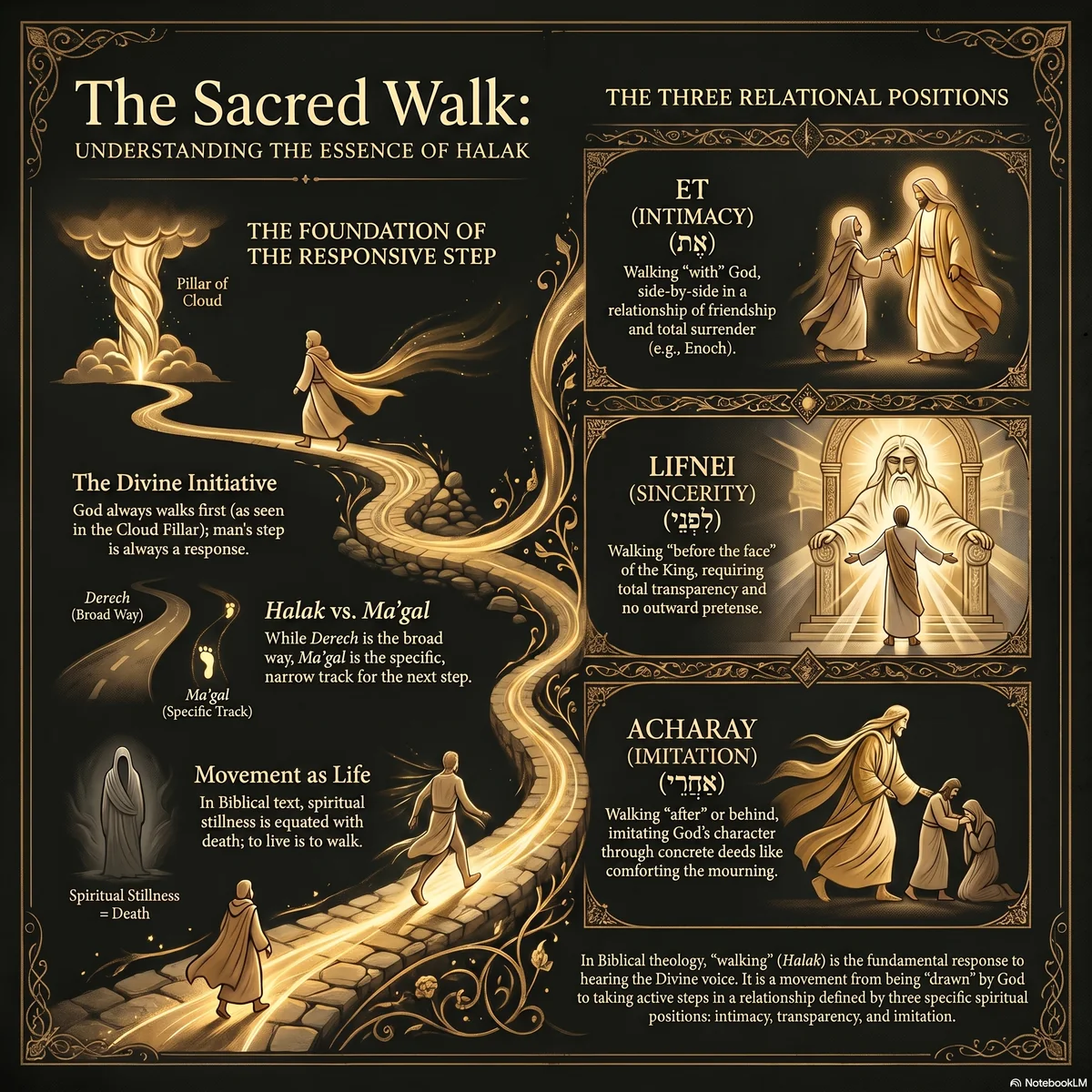
The keyword is הָלַךְ (halak, H1980) — the ordinary Hebrew verb for going or walking, and the root from which the later, extra-biblical concept halacha is built. This study therefore lays the foundation beneath all the other halachic studies on this site: hear, love, give, remember, glorify and purify are each a concrete footstep on the path mapped out here.
After this study, you will understand:- The distinction between halak, hithalek, derech, ma'gal, and the later concept of halacha
- The three relational postures of the walk: et (with), lifnei (before the face of), and acharay (behind, after)
- Five kinds of walking in the Greek of the Renewed Covenant — and why they do not mean the same thing
- How YHWH Himself always walks first — from the burning bush to the pillar of cloud — and why the first step is never a solitary initiative
- How the prophets test the walk: casual (keri) versus devoted, and the walk as priority over ritual
- Concrete biblical figures who take the first step, from Enoch to the crippled man at the temple gate — and how Yeshua's own walk is the blueprint for every step that follows
This study builds directly on Hear — Understanding the Voice of YHWH, which ends with the observation that hearing "always points onward to the road — to the walking that follows what has been heard." Read that study first if possible; this study does not repeat the foundation of shema, but picks it up as its starting point.
- Gen. 3:8 YHWH walking (mithalech) in the garden, in the voice of the day.
- Gen. 5:24 Enoch walked with God (hithalek), and he was no more.
- John 6:44 No one can come to Me unless the Father draws him.
- Acts 3:8 Leaping and walking and praising God, he entered the temple.
- Micah 6:8 To walk humbly with your God.
"And they heard the voice of YHWH God, walking (mithalech) in the garden, in the voice of the day."
Genesis 3:8 · בְּרֵאשִׁיתThis same verse carried the previous study: Adam and Eve "heard the voice." But the Hebrew says more. The participle מִתְהַלֵּךְ (mithalech, from halak, H1980) describes what YHWH does: He walks. Before there is any human hearing or human step, God is already present in the garden, walking. The human hides — the first response to God's walk is not a step, but a flight. This study is about what happens when that response changes: when the flight becomes a step.
Three Postures — Et, Lifnei, Acharay
The Tanakh knows no neutral walk. The Hebrew preposition standing behind halak determines the nature of the relationship. Three postures recur again and again:
| Posture | Hebrew | Function | Key Verse |
|---|---|---|---|
| Intimacy | אֶת — Et | Hand in hand, side by side. The walk of friendship and surrender, expressed in the hitpael form hithalek. | Genesis 5:24; 6:9 |
| Integrity | לְפָנַי — Lifnei | Before the face of — every step taken in the direct sight of the King. Requires transparency, not outward display. | Genesis 17:1; Exodus 13:21 |
| Following | אַחֲרַי — Acharay | Walking behind — imitating His character, not approaching His essence. The basis of concrete halacha. | Deuteronomy 13:4 |
None of these three postures stands apart from the others. One who seeks only intimacy without following mistakes closeness for non-commitment. One who chases only following without intimacy turns the walk into a performance. Scripture holds them together.
The Burning Bush — Shoes Off for Holy Ground
Before Israel walks behind the pillar of cloud, YHWH calls one man by name from a burning bush. Moses hears the Voice — and the very first thing that Voice asks is not a step forward, but a step back: "Do not come near! Take your shoes off your feet, for the place on which you are standing is holy ground (אַדְמַת־קֹדֶשׁ, admat kodesh)" (Exodus 3:5).
Set down first, then draw near. Shoes are what protect the foot from the ground it walks on — the image of everything that clings to the ordinary, everyday world (chol). Before there can be any question of walking toward kodesh, something must first be set down. This is not a legalistic threshold, but the logic of holiness itself: kodesh (set apart, dedicated to YHWH) and chol (ordinary, everyday) cannot simply coexist. Moses takes off his shoes, hides his face (Exodus 3:6) — and only then does YHWH continue speaking: His name, His commission, His promise of presence ("I will be with you," Exodus 3:12). Nearness follows the setting-down, not the other way around.
The Pillar of Cloud — Lifnei as a Verb
Genesis 3:8 is no isolated incident, and the burning bush does not stand alone. Throughout the Tanakh, YHWH walks before the human does. At the exodus from Egypt it is even stated grammatically, literally: וַיהוָה הֹלֵךְ לִפְנֵיהֶם — "and YHWH went (holech) before their face (lifneihem), by day in a pillar of cloud" (Exodus 13:21). Holech is a qal participle: in classical Hebrew, a participle of the basic stem (qal) of the verb, expressing a continuous action or state — functioning as both verb and adjective at once, usually translated with an "-ing" form such as "going" or "walking." The verb of this entire study and the preposition of the Lifnei-posture stand together in this single sentence: God walks, before Israel, visibly.
The order is never reversed. Israel walks only after and behind the pillar of cloud — exactly as Moses first had to set something down at the burning bush before he was allowed to draw near. There is no passage of Scripture in which the human walks first and YHWH then follows. This is the ground beneath this entire study: the first step a person takes is by definition a response, never an initiative. Even the most devoted walk — Enoch, Noah, Abraham — does not begin with their decision, but with God's presence already walking ahead of them.
This connects directly to where the previous study ended. Yeshua says of His sheep: "My sheep hear My voice, and I know them, and they follow (akoloutheō, G190) Me" (John 10:27). Following is already a form of walking here — but it is preceded by hearing, and that hearing is in turn preceded by a drawing: "No one can come to Me unless the Father who sent Me draws him" (John 6:44). Halak, then, does not begin at the feet. It begins with a Voice that had already called, and a Father who had already drawn.
Micah 6:8 sums up the whole direction of this study in three verbs: doing justice, loving mercy, and walking humbly (הַצְנֵעַ לֶכֶת, hatsnea lechet) with your God. Hatsnea means hidden, modest, staying within the right channel. This is not a walk of outward display, but a walk in the shelter — precisely the opposite of a walk that must furnish proof to itself or to others.
Torah echo. Micah's summary is itself no new formula — the prophet echoes Moses. Deuteronomy 10:12 asks the same question ("what does YHWH your God ask of you?") and answers it with the same four movements: to fear YHWH (יָרֵא, yare, H3372 — reverence, not fear-driven panic), to walk in all His ways (הָלַךְ, לָלֶכֶת בְּכָל־דְּרָכָיו), to love Him (אָהַב, ahav, H157), and to serve Him (עָבַד, abad, H5647 — devoted care, not slave labor). Micah 6:8 is the prophetic condensation of this Torah text, not an addition to it.
This pattern — the word goes first, the footstep enters what already stands — converges in the Tabernacle into a single image: Israel breaks camp "at the mouth of YHWH" (עַל־פִּי יְהוָה, al pi YHWH) and encamps "at the mouth of YHWH" (Numbers 9:15-23) — the word, literally the mouth, is here the signal to walk. Paul draws the same line through to the believer: "we are His workmanship, created in Christ Jesus for good works, which God prepared beforehand, that we should walk in them" (peripateō, Ephesians 2:10) — here too, what has already been prepared precedes the step.
Hifil — YHWH makes the walk happen. Deuteronomy 8:2 lifts the pillar-of-cloud image into a deeper register: "remember the whole way that YHWH your God made you walk (הוֹלִיכְךָ, holichacha — hifil of הָלַךְ, H1980) these forty years in the wilderness, to humble you, to test you, to know what was in your heart: whether you would keep (שָׁמַר, shamar, H8104) His mitzvot or not." The qal form (Exodus 13:21) shows that YHWH walks ahead; the hifil form here shows that He actively causes Israel's walk — including the testing itself. Humbling is not a byproduct of the wilderness, but its purpose — the same movement as at the burning bush: set down first, then draw near. Note the translation loss: "keep" (most English versions) renders shamar here — not legal compliance, but guarding and cherishing (per Protocol II.iv).
Case Study: Sihon and Og (Parasha Devarim). Deuteronomy 2:31 shows how this order works concretely: YHWH speaks (דָּבָר, davar, H1697) the victory over Sihon before Israel takes a single step — "see, I have begun to give Sihon and his land over to you; begin to possess it." Israel does not fight to establish a victory; it walks into an already-spoken reality. On the very threshold of the crossing, this exact pattern repeats: "every place that the sole of your foot will tread (from darach, H1869 — the root of derech, "the way"), I have given to you, as I spoke to Moses" (Joshua 1:3). Note well: davar and halak share no common root themselves — this connection runs through darach/derech, not through any supposed etymological link between "speaking" and "walking." Developed further in the study Parasha Devarim.
Halak, Hithalek, and the Later Halacha
הָלַךְ (halak, H1980) is the ordinary Hebrew verb for going or walking. In the Tanakh it is never a neutral, biological term: standing still equals spiritual death. The idols of Psalm 115:7 "have feet, but do not walk" — an explicit, canonical contrast between the true God and a dead idol, built on this very verb.
Contrast — sur, not halak. The Tanakh has its own verb for "turning aside from the way," one that is never confused with halak: סוּר (sur, H5493). Moses sees the golden calf and states: "you had turned aside (סַרְתֶּם, sartem) quickly from the way (derech) that YHWH had commanded you" (Deuteronomy 9:16). This is not a weaker form of walking — it is the canonical opposite. Where halak/hithalek describes a sustained, oriented movement with YHWH, sur describes an abrupt change of course away from Him. This study does not recognize two speeds of the same walk, but two opposite verbs.
The hitpael form hithalek — an intensive, reciprocal conjugation — literally means "to walk back and forth continually" and expresses an active, relational walk: Enoch (Genesis 5:24), Noah (Genesis 6:9), and Abraham (Genesis 17:1) all walk in this form. It is not dutiful trudging, but journeying together.
Halacha is not a biblical word — and that is not a problem. The term הֲלָכָה (halacha, "the going of the way") does not yet appear in the Tanakh itself in its later, technical sense of "Jewish religious-practical system." It is a Rabbinic/Traditional concept, built on the canonical root halak. This study therefore uses "halacha" solely to denote "how Torah-guidelines translate into today's concrete step" — not as a term that itself appears literally in Scripture.
Alongside the verb, the Tanakh has two nouns that further sharpen the walk: דֶּרֶךְ (derech, H1870) is the broad way — the life goal, the Torah as a whole (Proverbs 3:6: "In all your ways acknowledge Him"). מַעְגָּל (ma'gal, H4570) is the concrete, narrow track the foot is on right now (Proverbs 4:26). Psalm 119:105 deliberately chooses the image of the ma'gal, not the derech: "Your word is a lamp to my foot and a light to my path" — a lamp does not illuminate the whole horizon, only one step at a time. Halacha is concerned with the ma'gal, not primarily with the derech.
Kinds of Walking — Five Greek Verbs
The Renewed Covenant does not use one, but five different Greek verbs, all rendered "walk" in English translation. They do not describe synonyms, but five different movements — a set that, together with the Hebrew layer above, forms the complete picture of the walk.
| Greek | Strong's | Meaning | Key Verse |
|---|---|---|---|
| Peripateō | G4043 | The general, daily walk of life — "going about through life." The most commonly used form. | Ephesians 4:22–24; Romans 8:1 |
| Stoicheō | G4748 | Literally "to walk in a row, to march in formation" — a military term for order, direction, and following a shared rule. | Acts 21:24; Galatians 6:16 |
| Anastrephō / Anastrophē | G390 / G391 | "Your conduct, your entire lifestyle, how you carry yourself in the world." Often rendered "conduct" or "way of life" in older translations. | 1 Peter 1:15; 1 Timothy 4:12 |
| Orthopodeō | G3716 | Literally "to walk with a straight foot." Used once by Paul, of walking that strays from the truth of the Good News. | Galatians 2:14 |
| Poreuomai | G4198 | "To go, to travel, to journey onward." Emphasizes the journey or the distance covered, not the daily rhythm. | Luke 1:6 |
Acts 21:24 — en nomos, not hypo nomos. When James asks Paul to purify himself so that "all will know... that you yourself also walk (stoicheō) keeping the Torah (nomos, here translated "the law")," this is an en-nomos text: Paul walks within the Torah, as a living life-space, not under the Torah as a performance system (hypo nomos, compare Galatians 3:23). The common translation "keeps the law" conceals that this passage is evidence that Paul remained Torah-faithful. This passage is often skipped over in supersessionist readings; in fact, it contradicts that reading.
The same applies to Luke 1:6, where Zechariah and Elizabeth "walked blamelessly (poreuomai) in all the commandments and ordinances" — here "commandments" translates entolē, closer to "instructions arising from relationship" (mitzvot) than to a legal code. Restoration: "walked blamelessly in all the Torah-guidelines and ordinances."
Remez — the letters of halak. Paleo-Hebrew (Jeff Benner) reads הָלַךְ as Chet (fence, separation), Lamed (shepherd's staff, guiding authority), and Kaf (open palm). A suggestive image — not canonical proof — of walking as: within the fence of the covenant, guided by the staff, carried by an open hand. As a further, likewise reinforcing Remez layer: the numeric value of halak (Chet 8 + Lamed 30 + Kaf 20 = 58) exactly equals that of חֵן (chen, "grace" — Chet 8 + Nun 50 = 58). The numeric match is exact and thematically connected: the walk is carried by grace, not by performance. This is presented here as supporting, not as decisive, evidence.
Acharay — Walking Behind a Consuming Fire
Deuteronomy 13:4 carries an apparent impossibility within it: "You shall walk after YHWH your God." How does a creature of flesh and blood walk behind Him, when elsewhere it is said that He is "a consuming fire" (Deuteronomy 4:24)?
b. Sotah 14a — Imitatio Dei. The Talmud asks exactly this question and gives an answer that forms the practical core of this entire Halacha section: walking after God does not mean the human ascends to His essence, but that he brings His character traits down to earth. Four concrete, canonical acts of YHWH are taken as the example:
- Clothe the naked — YHWH clothes Adam and Eve after the fall (Genesis 3:21).
- Visit the sick — YHWH appears to the recovering Abraham at Mamre (Genesis 18:1).
- Comfort the mourning — YHWH blesses Isaac after Abraham's death (Genesis 25:11).
- Bury the dead — YHWH Himself buries Moses (Deuteronomy 34:6).
Each act is canonically grounded; the framing of these as four categories of Imitatio Dei is Rabbinic/Traditional (b. Sotah 14a).
These four acts dissolve the separation between "holy" and "ordinary." Giving a coat to someone who is cold is then no social side-issue next to the spiritual life — it is itself the acharay-walk, literally in the footsteps of what YHWH already did.
Conditional promise — Proverbs 3:6. "Acknowledge Him in all your ways (derech), and He will make your paths (netiv) straight." The promise follows acknowledgment, not full clarity beforehand. Whoever waits until the whole derech is visible before taking a step waits for something that is never given — Psalm 119:105 explicitly promises light only for the foot, not for the horizon.
This is the same reversal the previous study described concerning na'aseh ve'nishma: not full understanding first, then a step; but the step that opens sight for the next one.
The Prophetic Crisis — Walking After Emptiness
The reverse side of the walk is just as canonical as the walk itself. Jeremiah diagnoses Israel's drifting with exactly the same imagery: "walking in the stubbornness (שְׁרִירוּת, sherirut) of their heart" (Jeremiah 9:14; 11:8) — a root meaning "to fix, to harden": a walk stuck fast in its own autonomy, the opposite of the responsive step with which this study opens.
You become what you walk after. "They have gone far from Me, and have walked after emptiness (הֶבֶל, hevel — vapor, emptiness), and have become empty themselves" (Jeremiah 2:5). This is not a moral warning in a general sense, but a precise, canonical psychological law that reverses the whole Acharay principle: walk after the living God, and you become alive; walk after emptiness, and you become empty.
The Prophetic Walk — Casualness, Priority, Identity, and Destination
The prophets add four more sharp layers to Sherirut and Hevel. Together they form a mirror that forces the walker to test not only whether he walks, but how.
Keri — the "casual" walk (Leviticus 26). קֶרִי (keri) means "casual, incidental, non-committed." YHWH warns: if the people walk with Him in keri, He will also walk with them in keri (Leviticus 26:21–28). Halacha must never degrade into a walk of convenience — a side matter for the Sabbath, while the rest of the week is governed by self-interest. Where keri creeps into the walk, the tangible presence of YHWH withdraws.
The walk precedes the offering (Jeremiah 7:22–23). "When I led your fathers out of Egypt, I did not first of all command them concerning burnt offerings, but this: hear My voice, and walk in the whole way (Derech) that I set before you as direction." Translation-loss restored: "obey" here translates shema — orienting toward, not command-following; "command" translates the tsavah root (mitzvot) — instructions arising from relationship, not a code of law. The Torah did not begin at the Tabernacle, but at the exodus: a walk out of slavery, behind the pillar of cloud. When the walk is destructive — injustice, lovelessness — the religious ritual loses its value. Halacha seeks the ethical and relational walk first, and only then the correct form of worship.
Jeremiah 2:5 (already cited above) gains an additional contrast in this light: where walking after hevel (emptiness) produces emptiness, walking after the living God fills a person with כָּבוֹד (kavod, H3519 — weight, honor, glory). This particular contrast — kavod versus hevel — is not a separate Scripture verse but a homiletical application (Drash) built on both canonical words: the walk you choose shapes what you become.
The eschatological walk — Micah 4:5; Isaiah 2:3. The prophets extend the individual walk to the destination of the whole world: "Many peoples shall say: come, let us go up to the mountain of YHWH, that He may teach us His ways, and we may walk in His paths" (Isaiah 2:3) — with its counterpart: "all the peoples walk each in the name of his god, but we will walk in the Name of YHWH our God forever" (Micah 4:5). The Name (שֵׁם, shem) stands for character and authority: walking in His Name turns an entire life into a reflection of who He is. The horizon of the walk is therefore never merely private — it is a demonstration model for the nations, aimed at shalom.
Romans 8:4 closes this tension: the righteous requirement of the Torah is fulfilled "in us, who do not walk (peripateō) according to the flesh but according to the Spirit" — the same en-nomos posture as Paul's in Acts 21:24, now applied to every believer: walking in the Torah as a living space, carried by the Spirit, not as a performance system.
This week: one acharay-deed, unannounced. Choose one of the four acts from Sotah 14a — clothe, visit, comfort, or bury (in the broad sense: giving attention to someone who is lonely or neglected) — and do it this week, without anyone needing to know. Not as a task on a list, but as a concrete, followable step behind YHWH. Afterward, ask yourself: did this feel like duty, or like walking?
Enoch and Noah — Et. "Enoch walked with God, and he was no more, for God took him" (Genesis 5:24). Note the order: first the walk, then the taking — no miracle apart from the daily companionship. Enoch was taken, not raised from the dead; the walk precedes the miracle, not the reverse. Noah "walked with God" amid a collapsing world (Genesis 6:9) — the same hithalek form, this time not as flight from the world, but as perseverance within it.
Abraham — Lifnei. "Walk before My face and be blameless" (Genesis 17:1). Not a demand for performance, but an invitation to transparency: every step taken in full view of YHWH, without a split between the public and the hidden life.
Gideon — the step taken despite fear. When the Angel of YHWH finds Gideon threshing wheat in fear, hidden in the winepress, the address is not a description but a calling: גִּבּוֹר הֶחָיִל (gibbor hachayil, H1368/H2428) — "YHWH is with you, mighty warrior!" (Judges 6:12). Gideon objects at once: his clan is the weakest in Manasseh, and he is the least in his father's house (6:15). YHWH answers the objection not with proof, but by repeating the same identity: "But I will be with you, and you shall strike the Midianites as one man" (6:16) — the same order as Ephesians 2:10 above: what has already been prepared precedes the step. What follows is no act of heroism but a nighttime one: Gideon tears down the altar of Baal, but "because he was too afraid of his family and the men of the city" he does it by night, not by day (6:27). Scripture does not hide the fear. The walk does not begin when fear disappears, but when the step is taken despite it.
Remez — the name that becomes a declaration. That same day Gideon receives a new name: Jerubbaal — "let Baal contend against him, because he has torn down his altar" (Judges 6:32). The name itself becomes a spoken reality, the same movement as Romans 4:17: God "calls into being that which does not exist, as though it did." The word gibbor (H1368) with which the Angel addresses Gideon before he has done anything is the same word that later becomes a Messianic title: Mighty God, אֵל גִּבּוֹר (El Gibbor, Isaiah 9:6). Gideon's provisional, unsteady gibbor-status points forward to the perfect Gibbor. This is offered here as a supporting Remez layer, not decisive proof — the same restraint used above with the chen/halak gematria.
Peter — the first step after the call. When Yeshua says on the water, "Come!", Peter steps out of the boat (Matthew 14:29). This is the image of this entire study in miniature: not a self-chosen initiative, but a step that fits exactly the moment when hearing (the heard "Come!") becomes walking.
The crippled man — the prophetic goal of the walk. In Acts 3, a man is healed who had never been able to walk from his mother's womb (compare also Acts 14:8–10). His very first steps ever taken are described precisely: "And leaping up, he stood and walked, and entered the temple with them, walking and leaping and praising God" (Acts 3:8). This is no incidental detail. This man's first-ever step does not end somewhere along the way, but in the Temple, in praise. Walking (halak/peripateō) and glorifying (halal) converge here in a single motion — the walk is complete only when it issues in worship, not before.
Paul — stoicheō and the Torah. In Acts 21:24, Paul shows through his walk (stoicheō) that he himself keeps the Torah — en nomos, not hypo nomos (see the Understanding section above). His walk is the counter-evidence against every reading that turns him into a rejecter of the Torah.
Yeshua — The Ultimate Walk
In the first-century Jewish context, a talmid (disciple) did not primarily follow the words of his rabbi, but his walk — a saying from the Mishnah captures this concisely: "cover yourself in the dust of your rabbi's feet" (Rabbinic/Traditional — Mishnah, Pirkei Avot 1:4). Yeshua's own walk is the closest, most concrete fulfillment of everything built up in this study.
Hit-halek in its fullest form. "The Son can do nothing of Himself, unless He sees the Father doing it; for whatever He does, the Son does likewise" (John 5:19). No literal translation of hithalek appears in this Greek text — it is the fulfillment of the same pattern: no step taken in autonomy, every step in synchrony with the Father.
Sotah 14a embodied. Where Sotah 14a gives the four acts of Imitatio Dei as a guideline, Yeshua walks them out concretely: He touches the leper and restores purity (Mark 1:40–42), He eats with the tax collector and restores dignity (Matthew 9:10–11), He comforts the widow of Nain and brings life (Luke 7:11–15). His walk goes toward the margin, not around it.
Hatsnea Lechet — the hidden walk. Yeshua repeatedly withdraws to lonely places to pray (Luke 5:16) and regularly forbids the spreading of news about a miracle (for example, Mark 1:44). His walk is fed in the shelter, not on the stage — the same humility as Micah 6:8, now embodied.
Acharay all the way to the cross. "If anyone wants to come after (acharay) Me, let him deny himself, take up his cross daily, and follow Me" (Luke 9:23). The walk of the Suffering Servant (Isaiah 53) is the deepest form of the acharay posture: following that includes self-sacrifice, not as an exception to the walk, but as its ultimate consequence.
Four questions summarize what Yeshua's walk offers as a compass for one's own next step: Is this step in harmony with the Father (intimacy)? Does it bring restoration to another (chesed)? Is it taken before YHWH's face or for human applause (humility)? Does it cost me something for the benefit of another (self-denial)? This compass is an application (Drash) of the four preceding points, not a separate passage of Scripture.
Between Enoch and the crippled man at the temple gate lies the full breadth of this study: one walks his entire life in intimacy before being taken; the other takes his very first step ever, and within moments is already worshiping inside the Temple. Yeshua's walk contains and exceeds both: perfect hithalek-intimacy with the Father, and the readiness to walk, like the broken and the seeking, the lowest path. Halak requires no minimum prior experience. It begins at the first step, whoever takes it — and the dust of His feet is the ground on which every next step can safely be set.
Four questions, tied to the postures and examples in this study — not to be answered all at once, but to carry with you this week.
Which of the three postures — et, lifnei, acharay — do you recognize most in your own walk right now, and which do you lack?
Think of Enoch (et), Abraham (lifnei), and Israel behind the pillar of cloud (acharay).
Where in your life are you still walking after "emptiness" (hevel), rather than after YHWH?
Jeremiah 2:5 — you become what you walk after.
Which of the five Greek walking-words (peripateō, stoicheō, anastrophē, orthopodeō, poreuomai) best describes how you actually live this week?
Not how you'd like to walk — how it actually looks right now.
The crippled man took his first-ever step and ended up worshiping in the Temple. Where should your next step lead?
Acts 3:8 — the walk is not complete before the praise.
Sod — the Way Himself. Derech (the Way) is, in the Renewed Covenant, not merely a concept but a Person: "I am the Way (hodos, G3598), the Truth, and the Life" (John 14:6). Walking after YHWH (acharay) and walking in the Spirit (Romans 8:4) converge the moment the Way Himself is followed. The first step after the Voice is therefore, at its deepest, never a step toward a place — it is a step into a Person.
"...so that if he found any belonging to the Way (τῆς ὁδοῦ, tēs hodou), men or women, he might bring them bound to Jerusalem."
Acts 9:2 Canonical · Acts 9:2This name is no accident. Luke repeatedly uses hē hodos — "the Way" — as a standalone designation for the earliest Yeshua-believing community itself: Acts 19:9, 19:23, 22:4, 24:14, 24:22. When Paul defends himself before Governor Felix in Acts 24:14, he acknowledges the name directly: "that according to the Way, which they call a sect, so I worship the God of our fathers" — no defense against the name itself, only against the label "sect." Canonical · Acts 19:9,23 · 22:4 · 24:14,22 Derech is no longer merely a Hebrew word for a life-walk here — it has become the self-designation of those who walked it together.
Historical background — not canonical, yet clarifying. The community of Qumran, where John the Immerser grew up, explicitly appealed — according to the Dead Sea Scrolls (Community Rule, 1QS 8:12-14) — to Isaiah 40:3, "prepare in the wilderness the way of YHWH," as the basis for its own calling in the wilderness. This is historical, extra-biblical material, expressly not used as canonical grounding, but it explains why the same Scripture drew two wilderness movements — the Qumran community and, through John, the early Yeshua movement — toward the same self-understanding: whoever prepares the way of YHWH is marked by that way itself. Historical/extra-biblical · Dead Sea Scrolls, not a canonical source
"He has shown you, O man, what is good, and what YHWH requires of you: to do justice, to love mercy, and to walk humbly with your God."
Micah 6:8 · מִיכָהWalking never closes in on itself. Every step taken here — giving, remembering, loving, glorifying — is a concrete footstep on the same road.
- ScriptureGenesis 3:8; 3:21; 5:24; 6:9; 17:1; 18:1; 25:11; Exodus 3:5–6; 3:12; 13:21; Leviticus 26:21–28; Numbers 9:15–23; Deuteronomy 2:31; 4:24; 8:2; 9:16; 10:12; 13:4; 34:6; Joshua 1:3; Judges 6:12; 6:15–16; 6:27; 6:32; Psalm 115:7; 119:105; Proverbs 3:6; 4:26; Isaiah 2:3; 9:6; 30:21; 40:3; 53; Jeremiah 2:5; 7:22–23; 9:14; 11:8; 31:3; Micah 4:5; 6:8; Matthew 9:10–11; 14:29; Mark 1:40–42; 1:44; Luke 1:6; 5:16; 7:11–15; 9:23; John 5:19; 6:44; 10:27; 14:6; Acts 3:8; 9:2; 14:8–10; 19:9,23; 21:24; 22:4; 24:14,22; Romans 4:17; 8:1; 8:4; Galatians 2:14; 3:23; 6:16; Ephesians 2:10; 4:22–24; 1 Timothy 4:12; 1 Peter 1:15.
- HebrewBrown–Driver–Briggs Lexicon: halak (H1980), derech (H1870), darach (H1869), ma'gal (H4570), halikah (H1979), sherirut (from שָׂרַר), hevel (H1892), chen (H2580), davar (H1697), sur (H5493), shamar (H8104), yare (H3372), ahav (H157), abad (H5647). Strong's Concordance.
- Greek NTThayer's Greek Lexicon — peripateō (G4043), stoicheō (G4748), anastrephō/anastrophē (G390/G391), orthopodeō (G3716), poreuomai (G4198), akoloutheō (G190), hodos (G3598).
- Dead Sea ScrollsCommunity Rule (1QS) 8:12-14 — historical material, expressly not used as canonical source; cited only as historical background to Acts 9:2 et al.
- Rabbinic/TraditionalTalmud Bavli, Tractate Sotah 14a — the Imitatio-Dei reading of "walking after YHWH" (Deuteronomy 13:4), applied to the four Torah-anchors Genesis 3:21, 18:1, 25:11, and Deuteronomy 34:6. Mishnah, Pirkei Avot 1:4 — the saying about "the dust of your rabbi's feet," applied to talmid-discipleship of Yeshua. Explicitly not based on the Zohar, Sefer Yetzirah, or other kabbalistic sources — these are excluded per protocol.
- Paleo-HebrewJeff A. Benner, Ancient Hebrew Lexicon of the Bible (2005). Pictographic analysis of halak (Chet-Lamed-Kaf) — Remez layer, not canonically binding.
- Further StudyHear — Understanding the Voice of YHWH (halachic study) — the foundation on which this study builds. Giving — Beforehand, Not Afterward, Loving in Deed and Truth, Remember — The Hem of His Garment, and Glorify — The Halacha of Judah — each a concrete footstep on the road mapped out here. Parasha Devarim (parasha study) works out the case of Sihon and Og as a concrete illustration of this same beforehand/afterward principle.
- Source materialAddition "the Way" (Sod-close) checked against a teaching transcript (Eddie Chumney, Hebrew Heritage Ministries, "The Days of Elijah Part 2", 2026), Protocol VI.i. Incorporated: Acts 9:2, 19:9,23, 22:4, 24:14,22 as the canonical self-designation of the earliest community; the Dead Sea Scrolls background expressly labeled historical/extra-biblical, not canonical source.