Where Ki Tavo ended with the frightening prospect of the Tochechah — the warnings and curses — Nitsavim opens with a striking image of steadfastness: kol Yisrael (all Israel) stands shoulder to shoulder before YHWH's presence. The verb form nitsavim does not express mere incidental presence, but a conscious, upright stance — ready to renew the covenant.
Parasha Nitsavim forms the spiritual turning point of the book of Deuteronomy. It confronts the core question of covenant continuity: what happens when the people fail and go into exile? Moses lifts the people up out of the threat of judgment and hands them the key to restoration — the path of teshuvah (return) and the promise of a heart circumcised by God.
Scope and framework: the parasha has four major thematic movements: the universal covenant-making (Deut. 29:9-15) — Moses gathers the entire people, from tribal heads to woodcutters and water-carriers, and makes the covenant explicitly with all future generations as well; the warning against hidden idolatry (Deut. 29:16-29) — the bitterness of the one who thinks in his heart that all will be well while he walks in his own stubbornness, closing with the sharp boundary between what is hidden for YHWH and what is revealed for us; the promise of restoration and teshuvah (Deut. 30:1-10) — the prophetic assurance that when the people, in exile, turn back, YHWH Himself will circumcise their heart; and the near Word and the choice for life (Deut. 30:11-20) — the Torah is not unreachably high or far away, but near, in the mouth and in the heart, followed by the cosmic appeal in which heaven and earth are called as witnesses.
Nitsavim is the parasha of the second generation who themselves, without the mediation of the first Sinai generation, come to stand before YHWH to accept the covenant. Precisely at the point where Ki Tavo pronounces the book's heaviest warning, Nitsavim opens the door to restoration — not as a new beginning apart from the Sinai covenant, but as the renewal and deepening of that same covenant.
Note: as the seventh and last of the Shiv'ah d'Nechemta (Seven Sabbaths of Comfort) Rabbinic/Traditional, preceding Rosh Hashanah, Isaiah 61:10–63:9 is read. Where the parasha speaks of covenant renewal and the call to teshuvah, the prophetic mirror answers with the promise that YHWH will Himself have compassion on His people.
"I will greatly rejoice in YHWH, my soul shall be joyful in my God; for He has clothed me with the garments of salvation, He has covered me with the robe of righteousness, as a bridegroom decks himself with ornaments, and as a bride adorns herself with her jewels." — Isaiah 61:10
"You shall no longer be termed Forsaken... but you shall be called My Delight Is In Her, for YHWH delights in you." — Isaiah 62:4
Remez — canonical resonance: Nitsavim calls the people to return to YHWH; the haftarah answers with the image of the Bridegroom clothing His bride with garments of salvation. The call to return in the parasha finds its prophetic mirror here in YHWH's own initiative to make Jerusalem a praise on earth (Isa. 62:7) — not man preparing himself, but YHWH Himself who clothes.
"They stumbled over the stumbling stone, just as it is written: 'Behold, I lay in Zion a stone of stumbling'... and whoever believes in Him will not be put to shame." — Romans 9:32-33 (cf. Isa. 8:14; 28:16)
The stumbling stone and the goal of the Torah
Paul opens his argument in Romans 9:30–10:13 — the direct context of the Nitsavim quotation in Rom. 10:6-8 — with a painful observation: Gentiles who did not pursue righteousness have attained it by faith, while Israel, who did pursue a Torah of righteousness, did not arrive there — "because they did not seek it by faith, but as though it were by works" (Rom. 9:32). He then calls Yeshua "the goal (telos) of the Torah, for righteousness to everyone who believes" (Rom. 10:4).
The Greek telos (τέλος) primarily means "goal, destination, full intent" — not "abolition" or "ending" in the sense of termination. Yeshua is not the point where the Torah stops applying, but the point toward which the Torah pointed all along. This connects directly to the distinction between hypo nomos (under the Torah as a performance system, which Paul opposes) and en nomos (in the Torah as living space, which Paul pursues) — see also Romans 3:31: "Do we then nullify the Torah through faith? Certainly not! On the contrary, we uphold the Torah."
"Do not say in your heart, 'Who will ascend into heaven?'... or, 'Who will descend into the abyss?'... But what does it say? 'The word is near you, in your mouth and in your heart.' This is the word of faith which we preach." — Romans 10:6-8 (cf. Deut. 30:12-14)
The Word that is near
Paul quotes directly from Parashat Nitsavim to explain the heart of the good news. Where Torah-obedience could feel, to an uncircumcised heart, like an unreachable climb into heaven or a crossing of the sea, Paul shows that YHWH Himself has brought the Word near: in the incarnation, death, and resurrection of Yeshua, exactly what Deuteronomy 30:11-14 already promised is fulfilled — the command is no longer an external demand that crushes from outside, but an inner reality placed in mouth and heart by the Spirit.
The circumcision of the heart
Deuteronomy 30:6 contains the great promise: YHWH will circumcise the heart of the people, "to love YHWH your God with all your heart and with all your soul, that you may live." Paul picks up this motif to describe the work of the Renewed Covenant:
"For he is not a Jew who is one outwardly... but he is a Jew who is one inwardly; and circumcision is that of the heart, in the Spirit, not in the letter." — Romans 2:28-29 (cf. Col. 2:11)
What still sounds like a human task in Devarim 10:16 ("circumcise then the foreskin of your heart") and like a divine promise in Deuteronomy 30:6, becomes reality in the Renewed Covenant in Yeshua: man is not able, of himself, to reform his own heart — a spiritual operation is needed, not a replacement of the Torah but the fulfillment of what the Torah itself already promised (see section C in Connections).
The Torah-faithfulness of the Messiah
That Yeshua can be the "goal of the Torah" presupposes that He Himself did not abolish or transgress the Torah. The canonical starting point is sharp: "sin is lawlessness" (anomia, 1 John 3:4) — whoever sets the Torah aside, sins. If the Messiah Himself had abolished the Torah, He could not be the spotless sacrificial lamb (cf. Ex. 12:5; 1 Pet. 1:19). This connects to the prophecy that the Messiah would teach Torah to all nations:
"For out of Zion the Torah shall go forth, and the word of YHWH from Jerusalem." — Isaiah 2:3 (cf. Micah 4:2)
This is exactly the fourth facet of the messianic office within Devar Emet's covenant framework: the Messiah as King (David), Priest (Pinchas/Levi), Torah-teacher (Moses), and blessing (Abraham). Yeshua's teaching of the Torah in Matthew 5:17-19 ("I did not come to abolish the Torah or the Prophets, but to fulfill") stands within this line, not outside it.
The universal call
In Deuteronomy 29:10-15 Moses emphasizes that the covenant applies to everyone — from the highest leader to the least stranger and even the generations still to come. Paul builds on this:
"For there is no distinction between Jew and Greek, for the same Lord over all is rich to all who call upon Him." — Romans 10:12
This is the heart of Romans 9:30–10:13 as a whole: "if you confess with your mouth the Lord Yeshua and believe in your heart that God has raised Him from the dead, you will be saved" (Rom. 10:9-10) — confessing with the mouth is bringing outward what is already present in the heart, not a separate achievement alongside faith. "Whoever calls on the Name of YHWH shall be saved" (Rom. 10:13, quoting Joel 2:32).
The reach of Nitsavim is not limited to a closed circle: the offer of the covenant stands open to everyone who calls on the Name of YHWH. Paul carries this line even further in Romans 11:25-27, in direct echo of Devarim 30:1-6: one day "all Israel will be saved... the Deliverer will come out of Zion, and He will turn away ungodliness from Jacob" — the same collective teshuvah that Nitsavim already announces (see section D in Connections).
Echo — the wild olive branch and "whoever is not here with us today"
Nitsavim calls not only those present, but explicitly also "whoever is not here with us today" (Deut. 29:14-15) as co-party to the covenant — generations not yet born are already bound to the root. Paul draws on exactly this image in Romans 11:17-24: one enduring root into which branches are grafted without the root changing kind or being replaced, followed by the warning against pride in the grafted branch (Rom. 11:11,18,20). See Graft In — The Wild Olive Branch for the full treatment of this image, and Rom. 11:1-2 ("Has God cast away His people? Certainly not!") as the canonical rejection of every replacement reading.
No one stands outside: YHWH offers His covenant today, and the choice to live is within reach of every heart. The covenant with YHWH is not a static monument from the past, but a living confrontation in the "today" — "You stand today, all of you, before the presence of YHWH," not as spectators, but as active participants.
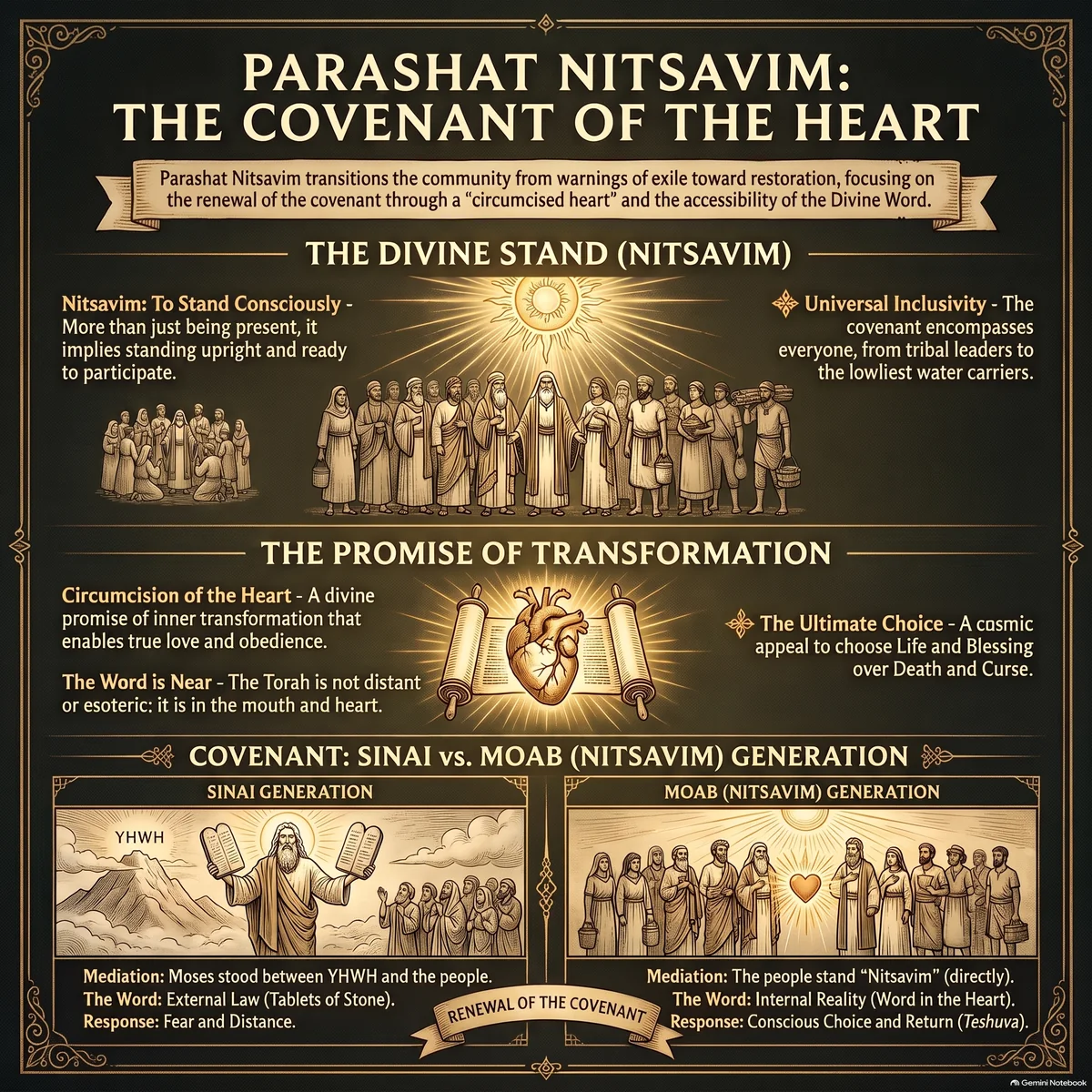
Nitsavim unmasks the notion that God's will would be unattainable, too heavy, or too far away. The command has been brought near. YHWH sets the two ultimate paths side by side — life and death, blessing and curse — and makes a passionate appeal to humanity: "Choose life!" That choice is not made on an unreachable mountaintop, but today, in the everyday choices of heart and mouth.
Where Ki Tavo pronounces the book's heaviest warning, Nitsavim is the hinge-point: the terrifying warnings of exile do not have the last word. The gate of teshuvah always stands open — not because the covenant is optional, but because YHWH Himself ultimately guarantees its completion, down to the circumcision of the heart.
Devarim 30:11-14 stresses that God's will is not mystical, extremely complicated, or geographically unreachable. The Torah is practical, near, and doable — kept in the mouth (speech/study) and in the heart (will/devotion). This rules out, from the outset, any claim to secret, exclusive access to God (see section B).
A — Word Study: natsav (נִצָּב) and kol Yisrael — the end of mediation
At Sinai the covenant was a mediated covenant: Moses stood between YHWH and the people, and the people themselves did not dare to approach (Ex. 20:18-19). On the plains of Moab, Moses steps out from between God and the people — he will die, and the people themselves now stand (nitsavim) before YHWH's presence to accept for themselves the covenant made with the fathers. Not only the leaders, but everyone: from tribal heads to woodcutters and water-carriers — and, with equal emphasis, gercha ("your ger"), the stranger in the midst of the camp (Deut. 29:10-11).
Canonical Deut. 29:10-11 uses ger (גֵּר, H1616, from the root gur, H1481 — to sojourn, to travel along), not ger toshav (גֵּר תּוֹשָׁב). This is the fellow-traveler who stands functionally within the covenant assembly — he serves, he travels along, he hears the words — yet remains legally outside it; a fundamentally different category from the ger toshav, who has already settled in the land after the crossing (Lev. 25:35,47). See Drawn — the Position of the Soul before YHWH for the full treatment of this distinction.
The principle of kol Yisrael (all Israel) shows that the covenant relationship knows no hierarchy of value before YHWH — everyone carries responsibility for the whole. A related root to natsav is matzav (H4673, "position, station") — both roots express that the soul stands somewhere in relation to YHWH, never neutrally (see Drawn — the Position of the Soul before YHWH).
Echo — Prophets and Brit Chadasha: the same word natsav elsewhere marks a turning point from mediation to direct accountability — Korach and his followers "stood up" against Moses' authority (Num. 16:2), and satan "stood" to accuse Joshua the high priest (Zech. 3:1). Standing before God's presence is thus not a neutral act; it can result in obedient surrender or in prideful rebellion. Prophetically, this moment when all Israel stands here also points forward to the moment when all nations will stand before the Judgment Seat (2 Cor. 5:10; Rev. 20:11-15).
B — The warning against hidden idolatry and the end of mystery religion (Deut. 29:16-29)
Moses reminds the people of the idols they saw along the way — "abominations... wood and stone, silver and gold" — and warns against the person who thinks to himself: "I shall have peace, even though I walk in the stubbornness of my heart" (Deut. 29:19).
Rabbinic/Traditional The Hebrew word pairing ha-ravah ("the watered/saturated") and ha-tsme'ah ("the thirsty") in verses 18-19 is read in classical rabbinic interpretation (e.g. Rashi ad loc.) as an image for unwitting and deliberate sin being reckoned together when someone knowingly acts against the covenant. Leviticus 4:2 and Numbers 15:22-31 elsewhere confirm the canonical distinction that the sacrificial system made provision only for unwitting, not for deliberate, high-handed transgression.
Echo — Brit Chadasha: Deuteronomy 29:18 speaks of "a root that bears gall and wormwood" — an image of dormant bitterness that only later bears visible fruit. The writer of Hebrews picks up this exact image:
"Pursue peace with all people, and holiness, without which no one will see the Lord: looking carefully lest anyone fall short of the grace of God; lest any root of bitterness springing up cause trouble, and by this many become defiled." — Hebrews 12:14-15 (cf. Deut. 29:18, LXX rhiza pikrias)
Nitsavim's warning against hidden, individual bitterness that can defile the whole people remains fully in force for the community of the Renewed Covenant: one "root" of unresolved bitterness never touches only the individual, but "many" around it — exactly the collective threat that Deuteronomy 29:18-19 already flagged.
The parasha closes this section with one of the Torah's sharpest statements against any form of secret, exclusive knowledge of God:
"The secret things belong to YHWH our God, but those things which are revealed belong to us and to our children forever, that we may do all the words of this Torah." — Deuteronomy 29:29
Rabbinic/Traditional In the Masoretic Text, eleven puncta extraordinaria (extraordinary points) appear above the words לָנוּ וּלְבָנֵינוּ ("to us and our children") and above the ayin of עַד ("forever") — one of only ten such places in the Torah (fifteen in the whole Tanach). The Talmud (b. Sanhedrin 43b) records a dispute about this: Rabbi Yehuda reads the dots as weakening the words, teaching that YHWH did not hold the people collectively responsible for hidden sins until they had crossed the Jordan; Rabbi Nechemya disputes that very reading by appeal to this same verse ("the secret things belong to YHWH" — meaning they are never collectively chargeable to the people). Ibn Ezra offers a different explanation: the dots may indicate that the scribes were uncertain whether these words originally belonged in the text. The protocol explicitly marks this as Rabbinic/Masoretic tradition, not a standalone canonical datum — the differing explanations are deliberately presented side by side here rather than one being presented as settled.
Where English translations here read "this law," the Hebrew has Torah — instruction and direction, not a law code (Protocol VI.ii.b/VI.iii). "Do" here carries the sense of living it out, not juridical compliance under threat of sanction.
Drash: this verse cuts off, in advance, any claim to secret, elitist knowledge of God — the canonical opposite of every form of mystery religion. YHWH's will is not hidden for a select group of initiates, but openly anchored in the Torah, for the whole people, through all generations. This is exactly the principle worked out in section E (the near Word).
C — The circumcision of the heart: divine initiative and the renewal of the covenant (Deut. 30:1-6)
Devarim 10:16 gave humanity the command: "circumcise then the foreskin of your heart." Devarim 30:6 turns this into a divine promise: YHWH Himself will circumcise the heart. This exposes the tension between teshuvah as human choice and transformation as a work of grace.
Canonical The text of Deuteronomy 30:6 says more, literally, than is often quoted: "YHWH your God will circumcise your heart, and the heart of your descendants." The promise is therefore not limited to those who themselves come to teshuvah. For anyone praying over the hearts of children or grandchildren who are not yet there themselves, this verse offers an encouragement anchored directly in the text: the same divine operation promised to the reader is spoken here over the descendants too — not as an automatic bypass of their own teshuvah, but as a promise that reaches further than only the generation now listening.
The first Sinai generation died in the wilderness because, shortly after being freed from slavery, they were not yet ready to remain independently within the covenant — not because they fell under a different or "older" covenant. The second generation standing here in Moab accepts the same Sinai covenant, now independently and without Moses' mediation. The difference between the two generations is maturation within one continuous covenant, not a transition from a "law covenant" to a "new covenant" — that framing is a popular-theological reading the text itself does not make (Protocol VI.ii.a). Devarim 30:6 is therefore not a replacement but a chadash-renewal (H2318) of this very covenant, exactly as Renewed Covenant — Restoration, Not Replacement describes.
Echo — Prophets and Brit Chadasha: the same promise of a renewed heart returns in Jeremiah 31:33 (the Torah written on the tablets of the heart) and Ezekiel 36:26 (a heart of flesh for a heart of stone) — see Heart-Torah — From Stone to Heart. Paul builds directly on Devarim 30:6 in Romans 2:28-29 (see Step 3).
D — The grammar of return (Deut. 30:1-6)
A precise reading of the Hebrew in Deut. 30:1-6 sheds light on the sequence of events in Israel's restoration.
Rabbinic/Traditional Rashi points out that the verb in verse 3 (weshav YHWH) stands in the qal form — "YHWH will return" — and not in the hifil form that would mean "bring back." This supports the reading that YHWH Himself goes with the exiles into exile and Himself returns with them, not merely as a Deliverer acting from outside. Verse 2 (weshavta ad YHWH, "you shall return unto/together with YHWH") confirms the same order: first the return to the land, then — in the land — the circumcision of the heart (verse 6).
Echo — Prophets: Nehemiah 1:8-9 reaches back to this promise in prayer; the book of Nehemiah itself shows the order worked out — first the return and the rebuilding of the walls, then only the public reading of the Torah by Ezra and the collective covenant renewal (Neh. 8-10). Jeremiah 32:37-40 and the vision of the dry bones in Ezekiel 37 (first the bodily restoration, then the Spirit that breathes life) confirm the same sequence. Yeshua confirms in Matthew 23:37-39 that, after the exile by the Romans, a moment will come when Jerusalem will say: "Blessed is He who comes in the Name of YHWH" (cf. Ps. 118:26).
E — The near Word (Deut. 30:11-14)
Moses closes the promise of restoration with a statement that removes every fear of threshold: the command is not too wonderful or too far off. No one needs to climb to heaven or cross the sea to find it — "this word is very near you, in your mouth and in your heart, that you may do it" (Deut. 30:14).
This connects directly to the canonicity warning of section B: no esoteric access, no elite of initiates, but a Word equally near to everyone. See Torah — Instruction of the Father and Step 3 for Paul's use of this verse in Romans 10.
F — Sod: heaven and earth as witnesses, and choose life (Deut. 30:15-20)
"I call heaven and earth as witnesses today against you: I have set before you life and death, blessing and curse! Therefore choose life, that you and your descendants may live." — Deuteronomy 30:19
Canonical This climax forms a literary bracket with Re'eh: "See, I set before you today the blessing and the curse" (Deut. 11:26) opens the very theme that Nitsavim closes here — see Parasha Re'eh. "Heaven and earth as witnesses" is moreover a fixed, canonical covenant formula that also occurs in Deut. 4:26 and 31:28.
Echo — Word Study: chaim (life, H2416) is in principle a plural noun in the Tenach — life is never an isolated individual fact but a connected reality. See Life & Death — Chaim & Mawet for the full treatment of this choice.
Related studies on Devar Emet
- Parasha Ki Tavo — When You Come In — the preceding parasha: the Tochechah from which Nitsavim points the way back
- The Covenants — the seven covenants, including the Land Covenant renewed here
- Renewed Covenant — Restoration, Not Replacement — chadash as restoration, not replacement
- Heart-Torah — From Stone to Heart — Jeremiah 31 and the promise of Deut. 30:6
- Life & Death — Chaim & Mawet — "choose life" unpacked
- Shema Yisrael — The Greatest Commandment — shema be-qolo in Deut. 30:2,8,10,20
- Graft In — The Wild Olive Branch — Romans 11:25-27 and the collective teshuvah of all Israel
- Drawn — the Position of the Soul before YHWH — the root natsav/matzav
- Torah — Instruction of the Father — the near Word of Deut. 30:11-14
Parasha Nitsavim challenges us to make covenant renewal and the call to teshuvah concrete in our daily walk:
1 — Consciously "stand" within community.
The covenant was made with the whole people — from leader to woodcutter. This week, make a point of reaching out to someone on the margins of your congregation or family and express your appreciation.
2 — Examine hidden bitterness.
Deuteronomy 29:18 warns against the thought that you can walk in your own stubbornness and still have peace. This week, examine your heart for hidden cynicism, and bring one area where you have ignored YHWH back under His direction.
3 — Do the near Word with your mouth.
The Word is "in your mouth and in your heart, that you may do it" (Deut. 30:14). This week, speak no slander, but actively use your mouth to restore a broken relationship by asking for or offering forgiveness.
4 — Explicitly choose life today.
"I have set before you life and death, blessing and curse. Therefore choose life" (Deut. 30:19). This week, when facing a difficult decision, make a conscious choice for building up, truth, and love — even when that costs you your own being right.
Each step is a concrete form of teshuvah: not unreachable piety, but a practical turning that makes the near Word visible in daily life.
Avinu Malkenu — Our Father, our King,
We stand today before Your presence, as our people once stood on the plains of Moab: young and old, leaders and servants alike. Thank You that Your covenant is not too high or unreachably far away, but that You have placed Your Word in our mouth and in our heart.
Circumcise our heart this week, YHWH. Renew our will by Your Spirit, that we may choose life and blessing with our whole being. Let the words of our mouth and the meditations of our heart be acceptable to You, our Rock and our Redeemer.
Baruch Atah YHWH, who renews His covenant and calls His people back to life. Amen.
- TorahDeuteronomy 29:9–30:20; Deuteronomy 29:9-15 (the universal covenant-making, kol Yisrael); Deuteronomy 29:16-29 (the warning against hidden idolatry and the revealed/hidden things); Deuteronomy 29:18 (the root that bears gall and wormwood); Deuteronomy 30:1-6 (promise of restoration and the circumcision of the heart, including the heart of one's descendants); Deuteronomy 30:11-14 (the near Word); Deuteronomy 30:15-20 (choose life, heaven and earth as witnesses); Deuteronomy 10:16 (the human command to circumcise the heart); Deuteronomy 4:26 & 31:28 (the same witness formula); Deuteronomy 11:26 (Re'eh, the opening of the same blessing/curse theme); Leviticus 4:2, Numbers 15:22-31 (unwitting versus deliberate sin and the sacrificial system); Exodus 12:5 (the spotless sacrificial lamb); Exodus 20:18-19 (the mediated covenant at Sinai).
- WritingsNehemiah 1:8-9 & 8-10 (the return to the land, followed by the public reading of the Torah and covenant renewal); Psalm 118:26-27 (blessed is He who comes).
- ProphetsIsaiah 61:10–63:9 (Haftarah Shabbat Nitsavim, seventh Comfort); Isaiah 61:10 & 62:4 (the Bridegroom who clothes with garments of salvation); Isaiah 2:3 (cf. Micah 4:2 — the Torah that goes forth from Zion); Isaiah 8:14 & 28:16 (the stumbling stone); Jeremiah 31:33 (Torah on the tablets of the heart); Jeremiah 32:37-40 (restoration first, then the new heart); Ezekiel 36:26 & 37 (heart of flesh; the dry bones); Joel 2:32 (whoever calls on the Name).
- Brit ChadashaRomans 2:28-29 (the circumcision of the heart, in the Spirit); Romans 9:30–10:13 (the stumbling stone, Yeshua as telos of the Torah, the near Word, confessing and calling); Romans 10:6-8, 10:9-10, 10:12-13 (the near Word, no distinction between Jew and Greek); Romans 3:31 (upholding, not nullifying, the Torah); Romans 11:25-27 (all Israel saved, direct echo of Deut. 30); Romans 11:1-2, 11:11, 11:17-24 (the wild olive branch grafted into the root, no replacement, echo of Deut. 29:14-15); Matthew 5:17-19 (Yeshua fulfills, does not abolish); Matthew 23:37-39 (Jerusalem and the Name of YHWH); 1 John 3:4 (sin as lawlessness); 1 Peter 1:19 (the spotless Lamb); Hebrews 12:14-15 (the root of bitterness, direct echo of Deut. 29:18); Colossians 2:11 (circumcision made without hands).
- Rabbinic/TraditionalRashi on Deut. 29:18-19 (deliberate/unwitting sin) and on Deut. 30:2-3 (the qal form of weshav, "YHWH returns"); Talmud, b. Sanhedrin 43b (the eleven dots over Deut. 29:29 — the dispute between Rabbi Yehuda and Rabbi Nechemya); ibn Ezra on Deut. 29:29 (an alternative explanation of the dots as scribal uncertainty).
- Source materialRabbi Monte Judah, Erev Shabbat teaching on Parashat Nitsavim (Rom. 9:30–10:13) — only the exegetical core (the stumbling stone, the telos of the Torah, confessing/believing, no distinction Jew/Greek) has been used; personal anecdotes, eschatological speculation, and non-textual applications are excluded per Protocol VI (named living teachers).
- PaRDeS HermeneuticsPshat (the covenant structure of Moab, natsav as a conscious stance, the grammar of return in Deut. 30:1-6); Remez (the literary bracket with Re'eh around the blessing/curse theme; heaven and earth as a fixed covenant formula); Drash (teshuvah as concrete walk, the warning against secret knowledge of God); Sod (the circumcision of the heart as the Spirit's work, fulfilled in the Renewed Covenant). Talmud, b. Sanhedrin 67b; b. Chagigah 14b. Kabbalistic Sod-content (Zohar, Sefer Yetzirah) explicitly excluded — Protocol VI.i extension.
- ProtocolCanonicity test (VI.i) applied to every concept: natsav, teshuvah, and the circumcision of the heart are canonically anchored in Deuteronomy 29-30 (badges). No use of Zohar, Sefer Yetzirah, or kabbalistic works. "Renewed Covenant" used, never "new covenant" (VI.ii.a) — the two Sinai generations are explicitly not framed as "old" versus "new covenant." "Torah-instructions"/"Torah" used in original text; "mitzvot" where applicable (VI.ii.b). YHWH used in original text (VI.iii). Telos (Rom. 10:4) explained as "goal," not "ending/abolition" (VI.iii.a, hypo nomos/en nomos). Source material from a named living teacher was used only for its exegetical core; personal anecdotes and eschatological speculation are excluded. The Masoretic-dots tradition at Deut. 29:29 is explicitly labeled Rabbinic/Traditional, with the underlying Talmudic dispute presented on both sides rather than one-sidedly.