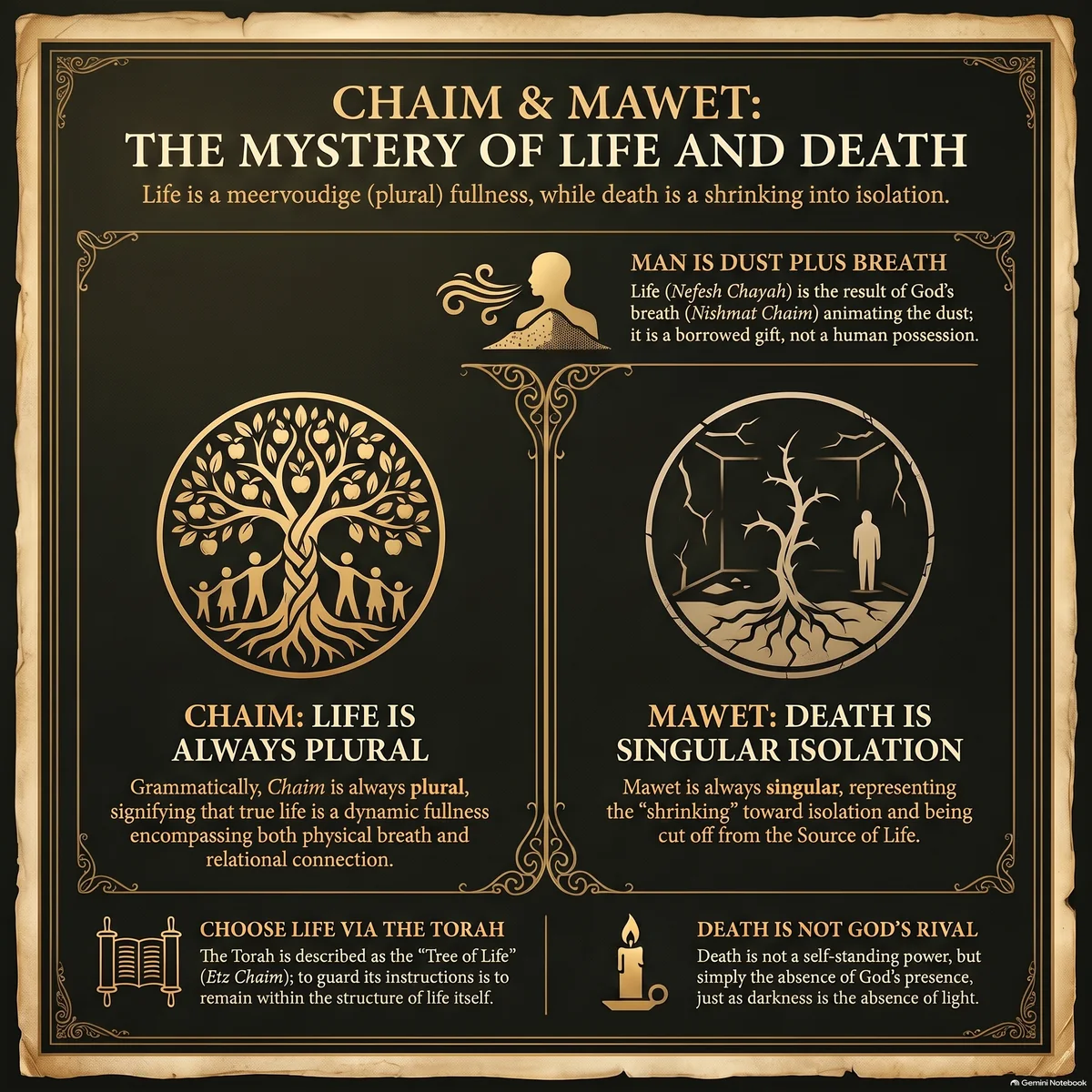
When God forms the man from the dust and breathes His breath of life into him (Gen. 2:7), no isolated concept of "life" results — the Hebrew word חַיִּים (chaim) is always plural. In the Hebrew mind, life is never static or singular: it is fullness, dynamism, a plural reality that encompasses both physical breath and relational connection with the Creator. Opposite chaim stands מָוֶת (mawet), always singular: the shrinking into isolation, being cut off from the Source. This study traces both concepts as one coherent whole, following the PaRDeS method.
This study connects directly to Sin, Blood & Forgiveness — Chet, Dam & Kapparah: where that study showed that chet (sin) costs life and that dam (blood) is the appointed bearer of atonement, this study examines precisely what is at stake when chet strikes — namely chaim itself, and the mawet that follows.
After this study you will understand:- Why chaim is grammatically always plural, and what that says about the nature of life.
- Why Eve's chaim is not granted through a second, independent breathing but is shared/derived from Adam's already-animated nefesh chayah.
- How procreation passes on Adam's mortal form, while the breath of life itself always continues to come directly from God.
- The distinction between the spiritual and the physical dimension of death in Mot Tamut (Genesis 2:17).
- Where the nefesh goes after death: the threefold division of dust, ruach and nefesh, and Sheol as a waiting state.
- How Leviticus 17:11 links chaim, dam and mawet together, and how this connects back to Sin, Blood & Forgiveness.
- Why Scripture never presents death as an independent counter-power to God.
- How Ezekiel 37 and Isaiah 25:8 carry the canonical promise of the resurrection (Techiyat HaMetim).
Read Genesis 2:7 and 2:17 slowly, one after the other. Where, for you, does the difference lie between "receiving life" and "being told you will die"?
Two Word Roots, Two Grammatical Numbers
| Concept | Hebrew / Strong's | Grammatical number | Core feature |
|---|---|---|---|
| Life | חַיִּים · H2416 | Plural (always) | Fullness, dynamism, plural reality — both physical and relational |
| Death | מָוֶת · H4194 | Singular | Shrinking into isolation — being cut off from the Source |
The Breathing-In of Life Canonical
God forms the man from the dust of the ground (adamah) and breathes the breath of life (נִשְׁמַת חַיִּים, nishmat chaim — "breath of lives," H5397 + H2416) into his nostrils. The man does not simply have a soul — he becomes a living soul (נֶפֶשׁ חַיָּה, nefesh chayah, H5315 + H2416). Physical life here is the combination of dust and divine breath, not an independent human possession.
For Eve, the text records no second, independent breathing. Genesis 2:22 uses a different verb than the yatzar (יָצַר, to form) of 2:7: banah (בָּנָה) — "to build." God builds her from the tzela (צֵלָע, side/rib) He takes from Adam while he lies in deep sleep — tissue that, at the moment of its taking, is already living and animated, not a new, separate nishmat chaim. Adam's own exclamation confirms this: "this is now bone of my bones and flesh of my flesh" (Gen. 2:23, paraphrase) — not a second creation alongside the first, but one chaim expressed in two bodies. This reinforces what part A already established: chaim is always plural. Genesis 2:18 already says so before Eve's forming — "it is not good that the man should be alone" (paraphrase) — and only with her arrival does creation become "very good" (tov meod) rather than merely "good" (Gen. 1:31). 1 Corinthians 11:8-12 reflects on this with deliberate balance: the origin is asymmetrical ("the woman is from the man"), but Paul immediately adds the reciprocity — "just as much is the man through the woman, and all things are from God" (paraphrase).
Procreation: Adam's Form, God's Breath Canonical
Genesis 2:7 contains two elements that are not passed on identically in procreation: the dust/flesh (basar) and the breath of life (nishmat chaim) itself. Scripture deliberately marks this distinction in the transition from chapter 1 to chapter 5:
Romans 5:12 draws the line further: "death spread to all men, because all sinned" (paraphrase) — the inheritance of mortality runs through the human birth line, from Adam onward. Psalm 51:5 and Job 14:4 confirm the same from the perspective of conception: man is already born vulnerable and mortal, not contaminated only later.
At the same time, Scripture nowhere identifies the nishmat chaim/ruach itself as something parents produce — it remains consistently attributed to God, even after Adam:
Ontologically: parents are the means here, God remains the Source — the same Makor Chaim canonically established in the Sod layer (part A). Procreation is thus not an independent human production of life apart from God; it is the channel through which God, as directly with Adam, continues to form chaim — together with the mortal form carried forward from Adam. This distinction — Adam's form via the birth line, God's breath as an ongoing gift — returns in the Sod layer (part C) in the contrast between the first and the last Adam.
Dust you are, and to dust you shall return.
— Genesis 3:19 (paraphrase)Death here is the ceasing of the breath of life and the returning of the body to the dust from which it was taken — the exact reversal of Genesis 2:7. What was joined there (dust + breath) is here separated again.
Where the Nefesh Goes: Sheol Canonical
Genesis 2:7 and Ecclesiastes 12:7 together yield a precise threefold division. Nefesh chayah in Genesis 2:7 is not a separate, third component alongside dust and breath, but the result of the two together — "the man became a living nefesh." At death, that unity comes apart:
In the Tanakh, nefesh is not the Greek, immortal little soul that exists apart from the body — the word primarily denotes the whole living, breathing being, and can even denote a corpse (נֶפֶשׁ מֵת, "nefesh met," Lev. 21:11; Num. 6:6). Where the nefesh does go after death is explicitly named elsewhere:
"For You will not abandon my nefesh to Sheol." — Psalm 16:10 (paraphrase)
Genesis 37:35 (Jacob: "I will go down to my son, mourning, to Sheol"), Psalm 30:4 and Psalm 89:49 confirm the same picture. Ecclesiastes 9:10 — by the same author as the ruach-verse in chapter 12 — explicitly characterizes Sheol as a waiting state without activity: "there is no work, no plan, no knowledge, no wisdom in Sheol." Sheol is therefore not a final destination and not annihilation, but a shadowy waiting place for the nefesh, awaiting the resurrection — exactly the point at which Techiyat HaMetim (Sod, part B) intervenes: the nefesh from Sheol reunited with a renewed body and the ruach. This is also why Psalm 16:10 is applied directly, messianically, to Yeshua's resurrection in Acts 2:27: not a flight into Sheol, but the return from it.
The Life-Force in the Blood Canonical
"For the nefesh of the flesh is in the blood." — Leviticus 17:11 (paraphrase)
This same anchor verse forms, in Sin, Blood & Forgiveness, the canonical foundation of the theology of blood: the nefesh (life, chaim in concrete, borne form) is in the blood (dam). Physical life is thus tangible and transferable — and death brings ritual impurity in the Torah, because it marks the end of the God-given life-force in the physical domain. Where chet (missing the mark) costs life, dam is the appointed bearer of restoration — chaim, mawet and dam thus form one continuous line.
Proverbs 14:30 uses the same chai-root for physical wellbeing itself: "a sound heart is chayei besarim (חַיֵּי בְשָׂרִים) — the life of the flesh; but envy is rottenness of the bones" (paraphrase). Here chaim is not merely "being alive" as opposed to "being dead," but a scale of vitality within life itself — the heart that gives the flesh "life," versus inner rot that eats away at the body from within. An early canonical indication that chaim and mawet are not merely an on/off opposition, but the direction and health of one and the same living basar.
The Double Death: Mot Tamut Canonical
God warns at the Tree of Knowledge: "in the day that you eat of it, you shall surely die." The Hebrew literally has the infinitive absolute followed by the verb — a grammatical doubling that in the Tanakh usually expresses certainty or intensity. Read as a hint (remez) of a layered death: on the day of the transgression, man dies spiritually — the relational breach with God takes effect immediately — which later leads to the physical dying of Genesis 3:19.
The Torah as the Restored Tree of Life Canonical
"Behold, the man has become like one of Us, knowing good and evil. Now then, let him not put out his hand and take also from the Tree of Life, and eat, and live forever (chai le-olam)." — Genesis 3:22 (paraphrase)
Chai le-olam (חַי לְעֹלָם) — "living forever" — is the explicit reason the text itself gives before the expulsion: not out of envy, but because man, now separated from his original matzav, must not be permanently locked into a fallen, mortal condition forever. Immediately afterward, in Genesis 3:24, access to that same Tree of Life (עֵץ הַחַיִּים, Etz HaChaim) is blocked by cherubim with a flaming sword. Proverbs 3:18 calls divine wisdom/Torah itself a Tree of Life:
"She is a Tree of Life to those who lay hold of her." — Proverbs 3:18 (paraphrase)
Popular readings present access to the Tree of Life as a reward for "obedience" in the sense of compliance under threat of sanction. That is a translation loss (Protocol VI.ii.b). Torah (תּוֹרָה, H8451) is instruction and direction, not a law code; whoever shamars it (שָׁמַר, H8104 — guards, cherishes, keeps in the heart) rather than merely, outwardly "obeying," lives within the life structure the Torah offers. The remez of Genesis 3:24 alongside Proverbs 3:18 is then: man regains access, through cherishing the Torah guidelines, to the fruit of life lost in Eden — not as achievement, but as a return to the intended life structure.
The same wisdom passage continues two verses later with a direct application to the nefesh: "let wisdom and discretion not depart from your eyes... they will be chaim for your soul (nefesh), an ornament for your neck" (Prov. 3:21-22, paraphrase). Here chaim is not merely a tree-image but something that nourishes and adorns the nefesh itself — the same link between Torah/wisdom and chaim that part D below develops further with mekor chayim (Prov. 13:14).
Proverbs 8:35 closes this line from the mouth of Wisdom herself, who speaks as a person in Proverbs 8: "for whoever finds Me finds life (chaim) and obtains favor from YHWH" (paraphrase). Three different Proverbs passages (3:18, 3:21-22, 8:35) independently point to the same thing: chaim is not found apart from Torah/wisdom, but in her.
Proverbs 15:4 applies the same Etz Chaim image to the tongue: "healing of the tongue is a Tree of Life, but perverseness in it is a breach in the ruach" (paraphrase — שֶׁבֶר בָּרוּחַ, shever ba-ruach). This is a rare verse in which chaim (via the Etz Chaim image) and a damage to the ruach itself stand opposed in one breath — not mawet as the counterpart, but shever, "breach," applied to the spirit. Words themselves therefore carry a chaim/mawet polarity: healing speech functions as a Tree of Life, destructive speech breaks something in the ruach that was breathed in as the breath of life in Genesis 2:7.
The Names of the Parashot Canonical
| Parasha | Meaning | Remez |
|---|---|---|
| Vayechi (Gen. 47:28) | "And he lived" | Describes the physical death of Jacob and Joseph — whoever lives in covenant with God, their life continues in the promise |
| Acharei Mot (Lev. 16:1) | "After the death" | Directly follows the death of Aaron's sons and leads into Yom Kippur — out of the confrontation with death, God opens the way to atonement and new life |
Acharei Mot is the same Torah section that in Sin, Blood & Forgiveness describes the two goats of Yom Kippur — the parasha name itself places mawet and the restoration of chaim immediately side by side.
The Reach of the Chai-Root Canonical
The root ח-י-ה reaches, in the Tanakh, further than human existence alone — four canonical occurrences show how broad the concept extends, from naming to flowing water.
Life and Death as Moral Categories Canonical
"See, I have set before you today life and good, and death and evil... choose life, that you may live, you and your descendants." — Deuteronomy 30:15-19 (paraphrase)
In prophetic and covenantal theology, life and death are not arbitrary events but the result of moral choices:
Ezekiel 18 shows this directly: the same person can, at different moments in his life, live or die, depending on his turning back (teshuvah). Chaim and mawet here are not a one-time, irreversible status, but an ongoing direction in which someone is moving.
The Hinge Verse Between Life and Walking Canonical
"On the path of righteousness is life (chayim), and the way of her path is no death (al-mavet)." — Proverbs 12:28 (paraphrase)
This verse connects chaim directly to derech/netivah — path, way — the same imagery later halachic tradition (literally "the walking," from halach, "to go") uses for the life-walk according to the Torah guidelines. Chaim here is thus not merely a state but a direction one walks in — it links the moral categories of part A directly to the image of a path being walked, not a position one occupies once.
"He taught me and said to me: let your heart hold fast my words; keep my mitzvot and live (chayeh)." — Proverbs 4:4 (paraphrase)
Many translations render this "commandments" — a popular-theological simplification (Protocol VI.ii.b) of mitzvot (מִצְוֹת, from tsavah, H6680): directives arising from relationship, not isolated rules under sanction. What stands out is the grammar of the close: chayeh (חֲיֵה) stands as an imperative — "live!" — not a distant promise but the direct, logical consequence of holding fast to the mitzvot. The same pattern as Deuteronomy 30 (Drash A): chaim is not a separate reward detached from the Torah guidelines, but what happens when you actually hold fast to them.
Alongside this theological chaim, Scripture also has a simple, earthly application of the same word: "may you see the good of Jerusalem all the days of your life (kol yemei chayeicha)" (Ps. 128:5, paraphrase). Here chaim is simply the duration of a human life — the blessing Deuteronomy 30 promises lands, in the end, in the concrete and everyday: healthy years, watching children grow up, peace in the city. Theological and everyday chaim are not two separate meanings but one and the same reality, carried through from above to below.
Where in my week am I actually choosing mawet — separation, isolation, the idolatry of busyness or fear — while chaim is available to me?
Name one concrete area this week (a habit, a relationship, a piece of stillness with God you avoid) in which you consciously choose chaim: cherish (shamar) one Torah guideline actively there, rather than leaving it a vague intention.
God as the Sole Source of Life Canonical
"For with You is the fountain of life; in Your light we see light." Death here is not an equal counter-force to life. God did not create death as an independent entity; death is the absence of God's presence, just as darkness is simply the absence of light — no substance of its own, no throne beside the Throne.
The Secret of the Resurrection Canonical
In the prophetic Scriptures, physical death is not the final endpoint of man.
The Ruach of God breathes into what is dead and withered, and it comes back to life — a people rising from dry bones.
— Ezekiel 37 (paraphrase)The same Ruach that breathed the first breath of life into man in Genesis 2:7 here breathes life collectively into a people who describe themselves as "wholly dried up" (Ez. 37:11) — chaim is not exhausted with the first creation but remains the creative movement of the same Spirit. Ezekiel 37 is thus, literally in the text, the exact mirror of Genesis 2:7 and of the threefold division of the Pshat layer (part C): first the bones (the dust) become flesh and sinew again, then the ruach is breathed in — and only then, in Ezekiel 37:12-13, are the graves (Sheol) opened and does "My people" come up out of them. The same order as Genesis 2:7, now applied to what fell apart after death.
"Adonai YHWH will swallow up death forever, and He will wipe away the tears from all faces." — Isaiah 25:8 (paraphrase)
Adonai (אֲדֹנָי) is a form of address — "my Lord" — not a proper name. YHWH (יהוה) is God's personal name, traditionally not pronounced; this study consistently uses YHWH rather than "the LORD," so that the personal name the source text carries here remains visible.
This is the eschatological promise that God will definitively swallow up death — not as one power overcoming another, equal power, but as the Source of life undoing the absence of Himself. Daniel 12:2 and Isaiah 26:19 carry the same canonical line: those sleeping in the dust will awaken.
Rabbinic/Traditional Techiyat HaMetim (תְּחִיַּת הַמֵּתִים, "resurrection of the dead") is the rabbinic collective term for this canonical fact — the term itself does not occur as such in the Tanakh, but summarizes what Ezekiel 37, Isaiah 25:8, 26:19 and Daniel 12:2 textually establish.
The Ultimate Triumph of Chaim
The deepest secret (sod) of the canon is that God's original creational purpose — that man would live in His presence — is not undone by the fall. God's plan moves from the lost Tree of Life in Genesis to the restored Tree of Life, accessible to all, in the perfect Kingdom of Peace. What is established in Sin, Blood & Forgiveness — that dam (blood) is the appointed bearer of atonement because it carries the nefesh (chaim) — finds its destination here: the blood that atones ultimately reopens access to the Tree of Life that was sealed off in Genesis 3:24. Mot Tamut thus, in the full canonical arc, is not the last word.
Chaim is always plural; mawet is always singular. Even grammatically, the Hebrew Scripture already carries the truth its story tells: life is richer, more manifold, and ultimately stronger than death — which is only one thing: absence.
This word study addresses the core words chaim and mawet themselves. For the full scheme of what happens to basar, nefesh and ruach at death — including soma psuchikon/pneumatikon, the canonical exceptions (Enoch, Elijah, the rapture), the second death, and the cross-reference with matzav — see the foundational study Undone and Reunited — Body, Soul and Spirit before YHWH.
- TorahGenesis 1:27, 31 (in God's image; very good); Genesis 2:7 (nishmat chaim, nefesh chayah); Genesis 2:17 (Mot Tamut); Genesis 2:18, 22-23 (Eve built from the tzela); Genesis 3:19 (dust to dust); Genesis 3:20 (Chava — mother of all living); Genesis 3:22 (chai le-olam — eternal life); Genesis 3:24 (Etz HaChaim sealed off); Genesis 5:1, 3 (Adam's likeness versus God's image); Genesis 7:22 (nishmat-ruach chayim); Genesis 37:35 (Jacob to Sheol); Genesis 47:28 (Parashat Vayechi); Leviticus 15:13 (mayim chayim — living water); Leviticus 16:1 (Parashat Acharei Mot); Leviticus 17:11 (nefesh in the blood); Leviticus 21:11 (nefesh met); Numbers 6:6 (nefesh met); Numbers 16:22; 27:16 (God of the spirits of all flesh); Deuteronomy 30:15-19 (life and death as choice).
- Prophets & WritingsJob 14:4 (born mortal); Job 34:14-15 (the borrowed breath of life); Psalm 16:10 (nefesh not abandoned to Sheol); Psalm 30:4 (brought up from Sheol); Psalm 36:9-10 (Makor Chaim, versification clarified); Psalm 51:5 (vulnerability from conception); Psalm 89:49 (deliverance from Sheol); Psalm 128:5 (kol yemei chayeicha — all the days of your life); Proverbs 3:18 (Etz Chaim — the Torah as Tree of Life); Proverbs 3:21-22 (chaim for the nefesh); Proverbs 4:4 (mitzvot and chayeh); Proverbs 4:23 (totzot chaim — the outflows of life); Proverbs 8:35 (whoever finds Wisdom finds chaim); Proverbs 12:28 (the path of chaim); Proverbs 13:14 (Torah as mekor chayim); Proverbs 14:30 (chayei besarim — the life of the flesh); Proverbs 15:4 (Etz Chaim and shever ba-ruach — the tongue); Ecclesiastes 9:10 (no work in Sheol); Ecclesiastes 12:7 (the spirit returns to God); Isaiah 25:8 (death swallowed up); Isaiah 26:19 (the sleeping ones awaken); Ezekiel 18 (moral life and death); Ezekiel 37 (the dry bones); Daniel 12:2 (awakening from the dust); Zechariah 12:1 (God forms the spirit of man).
- Brit ChadashaActs 2:27 (Psalm 16:10 applied messianically); John 3:6 (born of flesh versus born of the Spirit); Romans 5:12 (death spread to all people); 1 Corinthians 11:8-12 (the reciprocity of man and woman); 1 Corinthians 15:45 (the first and the last Adam).
- Further StudyThe full treatment of soma psuchikon/pneumatikon, Enoch/Elijah/the rapture, the second death, and the matzav cross-reference is found in the foundational study Undone and Reunited — Body, Soul and Spirit before YHWH.
- PaRDeSRabbinic hermeneutical framework. Talmud, b. Sanhedrin 67b; b. Chagiga 14b. Kabbalistic Sod content (Zohar, Sefer Yetzirah) explicitly excluded — Protocol VI.i extension.
- Source materialDevar Emet study design "Life (Chaim) and Death (Mawet)," tested against Protocol VI.i and canonically anchored in Torah, Prophets and Writings.
- ProtocolCanonicity test (VI.i) applied to every concept. No use of Zohar, Sefer Yetzirah, or kabbalistic works. YHWH used throughout the original text; the Adonai/YHWH combination recognized in Isaiah 25:8 (VI.iii). Torah guidelines/shamar used instead of "obedience"/"walking in commandments" (VI.ii.b).