Journey 2, The Seeing, closes with an act that at first glance seems the opposite of beholding: covering. But כָּסָה (kacah, H3680) is not a denial of seeing — it is the recognition that not everything may be beheld freely, until the relationship can bear it. Rebekah does this at the exact moment she knows whom she sees: "and she took the veil and covered herself" (Gen. 24:65) — not out of fear, but out of reverence for what from now on is reserved for the Bridegroom alone.
This study closes the walk of seeing where it belongs: at the boundary between what is visible to everyone and what is reserved. And that same movement returns messianically — in 2 Corinthians 3, this very veil is taken away the moment one turns to the Lord, opening into the beholding with which Journey 2 began.
After this study you will understand:- You understand why Rebekah covers herself only at the moment of recognition — not as a general rule, but as a threshold act.
- You recognise the same verb kacah in Numbers 4:9 (the menorah is covered) and Exodus 24:16 (the cloud covers Sinai) — covering out of reverence and being covered by glory are two sides of the same root.
- You see how the kesut (Deut. 22:12) — the garment to which the tzitzit are attached — carries the same root as Rebekah's veil, but as a daily, never-removed covering that guards the heart and eyes (Num. 15:39).
- You know the difference between kacah (Rebekah, Tamar), sathar (Moses at the burning bush), and masveh (Moses after Sinai) — different Hebrew words, not simply interchangeable.
- You recognise the contrast between Rebekah's reverent covering (Gen. 24:65) and Tamar's deceptive covering (Gen. 38:14–15) — the same act, opposite hearts.
- You see how Adam and Eve's shame-covering (Gen. 3:7, 10) is answered by God's own re-covering (Gen. 3:21) — the first sacrificial covering in Scripture.
- You can explain how 2 Corinthians 3:12–18 connects Moses' veil to hardening (v. 14–15) and to the beholding (v. 16, 18) with which the journey opens.
- You know how to relate to people who cannot yet bear the glory — like the people before Moses' radiant face.
Read the texts below slowly. Note the difference between what remains permanently covered and what is taken away in its time — and note who or what is covered each time.
The moment the veil falls
Rebekah travels the entire way from Aram-Naharaim to Canaan uncovered — for days, among the servant and his men. Only at one specific moment does she reach for the veil.
וַתֹּאמֶר אֶל-הָעֶבֶד מִי-הָאִישׁ הַלָּזֶה הַהֹלֵךְ בַּשָּׂדֶה לִקְרָאתֵנוּ וַיֹּאמֶר הָעֶבֶד הוּא אֲדֹנִי וַתִּקַּח הַצָּעִיף וַתִּתְכָּס
"And she said to the servant: Who is that man walking in the field to meet us? And the servant said: It is my master. Then she took the veil (ha-tza'if) and covered herself (vatitkas)."
Genesis 24:65 · Canonical · H6777 · H3680 · Gen. 24:65The order is exact: first the question ("who is that man?"), then the answer ("it is my master"), and only then the veil. This is not a general modesty rule she had followed the whole journey — it is a threshold act, performed at the moment of recognition. The instant she knows whom she sees, she lays down a boundary that was not there before.
This is the mirror image of what Journey 2 opens with: where chazah (Behold) is about the gaze fixed on YHWH, kacah is about the recognition that not everything may be freely beheld — until the relationship can bear it. Covering is thus not an opposite movement to beholding, but its necessary precondition: reverence before intimacy.
A threshold act, not a dress code
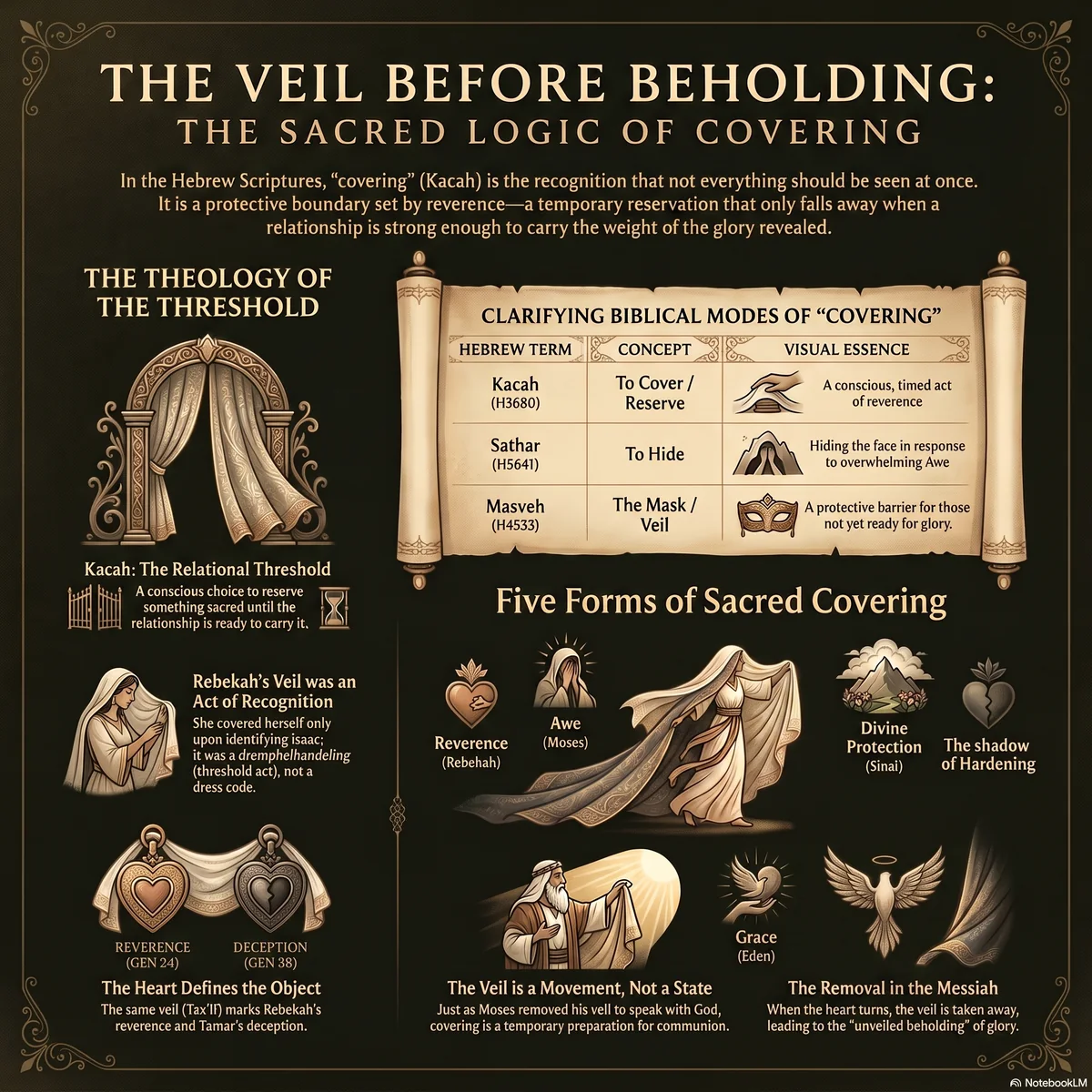
Translation Loss · כָּסָה (H3680) — "Covering" is often, in the popular-theological reading, detached from the relational moment and hardened into a general modesty rule or dress code. Translation Loss
In Genesis 24:65, kacah is not a norm Rebekah had already followed the whole journey, but a single, deliberate act at the moment of recognition. It is not about what is covered, but about which moment and before whom.
Restoration: read "covering" in this story not as a clothing rule, but as a reverent threshold act — a boundary laid down only when the relationship calls for it.
Translation Loss · four words, one translation — kacah, tza'if, masveh, and sathar are all translated into English as "cover" or "hide." That erases a distinction the source text itself preserves: not every covering is the same covering. Translation Loss
The three layers of Covering
Five forms of covering
Throughout Scripture, "covering" returns in at least five guises. They are briefly ordered below; in Examples, each receives its own witness.
The Contrast: Rebekah and Tamar — the same veil, opposite hearts
Two generations further in the same family line, the Torah places a disquieting mirror: the exact same word, tza'if, for a completely opposite use.
"She took off her widow's garments, and covered herself with a veil (vatchas ba-tza'if) and wrapped herself... And Judah saw her, and thought her to be a harlot, because she had covered her face (ki kisetah paneha)."
Genesis 38:14–15 · Canonical · H6777 · H3680 · Gen. 38:14–15Tamar veils herself not out of reverence but to deceive Judah — the same tza'if, the same kacah root, an opposite intention. The text itself invites comparison: where Rebekah's veil marks a boundary that creates reverence, Tamar's veil marks a boundary that enables deception. The outward gesture explains nothing on its own — the question is always: do I cover out of reverence for the relationship, or to mislead the other about who I really am? Canonical · Gen. 38:14–15
Covering is a movement, not a lasting state
Rebekah does not remain veiled for life — she enters the tent as bride, becomes Isaac's wife, and is loved by him (Gen. 24:67). The veil marks a threshold, not a permanent closure. That is the halachic key: covering belongs to the approach, not to completed fellowship.
"But when [the heart] turns to the Lord, the covering (kalymma) is taken away... And we all, with unveiled face beholding as in a glass the glory of the Lord (katoptrizomenoi), are changed into the same image."
2 Corinthians 3:16, 18 · Canonical · G2571 · 2 Cor. 3:16, 18Paul here draws the full arc: Moses' veil (masveh) protected the people from a fading glory they could not yet bear. But when one turns to the Lord, precisely that covering is taken away — and what follows is beholding, the same verb field as theaomai in 1 John 1:1, already used by the study Behold. The journey closes here: covering is the necessary intermediate step between fleeting seeing and full beholding — not its opposite.
The shadow side: hardening that holds the veil in place
That same text also carries a shadow side, no less important: "But their minds were hardened (eporōthē); for until this day the same covering remains unlifted in the reading of the Old Testament... until this day, when Moses is read, a covering lies upon their heart" (2 Cor. 3:14–15, G2571). Canonical · G2571 · 2 Cor. 3:14–15
It is important to read this cleanly: this is not an ethnic marker of "the Jews" versus "the Christians." The hardening Paul speaks of is a condition of the heart — anyone reading the text without turning to the Lord — and that can happen to any reader, Jewish or not, whether reading Torah or Gospel. The veil is not taken away by descent, but by turning.
"The glory of YHWH rested on Mount Sinai, and the cloud covered it (vayechasehu) six days."
Exodus 24:16 · Canonical · H3680 · Ex. 24:16Here YHWH himself is the subject of kacah — the same root as Rebekah's veil, now reversed: the person does not cover themselves, but is covered, by a glory too great to approach without transition. That is not a gentle experience. Moses himself later describes YHWH as "a consuming fire" (Deut. 4:24), an image Hebrews 12:29 repeats literally. Being covered by glory is thus not only comfort — it is also awe-inspiring, sometimes even frightening, precisely as the people shrank back from Moses' radiant face.
Pastoral application. What do you do with people who cannot yet bear the glory — like the people who shrank back from Moses' face (Ex. 34:30)? This is one of the hardest, and most important, lessons of this study. Moses did not force the people to endure his unveiled face — he voluntarily put on the masveh whenever he was with them, and took it off again the moment he spoke with YHWH alone. Covering out of reverence for another's capacity is not a compromise of the truth; it is the same love Rebekah's veil already showed. People stuck in hardening (2 Cor. 3:14) or fear (Ex. 3:6, without the reverent awe) cannot be forced into beholding — that work belongs to YHWH, not to us. Our task is to remain faithful in beholding, and where needed to cover patiently, without hiding the glory that ultimately wants to be seen.
Yeshua's teaching on prayer translates the same halacha into daily life: "But you, when you pray, enter into your inner room (tameion), and when you have shut your door, pray to your Father who is in secret." Not every spiritual intimacy belongs in public. Shutting the door is not secrecy out of fear, but the keeping of something precious before the relationship itself — precisely what Rebekah's veil already did.
Halachic application: three concrete exercises
1 · Distinguish threshold from habit. Ask yourself, with any form of reticence: is this a deliberate, reverent boundary for this moment, or a hardened habit that no longer has anything to do with the relationship? Rebekah's veil was the former, not the latter.
2 · Test the heart, not the gesture. When you keep something to yourself, test yourself against Genesis 38: am I keeping this out of reverence, or hiding something to deceive? The same outward gesture carries opposite meanings.
3 · Pray in the inner room before you behold. Connect to the study Behold: reserve time in secret first (Matt. 6:6), and let that be the preparation for beholding YHWH's loveliness (Ps. 27:4) — not the other way around.
Testimonies of Covering
From Rebekah to Paul, one line runs through: covering marks a threshold that is ultimately crossed, not a lasting distance.
The moment Rebekah knows that the man approaching is Isaac, she takes the veil. This is not general reticence but a precisely timed, reverent act.
She travels the whole way uncovered — covering does not belong to the journey, but to the encounter itself. Canonical · Gen. 24:65
Counter-example — Tamar covers herself to deceive. Two generations later, Tamar uses the exact same veil (tza'if) to deceive Judah about her identity (Gen. 38:14–15). He "thought her to be a harlot, because she had covered her face" — the gesture itself explains nothing without the intent behind it. Canonical · Gen. 38:14–15
Before the people move on, the Kohathites receive a precise instruction: "And they shall take a cloth of blue, and cover (v'kissu) the candlestick of the light, with its lamps..." The same verb as Rebekah's veil — now applied to the holiest light in the Tabernacle.
The New Testament calls the believer themselves a temple of the Holy Spirit (1 Cor. 3:16; 6:19). What was true for the menorah — reverently covered during transport, never carelessly exposed — applies also to what God carries in us. Not everything holy is meant to be constantly visible. Canonical · H3680 · Num. 4:9
The same root as Rebekah's veil returns in the Torah instruction on the tzitzit: "You shall make yourself tassels on the four corners of your garment (kesutcha), with which you cover yourself (techasseh)." Kesut — the garment itself — is a noun derived from kacah; the verb in the same clause is the same root. Not a thematic guess, but a root repetition at the text level. Canonical · H3680 · H3682 · Deut. 22:12
Where Rebekah's veil marks a one-time threshold that is later removed, the kesut is a daily worn covering that is never removed — and Numbers 15:39 itself gives the reason: "that you may not follow after your own heart and your own eyes." The same root, now not as a concealing veil but as a directed covering of daily life, guarding heart and eye for the One they will one day behold unveiled (2 Cor. 3:18). Canonical · Num. 15:39
Shame, answered by grace — Adam and Eve. After eating from the tree, "the eyes of them both were opened, and they knew that they were naked" (Gen. 3:7) — and they sewed fig leaves together (tafar), and hid themselves from YHWH out of fear (Gen. 3:10, chava/yare — here genuinely fear, not reverent awe). None of these verbs is kacah; this is therefore a thematic, not a linguistic, parallel.
But the text continues: "And YHWH God made for Adam and his wife garments of skin (kotnot or), and clothed them" (Gen. 3:21, lavash). This is the first sacrificial covering in Scripture — an animal had to die to provide a covering the self-made fig leaves could not offer. Human shame-covering is always inadequate; God's re-covering costs blood. This same passage also carries the first occurrence of yada (Gen. 4:1) already used by the study Know. Thematic connection · Remez Canonical · Gen. 3:7, 10, 21
At his very first encounter with YHWH, Moses hears: "I am the God of your father, the God of Abraham, the God of Isaac, and the God of Jacob." His response: "Moses hid his face; for he was afraid to look upon God (mehabit, from nabat)."
This "afraid" is yare — the same word this protocol elsewhere already establishes as reverent awe, not fear-driven terror. Moses' hiding is thus a sibling to Rebekah's veil: reverence before what is too great to simply look upon. Canonical · H5641 · H3372 · Ex. 3:6
After Moses has spoken with YHWH, his face shines so brightly that the people are afraid to come near. Moses puts a covering (masveh) over his face — but removes it again each time he speaks with YHWH anew.
The pattern is exactly what Rebekah already showed: covering belongs to the encounter with those not yet ready to bear the full glory — not to the intimate encounter itself. Canonical · Ex. 34:33–35
Paul takes up Moses' masveh and traces two possible outcomes. The first: "their minds were hardened; until this day the same covering remains... unlifted" (v. 14–15) — the veil that stays in place, not because YHWH keeps it there, but because the heart does not turn.
The second: "But when it turns to the Lord, the covering is taken away... and we all, with unveiled face beholding the glory of the Lord, are changed into the same image" (v. 16, 18). This is not an abolition of covering as a principle, but the fulfillment of what it always pointed to: a temporary protection giving way to full fellowship. The climax is exactly the verb field of Behold. Canonical · 2 Cor. 3:14–18
Paul's own summary elsewhere captures the whole pattern of this journey: "For now we see through a glass, darkly; but then face to face" (1 Cor. 13:12). From Rebekah's veil to this verse runs one movement: from partial and covered, to complete and beholding. Canonical · 1 Cor. 13:12
VIII · The Monday-morning Test — Practical Application
Covering is not pious restraint in general — it is the weekly question of what you keep this week, and for whom.
Our culture rewards the opposite of kacah: share everything, make everything visible, keep nothing back. But Rebekah's veil teaches something else — not everything true belongs in public. Some things are precious precisely because they remain reserved for the intimate relationship. That is true for prayer (Matt. 6:6), but equally for personal convictions, vulnerabilities, and spiritual experiences not meant for everyone.
This week, concretely: Choose one thing you would publicly share this week (on social media, in conversation, online) and instead deliberately keep it for your inner room with YHWH. Notice the difference between secrecy out of fear and reservation out of reverence.
- The difference between covering as a threshold act (Rebekah) and covering as deception (Tamar). Which of the two do you recognise more often in yourself?
- Covering is a temporary movement, not a permanent state — Moses' masveh comes off again each time he speaks with YHWH anew.
- Covering is not a dress code or a general modesty rule, but a relational, precisely timed posture of reverence.
- The veil that is taken away (2 Cor. 3) is not an abolition of reservation as a principle, but its fulfillment in full fellowship.
- Decide this week deliberately what you keep for the inner room (Matt. 6:6) rather than sharing publicly.
- Read Behold again with this insight: first the veil, then the beholding — not the other way around.
- Think of someone in your life stuck in hardening or fear. Ask yourself: am I acting like Moses — patiently covering out of love for what they cannot yet bear — or forcing a beholding that is not mine to compel?