Where Nitzavim had all Israel consciously stand before YHWH's presence to accept the covenant, VaYelech sets the movement of farewell into motion: Moses, a hundred and twenty years old, steps forward to complete the transfer of leadership to Joshua and to prepare the people for his own departure.
At a single chapter of thirty verses, VaYelech is the shortest parasha in the entire Torah — yet it carries an immense dramatic and prophetic weight. It addresses the transition of leadership, the securing of the written Torah, the shocking prophecy of future unfaithfulness and the hiding of God's face (Hasteir Panim), and the institution of the prophetic Song (Ha'azinu, the subject of the next parasha) as an eternal witness.
Scope and structure: the parasha carries four principal thematic movements: the transfer of leadership and encouragement (Deut. 31:1-8) — Moses announces that he will not cross the Jordan, hands leadership to Joshua before all Israel, and speaks the foundational encouragement: Chazak ve'ematz ("be strong and courageous"); the command of Hakhel and the writing of the Torah (Deut. 31:9-13) — Moses writes down the Torah, hands it to the priests and elders, and institutes that once every seven years, during the Feast of Tabernacles of the sabbatical year, the whole people — men, women, children and the stranger — must assemble to hear the Torah; the prophecy of unfaithfulness and Hasteir Panim (Deut. 31:14-23) — YHWH reveals to Moses and Joshua that the people will turn unfaithful after Moses' death, leading to the hiding of God's face, and Moses is commanded to write a Song that will serve as witness; and the placing of the Torah beside the Ark (Deut. 31:24-30) — Moses finishes writing the Torah on a scroll and commands the Levites to place it beside the Ark of the Covenant.
VaYelech is the hinge between the covenant renewal of Nitzavim and the witness-song of Ha'azinu: where Nitzavim opened the door to restoration, VaYelech shows how that restoration is secured — not in the person of an irreplaceable leader, but in the written Word itself, which outlives the generations.
Note: VaYelech almost always falls on the Shabbat between Rosh Hashanah and Yom Kippur. In rabbinic tradition Rabbinic/Traditional this Shabbat carries the name Shabbat Shuvah ("Shabbat of Return") — a liturgical designation, not a biblical term. The haftarah combination itself (Hosea, Micah, Joel) is canonical and opens with the urgent call: "Return, Israel, to YHWH your God!"
"Return, Israel, to YHWH your God, for you have stumbled because of your iniquity." — Hosea 14:2
"Who is a God like You, forgiving iniquity and passing over the transgression of the remnant of His inheritance?" — Micah 7:18
Remez — canonical coherence: where VaYelech warns that the people will forsake YHWH and that He will hide His face (Deut. 31:17-18), the prophetic mirror answers with the promise that God will heal their waywardness when the people return with sincere words (Hos. 14:5). Micah's praise of God's unique mercy forms the prophetic counterweight: God's mercy is stronger than the hiding of His face, and stronger than the human failure that leads to it.
I will not leave you or forsake you
"Let your conduct be without covetousness; be content with such things as you have. For He Himself has said, 'I will never leave you nor forsake you.' So we may boldly say: 'The Lord is my helper; I will not fear.'" — Hebrews 13:5-6 (cf. Deut. 31:6,8)
The writer of Hebrews quotes directly the encouragement Moses gave to Joshua and the people. In VaYelech the people faced a massive transition: the great leader Moses was departing. Yet YHWH guaranteed that His presence did not depend on Moses' physical presence. In the Renewed Covenant this promise is anchored in Yeshua, who assures His disciples: "Behold, I am with you always, even to the end of the age" (Matt. 28:20). The people's assurance rests not on human leaders, but on the unchanging faithfulness of YHWH Himself.
The Word that must be kept and heard
"Preach the word! Be ready in season and out of season. Convince, rebuke, exhort, with all longsuffering and teaching. For the time will come when they will not endure sound doctrine..." — 2 Timothy 4:2-3 (cf. Deut. 31:11-12,29)
Just as Moses, at the end of his life, secured the written Torah beside the Ark and instituted the command of Hakhel to impress the Word on every generation, Paul instructs his young disciple Timothy shortly before his own departure. Moses foresaw that the people would turn away after his death (Deut. 31:29); Paul foresaw times when people would no longer want to hear the Word. The answer in both Covenants is the same: the faithful, unadulterated teaching and keeping of the written Word of YHWH as a fixed anchor — see also The Great Message for the broader proclamation-line in which this teaching stands.
Joshua and Yeshua — the leader who brings in
"For if Joshua had given them rest, then He would not afterward have spoken of another day. There remains therefore a rest for the people of God." — Hebrews 4:8-9
In Parashat VaYelech, Moses transfers leadership to Joshua (Yehoshua), for Moses cannot bring the people into the promised land. The Renewed Covenant sees here a deep typological line: Moses, as a mortal mediator, could not bring the people in — not because the Torah he carried was inadequate, but because every human mediator dies. Yeshua, the true Yehoshua (the same name, "YHWH is salvation"), leads His people through the Jordan of death into the eternal rest.
A common but imprecise reading holds that "the law" (Moses) failed where Yeshua succeeds — as though the Torah itself were inadequate. Romans 3:31 is the controlling text here: "Do we then make void the law through faith? Certainly not! On the contrary, we establish the law." The limitation in VaYelech does not lie in the Torah, but in the mortality of its human bearer. See Torah Fulfillment — Not Abolished but Deepened for the full treatment.
Does the Torah bring death — or life? Moses' fall and Romans 7
"Because you did not believe Me, to hallow Me in the eyes of the children of Israel, therefore you shall not bring this assembly into the land which I have given them." — Numbers 20:12 (cf. Deut. 32:51)
Moses' exclusion from the land is sharper than mere "mortality" — it is a concrete covenant breach at Meribah: he struck the rock instead of speaking to it, and did not hallow YHWH before the eyes of the people (Num. 20:12; Deut. 32:51). The giver of the Torah himself falls under the very judgment the Torah pronounces on transgression. This sharpens the question Paul asks explicitly:
"And the commandment, which was to bring life, I found to bring death... So then, the Torah is holy, and the commandment holy and just and good. Has then what is good become death to me? Certainly not! But sin, that it might appear sin, was producing death in me through what is good, so that sin through the commandment might become exceedingly sinful." — Romans 7:10,12-13
Paul explicitly rejects the conclusion that the Torah itself is deadly or deficient: the Torah is holy, righteous, good (Rom. 7:12). Moses' fall at Meribah is the canonical illustration of exactly this point — the Torah does not fail; rather, even its own bearer proves to fall short under it. An instruction to try harder does not change a hardened heart; that is exactly the problem Devarim 30:6 already signals before Paul names it.
Echo — the solution lies in Nitzavim, not in a greater effort of the will: where Moses' death leaves humanity in Romans 7 empty-handed — the Torah exposes sin but does not change the heart — Nitzavim §C already answers this in advance with the promise that YHWH Himself will circumcise the heart (Deut. 30:6), fulfilled in the outpouring of the Spirit who writes the Torah on the heart (Jer. 31:33; Ez. 36:26-27; Acts 2:38-41). The same distinction from this section stands firm: Moses died for his own transgression (Num. 20:12; Deut. 32:51); Yeshua, the true Yehoshua, carried a death that was not His own (Isa. 53:5-6; Rom. 5:8) — not a second attempt at self-improvement, but the divine intervention Devarim 30:6 had already announced. See Parasha Nitzavim, section C, and Heart-Torah — From Stone to Heart for the full treatment.
The Torah as tutor unto the Mashiach — hypo nomos, not en nomos
"But before faith came, we were kept under the law... Therefore the law was our tutor (paidagogos) to bring us to Mashiach, that we might be justified by faith." — Galatians 3:23-25
Paul here describes the position hypo nomos ("under the law") — the Torah misused as a performance system to earn justification — not the Torah itself. The paidagogos in the Greco-Roman world was not a jailer but a supervising guide of a child until adulthood; the image speaks of temporary custody, not oppression. Paul contests the misuse of the Torah as a means of earning merit, not the Torah as a living space (en nomos, "in the law," Rom. 8:4) in which the believer, moved by the Spirit, walks. For the full working-out of this distinction, see What Does the Law Bring? — hypo nomos versus en nomos.
This distinction is directly relevant to VaYelech: Moses' departure marks no end of the Torah, but the end of the phase in which one mortal mediator carried it. The Torah itself enters the land — carried along, as Joshua and the people will read and live it precisely within the promised land (Deut. 31:12-13) — and comes to its full flowering when Yeshua fulfills it (plēroō, "to bring to its full meaning"), not abolishes it. See Torah on the Heart — From Stone to Heart.
The Great Commission — Hakhel in the fullness of time
"All authority has been given to Me in heaven and on earth. Go therefore and make disciples of all the nations... teaching them to observe all things that I have commanded you; and lo, I am with you always, even to the end of the age." — Matthew 28:18-20
Where Hakhel gathered the people of Israel once every seven years to hear the Torah, Yeshua extends the reach to all nations — an ongoing commission, not confined to a septennial ceremony. The pattern remains the same: teaching, skipping no generation, and the promise of abiding presence ("I am with you") is the very same pledge Moses had already passed on to Joshua.
Human leaders depart and times change, but God's presence and His written Word stand eternally firm.
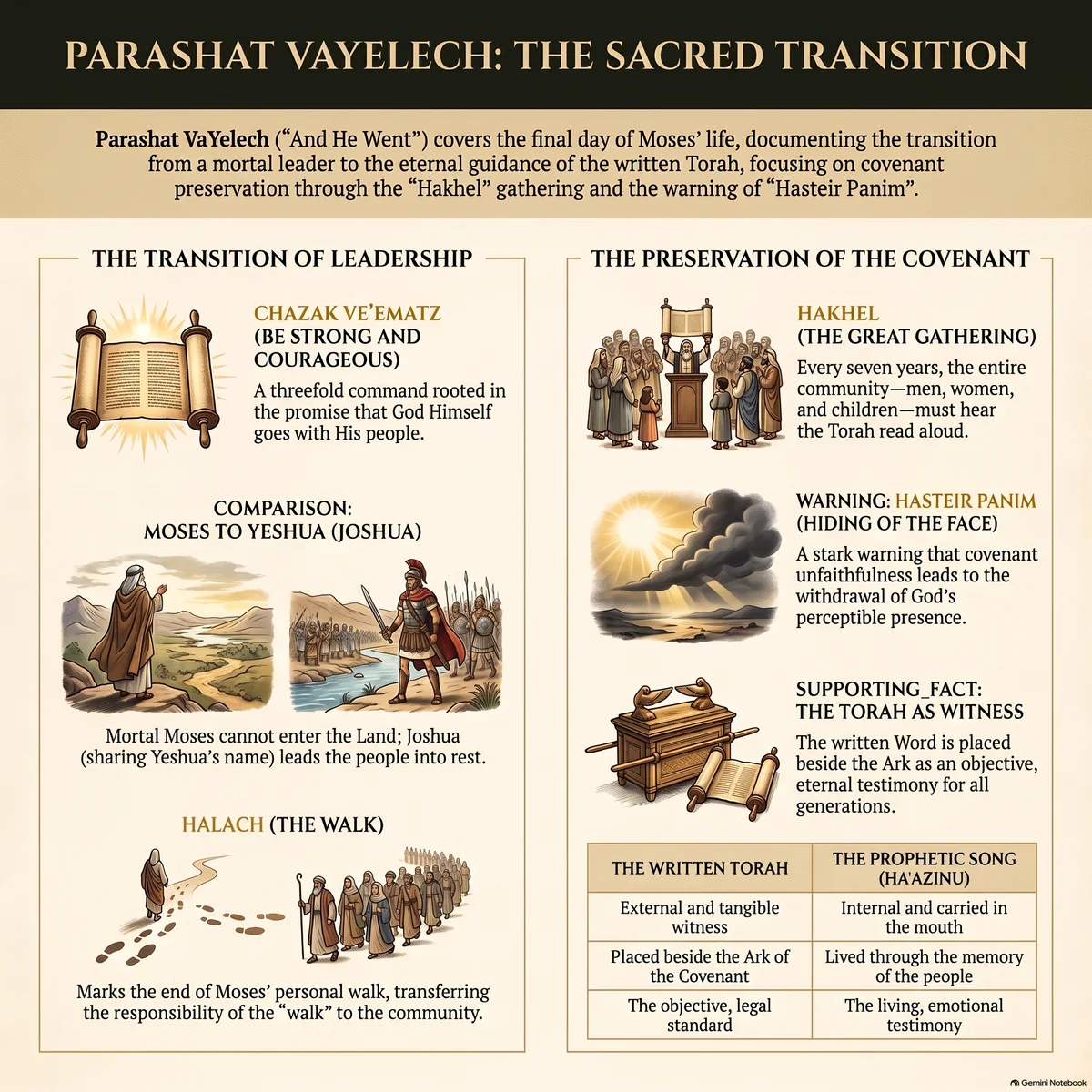
VaYelech puts its finger on the fragility of human transitions. Moses, the giant of faith, must let go. The people are about to face an uncertain future without the man who led them out of Egypt. Precisely into that vacuum, YHWH reveals the foundation that never wavers: His promise that He Himself goes along, His fixed Word that must be read to every generation, and the prophetic warning that turning from His ways leads to estrangement — the hiding of His face.
VaYelech teaches that faith is not built on the charisma of a human leader, but on the living God who raises up Joshuas, secures His Word, and remains faithful to His people — even when they pass through periods of spiritual darkness.
Placing the Torah scroll beside the Ark (Deut. 31:26) is not a magical act but a legal-testimonial one: the written Word functions as an objective, verifiable standard above any later subjective claim about what God supposedly said. This rules out, from the outset, every form of esoteric or exclusive knowledge of God (see part E under Connections) — the same canonical vigilance that Nitzavim had already established in Deut. 29:29.
A — Word study: halach (הָלַךְ) — the root of the title and the circle of the Torah
VaYelech opens with the same root that names the third parasha from the beginning of the Torah: Lech Lecha ("go forth", Gen. 12:1). VaYelech is likewise, counted from the end, the third parasha of the Torah. Both concern a radical command to go — but with opposite direction of movement: Abraham leaves his land to enter the promised land; Moses stands on the threshold of the promised land and must not enter it, but goes to die, to be reunited with his forebears.
Remez-speculative The final portions of the Torah appear to correspond thematically to the first: VaYelech (halach) with Lech Lecha (halach); the next parasha, Ha'azinu, opens with a summons to heaven and earth and words that "drop down like rain" (Deut. 32:1-2) — a reversal of the flood that bursts from that same heaven and earth in the second parasha, Noach; and the final parasha, V'Zot HaBerachah, closes with Moses' blessing over Israel, an echo of the blessing God speaks over humankind and animals at creation (Gen. 1:22, 28). This structural observation rests on canonically verifiable roots, but the suggested chiastic framing of the entire Torah is a literary-interpretive observation (Remez), not an explicit textual claim, and is labeled accordingly.
Echo: the same root halach is used for the walk of Enoch, Noah and Abraham (Gen. 5:22, 6:9, 17:1 — the hitpael form of a continual, intimate walk). VaYelech marks the moment Moses' own walk ends, while the people's walk — now without his personal guidance — must continue. See Walking — The First Step After the Voice and The Crossing for the next step: the crossing of the Jordan that VaYelech is preparing.
B — Chazak ve'ematz — the threefold command (Deut. 31:6,7,23)
The formula chazak ve'ematz ("be strong and courageous") sounds three times in this chapter: first to all Israel (v. 6), then specifically to Joshua before the people (v. 7), and finally directly from YHWH to Joshua (v. 23). The same threefold repetition returns when Joshua begins to lead independently (Josh. 1:6-9) — a canonically confirmed pattern, not a coincidence.
"Be strong and of good courage, do not fear nor be afraid of them; for YHWH your God, He is the One who goes with you. He will not leave you nor forsake you." — Deuteronomy 31:6
"Do not be afraid" (al tira'u) uses the same root yare (H3372) that elsewhere means "awe" or "reverence" — not a denial of human emotion, but a call not to let the reverence due to YHWH drain away toward the enemy or the circumstance. The courage of Chazak ve'ematz is pointedly derived: it follows immediately on the promise "for YHWH your God is the One who goes with you" — not self-generated bravery, but a response to an already-given promise.
C — Hakhel — the command to hear the Torah (Deut. 31:9-13)
Moses writes down the Torah and institutes the command of Hakhel: once every seven years, during the Feast of Tabernacles of the sabbatical year, the whole people — men, women, children (taf) and the stranger (ger) within the gates — must assemble to hear the Torah read.
Canonical the verb hakhel (הַקְהֵל, hifil imperative of qahal, H6950) stands literally in Deut. 31:12. Rabbinic/Traditional the institutionalization of this ceremony as an annually fixed practice in the year following the sabbatical year, with specific liturgical elaboration, is later rabbinic development of the canonical command.
The enumeration of hearers is deliberately all-encompassing: biblical teaching is no elite matter but a community-forming duty that skips no generation, gender, or social status. Because the sabbatical year is a year of release — debts are cancelled, slaves go free (Lev. 25:8-10) — the people travel to the gathering place free of financial burden, making the hearing of the Torah a moment of freedom, not obligation.
Echo — Brit Chadasha: the sabbatical-year principle reaches its superlative in the jubilee, the fiftieth year (Lev. 25:8-10). When Yeshua, in the Nazareth synagogue, reads Isaiah 61:1-2 and says, "Today this Scripture is fulfilled in your hearing" (Luke 4:18-21), He canonically proclaims the jubilee — the same freedom and release in which Hakhel takes place, now embodied in His own ministry. See also Sukkot — The Crown of Indwelling for the festival context in which Hakhel occurs, and Micah 4:2 for the prophetic expectation that ultimately all nations will go up to learn the Torah.
D — Hasteir Panim — the hiding of the face (Deut. 31:16-18)
"Then My anger shall be aroused against them on that day, and I will forsake them and hide My face from them... I will surely hide My face in that day because of all the evil which they have done." — Deuteronomy 31:17-18
The root satar (H5641, "to hide") appears here doubled as an infinitive absolute — a Hebrew construction that intensifies: "hiding, surely hiding." This forms a striking mirror image of Panim — His Face Passes By: where Exodus 34 shows YHWH's face passing by in grace and proclaiming the thirteen attributes, Deuteronomy 31 shows that same face withdrawing after covenant breach. Together the two texts display the two sides of the same covenant reality: nearness as gift, distance as consequence of unfaithfulness — never arbitrariness.
The same root satar recurs in Isaiah 8:14, where the speaker — the "stone of stumbling" canonically applied to Yeshua (Matt. 21:44; Rom. 9:32-33) — says he waits for YHWH "who is hiding His face from the house of Jacob." See Covering — The Veil Before Beholding for the related line of Moses' own veiled face (Ex. 34:33-35; 2 Cor. 3:13-16), and Yeshua — Who Is He? for the full working-out of the stumbling-stone typology.
Drash: Hasteir Panim is canonically no arbitrary punishment but the direct, foretold consequence of pursuing foreign gods (Deut. 31:16, 20) — a consequence that is, as the haftarah of Shabbat Shuvah shows (Step 2), always reversible through teshuvah.
E — The Torah as witness beside the Ark (Deut. 31:24-27)
Moses finishes writing the Torah and commands the Levites to place the scroll beside the Ark of the Covenant — not inside it, as the two stone tablets were, but beside it, as an additional, standing witness (ed) against the people should they stray. This connects directly to Two Witnesses — Torah and Prophets: the written Word functions canonically as an objective standard, standing outside the subjective experience of any single generation.
F — Sod: the Song as eternal witness
Moses is commanded to write a Song (Deut. 31:19-22) that, unlike written Torah which can be lost or ignored, will live on in the people's mouth as witness — the subject of the next parasha, Ha'azinu. This Song and the written Torah are two complementary forms of the same testimony: one external and tangible (beside the Ark), the other internal and carried (in the mouth).
Moses' departure in VaYelech is the direct continuation of Nitzavim's "choose life" (Deut. 30:19): the Torah as a "planted tree of life" reaches beyond the death of any individual bearer. See Life & Death — Chaim & Mawet for the full working-out of why chaim in the Tanakh is never an isolated individual fact, but a connected reality spanning generations.
Further study on Devar Emet
- Parasha Nitzavim — You Are Standing — the preceding parasha: from consciously standing to consciously going
- Panim — His Face Passes By — the mirror image of Hasteir Panim
- Covering — The Veil Before Beholding — Moses' veiled face, the same root satar
- Yeshua — Who Is He? — the stone of stumbling, Isaiah 8:14
- The Crossing — the Jordan that Joshua will lead the people through
- Two Witnesses — Torah and Prophets — the Torah as objective witness beside the Ark
- What Does the Law Bring? — hypo nomos versus en nomos, Galatians 3:23-25 unpacked
- Renewed Covenant — Restoration, Not Replacement
- Life & Death — Chaim & Mawet — "choose life," carried forward into VaYelech
- Sukkot — The Crown of Indwelling — the feast in which Hakhel takes place
Parasha VaYelech challenges us to make the transition of times, YHWH's encouragement, and the anchoring of His Word concrete in daily life:
1 — Speak Chazak ve'ematz over someone else.
Someone in your circle — a child, a young believer, or a leader facing a heavy task — is wrestling this week with uncertainty about the future. Deliberately take on Moses' role: encourage that person explicitly with the promise that YHWH will not leave or forsake them.
2 — Organize a Hakhel moment.
Do not wait for others to take the initiative. Take time this week to read Scripture aloud with family or a small group and talk about it openly — including the children. Let the reading itself take center stage, without it needing to become an elaborate sermon.
3 — Test your dependence on human leaders.
Examine your own heart: does your spiritual life lean too heavily on a particular pastor, teacher, or author? Make the conscious turn to anchor your trust in the living God Himself and His written Word — knowing that human leaders are temporary, but YHWH remains forever.
4 — Seek God's face in stillness.
As a safeguard against Hasteir Panim, choose a deliberate moment of repentance (teshuvah) this week. Clear away the noise, distraction, or hidden sin that clouds your relationship with YHWH, and pray concretely: "Do not hide Your face from me."
Each step is a concrete expression of this week's walk: not paralyzed by fear of the future, but pressing on with strength and courage in the track of God's Word.
Avinu Malkeinu — Our Father, our King,
You are the God of the generations. Where people come and go, You remain the same, yesterday, today, and forever. Thank You for Your promise that You will not leave us or forsake us when we stand before difficult transitions or unfamiliar paths.
Impress Your written Word deep into our hearts and into the hearts of our children. Give us the courage of Joshua to be strong and brave — trusting not in our own strength, but in Your presence that goes with us. Do not hide Your face from us, but restore us when we stray, and lead us through Yeshua, our Redeemer, into the promised land of Your rest.
Baruch Atah YHWH, who calls His servants and keeps His Word forever. Amen.
- TorahDeuteronomy 31:1-30; Deuteronomy 31:1-8 (transfer of leadership and Chazak ve'ematz); Deuteronomy 31:9-13 (Hakhel and the writing of the Torah); Deuteronomy 31:12 (the instituting command); Deuteronomy 31:14-23 (the prophecy of unfaithfulness and Hasteir Panim); Deuteronomy 31:16-18 (the hiding of God's face); Deuteronomy 31:24-30 (the Torah beside the Ark and the Song); Deuteronomy 31:26 (the Torah as witness); Deuteronomy 31:28-29 (the witness formula and the apostasy prophecy, direct echo of Nitzavim); Deuteronomy 34:7 (Moses' undiminished strength to his 120th year); Deuteronomy 32:51 (Moses' fall at Meribah); Deuteronomy 10:16 & 30:19 (callbacks to Nitzavim); Genesis 6:3 (the 120-year limit); Numbers 20:12 (Meribah, the reason for Moses' exclusion); Genesis 12:1 (Lech Lecha, the same root halach); Genesis 1:22 (the creation blessing); Numbers 27:18-23 (Joshua's earlier appointment); Leviticus 25:8-10 (the sabbatical and jubilee years); Joshua 1:6-9 (the repeated Chazak ve'ematz to Joshua).
- ProphetsHosea 14:2-10, Micah 7:18-20, Joel 2:15-27 (Haftarah Shabbat Shuvah); Micah 4:2 (the Torah going forth from Zion for all nations); Isaiah 8:14 (the stone of stumbling, the same satar root); Isaiah 61:1-2 (the jubilee announced).
- Brit ChadashaHebrews 13:5-6 (direct citation of Deut. 31:6,8); Hebrews 4:8-9 (Joshua/Yeshua typology, the sabbath rest); Hebrews 12:14-15 (the root of bitterness, echo of Nitzavim); Romans 7:10,12-13 (the Torah holy, death through sin, not the Torah); Isaiah 53:5-6, Romans 5:8 (Yeshua carried a death not His own, contrasted with Moses' own transgression); 2 Timothy 4:2-3 (keeping the Word); Matthew 28:18-20 (the Great Commission as extension of Hakhel); Luke 4:18-21 (Yeshua proclaims the jubilee, Isa. 61:1-2 fulfilled); Luke 24:27 (PaRDeS anchoring); Romans 3:31 (the Torah established, not made void); Galatians 3:23-25 (the Torah as paidagogos, hypo nomos); 2 Corinthians 2:14 (triumphing in Yeshua); Revelation 20:11 (the millennial kingdom, see protocol note below).
- Rabbinic/TraditionalThe name "Shabbat Shuvah" for the Shabbat between Rosh Hashanah and Yom Kippur; the institutionalization of Hakhel as an annual ceremony in the year after the sabbatical year; the Bar Mitzvah age (12-13) as a comparative framework for the age at which children first consciously experience Hakhel.
- Source materialSupplementary aliyah-based teaching material on Parashat VaYelech was screened against Protocol VI. The exegetical core (transfer of leadership, Chazak ve'ematz, Hakhel, the Torah-circle structure as a literary observation, the jubilee) has been used and explicitly labeled where Remez-speculative. Incorrect rendering of the divine Name has been corrected to YHWH (Protocol VI.iii). Unqualified use of "law"/"commandments" has been restored to "Torah"/"Torah guidelines" (Protocol VI.ii.b). A hypo-nomos translation trap in the explanation of Galatians 3:23-25 (the Torah presented as a "prison" giving way to Yeshua) has been corrected per Protocol VI.iii.a. Speculative eschatological claims about a near, datable return have been excluded per protocol (named sources: no eschatological speculation). An unsourced psychological claim about childhood formation of one's image of God has been omitted for lack of verifiability.
- PaRDeS HermeneuticsPshat (the transfer of leadership, Hakhel as historical institution); Remez (the Torah-circle structure, halach as connecting root with Lech Lecha, the jubilee-Hakhel link); Drash (Chazak ve'ematz as derived courage, teshuvah against Hasteir Panim); Sod (the Song as abiding witness, the Torah that outlives the death of its bearer). Talmud, b. Sanhedrin 67b; b. Chagigah 14b. Kabbalistic Sod-content (Zohar, Sefer Yetzirah) explicitly excluded — Protocol VI.i extension. The premillennial framework in which the Feast of Tabernacles is read as foreshadowing the millennial kingdom (Rev. 20) is one interpretive framework within messianic eschatology and is presented as such, not as the only possible reading.
- ProtocolCanonicity test (VI.i) applied to every concept: halach, chazak ve'ematz, Hakhel and Hasteir Panim are canonically anchored in Deuteronomy 31 (badges). No use of Zohar, Sefer Yetzirah, or kabbalistic works. "Renewed Covenant" used, never "new covenant" (VI.ii.a). "Torah"/"Torah guidelines" used in original text (VI.ii.b). YHWH used in original text, never the hybrid substitution "Jehovah" (VI.iii). The hypo nomos/en nomos distinction (VI.iii.a) applied to Galatians 3:23-25, with a cross-reference to the study that fully develops this distinction rather than repeating the doctrine here. Hakhel and its institutionalization explicitly labeled Rabbinic/Traditional alongside the canonical command itself.