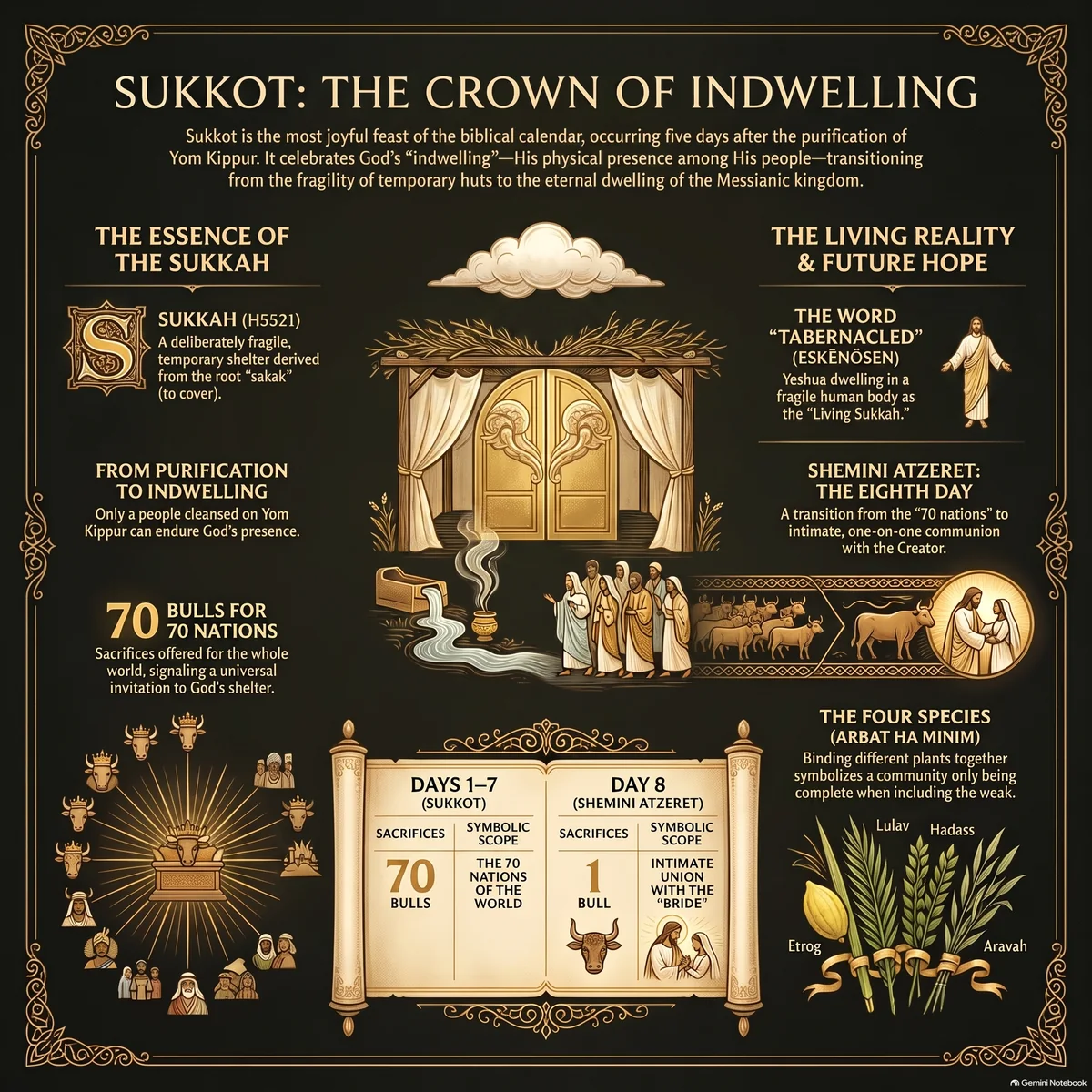
Five days after Yom Kippur, the mood turns. Where the Day of Atonement calls for silence, fasting, and self-affliction, the fifteenth of Tishri brings the most joyful feast of the calendar: seven days of dwelling in fragile, temporary booths — Sukkot, the Feast of Booths. This is no accidental sequence. Only a people cleansed on Yom Kippur can bear the physical presence of a holy God in their midst. Sukkot is the crown of the autumn cycle: after the wake-up call (Yom Teruah) and the atonement (Yom Kippur) comes the indwelling.
This study lays bare the canonical ground of Sukkot (סֻכּוֹת, plural of sukkah — booth, shelter): the sakak root, the ritual of the Four Species, and this feast's place as the closing of the C' group in Leviticus 23. It marks precisely where the canonical text gives way to Second Temple and rabbinic practice (the water-drawing ceremony, the menorah lighting, the interpretation of the Four Species) — per Protocol VI.i.
After this study you understand:- You know the canonical ground of Sukkot (Leviticus 23:33–43; Deuteronomy 16:13–15) and the sakak root (H5526) behind the word sukkah.
- You understand why Sukkot, unlike Yom Teruah and Yom Kippur, is indeed a mandatory pilgrimage feast — and what that means for "appearing."
- You recognize the completion of the C' group in the chiasm of Leviticus 23: from wake-up call through atonement to indwelling.
- You can distinguish which Sukkot rituals are canonical (the sukkah, the Four Species as categories) and which are Second Temple practice or rabbinic interpretation (the water-drawing ceremony, the menorah lighting, the symbolism of taste and fragrance).
- You understand how John 7 and 8 respond directly to the liturgical high points of the feast.
- You know the canonical tension between the seventy offering animals for the nations and the one bull on the eighth day (Shemini Atzeret).
- You know what the Monday morning after Sukkot concretely means for your walk.
Read the four Scripture passages below slowly — preferably aloud. Before reading, ask yourself: what connects these texts? What pattern do they repeat?
The canonical text ground
בַּחֲמִשָּׁה עָשָׂר יוֹם לַחֹדֶשׁ הַשְּׁבִיעִי הַזֶּה חַג הַסֻּכּוֹת שִׁבְעַת יָמִים לַיהוָה
"On the fifteenth day of this seventh month is the Feast of Booths, seven days to YHWH."
Leviticus 23:34 Canonical · H5521Sukkot begins on the fifteenth of Tishri — five days after Yom Kippur — and lasts seven days, followed by an eighth, separate day: Shemini Atzeret (Lev. 23:36). It is explicitly a pilgrimage feast: together with Pesach/Matzot and Shavuot, Sukkot belongs to the shalosh regalim, the three feasts at which every man had to appear in Jerusalem (Deut. 16:16). Canonical · Lev. 23:34, 36 · Deut. 16:13–16
The ritual of the sukkah
Seven days spent living in temporary booths — a reminder of the forty-year wilderness journey, in which YHWH let His people dwell in booths and enveloped them with the cloud pillar of His presence. Canonical · Lev. 23:42–43
The feast falls at the close of the harvest — the moment the land's fruits have been fully gathered in, with gratitude for the year's provision. Canonical · Ex. 23:16
The most joyful feast of the calendar — "you shall rejoice before YHWH your God for seven days." Canonical · Deut. 16:14–15
The completion of the autumn trilogy
The order is theologically compelling: without cleansing, no indwelling is possible. Only after man has been cleansed on Yom Kippur can a holy God dwell physically in the midst of His people. The mood turns in five days — from fasting and self-affliction to the most joyful festivity of the calendar. Canonical · Lev. 23:23–43 (literary structure)
King Solomon chose to dedicate the temple in Jerusalem during the feast of the seventh month. At that moment the Kavod of YHWH filled the house so powerfully that the priests could not stand to minister (1 Kings 8:2, 10–11). Indwelling here is no abstract concept but a physical, observable event. Canonical · 1 Kings 8:2, 10–11
Zechariah proclaims that in the Messianic Kingdom, all the remaining nations will go up to Jerusalem year after year to keep the Feast of Booths — whoever does not go receives no rain (Zech. 14:16–19). Sukkot is thereby the only feast for which Scripture explicitly foretells an end-time, worldwide observance. Canonical · Zech. 14:16–19
On the last, great day of the feast, Yeshua stands and cries out: "If anyone is thirsty, let him come to Me and drink! Whoever believes in Me, as Scripture says, out of his heart will flow rivers of living water" (John 7:37–38). In John 8:12 He declares: "I am the Light of the world." Both statements respond directly to the feast's liturgical high points — the water-drawing ceremony and the menorah lighting (see ⑤ Anchoring for the rabbinic background of both rituals). Canonical · John 7:37–38 · John 8:12
The great multitude before the throne carries palm branches — a direct Sukkot reference (Rev. 7:9). Of them it is said that He who sits on the throne "will spread His tabernacle over them" (Rev. 7:15) — the same Greek verb σκηνόω that John 1:14 uses for Yeshua's incarnation. In Revelation 21:3 this reaches its fulfillment: "Behold, the tabernacle of God is with man, and He will dwell with them." Canonical · Rev. 7:9, 15 · Rev. 21:3
The Trumpets–Atonement–Tabernacles triad: a popular Messianic scheme identifies Yom Teruah with the resurrection, Yom Kippur with the Day of the Lord, and Sukkot with the end-time ingathering — and typologically links Shemini Atzeret with the new creation of Revelation 21:1–3. The individual canonical texts (Zech. 14, Rev. 7, Rev. 21) stand firm; the precise one-to-one mapping of each feast to a specific end-time event is an interpretive scheme, not an explicit Scriptural statement. Speculative-Remez · no canonical consensus
Yeshua — God pitching His tent among us
"The Word became flesh and tabernacled among us" (John 1:14) — the Greek ἐσκήνωσεν (eskēnōsen) literally means: He pitched His tent, His sukkah, among us. Yeshua is Immanuel: God who came to dwell in a human, fragile "temporary house" — the same movement Sukkot celebrates every year. Canonical · John 1:14
At the moment the water-drawing ceremony reaches its climax, Yeshua stands and declares Himself the ultimate source from which living water flows (John 7:37–38). What the ritual pictured century after century — the plea for rain and Spirit — becomes reality in His Person. Canonical · John 7:37–38
Against the backdrop of the illuminated temple during Sukkot, Yeshua declares: "I am the Light of the world; whoever follows Me will never walk in darkness" (John 8:12). Just as the sukkah lets the stars through at night — no sealed roof, but shelter that does not shut out the sky — so Yeshua is the light that does not exclude but lets in. Canonical · John 8:12
Three misunderstandings that weaken the indwelling
The popular-theological reading: a solid house and established prosperity are signs of God's blessing and security.
The Scriptural contrast: the sukkah is deliberately a fragile, temporary booth, not a fortified house. The roof lets the stars through. The message is explicit: earthly possessions, houses, and status offer no lasting security — security lies solely in the shelter of God's presence. Canonical · Lev. 23:42–43
The popular-theological reading: Sukkot is a feast of and for Israel alone, closed to the nations.
The Scriptural contrast: during the seven days of Sukkot a total of seventy bulls were offered (Num. 29:12–34) — a number rabbinic tradition connects to the seventy nations of Genesis 10. Rabbinic-Traditional · b. Sukkah 55b The offering counts themselves are canonical; Zechariah 14:16–19 canonically confirms that the nations are explicitly invited to celebrate the feast together. Sukkot is God's invitation to all nations to shelter under His roof, not a closed feast. Canonical · Num. 29:12–34 · Zech. 14:16–19
The popular-theological reading: the joy of Sukkot is comparable to worldly entertainment — loose fun without deeper substance.
The Scriptural contrast: the simcha of Sukkot is the joy of a people cleansed on Yom Kippur, now walking in fellowship with the Creator — joy "before the face of YHWH" (Deut. 16:14–15), not apart from it. Canonical · Deut. 16:14–15
Connection I — The Eighth Day: from the nations to the intimate Bride
Shemini Atzeret — the closing assembly, canonically instituted as a separate, eighth day (Lev. 23:36). Where the seven days of Sukkot see seventy bulls for the seventy nations, only one bull is offered on the eighth day (Num. 29:35–38). Canonical · Lev. 23:36 · Num. 29:35–38
Seventy bulls, decreasing from thirteen to seven per day. A universal feast for the whole world. Temporary booths — a picture of this earth.
Only one bull. Intimate togetherness, canonically instituted apart from Sukkot itself — not an extension but its own "atzeret" (assembly / holding-back).
Rabbinic and homiletical tradition reads the shift from seventy to one as the moment the feast turns from the world to intimate togetherness between the King and His people — pictured in the well-known parable: "Stay one more day with Me, for parting from you is hard for Me." Rabbinic-Traditional · cf. Rashi on Num. 29:35; b. Sukkah 55b The canonical text itself only records the difference in offerings (seventy versus one); the interpretation of that shift is homiletical. Canonical · Num. 29:12–38 (offering counts)
Connection II — The Sukkah of David
"On that day I will raise up the fallen booth of David, and repair its breaches, and raise up its ruins, and rebuild it as in the days of old."
Amos 9:11 CanonicalAmos deliberately uses the same word — sukkah — for the restoration of David's royal house. James cites this text at the Jerusalem council to explain why the Gentiles, without circumcision, are being added to the people of God: the restoration of David's fallen booth explicitly includes "all the Gentiles who are called by My name" (Acts 15:16–17). One of the strongest canonical intertextual connections in this entire study: the very hut that pictures the fragility of Sukkot is the image that carries the inclusion of the nations into the covenant. Canonical · Amos 9:11–12 · Acts 15:16–17
Connection III — The water-drawing ceremony: shadow and reality
Each day of Sukkot a priest carried water from the pool of Siloam to the temple and poured it out on the altar, while the crowd cried "Hoshana!" ("Save now!") and waved palm branches. On the seventh day (Hoshana Rabbah) this happened seven times. This entire ceremony — the golden pitcher, the procession, the funnel-shaped basins on the altar — is nowhere in the Torah itself: it is Second Temple and Mishnaic practice. Rabbinic-Traditional · Mishnah Sukkah 4–5
That same week, moreover, enormous golden menorahs were lit on the Temple Mount that illuminated all Jerusalem — likewise Mishnaic practice, not Torah prescription. Rabbinic-Traditional · Mishnah Sukkah 5:2–4 Both rituals form the indispensable background for understanding John 7:37–38 and 8:12 — Yeshua's statements are no arbitrary imagery, but a direct response to what was happening in the temple at that very moment. The canonical text of John stands firm; the historical backdrop is Second Temple/rabbinic.
Connection IV — The deeper meaning of the Four Species
The Torah names four general plant categories in Leviticus 23:40. Rabbinic tradition specifically identifies these as etrog (citron), lulav (palm branch), hadas (myrtle), and aravah (willow), bound together as the lulav bundle. Rabbinic-Traditional · Mishnah Sukkah 3
Taste and fragrance — the person who knows Scripture and walks in love.
Taste, no fragrance — the person with deep biblical knowledge, but few deeds.
Fragrance, no taste — the person with little theory, but full of good deeds.
No taste, no fragrance — the person without knowledge and without outward fruit.
This taste/fragrance symbolism (knowledge versus deeds) is a well-known homiletical teaching, not the Torah text itself. Rabbinic-Traditional · Vayikra Rabbah 30:12 The prophetic lesson remains canonically traceable: Leviticus 23:40 commands that all four branches be bound together to wave — not merely the most fruitful species. The community before YHWH's face is complete only when the weakest and fruitless are brought in too, under the shelter of the sukkah. Canonical · Lev. 23:40
Questions for reflection
Questions for personal reflection or fellowship
- Do I seek my safety in my own "house of stone" (possessions, control, status), or do I dare to trust God's protection in the fragile "booth" of this life?
- Is the joy of atonement (Yom Kippur) visible in my daily life as a contagious Sukkot-joy to the people around me?
- The sukkah does not shut out heaven — the roof lets the stars through. Where in my life do I build a tighter, safer roof than God asks for?
- The Four Species are bound together, not separated. Whom in my community do I treat as a "Willow Branch" — someone without visible knowledge or fruit — and how does that change once I realize the community is complete only with them?
- If someone asked me tomorrow why Christians don't keep Sukkot but I do — what would I say in one sentence?
The speakable testimony
Speakable faith — for when it is asked
"Sukkot, for me, is the feast of God's indwelling. After being shaken awake on Yom Teruah and cleansed of our sins on Yom Kippur, on Sukkot we celebrate that God is not far away, but dwells with us. The fragile booth reminds me that my earthly life is temporary — but that I get to shelter forever under the protection of King Yeshua, who Himself pitched His tent among us."