Nine days after the wake-up call of Yom Teruah comes the silence of Yom Kippur — the one day of the year the High Priest may pass behind the veil to sprinkle blood on the Kapporet, the atonement cover of the Ark. Where Yom Teruah alarms, Yom Kippur confronts: with the holiness of God, with one's own guilt, and with the question whether that gap can ever be bridged. Leviticus 16 and 23:27–32 do not answer this with vague religious reassurance, but with a precisely worked-out ritual — blood, the laying on of hands, a goat sent away.
This study lays bare the canonical ground of Yom Kippur (כִּפֻּרִים, H3725 — Atonements): the kafar root that means to cover and to bridge, the ritual of the two goats, and this feast's place in the chiastic structure of Leviticus 23. It marks precisely where the canonical text gives way to rabbinic tradition (the Book-of-Life framework, the fasting interpretation of "innui nefesh") and where Messianic typology becomes speculative — per Protocol VI.i.
After this study you understand:- You know the canonical ground of Yom Kippur (Lev. 16; Lev. 23:27–32) and the distinction between the goat for YHWH and the goat for Azazel.
- You understand the kafar root (H3722) — to cover, to bridge, to pay a ransom — and why, in light of Hebrews 9–10, "covering" was a temporary, not a final, solution.
- You recognize the shared chiastic position of Yom Teruah and Yom Kippur (C') in Leviticus 23, and the distinction between the two within that block.
- You can distinguish which traditions around Yom Kippur are canonical and which are rabbinic — especially the Book-of-Life framework and the "innui nefesh" interpretation.
- You understand why the Jubilee year was proclaimed specifically on Yom Kippur, not on Yom Teruah, and what that means theologically.
- You know the canonical Book-of-Life motif through Torah, Prophets, and Renewed Covenant — apart from the rabbinic calendar mechanism around it.
- You know what the Monday morning after Yom Kippur concretely means for your walk.
Read the four Scripture passages below slowly — preferably aloud. Before reading, ask yourself: what connects these texts? What pattern do they repeat?
The canonical text ground
אַךְ בֶּעָשׂוֹר לַחֹדֶשׁ הַשְּׁבִיעִי הַזֶּה יוֹם הַכִּפֻּרִים הוּא מִקְרָא־קֹדֶשׁ יִהְיֶה לָכֶם וְעִנִּיתֶם אֶת־נַפְשֹׁתֵיכֶם
"But on the tenth day of this seventh month is the Day of Atonement; it shall be a holy convocation for you, and you shall afflict your souls and present a fire offering to YHWH."
Leviticus 23:27 Canonical · H3725Yom Kippur is the holiest day of the calendar, and the only day the High Priest may enter the Most Holy Place (Lev. 16:2; Heb. 9:7). It falls on the tenth of Tishri — nine days after the wake-up call of Yom Teruah on the first. Canonical · Lev. 16:2 · Heb. 9:7
The chiastic position — shared with Yom Teruah on C'
In the chiasm of Leviticus 23 (see The Zadok Calendar), Yom Teruah and Yom Kippur do not stand apart — they share position C', mirrored against Bikkurim (C) on the other side of the Shavuot axis.
Within this shared block there is an internal movement: Yom Teruah opens the nine days with an alarm, Yom Kippur closes them with a judgment and an atonement. Both stand canonically within the same text segment (Lev. 23:23–32) — this is no added typology but the literary structure of the text itself. Canonical · Lev. 23:23–32 (literary structure)
The two goats — one atoning work, two movements
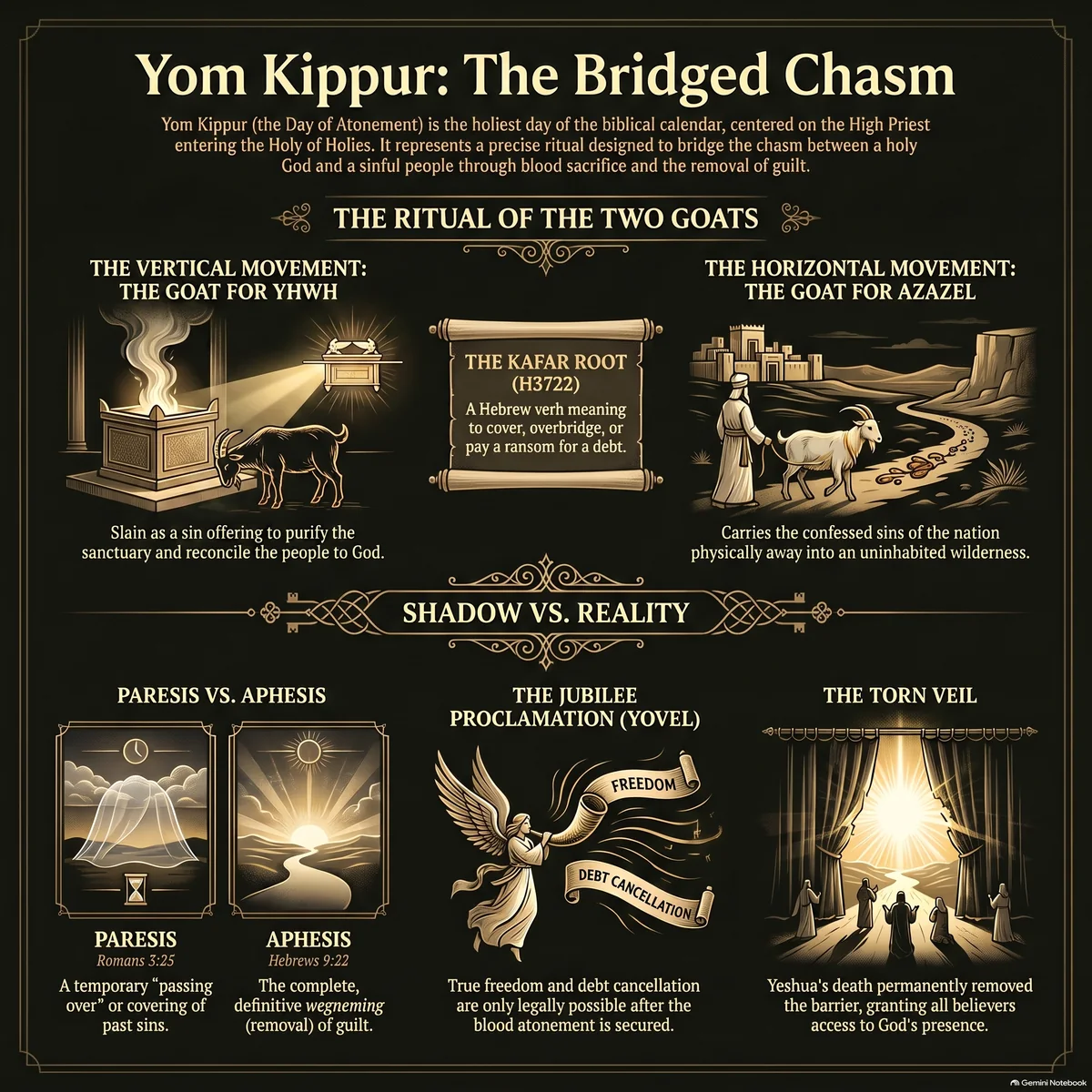
The ritual climax of Yom Kippur consists of two identical goats whose roles are assigned by lot (goral) (Lev. 16:7–10). Together they picture one atoning work — blood atonement and guilt-removal. Canonical · Lev. 16:7–22
Slaughtered as a sin offering (chatat). The High Priest brings the blood behind the veil and sprinkles it on the Kapporet (Lev. 16:15). Effect: blood atonement, cleansing of the sanctuary itself. Vertical movement — atonement with God.
The High Priest lays both hands on the head of the living goat and confesses over it all the iniquities of the people. The goat is led away into an uninhabited, barren wilderness (Lev. 16:21–22). Effect: guilt carried away. Horizontal movement — liberation from the burden.
Translation flag · Azazel etymology uncertain — a common explanation derives Azazel (עֲזָאזֵל) from ez (goat) + azal (to go away) — "the goat that goes away." This compound is one of several explanations proposed by Hebraists; others read Azazel as the proper name of a wilderness spirit or place, or as denoting "complete removal." The Tanakh itself does not define the term. This study presents the ez/azal reading as one linguistic possibility, not as an established fact. Linguistically disputed
Isaiah 58 confronts Israel with the question of what true fasting means — not outward self-affliction, but breaking every yoke and seeking justice (Isa. 58:6–7). Isaiah 58 does not itself name Yom Kippur; the link to this specific day runs through the fixed rabbinic Haftarah reading for Yom Kippur. Rabbinic-liturgical · traditional Haftarah link The content of Isaiah 58 remains fully canonical Scripture, apart from that specific day-link. Canonical · Isa. 58:6–7
The earthly ritual of the High Priest entering the earthly sanctuary year after year with the blood of bulls and goats was a shadow of the heavenly reality (Heb. 9:9, 23–24). Yeshua did not enter with strange blood, but with His own blood, once, into the heavenly Most Holy Place, and secured eternal redemption (Heb. 9:12). Canonical · Heb. 9:9–24
Here lies the sharpest Greek distinction of this study: Romans 3:25 uses paresis (πάρεσις) — the passing over of previously committed sins, a temporary, provisional covering before the cross. Hebrews 9:22 uses aphesis (ἄφεσις) — full, final removal. Thanks to Yeshua, Yom Kippur is no longer a yearly repetition that merely covered sins (paresis), but an eternal, complete removal of guilt (aphesis). Canonical · Rom. 3:25 · Heb. 9:22
Yeshua embodies three roles at once
In place of the fallible Aaronic priesthood, which had to offer year after year, Yeshua is the eternal High Priest after the order of Melchizedek (Heb. 7:24–27) — a priestly order older and higher than the Levitical (Heb. 7:9–10, cf. Gen. 14:18). He intercedes permanently for us, not repeated yearly. Canonical · Heb. 7:24–27
The first goat cleansed the sanctuary and brought blood atonement. Yeshua is the Lamb of God whose blood cleanses us fully from all unrighteousness (1 John 1:7). He shed His blood behind the veil — silently, as Isaiah 53 describes. Canonical · 1 John 1:7 · Isa. 53:7
The second goat received the sins of the people through the laying on of hands and was sent into the wilderness to carry them far away (Lev. 16:21–22) — the living picture of Psalm 103:12: "As far as the east is from the west, so far has He removed our transgressions from us." Yeshua did not merely take away our guilt — He carried it away, physically and legally, outside the camp (cf. Heb. 13:12–13). Canonical · Lev. 16:21–22 · Ps. 103:12
Three misunderstandings that weaken the atonement
The popular-theological reading: the ritual works automatically, regardless of the state of the heart — an annual switch that erases guilt.
The Scriptural contrast: without sincere confession of guilt (vidoei) and restoration toward one's neighbor, the offering has no spiritual effect. Isaiah 58 (canonical in its own right, apart from the day-link) makes this explicit: outward fasting without justice is empty. Canonical · Isa. 58:3–7
The popular-theological reading: "afflicting the soul" is a performance or punishment to earn God's favor.
The Scriptural contrast: innui nefesh (Lev. 16:29, 31) is a humble acknowledgment of total dependence and lostness apart from grace — not a merit. The specific interpretation as fasting and the "five afflictions" are rabbinic elaboration of a canonical command that itself leaves the exact form open. Canonical · Lev. 16:29 Rabbinic · b. Yoma 74b–77b
The popular-theological reading: Yom Kippur, even after Yeshua, remains a yearly repetition needed because the previous covering has "expired."
The Scriptural contrast: the distinction between paresis (passing over, a temporary covering — Rom. 3:25) and aphesis (full, final removal — Heb. 9:22) marks precisely this difference. Thanks to Yeshua, guilt is no longer covered yearly, but removed once and for all. Translation loss · "covering" vs. "removal" Canonical · Rom. 3:25 · Heb. 9:22
Connection I — The Jubilee is proclaimed on Yom Kippur, not on Yom Teruah
"Then you shall sound the trumpet loudly in the seventh month, on the tenth day of the month; on the Day of Atonement you shall sound the trumpet throughout all your land. You shall consecrate the fiftieth year, and proclaim liberty throughout the land to all its inhabitants."
Leviticus 25:9–10 Canonical · H3104Yovel (H3104) — the Jubilee year. Threefold restoration: cancellation of debts, release of slaves, return of ancestral land. It is theologically precise that this is proclaimed not on Yom Teruah but on Yom Kippur: there can be no true freedom while the debt before God remains unsettled. The blood atonement forms the legal ground on which the cancellation rests. Canonical · Lev. 25:9–10
Yeshua reads in the synagogue at Nazareth from Isaiah 61: "The Spirit of YHWH is upon Me (...) to proclaim the acceptable year of YHWH. (...) Today this Scripture has been fulfilled in your hearing" (Luke 4:16–21). "The acceptable year of YHWH" (shenat ratzon l'YHWH) is the prophetic term for the Jubilee. Here Yeshua presents Himself as both the accomplished atonement and the herald of the ultimate Yovel: debts erased, the slavery of sin and death broken, the inheritance of fellowship with the Father restored. Canonical · Luke 4:16–21 · Isa. 61:1–2
Connection II — The Face: from Eden to the torn veil
There is a canonical development in how near man may draw to God's face (paniem). In Eden man walks openly with God; after the fall, cherubim with a flaming sword guard the way to the Tree of Life (Gen. 3:24). At the Tabernacle, God's holiness withdraws into the Most Holy Place — only the High Priest may enter there, once a year, on Yom Kippur (Lev. 16:2). When Yeshua dies, the veil in the temple tears from top to bottom (Matt. 27:51) — a sign that God Himself removes the separation, not man. In the New Jerusalem, the privilege of one High Priest on one day becomes the eternal reality for all believers: "they will see His face" (Rev. 22:4). Canonical · Gen. 3:24 · Lev. 16:2 · Matt. 27:51 · Rev. 22:4
Connection III — The Book of Life: canonical thread, rabbinic framework
The motif of a heavenly register in which the names of the righteous are written runs as a canonical thread through all of Scripture — this stands fully biblically grounded, apart from any calendar mechanism.
Translation flag · "The canonical connection" to the feast calendar — the idea that the books are specifically "opened on Yom Teruah and sealed on Yom Kippur" is a Talmudic, not a canonical, statement (b. Rosh HaShana 16b — "three books are opened on Rosh HaShana"). The Book-of-Life texts above are each canonical on their own; the precise link to the calendar dates of 1 and 10 Tishri is a rabbinic interpretive framework around them, not a biblical statement. Rabbinic-Traditional · b. Rosh HaShana 16b
Typology: the two goats and the two comings of the Messiah. Part of Messianic hermeneutics links the first goat (for YHWH) with Yeshua's first coming — He carried away sin silently (Isa. 53) — and the second goat (for Azazel) with the second coming, at which Yeshua would definitively imprison and banish "sin and the ruling powers of this world" at His return, with Azazel explicitly identified with Satan being bound (Rev. 20:1–3).
This is a minority reading within Messianic typology. The classical reading sees in the two goats one coherent picture of one completed atoning work — death and the carrying-away of sin, both already fulfilled at the cross (Heb. 9:12, 26–28) — without dividing the goats across two separate comings. The specific link of the scapegoat to Satan (rather than to the carried-away sin of the people) does not appear in Leviticus 16 and is an added typological layer. Both elements — the two-comings division and the Azazel-Satan identification — are explicitly labeled here as Speculative-Remez, not as canonical or established rabbinic teaching. Speculative-Remez · minority reading
Questions for reflection
Questions for personal reflection or fellowship
- Do I still feel the burden of guilt from the past, or do I actually live in the freedom of complete atonement through Yeshua?
- The distinction between paresis (passing over) and aphesis (removal) is sharp. In which area of my life do I still treat my own guilt as merely "covered," rather than definitively removed?
- How does the deep cleansing of Yom Kippur translate into extending forgiveness to the people in my immediate circle?
- The veil is torn — not by my effort, but by Yeshua's death. Where do I still live as though I must earn my own access?
- The Jubilee is proclaimed after atonement, not before it. What freedom in my life is waiting on a debt I have not yet brought before YHWH?
The speakable testimony
Speakable faith — for when it is asked
"Yom Kippur, for me, is the day the ultimate gap between God and man was bridged — not by a yearly ritual I must repeat, but by Yeshua, my eternal High Priest, who gave Himself not merely to cover my guilt but to carry it away for good. Where I once had to remain outside, the veil is torn. I approach God's throne not out of fear, but in full boldness — knowing my name is not blotted out, but written down forever."