Leviticus 23:24 gives no reason. It simply states: on the first day of the seventh month there is a day of rest, announced by trumpet blasts, a holy convocation. No explanation of why the trumpet sounds — only the bare fact that it does. This silence is not a shortcoming of the text. It is an invitation: Scripture deliberately leaves the Peshat layer open, and then fills it in through the Echo — how teruah resounds through the rest of the Tanakh, at Sinai, at Jericho, at the coronation of a king.
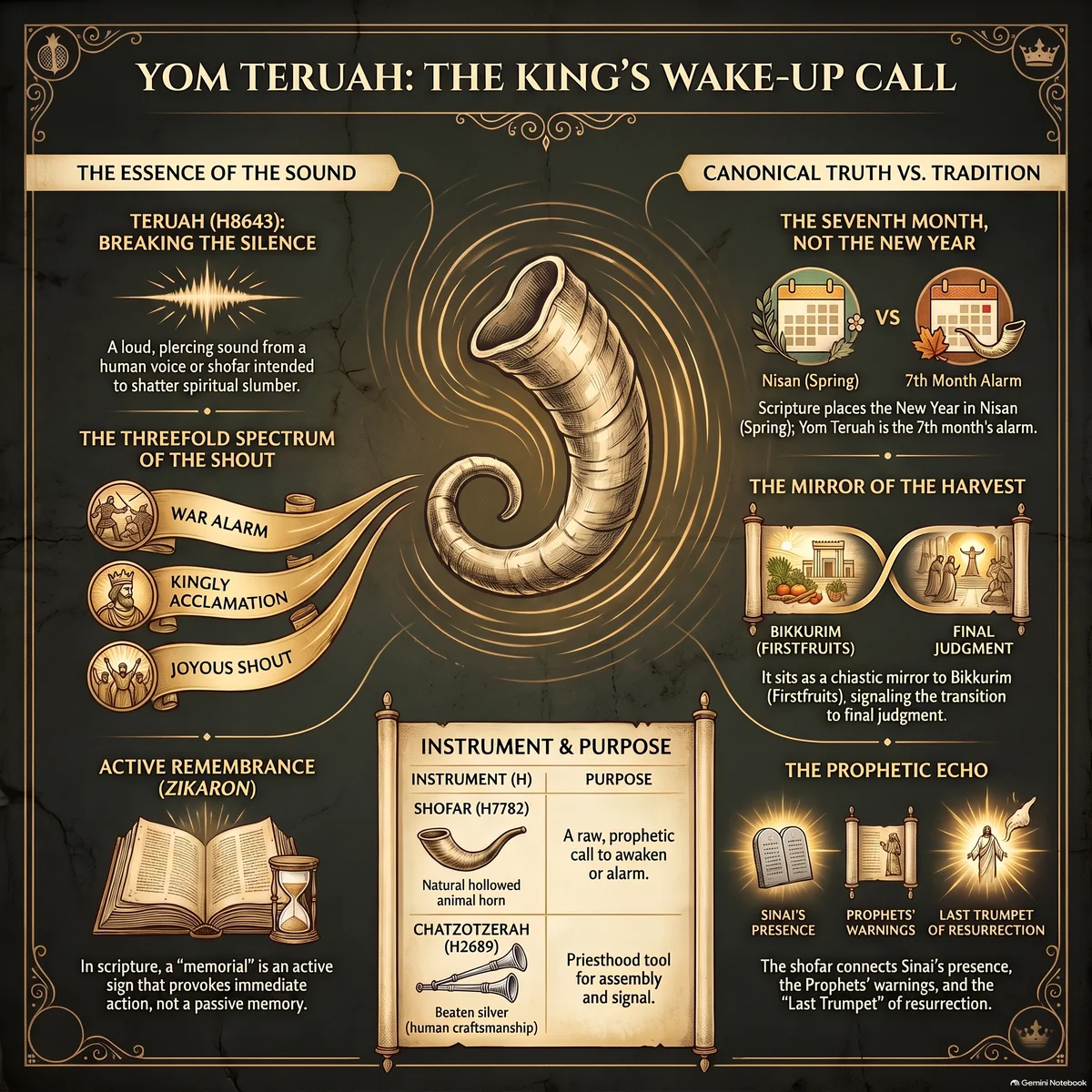
This study lays bare the canonical ground of Yom Teruah (תְּרוּעָה, H8643 — the Day of Trumpet Blasts): the rua root that carries both alarm and jubilation, the three spectrums in which teruah sounds through the Tanakh, and this feast's place in the chiastic structure of Leviticus 23. It marks precisely where canonical text gives way to rabbinic tradition, and where Messianic typology becomes speculative — per Protocol VI.i.
After this study you understand:- You know the canonical ground of Yom Teruah (Lev. 23:23–25; Num. 29:1–6) and why Scripture itself gives no reason for the trumpet blast.
- You understand the rua root (H7321) and its three spectrums: war alarm, royal acclamation, and joyful shout — and why context determines the direction.
- You recognize the chiastic mirror-position of Yom Teruah against Bikkurim in the structure of Leviticus 23 (C ↔ C').
- You can distinguish which shofar traditions (the Akedah ram, the hundred blasts, Tekiah/Shevarim/Teruah) are rabbinic and which are canonical — without letting one pass for the other.
- You know the two Messianic readings of "the last trumpet" (1 Cor. 15:52) — and why both are labeled Speculative-Remez, not settled doctrine.
- You understand why Yom Teruah, unlike Pesach/Matzot, Shavuot, and Sukkot, is not a mandatory pilgrimage feast — and what that means for how "appearing" applies here.
- You know what the Monday morning after Yom Teruah concretely means for your walk.
Read the four Scripture passages below slowly — preferably aloud. Before reading, ask yourself: what connects these texts? What pattern do they repeat?
The canonical text ground
בַּחֹדֶשׁ הַשְּׁבִיעִי בְּאֶחָד לַחֹדֶשׁ יִהְיֶה לָכֶם שַׁבָּתוֹן זִכְרוֹן תְּרוּעָה מִקְרָא־קֹדֶשׁ
"In the seventh month, on the first day of the month, you shall have a rest, a memorial announced by trumpet blast, a holy convocation."
Leviticus 23:24 Canonical · H8643Scripture itself gives no reason for the trumpet blast. Leviticus 23:24 and Numbers 29:1 record only the fact: the trumpet sounds, it is a day of rest, a holy convocation. No explanation of "why," no link to a historical event as with Pesach (the exodus) or Sukkot (the wilderness journey). This study fills that silence through the Echo layer below — but the Peshat remains: the text itself leaves the reason open. Canonical · Lev. 23:24 · Num. 29:1
Ezekiel gives the empty space of Leviticus 23:24 a sharp, personal application. The watchman who sees the trumpet-danger approaching and does not sound the alarm bears the guilt of whoever perishes; whoever does warn has delivered his own life — regardless of whether the people listen (Ez. 33:4–6). The blast is thus never neutral: it places responsibility on both the one who warns and the one who hears. Canonical · Ez. 33:4–6
Three spectrums of teruah in the Tanakh
The same word — teruah — moves in three directions through Scripture. Which direction is meant is determined not by the word itself but by the context in which it sounds.
The war alarm. The shofar gathers troops, warns of impending danger, and strikes fear into the enemy — from Gideon's three companies feigning to be an army to the trembling that overtakes any city at the sound of a trumpet blast. Canonical · Num. 10:9 · Josh. 6:5 · Judg. 7:18–20 · Amos 3:6
The royal acclamation. The people's shout at the coronation of a king, or when the Ark enters the camp — as at Solomon's anointing: "they blew the trumpet, and all the people said, 'Long live King Solomon!'" Canonical · 1 Sam. 4:5 · Num. 23:21 · 1 Kings 1:39 · 1 Chr. 15:28 · Ps. 98:6
Loud shouting in worship, exceeding the bounds of restrained speech to sing the greatness of YHWH. Canonical · Ps. 100:1 · Ps. 150:5
Yom Teruah is the first of the three autumn feasts (Lev. 23:23–25; Num. 29:1–6), kept on the first day of the seventh month (Tishri). It is the only feast day that coincides with Rosh Chodesh — the new moon, the beginning of a month. Numbers 29:1–6 adds that it is a day of special offerings, in addition to the regular monthly new-moon offerings. The day marks the transition into the month of the great autumn feasts: Yom Teruah, Yom Kippur, Sukkot. Canonical · Lev. 23:23–25 · Num. 29:1–6
Rabbinic tradition calls this day Rosh HaShana — "head of the year" — and connects it to a civil year count and to the day of the creation of man. Rabbinic · b. Rosh HaShana 10b–11a — traditional, not canonical as anchor text This name and its accompanying year-count do not occur in the Tanakh itself. What is canonically fixed is only: first day of the seventh month, day of rest, trumpet blast, holy convocation.
The chiastic mirror-position — Bikkurim and Yom Teruah
Leviticus 23 is not a random list. The seven moadim form a chiastic structure with Shavuot as the axis (see The Zadok Calendar). Yom Teruah stands at position C' — precisely mirrored against Bikkurim (C) on the other side of the axis.
Where Bikkurim opens with the first sheaf of a harvest yet to come, Yom Teruah closes the harvest cycle with an announcement that moves toward judgment. The mirror-connection is canonical — it lies in the text structure of Leviticus 23 itself, not in an added typology. Canonical · Lev. 23 (literary structure)
The pattern of teruah through Scripture
Teruah is not an isolated ritual. The sound runs as a recognizable signal through Torah, Prophets, and the Renewed Covenant — always carrying the same two charges: awakening and kingship.
When YHWH descends to make His covenant, the sound of the shofar grows exceedingly loud — so loud the whole people trembled (Ex. 19:16, 19). This is no decorative sound effect: it is the first canonical shofar blast, tied to the announcement of YHWH's direct presence. The writer of Hebrews recalls this moment: the people begged that no further word be spoken to them after the trumpet blast and the voice — so overwhelming was YHWH's direct nearness (Heb. 12:19). Canonical · Ex. 19:16–19 · Heb. 12:19
Joel uses the shofar as an alarm at the approaching Day of YHWH: "Blow the shofar in Zion, sound an alarm on My holy mountain" (Joel 2:1). The same sound carries the opposite charge in the Psalms — joy at the King's enthronement: "God has ascended with a shout [teruah], YHWH with the sound of a shofar" (Ps. 47:6). Canonical · Joel 2:1 · Ps. 47:6
Isaiah adds a third moment: the shofar gadol, the great trumpet announcing the return of the scattered ones (Isa. 27:13). Zephaniah repeats Joel's alarm tone with the same directness: "A day of trumpet blast and battle cry against the fortified cities" (Zeph. 1:16). Three prophetic moments, one instrument: warning, coronation, homecoming. Canonical · Isa. 27:13 · Zeph. 1:16
Translation flag · "the LORD" in Psalm 47:6 — Many English translations render "the LORD" (in capitals), substituting a title for the personal name YHWH. Per Protocol VI.iii, this study consistently uses YHWH: "God has ascended with a shout, YHWH with the sound of a shofar." Translation loss · VI.iii
Yeshua says the dead will hear His voice and rise (John 5:28–29); at His return the great trumpet sounds and the angels gather the elect (Matt. 24:31). Paul takes up the same image: "at the last trumpet (...) the dead will be raised imperishable" (1 Cor. 15:52), and "the Lord Himself will descend with a cry, with the voice of an archangel and with the trumpet of God" (1 Thess. 4:16). Canonical · John 5:28–29 · Matt. 24:31 · 1 Cor. 15:52 · 1 Thess. 4:16
View A — Parallel identification: Paul's "last trumpet" (1 Cor. 15:52) is the same event as the seventh trumpet in Revelation 11:15. Argument: the seventh trumpet is numerically the last in the book of Revelation, and that trumpet announces both the kingship of the Messiah and the reward of the saints (Rev. 11:15, 18) — which aligns with Paul's resurrection imagery.
View B — Temple- and feast-liturgical identification: Paul's "last trumpet" refers specifically to the Tekiah Gedolah, the rabbinic term for the long, unbroken final blast that closes the sequence of shofar blasts on Yom Teruah — distinguished from a Tekiah Rishona (associated with Shavuot) and a Shofar Gadol (associated with Yom Kippur, cf. Isa. 27:13). On this reading, Revelation 11 stands apart from Paul's text: Revelation 11 describes the cosmic seizure of power, Paul the physical transformation of believers.
Both views are deliberately set side by side here. View A rests on a numerical and thematic parallel within the canonical text itself. View B rests on a rabbinic-liturgical triad (Tekiah Rishona / Gedolah / Shofar Gadol) that, in this specific threefold division, has no canonical or established rabbinic source — it is a popular scheme within Messianic hermeneutics. Neither view is canonical doctrine here; both are offered as a Remez layer, not as settled fact. Speculative-Remez · no canonical consensus
Joshua 6 as a typological pattern: at Jericho, seven priests carry seven shofars around the city for seven days; on the seventh day, seven times, followed by a final teruah at which the walls fall (Josh. 6:1–20 — canonical). Revelation likewise has seven angels with seven trumpets, with the seventh trumpet as the climax announcing the fall of "Babylon the Great" (Rev. 8–11, 16:17–19). The sevenfold pattern and the structure of climax-at-the-seventh are canonically present in both texts. That Jericho is a deliberate blueprint for Revelation, however, is a typological — hence Remez — reading, not a textually demonstrated link between the two books. Speculative-Remez · typological pattern
Yeshua — the Voice that calls, the King who comes
The Messianic reading of Yom Teruah follows the same two tracks as the rua root itself: alarm and kingship. Yeshua embodies both: He is the voice that wakes, and He is the King whose coming is announced.
Yeshua says of Himself that the dead will hear His voice and rise (John 5:28–29). At His return the great trumpet sounds by which the angels gather the elect (Matt. 24:31). Just as the teruah on the first day of the seventh month wakes the people to reflection, so Yeshua's voice is the sound that calls humanity out of spiritual — and ultimately physical — sleep. Canonical · John 5:28–29 · Matt. 24:31
Just as a teruah announces the coming of a king — the teruah melech of Numbers 23:21 and 1 Samuel 4:5 — so Yeshua announces the Kingdom of God. Zechariah draws this even sharper for the end times: not an angel but YHWH Himself blows the trumpet at His appearing (Zech. 9:14). The climax of this line coincides with the seventh trumpet: "The kingdoms of the world have become the kingdom of our Lord and of His Christ, and He shall reign forever and ever" (Rev. 11:15). Canonical · Zech. 9:14 · Rev. 11:15
A common application links the shofar to the ram caught in the thicket at the binding of Isaac (Gen. 22:13). Genesis 22 itself says nothing about the ram's fate or about a shofar being fashioned from its horn — that connection is not in the canonical text. It is a midrashic tradition (Pirkei de-Rabbi Eliezer 31), which assigns the ram's two horns to the shofar of Sinai and the shofar of end-time redemption. Rabbinic-Traditional · Pirkei de-Rabbi Eliezer 31
As an illustration of the atoning offering, the Akedah itself remains canonically strong: the ram takes Isaac's place, as Yeshua takes the place of mankind. But the shofar-origin specifically is an added, rabbinic layer — useful as homiletical illustration, not as biblical proof. Canonical · Gen. 22:13
Related rabbinic note: a shofar is never made from a bull's horn — a reminder of the sin of the golden calf. Only horns from other animals, usually the ram, are permitted. This too is liturgical practice, not biblical instruction. Rabbinic-Traditional · b. Rosh HaShana 26a
Three misunderstandings that mute the wake-up call
The popular-theological reading: Yom Teruah is "Rosh HaShana" — the Jewish New Year, the start of the calendar.
The Scriptural contrast: the biblical year canonically begins in the month of Aviv/Nisan, not Tishri: "This month shall be for you the beginning of months; it shall be the first month of the year for you" (Ex. 12:2). The name "Rosh HaShana" and the year-count attached to it in rabbinic tradition do not occur in the Tanakh. Rabbinic · traditional year count, not canonical
The emphasis on "new year" pushes the urgency of the alarm into the background — a feast that calls for attention and reflection becomes a calendar point to celebrate. Canonical · Ex. 12:2
The assumption: Yom Teruah, like Pesach, Shavuot, and Sukkot, requires physically "appearing" before YHWH at a designated place.
The Scriptural contrast: the shalosh regalim — the pilgrimage feasts at which every man had to appear three times a year — are canonically limited to Pesach/Matzot, Shavuot, and Sukkot (Ex. 23:14–17; Deut. 16:16). Yom Teruah and Yom Kippur are not among them. Both are indeed "mikra kodesh" — holy convocations — but without the travel obligation attached to the three regalim. Canonical · Ex. 23:14–17 · Deut. 16:16
This does not mean Yom Teruah carries less weight — it means the nature of the "appearing" is different here: no travel requirement to a central place, but a local, watchful appointment with the sound of the shofar. → see also: Appear — At God's Appointed Times
The popular-theological reading: the shofar blast is an atmospheric, musical tradition — pleasant to hear, otherwise non-committal.
The Scriptural contrast: zikaron (H2146, memorial-sign) is never a neutral remembrance in the Tanakh — it is a sign that prompts action. The blast is not an artistic expression but a prophetic signal of wake-up urgency, tied to the Day of YHWH (Joel 2:1). Canonical · H2146 · Joel 2:1
Rabbinic tradition built on this with the Aseret Yemei Teshuvah — the "Ten Days of Repentance" between Yom Teruah and Yom Kippur. This name and its established framework do not occur as such in the Tanakh; it is a rabbinic filling-in of the space the text leaves open between the first and the tenth day of the seventh month. Rabbinic-Traditional · Aseret Yemei Teshuvah That does not mean the ten days between 1 and 10 Tishri are not canonically real (Lev. 23:24, 27) — only the label and the elaborated liturgy around it are tradition, not text.
The live question: now that Yeshua has brought redemption, do we keep Yom Teruah the same as always — or is the feast, like Yom Kippur, "fulfilled" and therefore obsolete?
Why these are two different questions: Yom Kippur and Yom Teruah do not stand at the same theological point. With Yom Kippur the offering is complete: Hebrews 9–10 explicitly states no yearly repetition is needed anymore — the blood once only covered (paresis), now sin is removed for good (aphesis, Heb. 9:22). A literal reconstruction of the goat ritual would therefore suggest that what Yeshua did was insufficient. Canonical · Heb. 9:22; 10:1–4
With Yom Teruah it is different: the last trumpet has not yet sounded. 1 Corinthians 15:52 and Matthew 24:31 are still future, not accomplished fact. This feast is therefore not "fulfilled and thus obsolete" — it still awaits its fulfillment. Keeping it here means more than remembering what happened; it means actively taking up the posture of a watchman: the wake-up call is not nostalgia, it still applies. Canonical · 1 Cor. 15:52 · Matt. 24:31
The canonical hinge text: Paul writes that the feasts "are a shadow of the things to come, but the substance belongs to Christ" (Col. 2:16–17) — and explicitly adds that no one is to judge in this matter, in either direction. This is not replacement but depth of focus: the shadow is not discarded because the substance has arrived, and no one may be compelled or forbidden either way. Canonical · Col. 2:16–17
Concretely, for Yom Teruah this means: no literal reconstruction of the temple service, but hearing the shofar as a call that still applies today — waking up, self-examination, seeking reconciliation with those around you, and actively watching for a King who has not yet come. The tension many believers feel here — "must we keep observing this" versus "isn't this outdated" — does not need to be resolved by choosing one side: the feast remains, but as living expectation, not as ritual repetition of something already completed.
Connection I — The three autumn feasts as one movement
The three feasts of the seventh month together form a single prophetic movement in three phases. This is canonically visible in the very order of Leviticus 23:23–43; the Messianic application of each phase below is a Derash layer — application, not a literal text claim.
Without the teruah — the wake-up call — the preparation for Yom Kippur's judgment is missing; without that judgment there is no holy indwelling such as Sukkot celebrates. The three feasts cannot be read apart from one another. Canonical · Lev. 23:23–43
Connection II — What "no reason given" theologically means
That Leviticus 23 gives no reason for the trumpet blast is itself telling. Every other feast in Leviticus 23 is tied to a concrete memory: Pesach to the exodus, Matzot to the unleavened bread of the haste, Sukkot to dwelling in booths in the wilderness. Yom Teruah alone carries no historical anchor — only the sound itself, and the title "memorial." This makes the feast structurally different: it does not point back to an event, but forward to an expectation. This is a canonical observation about the text itself (the absence of a reason), followed by a Derash application (what it then points to). Canonical · Lev. 23 (structural comparison)
Connection III — The hundred blasts, a devotional custom
In the later rabbinic liturgy of Rosh HaShana, the shofar is traditionally sounded a hundred times, divided into fixed sequences of tekiah, shevarim, and teruah, closed by the tekiah gedolah. Rabbinic-Traditional · b. Rosh HaShana 33b–34a; Mishnah Rosh HaShana 4:9 This number and this fixed blowing pattern are not in the Tanakh — Leviticus 23 and Numbers 29 prescribe no count or sequence, only that the trumpet sounds. As a devotional practice, the custom does illustrate well what the canonical text does say: repetition that keeps the heart awake, rather than a single fleeting signal.
Connection IV — Yom Teruah on the Zadok Calendar: guaranteed on Wednesday
The rabbinic calendar determines 1 Tishri by the first visible crescent moon — and historically had to be awaited, not calculated in advance. The Zadok Calendar works fundamentally differently: a fixed solar calculation in which every year begins on a Wednesday — the fourth day of creation, on which YHWH established the luminaries "for signs and for appointed times" (Gen. 1:14). Because the year falls into four quarters of exactly 91 days each (30+30+31 = 91 = exactly 13 weeks), the first day of every quarter — including 1 Tishri, the start of the seventh quarter — is mathematically guaranteed to fall on the same weekday as 1 Aviv: Wednesday. Canonical · Gen. 1:14 · Lev. 23
The "lo ADU rosh" rule (Rosh HaShana never falls on Sunday, Wednesday, or Friday) is itself a rabbinic postponement rule from the fixed calendar of Hillel II (4th century CE) — a human correction to a human observation system, not a Torah instruction. Rabbinic-Traditional · fixed calendar of Hillel II For the Bene Zadok priests behind the Dead Sea Scrolls, this was precisely the problem: a calendar dependent on human moon-sighting can shift through human intervention. Jubilees 6:32–38 explicitly calls following a lunar calendar a disruption of God's appointed times. Extra-biblical comparative material · Book of Jubilees 6:32–38, non-canonical Devar Emet cites this solely as historical confirmation of the Zadokite polemic — not as a canonical source in its own right, per the source treatment in The Zadok Calendar.
That Yom Teruah on the Zadok Calendar can never fall on the Shabbat is no coincidence but a built-in feature of a calendar deliberately constructed around the Sabbath cycle. For the Zadok priests who withdrew into the wilderness (see The Zadok Calendar, Ezek. 44:24), any deviation from this clock was a matter of principle: man may not adjust the times YHWH has appointed according to his own observation. Canonical · Ezek. 44:24
Questions for reflection
Questions for personal reflection or fellowship
- Leviticus 23:24 gives no reason for the blast — only the fact. Why is that silence in the text itself meaningful, rather than a gap that needs to be filled?
- Teruah carries both alarm and jubilation. In which area of your life do you need an alarm right now — and in which do you need a shout of jubilation to recognize the King who already reigns?
- Yom Teruah is not a pilgrimage feast — no travel obligation. What does it mean to faithfully "appear" on a day that requires no physical journey?
- The hundred shofar blasts are a human, later addition to a bare biblical command. Where in your faith life do you have devotional habits that are good — as long as you remember they are tradition, not commandment?
- If someone asked you tomorrow why you don't keep Yom Teruah as a "Jewish New Year" but as a wake-up call — what would you say in one sentence?
The speakable testimony
Speakable faith — for when it is asked
"Yom Teruah, for me, is not just a date on the calendar, and not a new year I must celebrate. It is YHWH's yearly wake-up call — the same sound that rang at Sinai when He made His covenant, the same sound that announces a King. Scripture doesn't say why the trumpet sounds; it leaves me to ask the question myself. I hear an invitation in it: to stop wandering aimlessly, to acknowledge my drifting, and to prepare for the coming of King Yeshua — not out of fear of an alarm, but out of longing for a coronation."