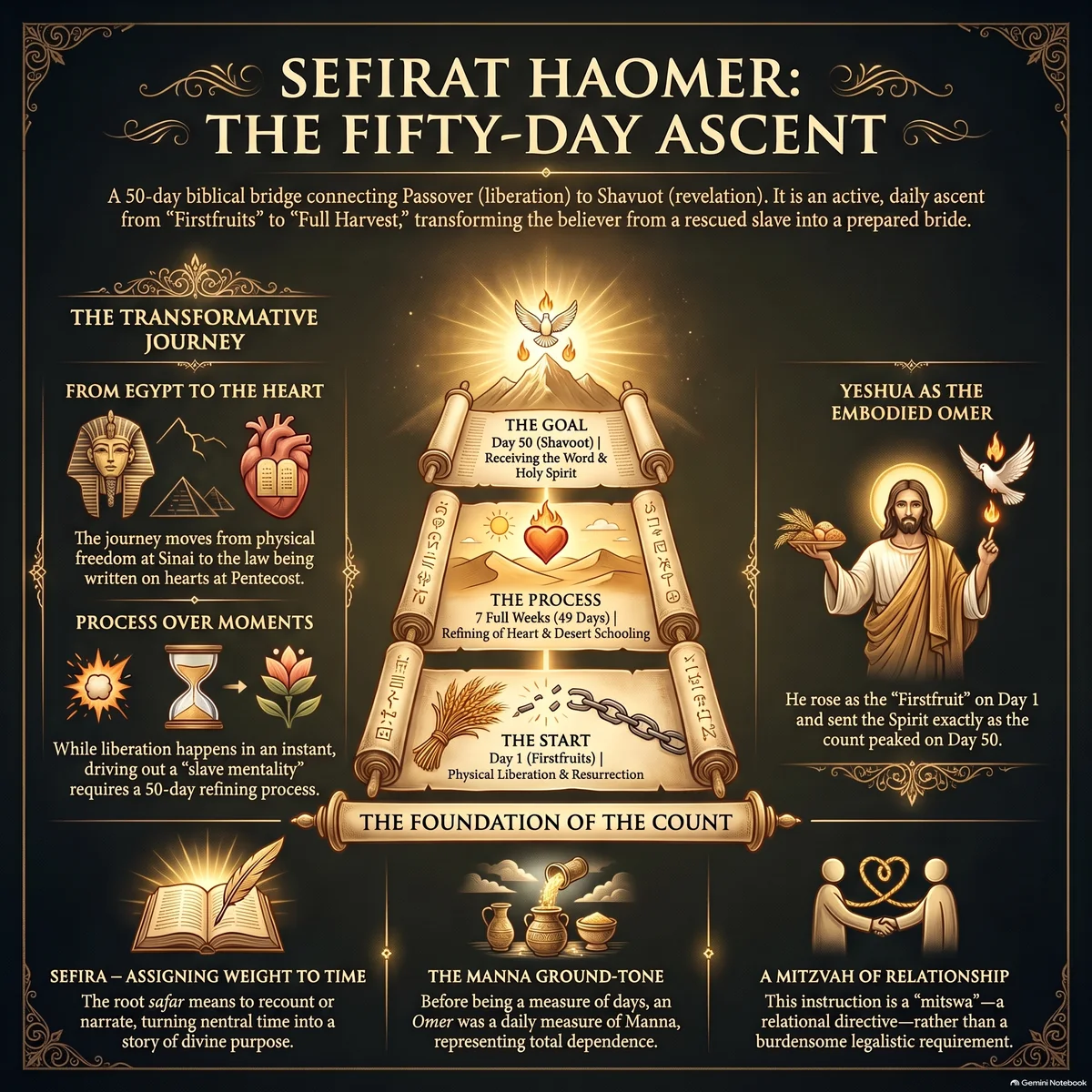
Leviticus 23:15 gives no countdown clock but a count-up instruction: "you shall count" — from the day after the Sabbath on which the omer of the wave offering was brought, seven full weeks, up to fifty days. Not passive waiting for a date, but a daily, spoken act that moves the Qahal from Bikkurim to Shavuot — from the first sheaf of barley to the baked bread of wheat.
This study lays bare the canonical ground of the Omer count (עֹמֶר, H6016; סָפַר, H5608): the manna ground-tone in Exodus 16, the daily counting mitzvah of Leviticus 23, and the road it opens between Torah, Prophets, and the Renewed Covenant. It marks precisely where canonical text gives way to Zadokite extra-biblical source material, and where Messianic typology becomes speculative — per Protocol VI.i.
After this study you will understand:- You know the canonical ground of the Omer count (Lev. 23:15–16; Deut. 16:9–10) and the distinction between sefira (the count) and the omer as a grain measure.
- You understand the manna ground-tone of the omer (Ex. 16:16) and how it carries the count of Leviticus 23: from daily provision to daily devotion.
- You recognize the Torah–Prophets–Renewed Covenant echo of the fifty days: from the wilderness journey to Sinai, through Ruth's harvest story, to the outpouring of the Spirit in Acts 2.
- You know the canonical distinction between what the Omer count itself is (Lev. 23:15–16) and what later Zadokite sources (Jubilees, the Temple Scroll) add to it — explicitly labeled, never as canonical ground.
- You recognize the Remez layer around John 20:26 (the appearance to Thomas "eight days later") and why it stands apart from the canonical fact itself.
- You distinguish the canonical counting mitzvah from the later rabbinic mourning tradition and from a personal, congregational counting liturgy.
- You know what the Monday morning after each Omer day concretely asks of your walk.
Read the four Scripture passages below slowly — preferably aloud. Before you read, ask yourself: what connects a daily measure of grain with a daily count of days?
The canonical textual ground
וּסְפַרְתֶּם לָכֶם מִמָּחֳרַת הַשַּׁבָּת מִיּוֹם הֲבִיאֲכֶם אֶת־עֹמֶר הַתְּנוּפָה שֶׁבַע שַׁבָּתוֹת תְּמִימֹת תִּהְיֶינָה׃ עַד מִמָּחֳרַת הַשַּׁבָּת הַשְּׁבִיעִת תִּסְפְּרוּ חֲמִשִּׁים יוֹם
"And you shall count from the day after the Sabbath, from the day that you brought the omer of the wave offering: seven full weeks shall there be. Until the day after the seventh Sabbath you shall count fifty days."
Leviticus 23:15–16 Canonical · H6016 · H5608The very first mention of "omer" in the Tanakh is not in Leviticus 23, but in the wilderness, at the manna: "Gather of it, every man according to his eating: an omer for every man" (Ex. 16:16). Before the omer becomes a unit for counting days, it is a daily food measure — exactly enough, no more and no less, given fresh each morning. Canonical · Ex. 16:16
This is the ground-tone that Leviticus 23 picks up: the Omer count is not an abstract calendar exercise but a continuation of the same rhythm — receiving each day what YHWH gives that day, and consciously counting it. Whoever counts the omer does, in the shape of days, what Israel did in the wilderness with grain: daily trust, not stockpiling ahead. Canonical · Ex. 16:16 · Lev. 23:15
Translation flag · "commandment" without explanation — Where popular-theological summaries speak of "the commandment of the Omer count," what stands here canonically is a mitzvah (Torah-direction, from tsavah H6680): a direction arising from relationship, not a legal burden under sanction. Per Protocol VI.ii.b, this study uses: the mitzvah of Leviticus 23:15–16. Translation Loss · VI.ii.b
The canonical ground is thus an explicit, time-bound mitzvah that begins with the waving of the omer — the day after the weekly Sabbath during the Feast of Unleavened Bread — and is kept, unbroken, for fifty days until Shavuot. In 2026 the waving of the omer falls on April 19; Shavuot on June 7. Canonical · Lev. 23:15–16 The full calculation — why the count begins on this exact day, and why Shavuot never shifts on the Zadok Calendar — is worked out in The Zadok Calendar; this study does not repeat that mechanics but builds on it.
The 15th of the third month — Jubilees, not the Tanakh. The book of Jubilees (ch. 6) links the covenant with Noah, and the Sinai covenant itself, to the same date: the 15th day of the third month — the day on which the Omer count lands on the Zadok Calendar. Jubilees is pseudepigraphal Second Temple material, not included in the Tanakh or the New Testament. Extra-Biblical comparative material · Jubilees 6, non-canonical
The Qumran Temple Scroll. That same Zadokite tradition (11QT, the Temple Scroll) extends the 7×7+1 pattern of the Omer to two further fifty-day counts — for New Wine and Fresh Oil. This too is a sectarian Qumran document, not a canonical or rabbinic source. Extra-Biblical comparative material · Temple Scroll (11QT), non-canonical
Devar Emet cites both sources solely as historical illustration of how the Zadokite priests developed the Omer count further — never as support for a Biblical concept, per the same source treatment used in The Zadok Calendar and Yom Teruah.
A golden thread through Torah, Prophets, and Renewed Covenant
The Omer count is not an isolated ritual but a pattern that sounds through the whole of Scripture: fifty days as the road from liberation to covenant, from the first sheaf to the full harvest.
At Pesach Israel was physically freed from Egypt; in the third month the people arrived at Mount Sinai to receive the Torah (Ex. 19:1). That the intervening period spanned exactly fifty days — paralleling the later Omer count — is not fixed by a number in Exodus itself; the precise link of this dating to the Omer count is a rabbinic calculation. Rabbinic-Traditional · b. Shabbat 86b — traditional, not canonical as an anchor text What does stand canonically is the direction of movement itself: first the exodus, then a period of testing and formation, then covenant-making. Canonical · Ex. 12; 19:1
Jeremiah reminds YHWH's people of "the love of your betrothal, when you went after Me in the wilderness" (Jer. 2:2). The period between liberation and covenant-making is, in the Prophets, no empty waiting time but a time of readying oneself — the bride preparing for her wedding to YHWH. Canonical · Jer. 2:2
The book of Ruth unfolds during the barley and wheat harvest — precisely the period the Omer count spans. The meeting between Boaz and Ruth takes place "to the end of barley harvest and of wheat harvest" (Ruth 2:23). Where Leviticus 23 prescribes the count, Ruth shows what it looks like in an actual human life: faithfulness, kinsman-redemption, and providence, all unfolding within these exact fifty days. Canonical · Ruth 2:23
The same structure of seven full cycles plus one — 7×7 days to the fiftieth — returns at the level of years in the jubilee: "Seven sabbaths of years you shall count" — "seven times seven years" (Lev. 25:8), to the fiftieth year of release. The Omer count is the yearly pattern of this larger rhythm in miniature. The full development of this connection is laid out in Shavuot — Connection I; this study names it only briefly, as confirmation that 7×7+1 is no accidental sum but a recurring Biblical design. Canonical · Lev. 25:8
After the resurrection Yeshua appeared to His disciples over forty days (Acts 1:3) and instructed them to wait for the promise. On the fiftieth day — exactly as the Omer count was completed, on Shavuot — the Holy Spirit was poured out (Acts 2:1–4). What at Sinai was written on tablets of stone was now engraved on hearts (Jer. 31:33). Canonical · Acts 1:3 · Acts 2:1–4 · Jer. 31:33
James draws the same picture with a single word: believers are "a kind of firstfruits of His creatures" (Jas. 1:18) — the same bikkurim language that opens the Omer count, now applied to the assembly itself. Canonical · Jas. 1:18
Yeshua — not a spectator, but the embodiment of every day
Yeshua rose from the dead on the Feast of Firstfruits — the day the very first sheaf of barley was waved in the Temple. Paul confirms this directly: "But now is Christ risen from the dead, and become the firstfruits of them that slept" (1 Cor. 15:20, 23). Canonical · 1 Cor. 15:20, 23
John records precisely: "eight days later" the disciples were gathered again, and this time Thomas was with them; Yeshua appeared again and showed him His wounds (Jn. 20:26). Counted from the resurrection as Omer day 1, this falls around the eighth day of the count. This timing itself is canonical. Canonical · Jn. 20:26
A typological reading of "eight days": Leviticus 12 states that after the birth of a son a mother is unclean for seven days, that circumcision takes place on the eighth day, and that she then remains a further thirty-three days in purification — forty days in total until she may approach the holy things again (Lev. 12:2–4). Some read a typological parallel here: Yeshua, "Firstborn from the dead," appears on the eighth day "with wounds" to Thomas, and after forty days (Acts 1:3) enters heavenly fellowship at His ascension.
This is a legitimate Remez layer — the numbers eight and forty stand canonically fixed in both passages separately — but the link between the two texts is nowhere made explicit in Scripture. This study therefore presents it as a typological suggestion, not as a settled identification. Remez-Speculative · typological parallel, not a textual identification
During the forty days between His resurrection and ascension, Yeshua taught His disciples about the things of the Kingdom and opened their understanding of the Scriptures (Lk. 24:45). He walked the Omer period Himself, not as a spectator but as a teacher forming His disciples within the exact span of time the count describes. Canonical · Lk. 24:45 · Acts 1:3
Yeshua promised to send the Comforter. Through His offering and ascension, the Spirit could be poured out on the fiftieth day (Acts 2:1–4). Thus Yeshua embodies the full Omer: from death (Pesach), through the process of transformation (the count), to fulfillment with Spirit and power (Shavuot). Canonical · Acts 2:1–4
Four misunderstandings that weaken the count
The popular-theological reading: the Omer count is passively waiting for Shavuot to begin, like counting down to a vacation.
The Scriptural contrast: Sefirat HaOmer is active upward counting — day 1, day 2, up to day 49 (or 50, see below). Each day builds on the previous and adds value; it is not a countdown to zero but a build-up to fullness. Canonical · Lev. 23:15
The popular-theological reading: counting the days is a formula for earning favor with God.
The Scriptural contrast: the Omer count is a mitzvah — a Torah-direction arising from relationship, not a performance system. It is a rhythm given by YHWH to attune the heart to His agenda, carried by the same daily dependence the manna already taught (Ex. 16:16). Canonical · Ex. 16:16
The assumption: the Omer period is originally a time of mourning, with restrictions on weddings, music, and celebration.
The Scriptural contrast: in Leviticus 23 and Deuteronomy 16 the Omer count is rooted in gratitude for the harvest and longing for covenant-making — no mourning motif whatsoever stands in the canonical text. Canonical · Lev. 23:15–16 · Deut. 16:9–10
The mourning tradition is a later, rabbinic addition: the Talmud links part of the Omer period to the death of twenty-four thousand disciples of Rabbi Akiva through a plague. Rabbinic-Traditional · b. Yevamot 62b Useful as historical background, but not as the Biblical foundation of the count itself.
The assumption: Shavuot (Pentecost) is a stand-alone, New Testament feast day, detached from Pesach and the intervening count.
The Scriptural contrast: Pentēkostē is simply the Greek rendering of "the fiftieth day" — without the Omer count, the preparatory road from liberation to fulfillment is missing. The apostles in Acts 2 gathered to celebrate Shavuot as Torah-observant Jews, not to institute a new religious act. Canonical · Acts 2:1
Connection I — My days carry eternal weight
"Teach us to number our days, that we may apply our hearts unto wisdom" (Ps. 90:12) — the same safar root as in Leviticus 23:15. The Omer count makes concrete what the psalmist prays: becoming aware of the daily walk with God, rather than letting days pass by uncounted. Canonical · Ps. 90:12
Connection II — Process over moments
Being freed from sin happens in an instant; driving an "Egyptian mindset" out of the heart takes time. Moses confirms this explicitly regarding the wilderness period: "Remember all the way which YHWH your God led you these forty years in the wilderness, to humble you, and to prove you, to know what was in your heart" (Deut. 8:2–3). The fifty days of the Omer teach the same principle in miniature: transformation is a process of growth and refining, not a single moment. Canonical · Deut. 8:2–3
Connection III — Dependence on the Lord of the Harvest
Just as the Israelite watched the ripening of the grain day by day, the Omer anchors the awareness that daily bread, spiritual growth, and rain are entirely dependent on YHWH. This connects directly to the manna ground-tone from The Ground: an omer per head, given fresh each morning (Ex. 16:16) — never to be stockpiled ahead, always to be received anew. Canonical · Ex. 16:16
Questions for reflection
Questions for personal reflection or gathering
- Do you count your days only on the calendar, or do you consciously give each day meaning for the King?
- After your liberation from sin (Pesach), have you stood still, or do you actively walk the fifty days on the way to being filled with the Holy Spirit?
- What "old leaven" or slave mindset still needs to be purged from your life during this counting time?
- The omer was first a daily measure of manna, only afterward a count of days. Where in your life do you try to stockpile ahead, instead of receiving daily?
- If someone asked you tomorrow what the Omer count is, what would you say in one sentence?
The speakable testimony
Speakable faith — for when it is asked
"The Omer count is the fifty-day journey between liberation and destiny. Think of a prisoner who is set free: the door stands open, but he still has to learn how to live as a free man. YHWH gives fifty days of active preparation in which every day counts, to ready the heart for His Word and His Spirit. Yeshua is the Firstfruit within it: He rose at the beginning of the count and poured out His Spirit at its end."
Practice — speaking the count aloud
The tradition of counting aloud (Sefirat HaOmer) is rabbinic-liturgical, not canonically prescribed — Leviticus 23 says that counting must happen, not how to speak it aloud. Below is an abbreviated example of three counting moments from a full fifty-day sequence, with a common blessing formula. Both are explicitly labeled here as a practice example, not as canonical text. Rabbinic-Traditional / own congregational application
A canonical note on the fiftieth day: Leviticus 23:16 says "until the day after the seventh Sabbath you shall count fifty days" — the text itself therefore does not rule out counting the fiftieth day as well, even though common rabbinic practice usually counts through day 49. Canonical · Lev. 23:16
Anyone wishing to speak a personal blessing over the count would do well to recognize that every bracha form — even a Messianically adapted one — is a devotional addition, not a Biblical text. It is welcome as a personal or congregational practice, provided it is clearly distinguished from the canonical mitzvah itself. Popular-Theological · own liturgical application