Four times a year, the earth turns through an invisible gate: the hinge-point where one season gives way to the next. The Tanakh has its own word for this — tekufah — and uses it not by accident, but at key moments: at the feast of the harvest (Exod. 34:22), at the temple's rebuilding (2 Chr. 24:23), and in the most poetic description of the sun's path Scripture contains (Ps. 19:5–7).
This study lays bare the canonical ground of the tekufah — and strengthens that ground considerably compared to source material that often leans heavily on Enoch and Jubilees. The Tanakh itself already contains enough direct material to firmly ground the tekufah, without needing extra-biblical texts as its first line of evidence. Where Enoch/Jubilees do add something — the link to Noah, the name "Tekufot" as a fixed calendar term — this is explicitly labeled extra-biblical, per Protocol VI.i.
After this study you understand:- You know the canonical ground of tekufah (H8622) in Exodus 34:22, 2 Chronicles 24:23, and Psalm 19:5–7 — before any reference to Enoch or Jubilees.
- You understand the difference between what Genesis 8:22 canonically says about the seasons, and what Jubilees adds to it later.
- You can place the four tekufah moments within the quarterly structure of the Zadok Calendar, and why they always fall on Wednesday.
- You see the difference between an ordinary Rosh Chodesh and a tekufah-Rosh Chodesh — and why the seventh-month tekufah has a dual role.
- You know what the rhythm of the seasonal gates concretely means for your walk.
Read the four Scripture passages below slowly — preferably aloud. Before reading, ask yourself: what connects these texts? What pattern do they repeat?
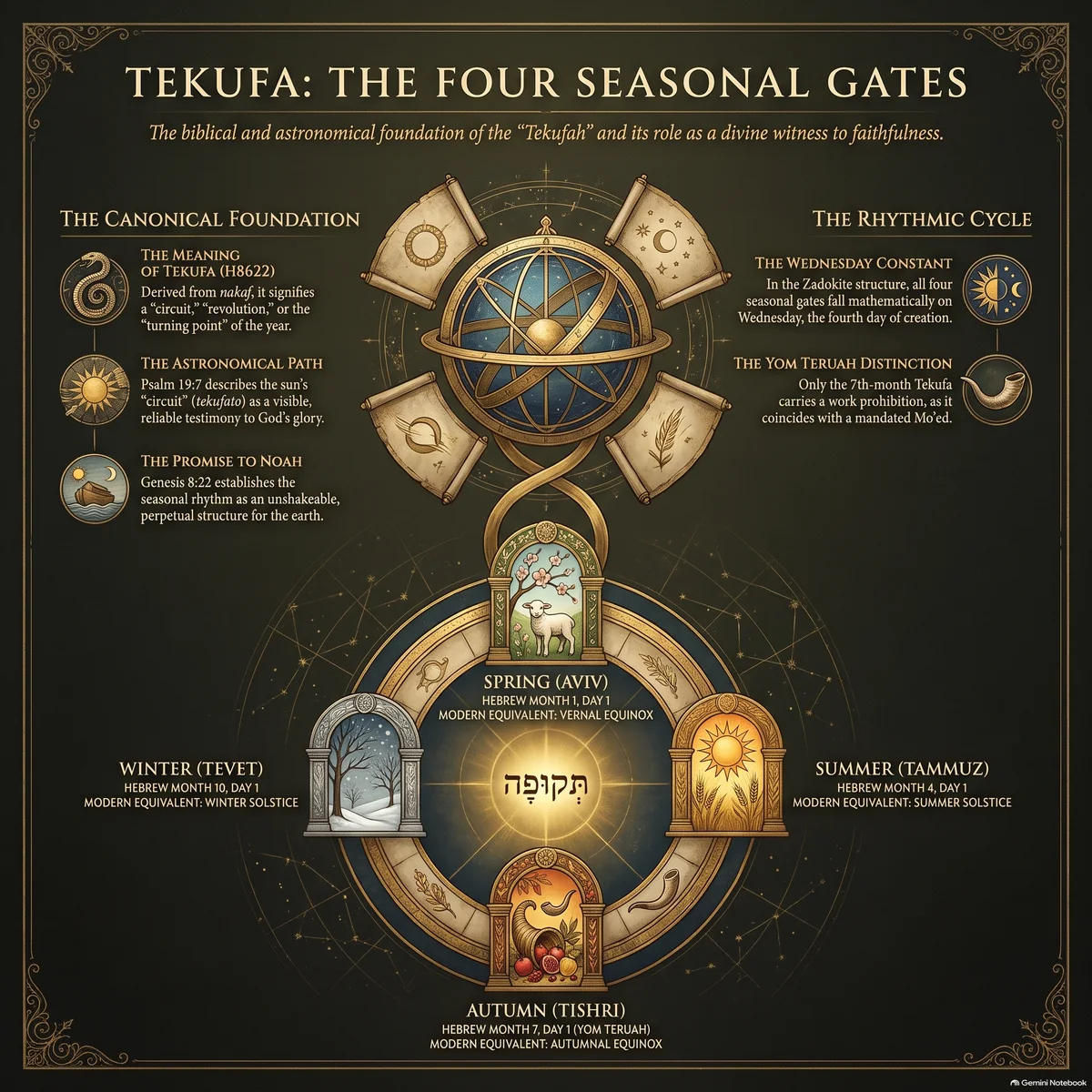
The canonical text ground — the word itself, not just the system
וְחַג שָׁבֻעֹת תַּעֲשֶׂה לְךָ בִּכּוּרֵי קְצִיר חִטִּים וְחַג הָאָסִיף תְּקוּפַת הַשָּׁנָה
"You shall also observe the Feast of Weeks for yourself, at the firstfruits of the wheat harvest, and the Feast of Ingathering, at the turn [tekufah] of the year."
Exodus 34:22 Canonical · H8622וּמִקְצֵה הַשָּׁמַיִם מוֹצָאוֹ וּתְקוּפָתוֹ עַל־קְצוֹתָם וְאֵין נִסְתָּר מֵחַמָּתוֹ
"From one end of the heavens is its rising, and its circuit [tekufato] to the other end of them; and nothing is hidden from its heat."
Psalm 19:7 Canonical · H8622This is the canonical heart of the study: the tekufah is literally the path the sun itself travels — David sings of it in the same psalm in which the heavens declare God's glory (Ps. 19:2). The word is thus primarily an observable, astronomical fact that Scripture itself uses, not a technical term invented only in later writings. Canonical · Ps. 19:2, 7
Four moments, one word
Within the Zadok Calendar structure (see The Zadok Calendar), the four quarterly transitions — each time the first day of month 1, 4, 7, and 10 — coincide with the four seasonal gates: spring, summer, autumn, winter. Because every quarter counts exactly 91 days (13 weeks), these four days mathematically always fall on the same weekday: Wednesday, the fourth day of creation. Canonical · Gen. 1:14 · Lev. 23 (arithmetic, see zadok-calendar.html)
Day 1 of month 1
Nisan/Aviv
Day 1 of month 4
Tammuz
Day 1 of month 7
Tishri — Yom Teruah
Day 1 of month 10
Tevet
The Tanakh itself does not explicitly call the tekufah a "moed" (appointed time) — Genesis 1:14 does give the luminaries that general function ("for signs and for appointed times"), but does not name-apply that word to the four seasonal gates specifically. That the tekufot fall under that general creation mandate is a warranted inference — not a direct quotation.
The promise to Noah: seasons that will not cease
"While the earth remains, seedtime and harvest, cold and heat, summer and winter, and day and night shall not cease."
Genesis 8:22 CanonicalRight after the flood, YHWH anchors the rhythm of the seasons as a lasting, guaranteed structure — not a one-time creation that could fall away, but a fixed promise carrying the rest of earth's history. Jeremiah later takes this up as the strongest image of unshakability he knows: just as it is impossible to break YHWH's covenant with day and night, so it is impossible to break His covenant with David and the Levites (Jer. 33:20, 25). Canonical · Gen. 8:22 · Jer. 33:20, 25
2 Chronicles 24:23 explicitly dates the Aramean army's attack on Judah "at the turn of the year" (tekufat hashanah) — the same word as in Exodus 34:22, now used as an ordinary, everyday dating device in historiography. This confirms that tekufah was no exotic concept, but a recognizable benchmark in Israel's day-to-day year-reckoning. Canonical · 2 Chr. 24:23
Enoch and Jubilees — the four tekufot as fixed memorial days, and the link to Noah: the book of Enoch (Astronomical Book, Enoch 72–82) and the book of Jubilees (6:23–38) elaborate the concept heavily into four explicitly named, yearly memorial days ("Tekufot"), and link their institution directly to Noah after the flood as a sign of the covenant from Genesis 8:22. Neither book is part of the canonical Tanakh. Genesis 8:22 itself says nothing about four specific memorial days or about an instruction to Noah to observe them — that is the elaboration of Enoch/Jubilees, not of Scripture. Devar Emet cites this material solely as historical confirmation of how later priestly groups (including the Qumran community) understood the tekufot — never as canonical grounding itself.
What the tekufah pictures
Psalm 19 first sings of the tekufah of the sun (v. 2–7) and moves without transition to the perfection of the Torah (v. 8–11) — the same psalm links the reliable, cyclical order of the heavens to the reliable, unchanging order of God's word. Malachi picks up this same image for the Messiah: the "Sun of Righteousness, with healing in His wings" (Mal. 4:2). The canonical basis (Ps. 19; Mal. 4:2) stands firm; the specific link to the Zadok Calendar's four tekufot is homiletical application. Canonical · Ps. 19:2–11 · Mal. 4:2 Remez · application to the tekufot
Just as Jeremiah mirrors the covenant with David against the covenant with day and night (Jer. 33:20, 25), so Yeshua's faithfulness is not subject to changing circumstances. Every tekufah is a reminder: the seasons change, the foundations do not. Canonical · Jer. 33:20, 25 (application)
Two misunderstandings that distort the tekufah
The popular-theological reading: a tekufah day carries, like Shabbat or Yom Kippur, a prohibition on work.
The Scriptural contrast: no canonical text imposes a rest obligation on the tekufah. The only tekufah moment with a prohibition on work is the seventh-month tekufah — but that is because that day is also Yom Teruah (a genuine moed from Lev. 23), not because tekufah itself requires rest. The other three tekufot (month 1, 4, 10) remain ordinary working days, just like the regular Rosh Chodesh. Canonical · contrast Lev. 23:23–25 against the other tekufot
The popular-theological reading (sometimes voiced as criticism): attention to solstices and equinoxes resembles astrology or nature worship.
The Scriptural contrast: Psalm 19 places the tekufah of the sun explicitly under God's rule — "the heavens declare the glory of God" (Ps. 19:2) — and the sun itself is not worshiped but sung about as God's handiwork. The same distinction already made at Rosh Chodesh (see Rosh Chodesh) applies here: marking time is not worshiping a celestial body. Canonical · Ps. 19:2 · Deut. 4:19
Connection I — The tekufah as hinge-point in the Zadok Calendar
Every quarter of the Zadok Calendar counts exactly 91 days (30+30+31), and thus exactly 13 weeks. Because every quarter is the same length, each tekufah day is mathematically guaranteed to fall on the same weekday as the previous one: Wednesday. The four tekufot thus form the fixed hinge-points on which the entire yearly structure turns. Canonical · Gen. 1:14 · Lev. 23 (arithmetic)
Connection II — Tekufah-Rosh Chodesh versus ordinary Rosh Chodesh
Not every Rosh Chodesh is a tekufah. Of the twelve new moons, only four (month 1, 4, 7, 10) carry the extra weight of a seasonal gate.
| Type of day | Is it a tekufah? | Prohibition on work? | Character |
|---|---|---|---|
| Shabbat (Saturday) | No | Yes — strict prohibition | Weekly day of rest |
| Great feast days (1st day Pesach, Yom Kippur, 1st day Sukkot) | No | Yes — no servile work | Holy convocation (mikra kodesh) |
| Rosh Chodesh (month 2, 3, 5, 6, 8, 9, 11, 12) | No | No | Monthly renewal and offerings |
| Tekufah-Rosh Chodesh (month 1, 4, 10) | Yes | No | Seasonal memorial of creation |
| Tekufah-Rosh Chodesh (month 7) = Yom Teruah | Yes | Yes — dual role | Seasonal gate and moed at once |
This dual role of the seventh month is precisely what Yom Teruah — The Wake-Up Call of the King works out: that study treats the canonical, festal side of this one day; this study treats the underlying seasonal gate it happens — or perhaps does not merely happen — to coincide with. Canonical · Lev. 23:23–25
Questions for reflection
Questions for personal reflection or fellowship
- Psalm 19 links the sun's path (tekufah) directly to the perfection of the Torah. Do I ever see the fixed order of nature as a testimony to God's reliability, or does it pass me by?
- Jeremiah uses the unshakable seasonal cycle as the strongest image he knows for God's faithfulness. In what area of my life could that image encourage me today?
- Not every Rosh Chodesh is a tekufah, and not every tekufah is a day of rest. What does that distinction teach me about reading carefully what Scripture does and does not say?
The speakable testimony
Speakable faith — for when it is asked
"The tekufah reminds me that change and faithfulness are not opposites. Four times a year the earth turns through a seasonal gate — and it is precisely that shifting rhythm Scripture uses as the image for God's unshakable covenant. My circumstances change with the seasons; His faithfulness does not."