Shoftim (from the root shafat, "to judge, to direct") are those who render judgment; shotrim (from a root suggesting "to write, to order") are the enforcers who make that judgment actionable. The parasha opens with the command to appoint both offices "in all your gates" — justice is not the business of a distant capital but of every local community.
Where Re'eh stressed worship at the chosen place (Ham-Makom) and the sanctification of personal life, Shoftim maps out Israel's four structures of authority: the judge, the king, the priest, and the prophet.
Scope and framework: the parasha unfolds in five clear movements: judges and officers (Deut. 16:18–17:13) — the appointment of impartial judges in every gate, the absolute prohibition on bribery, and the institution of the high court for difficult cases; the kingship law (Deut. 17:14-20) — the criteria for a future king and the requirement to write his own Torah scroll; priests and Levites (Deut. 18:1-8) — the priesthood's inheritance and the Levite's right to serve at the central place; occultism versus the promised Prophet (Deut. 18:9-22) — the prohibition of divination and sorcery, followed by the prophetic promise of a Prophet "like Moses"; and the law of warfare and the unsolved murder (Deut. 19:1–21:9) — cities of refuge for the manslayer, the rule of two or three witnesses, the rules of warfare, and the Eglah Arufah ceremony.
The connection to the preceding parasha is direct. Re'eh ended at Ham-Makom and the three pilgrimage feasts — the place and rhythm of communal worship. Shoftim builds on this: now that worship is ordered, the question turns to how society itself is ordered around it — with judges who cannot be bribed, a king who does not exalt himself, and a people who seek guidance from YHWH and His Prophet rather than from occult practices.
Note: as the fourth of the Shiv'ah d'Nechemta (Seven Shabbats of Comfort) Rabbinic/Traditional the reading comes from Isaiah 51 and 52 — a divine word to the afflicted city of Zion.
"I, I am He who comforts you. Who are you that you should be afraid of a man who dies, of a son of man who is made like grass... Awake, awake, put on your strength, O Zion!" — Isaiah 51:12, 52:1 (paraphrase)
"How beautiful upon the mountains are the feet of him who brings good news, who publishes peace, who brings good news of happiness, who publishes salvation, who says to Zion, 'Your God reigns!'" — Isaiah 52:7
Remez — canonical connection: Shoftim commands human judges and kings to render justice without partiality and warns against fear of powerful enemies in warfare (Deut. 20:1). The haftara connects seamlessly: Israel need not fear human tyrants, for YHWH Himself is the highest Judge and the ultimate King who redeems His people and secures justice.
"YHWH your God will raise up for you a Prophet like me from among you, from your brothers — it is to Him you shall listen." — Deuteronomy 18:15
How offices are obtained — the question put to the Baptist
Shoftim draws a sharp distinction in how each authority-bearer comes to their position. A judge is chosen by the community itself — one looks among one's own people for who is wise enough to render judgment (Deut. 16:18; cf. Ex. 18:21). A Levite is not chosen but born into the office (Deut. 18:1-8). A prophet is appointed by no one; he is anointed and sent by YHWH — and often precisely to confront the existing leadership with its failures (Deut. 18:15-22). And the king, finally, is chosen by YHWH, not in the first place by the people (Deut. 17:15).
This taxonomy explains the precise sequence of questions the envoys from Jerusalem put to John the Baptist: "Are you the Messiah? Are you Elijah? Are you the Prophet?" (John 1:19-21). They are deliberately working through the recognized categories of spiritual authority within Israel. John fits none of them, and identifies himself only as "the voice" of Isaiah 40:3 — not an office, but an announcement.
Canonical That question about Elijah is not asked out of nowhere. John's clothing — "a garment of camel's hair and a leather belt around his waist" (Matt. 3:4; Mark 1:6) — is a deliberate echo of the description of Elijah himself: when the king of Israel asked his messengers what the man who met them looked like, they answered, "a hairy man, with a leather belt around his waist," and the king immediately concluded: "This is Elijah the Tishbite" (2 Kings 1:8). Yeshua Himself later confirms this typology directly: "he is Elijah who is to come" (Matt. 11:14; cf. 17:12).
Rabbinic/Traditional Why Elijah specifically is asked about relates to Malachi's promise that Elijah would come before the great and awesome day of YHWH, to turn the hearts of fathers and children toward each other (Mal. 4:5-6). This expectation lives on within Judaism to this day, visible among other things in the custom of setting aside a separate cup for Elijah at the Passover seder (Kos Eliyahu) — in the hope that he will appear as a sign that the greater redemption has begun.
In the footsteps of Moses
When John the Baptist baptizes in the Jordan, envoys from Jerusalem ask him directly: "Are you the Prophet?" (John 1:21) — a direct reference to Deuteronomy 18:15. Later, on seeing Yeshua's miracles, the crowds exclaim: "This is truly the Prophet who is to come into the world" (John 6:14; cf. Acts 3:22-23).
The water-libation ceremony at the Feast of Tabernacles
Rabbinic/Traditional During the Feast of Tabernacles (Sukkot), the water-libation ceremony (Nisukh HaMayim, Mishnah Sukkah 4-5) formed the high point of temple service: water drawn from the Pool of Siloam was poured out on the altar together with wine, while the leaders of Israel looked on. The name Siloam (שִׁלֹחַ, Shiloach) means "Sent" — the text itself confirms this (John 9:7).
Precisely within that setting, on the last, great day of the feast, Yeshua stands up and cries out:
"If anyone thirsts, let him come to Me and drink. Whoever believes in Me, as the Scripture has said, out of his heart will flow rivers of living water." — John 7:37-38
Yeshua identifies Himself with the very heart of the ceremony. This declaration finds a striking echo at His crucifixion, when a soldier pierces His side: "and at once there came out blood and water" (John 19:34) — John explicitly records this as an eyewitness (John 19:35). What was ceremonially enacted at the Feast of Tabernacles is here truly fulfilled.
"Is the Christ to come from Galilee? Has not the Scripture said that the Christ comes from the offspring of David... So there was a division among the people over Him." — John 7:41-43 (paraphrase)
The division over Yeshua in John 7:40-52 mirrors the tension Shoftim itself names: how does one tell a true prophet from a false one? The Sanhedrin — itself the highest judicial body, instituted on the pattern of Deuteronomy 17:8-13 — fails precisely at examining the facts before it judges (John 7:51), violating the very principle of fair judgment that Shoftim establishes.
The transfiguration on the mountain — confirmation of the Prophet
The clearest canonical confirmation that Yeshua is the Prophet of Deuteronomy 18:15 comes at the transfiguration. Moses and Elijah — Torah and the Prophets in person — appear beside Yeshua and speak with Him, then vanish, leaving only the voice of the Father:
"This is My beloved Son, with whom I am well pleased; listen to Him!" — Matthew 17:5 (cf. Mark 9:7; Luke 9:35)
The command "listen to Him" repeats, word for word, the phrasing of Deuteronomy 18:15 ("it is to Him you shall listen"). As Moses and Elijah vanish and only Yeshua remains, it becomes visible that He is not merely a prophet alongside Moses, but the Prophet who fulfils and takes up Moses' own role.
Two or three witnesses
The Torah-standard of Deuteronomy 19:15 is applied directly by Yeshua and Paul within congregational discipline and legal process:
"Every charge must be established by the testimony of two or three witnesses." — Deuteronomy 19:15
Yeshua applies this standard to congregational correction (Matt. 18:16), Paul to his own apostolic visit to Corinth (2 Cor. 13:1), and to handling a complaint against an elder (1 Tim. 5:19) — each time the same protection against reckless accusation already found in Deuteronomy 19.
Parasha Shoftim shows that a holy society stands or falls with a pure system of justice and with servant leadership. Judges, kings, priests, and prophets all stand under the authority of the Torah. Justice cannot be a merely passive ideal — it must be actively pursued (tzedek tirdef), so that the land is not defiled by innocent blood or corruption.
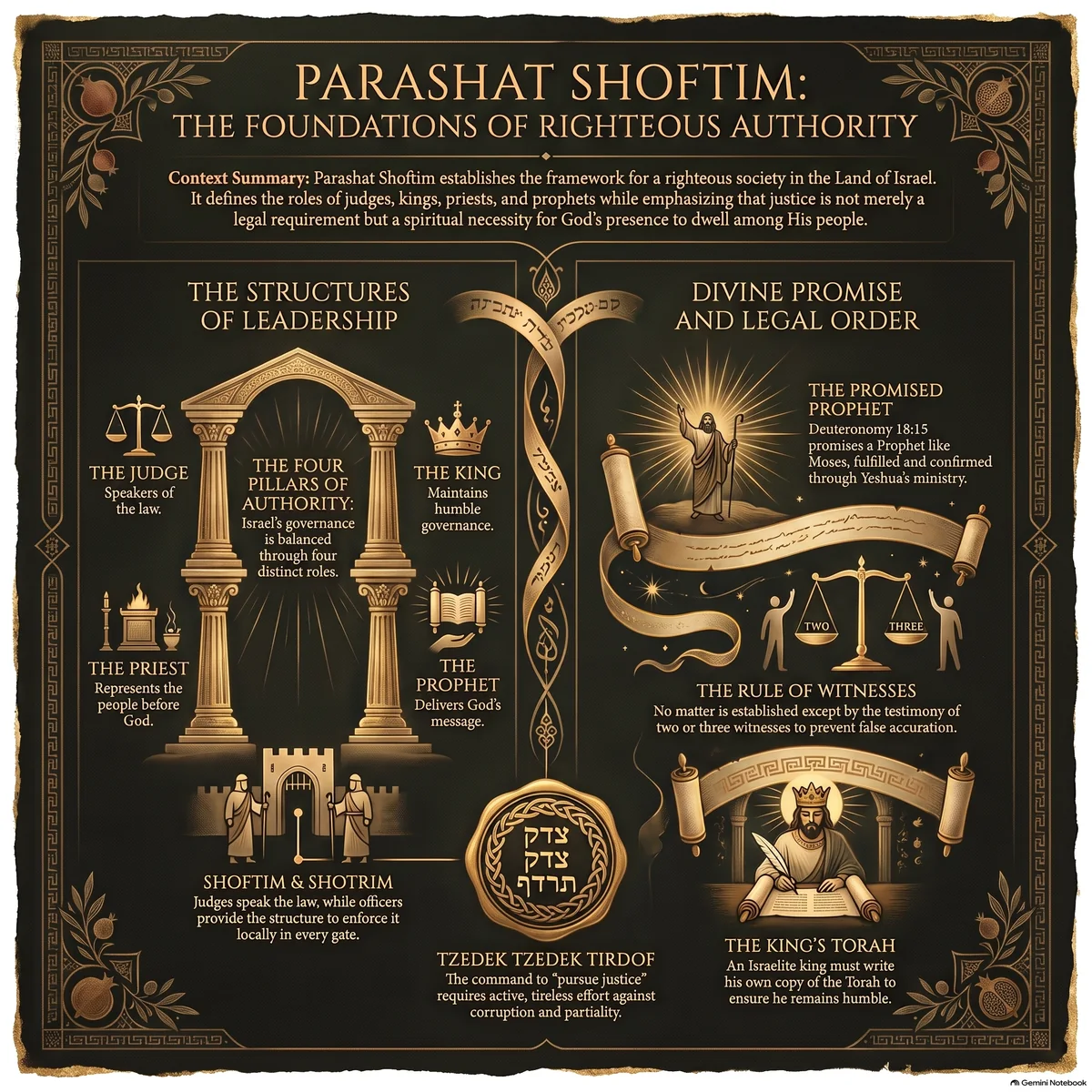
Every layer of this parasha returns to the same axis: authority that places itself under the Torah rather than above it. The judge may not accept a bribe (section A); the king must not exalt himself above his brothers (section B); the people seek guidance not through occult detours but through the Prophet YHWH appoints (section C); no one is condemned on a single voice (section D); the army does not trust in its own strength or numbers (section E); and even at an unsolved crime, the community takes up its responsibility (section F).
This structure is not bureaucracy for its own sake, but the condition under which YHWH can remain dwelling in the midst of His people. Injustice, corruption, and innocent blood defile the land itself (cf. Num. 35:33-34) — doing justice is therefore never merely a social virtue, but a condition for YHWH's continued Presence among His people.
Unlike the surrounding nations, where the king stood above the law and was worshipped as a demigod, in Israel every office — judge, king, priest, prophet — is explicitly placed under the Torah as well. Authority in Israel is never autonomous authority; it derives its validity solely from submission to the same Torah-instructions that bind everyone else (cf. VI.ii.b — mitswot as directions arising from relationship, not juridical arbitrariness).
A — Word study: Tzedek Tzedek Tirdof (צֶדֶק צֶדֶק תִּרְדֹּף) — the double justice
The repetition raises the question: why does tzedek appear twice? Pshat: for emphasis by repetition — justice holds the highest priority in the community. Rabbinic/Traditional Rashi on Deut. 16:20 and Talmud Sanhedrin 32b read it as: justice must be pursued by just means — a good end never sanctifies an unjust means. Drash: the first tzedek concerns a just verdict for the plaintiff, the second a just treatment of the defendant.
→ Further study: Torah — Instruction of the Father — justice as an expression of the Torah, not an autonomous virtue
B — The kingship law: the king under the Torah (Deut. 17:14-20)
Unlike the surrounding nations, Israel places a constitutional limit on royal power. Three prohibitions (Deut. 17:16-17): not acquiring many horses (prevents military imperialism and a return to Egypt); not taking many wives (prevents diplomatic idolatry and a heart turned away); not accumulating much silver and gold (prevents economic exploitation and greed).
"When he sits on the throne of his kingdom, he shall write for himself in a book a copy of this law... It shall be with him, and he shall read in it all the days of his life, that he may learn to fear YHWH his God... that his heart may not be lifted up above his brothers." — Deuteronomy 17:18-20 (paraphrase)
As soon as the king takes the throne, he must write his own Torah scroll — Rabbinic/Traditional called Mishneh ha-Torah in rabbinic tradition — under the oversight of the Levitical priests (cf. Deut. 17:18; 31:9). He must read it daily, all his life, so that his heart does not exalt itself above his brothers. Psalm 110 and Jeremiah 33 ultimately join this kingship with the priesthood in one Person — the Messiah as King in the pattern of David and Priest in the pattern of Pinchas/Levi.
Rabbinic/Traditional The Talmud (b. Sanhedrin 21b) derives from the word mishneh in "a copy (mishneh) of this Torah" (Deut. 17:18) that the king must write not one but two Torah scrolls: one that accompanies him wherever he goes, and one kept for him in his treasury (b. Sanhedrin 21b). The scroll in the treasury is the fixed, unchanging foundation; the scroll the king carries with him is that same Torah, applied to every situation he encounters along the way. The distinction is not a contradiction — it is the same Torah, once kept and once practiced.
Canonical The Torah also sets a boundary that carries the later Messianic line: the king must be appointed "from among your brothers" — "you may not set a foreigner over you, who is not your brother" (Deut. 17:15). Israel's true kingship does not come from outside but from within the nation itself — a provision directly connected to the promise that the Messiah would arise from the house of David (2 Sam. 7:12-16; Ps. 110). Isaiah describes this future King not as a merely political ruler, but as One whose reign is marked by mishpat (judgment) and tzedek (righteousness): "with righteousness he shall judge the poor" (Isa. 11:4) — the same tzedek this parasha requires of every judge in Israel's gates, fully embodied in the coming King.
→ Further study: King of Israel
C — No spiritism, but the living Prophet (Deut. 18:9-22)
The nations of Canaan sought guidance through occult practices: child sacrifice, divination, sorcery, and consulting the dead (Deut. 18:10-11). YHWH calls these practices an abomination (to'evah).
The divine alternative: Israel needs no occult media to know YHWH's will. YHWH promises to raise up a Prophet from their midst. A true prophet speaks only what YHWH commands; what he speaks in YHWH's Name comes to pass. If a prophet speaks in the name of other gods, or speaks what does not come true, he is a false prophet (Deut. 18:20-22) — the same test (content and fulfilment, not impression) that recurs elsewhere in Scripture when testing the spirits.
→ Further study: Messianic Prophecies — Canonical Signs — the same test applied to the Messianic prophecies
D — The cities of refuge and the standard of witnesses (Deut. 19:1-21)
Three cities west of the Jordan (alongside three in the Transjordan) offer protection to anyone who accidentally kills a neighbor — for instance, if an axe-head slips loose from its handle. Innocent blood must not be shed.
One witness is not sufficient to convict; at least two or three witnesses are required. If someone gives false testimony to harm a brother, the judge must impose on him exactly the punishment he intended for his brother:
"Your eye shall not pity: life for life, eye for eye, tooth for tooth, hand for hand, foot for foot." — Deuteronomy 19:21
Rabbinic/Traditional The Talmud (Bava Kamma 83b-84a) does not read this formula as literal, reciprocal mutilation, but as the standard for proportional monetary compensation. The function of the text is not to encourage revenge but to bound it: the penalty may never exceed the harm done — exactly as the context itself indicates, aimed against arbitrary vengefulness in cases of false testimony.
→ Further study: Parasha Mas'ei — The Journey to the City of Refuge — the cities of refuge explored · Two Witnesses — Torah and Prophets — the canonical witness-principle deepened
E — The law of warfare and military exemptions (Deut. 20:1-20)
Before Israel goes to war, the priest addresses the people: "Let not your heart faint; fear not" (Deut. 20:3). Then the officers (shotrim) send certain men home: whoever has built a new house but not yet dedicated it; whoever has planted a vineyard but not yet enjoyed its fruit; whoever is betrothed but not yet married; and whoever is fearful and fainthearted — this last so that his heart does not melt the hearts of his brothers.
Even in wartime, creation is respected: when besieging a city, the fruit trees around it may not be cut down. "Is the tree of the field man...?" (Deut. 20:19). Trust in YHWH takes precedence over military expedience.
F — Sod: Eglah Arufah, the unsolved murder (Deut. 21:1-9)
When a murdered man is found in the open field and the killer is unknown, the elders of the nearest city are summoned. They bring a young heifer (eglah) to an unworked valley and break its neck there.
"Our hands did not shed this blood, nor did our eyes see it shed. Accept atonement, O YHWH, for Your people Israel, whom You have redeemed, and do not set the guilt of innocent blood in the midst of Your people Israel." — Deuteronomy 21:7-8 (paraphrase)
No crime may be silently ignored. The community bears co-responsibility for safety within its territory; innocent blood cries out from the ground (cf. Gen. 4:10). The washing of hands and the offering of the animal point, in salvation history, ahead to the blood of Yeshua, which brings atonement for guilt that humanity itself cannot resolve — a Sod-layer typology, built on the Pshat of the ceremony itself, not on Kabbalistic speculation (cf. VI.i-extension).
Rabbinic/Traditional Deuteronomy 18 (the Prophet) and Deuteronomy 19 (innocent blood) fall together within the synagogue reading cycle in a single aliyah — a reading division with no canonical authority of its own, yet one that surfaces a real thematic link: the Torah places the promise of a true Prophet directly beside the concern for innocent blood, because the prophets themselves were repeatedly called to warn against bloodshed.
These two lines converge in Yeshua, the Prophet Himself. He explicitly names that the blood of all murdered prophets — "from the blood of righteous Abel to the blood of Zechariah" — would come upon His own generation:
"Therefore I send you prophets, wise men, and scribes... so that on you may come all the righteous blood shed on the earth." — Matthew 23:34-35 (paraphrase)
Yeshua also announces His own death as the last in this line of murdered prophets:
"It cannot be that a prophet should perish away from Jerusalem... O Jerusalem, Jerusalem, the city that kills the prophets and stones those who are sent to it!" — Luke 13:33-34
At Yeshua's condemnation, the image of the Eglah Arufah itself returns ironically: where the elders wash their hands to declare themselves innocent of shed blood, Pilate washes his hands while knowingly handing over innocent blood:
"I am innocent of this Man's blood; see to it yourselves." — Matthew 27:24
Where the blood of Abel and of the murdered prophets cried out from the ground for vengeance (cf. Gen. 4:10), the blood of Yeshua speaks of something beyond vengeance:
"...to Jesus, the mediator of a new covenant, and to the sprinkled blood that speaks a better word than the blood of Abel." — Hebrews 12:24
The Eglah Arufah does not seek out a culprit to punish, but carries the bloodguilt collectively before YHWH — the community takes responsibility without being able to name a guilty party. The blood of Abel and of the murdered prophets cried out for the perpetrator's vengeance; the blood of Yeshua carries the guilt of all who could not resolve it themselves, and speaks not of vengeance but of atonement (Heb. 12:24). This is a Drash/Sod-layer reading, built on the text of Genesis 4, Deuteronomy 21, and Hebrews 12 itself — not Kabbalistic speculation.
→ Further study: Sin, Blood & Forgiveness — Chet, Dam & Kapparah — the full word study behind dam and kapporah · Parasha Pinchas — The Covenant of Peace — priesthood and atonement for bloodguilt
Further study on Devar Emet
- Torah — Instruction of the Father — justice as an expression of the Torah
- King of Israel — the kingship law and the Torah scroll as royal foundation
- Messianic Prophecies — Canonical Signs — the test of the prophet applied to Yeshua
- Parasha Mas'ei — The Journey to the City of Refuge — the cities of refuge explored
- Two Witnesses — Torah and Prophets — the witness-principle deepened
- Sin, Blood & Forgiveness — Chet, Dam & Kapparah — dam and kapporah from root to application
- Parasha Pinchas — The Covenant of Peace — the eternal priesthood and atonement for bloodguilt
- Parasha Re'eh — the preceding parasha: Ham-Makom and the sanctification of daily life
Parasha Shoftim challenges us to give justice a concrete face this week:
Turned inward: judges and officers for yourself
Canonical The opening command of this parasha is grammatically singular in its address: "Judges and officers you shall appoint for yourself, in all your gates" (Deut. 16:18). Alongside the national institution of courts, the Torah addresses each person individually here as well. Drash: which shofet (discernment — what is right, what is wrong) do you appoint over your own gates? And which shoter (the enforcer who actually carries out that discernment) executes it? Knowledge of what is right, without the discipline to act on it, changes nothing — Shoftim calls for both.
The gates of the body
Canonical Scripture speaks in several places of the eyes, ears, mouth, and heart as the gateways through which life — or death — enters and exits the inner person. Job describes this as a deliberate, covenantal choice:
"I have made a covenant with my eyes; how then could I gaze at a virgin?" — Job 31:1
Job does not merely state an intention ("I try not to look"); he makes a brit — a covenant — with his eyes. The same guarding applies to the ear ("incline your ear... that your soul may live," Isa. 55:3), the tongue ("keep your tongue from evil," Ps. 34:13; "whoever guards his mouth preserves his life," Prov. 13:3), and the heart, which Scripture names as the source of it all: "keep your heart with all vigilance, for from it flow the springs of life" (Prov. 4:23). Yeshua confirms that account will be given for every word spoken (Matt. 12:36-37), Paul calls for taking every thought captive to obey the Messiah (2 Cor. 10:5) and for transformation by the renewal of the mind (Rom. 12:2), and James devotes an entire chapter to the power of the tongue (Jas. 3). Yeshua Himself ultimately connects this to the gate in the most direct sense:
"I am the door; if anyone enters through Me, he will be saved." — John 10:9
This parasha's question thus becomes personal: who is the shofet at the gates of your eyes, ears, mouth, and heart — and does Yeshua Himself stand as the Door through which you enter?
1 — Actively pursue justice.
Be honest in your business and personal dealings. Do not let your decisions be swayed by favoritism, preferential treatment, or self-interest.
2 — Carry the Torah in your heart.
As the king had to read his own Torah scroll daily to remain humble, so we too consult Scripture daily to calibrate our thoughts and decisions to God's will.
3 — Avoid every form of occultism.
Have nothing to do with horoscopes, psychics, tarot cards, or occult practices in the media. Seek your guidance solely from YHWH and His spoken Word.
4 — Do not speak evil without witnesses.
Do not repeat rumors or gossip from others when there is no reliable evidence or multiple witnesses. Protect your neighbor's honor and good name.
5 — Guard the gates of your body.
Like Job, make a covenant with your eyes about what you look at. Test what you allow your ears to take in. Guard your tongue from evil and deceit. Take every thought captive before it takes root in your heart.
Each step is a concrete expression of the same pattern: authority, thought, and speech submitting to the Torah in all your gates, rather than exalting themselves above it.
Avinu Malkenu — Our Father, our King,
You are the righteous Judge and the King of kings. We ask You: give us judges and leaders who fear You and who pursue justice without partiality or bribery.
Purify our hearts of every form of pride and self-interest. Grant that we trust not in our own strength or human means, but in the living Word of the Prophet You have raised up: Yeshua, the Messiah.
Keep our land and our communities from innocent blood, and give us open eyes for the protection of life.
Baruch Atah YHWH, the Righteous Judge who loves justice. Amen.
- TorahDeuteronomy 16:18–21:9; Deuteronomy 16:18-20 (institution of judges, Tzedek tzedek tirdof, "for yourself" — individual application); Deuteronomy 17:8-13 (the high court); Deuteronomy 17:14-20 (the kingship law and the Torah scroll); Deuteronomy 17:15 (the king chosen by YHWH, from among the brothers); Deuteronomy 17:18 (mishneh ha-Torah, the king's copy); Deuteronomy 18:1-8 (inheritance of priests and Levites); Deuteronomy 18:9-14 (prohibition of occult practices); Deuteronomy 18:15-22 (the promised Prophet like Moses, test of prophecy); Deuteronomy 19:1-13 (the cities of refuge for manslaughter); Deuteronomy 19:15-21 (the requirement of two or three witnesses, false testimony); Deuteronomy 20:1-20 (the law of warfare, exemptions, preservation of fruit trees); Deuteronomy 21:1-9 (the Eglah Arufah ceremony for an unsolved murder); Exodus 18:21 (Jethro's advice: appointing capable men as judges); Numbers 35:33-34 (bloodguilt defiles the land); Genesis 4:10 (the blood that cries out from the ground); Job 31:1 (the covenant with the eyes); 2 Samuel 7:12-16 (the promise to David).
- ProphetsIsaiah 51:12–52:12 (Haftara Shabbat Shoftim); Isaiah 51:12 (comfort of YHWH versus fear of man); Isaiah 52:7 (the beautiful feet of the messenger of joy); Isaiah 40:3 (the voice that prepares the way, applied by John to himself); Isaiah 55:3 (incline your ear, that your soul may live); Isaiah 11:4 (the future King judges the poor with righteousness); 2 Kings 1:8 (Elijah's clothing — a hairy garment and a leather belt); Jeremiah 33 (kingship and priesthood eternally joined); Malachi 4:5-6 (the promise of Elijah before the day of YHWH); Psalm 34:13 (keep your tongue from evil); Proverbs 4:23 (guard your heart, for from it flow the springs of life); Proverbs 13:3 (whoever guards his mouth preserves his life).
- Brit ChadashaJohn 1:19-27 (question about the Prophet like Moses); John 6:14 & Acts 3:22-23 (Yeshua as the fulfilment of Deut. 18:15); John 7:37-38 (the water-libation ceremony, "rivers of living water"); John 9:7 (Siloam means "Sent"); John 10:9 (Yeshua as the Door/Gate); John 19:34-35 (blood and water at the crucifixion, eyewitness account); Matthew 3:4 & Mark 1:6 (John's clothing as an Elijah-typology); Matthew 6:21 (where your treasure is, there your heart will be also); Matthew 11:14 & Matthew 17:12 (Yeshua confirms John as the Elijah who was to come); Matthew 12:36-37 (account for every word); John 7:40-52 (division over the Prophet, the Sanhedrin's failed process); Matthew 17:5 & Mark 9:7 & Luke 9:35 (the transfiguration — "listen to Him"); Matthew 18:16 & 2 Corinthians 13:1 (application of the two-or-three-witnesses rule); 2 Corinthians 10:5 (taking every thought captive to obey the Messiah); Romans 12:2 (renewal of the mind); James 3 (the power of the tongue); 1 Timothy 5:17-22 (elders and discipline based on testimony); Matthew 23:34-35 (the blood of all murdered prophets, from Abel to Zechariah); Luke 13:33-34 (Yeshua announces His own death as a prophet); Matthew 27:24 (Pilate washes his hands — an ironic mirror of the Eglah Arufah); Hebrews 12:24 (the blood of Yeshua speaks a better word than Abel's); Genesis 4:10 (Abel's blood cries out for vengeance); Psalm 110 (king and priest in one Person).
- Rabbinic/TraditionalRashi on Deut. 16:20 (the double Tzedek explained); Talmud Sanhedrin 32b (procedural law and the meaning of tzedek tirdef); Talmud Sanhedrin 21b (the limits placed on the king; the two Torah scrolls — mishneh ha-Torah); Talmud Bava Kamma 83b-84a (eye for eye as monetary compensation, not literal mutilation); Mishnah Sotah 9:1-9 (the working-out of the Eglah Arufah); Mishnah Sukkah 4-5 (the water-libation ceremony, Nisukh HaMayim); the custom of the Cup of Elijah (Kos Eliyahu) at the Passover seder; the synagogue's aliyah division that joins Deut. 18 (Prophet) and Deut. 19 (innocent blood) — a reading tradition, not canonical text-authority.
- PaRDeSPshat (the constitutional and societal structures of Israel in Moab); Remez (the kingship law and the double Tzedek); Drash (the lessons for congregational justice); Sod (the Eglah Arufah and the prophecy of the Prophet like Moses as a foreshadowing of Messiah Yeshua). Talmud, b. Sanhedrin 67b; b. Chagigah 14b. Kabbalistic Sod-content (Zohar, Sefer Yetzirah) explicitly excluded — Protocol VI.i-extension.
- ProtocolCanonicity test (VI.i) applied to every concept: Shoftim, Shotrim, and Tzedek Tzedek Tirdof are canonically anchored in Deuteronomy 16 (badges); Mishneh ha-Torah is explicitly labeled Rabbinic/Traditional. No use of the Zohar, Sefer Yetzirah, or Kabbalistic works. "Renewed Covenant" used, never "new covenant" (VI.ii.a). "Torah-instructions"/"mitswot"/"Torah scroll" used in original prose; "law"/"lawbook"/"commandments" avoided or, where unavoidable in paraphrase, given explanatory context (VI.ii.b). YHWH used in original prose (VI.iii).