The parasha opens with the exact same words as Deuteronomy 20:1 — the same root yatsa that also carries the Exodus from Egypt (yetsiat Mitzrayim). Where Shoftim prepares the people before the battle, Ki Tetse addresses life after the battle: not an impulsive act, but a deliberate, ordered movement under YHWH's direction.
Where Shoftim orders the four structures of authority in Israel — judge, king, priest, and prophet — Ki Tetse zooms in on the raw, everyday reality of human life: from the battlefront to the roof of a house, from marriage to the workplace. Ki Tetse contains the highest density of mitswot in the entire Torah: 74 of the 613 are given in this single reading.
Scope and framework: the parasha unfolds through countless cases across four main themes: ethics in crisis and family (Deut. 21:10–22:12) — the female captive, the firstborn right of the unloved wife, the rebellious son, the sanctity of the body (the hanged man), returning lost property, the command concerning the mother bird (Shilluach ha-Ken), the parapet on the roof, and the ban on unlawful mixtures (Kil'ayim); sexual morality and the sanctity of marriage (Deut. 22:13–23:14) — protection of virginity and fidelity, strict provisions concerning infidelity and assault, and the required holiness of the military camp; social justice and mercy (Deut. 23:15–25:16) — receiving an escaped slave, the ban on interest between brothers, the faithful keeping of vows, divorce provisions, levirate marriage (Yibbum), honest weights and measures, and the ox that must not be muzzled while threshing; and the memory of Amalek (Deut. 25:17-19) — the closing command to blot out the memory of Amalek, who attacked Israel from behind when the people were weary and worn out.
A recurring thread runs through the whole parasha: the Israelites are permitted, under certain conditions, to take a woman from a conquered people as a wife — but not impulsively. She is given a month to mourn her parents before marriage can take place (Deut. 21:13). This is not an ideal of war, but a great advance within a broken situation: Yeshua Himself names this pattern when He says that Moses "because of the hardness of your heart" permitted certain things, "but from the beginning it was not so" (Matt. 19:8). Deuteronomy is the first Torah-exposition, the first midrash, from the mouth of Moses himself — God's direction applied to a broken situation.
Note: as the fifth of the Shiv'ah d'Nechemta (Seven Shabbatot of Comfort) Rabbinic/Traditional the reading is taken from Isaiah 54 — the prophet addresses Zion, who feels like a forsaken and grieving wife.
"Sing, O barren one, who did not bear! Break forth into singing and cry aloud... For your Maker is your husband, YHWH of hosts is His name... For YHWH has called you like a wife deserted and grieved in spirit." — Isaiah 54:1, 5-6
"For the mountains may depart and the hills be removed, but My steadfast love shall not depart from you, and My covenant of peace shall not be removed, says YHWH, who has compassion on you." — Isaiah 54:10
Remez — canonical connection: Ki Tetse contains the complex regulations surrounding divorce and the grief of the divorced woman (Deut. 21:15; 24:1). The haftarah takes hold of this motif with grace: though YHWH let Zion go for a time because of her unfaithfulness, He does not cast her off forever. His covenant of peace is unshakeable. Here YHWH reveals Himself as the ultimate Go'el (Redeemer) who receives the forsaken wife back with compassion.
"For it is written in the Torah of Moses, 'You shall not muzzle an ox when it treads out the grain.' Is it for oxen that God is concerned? Does He not certainly speak for our sake? For our sake it was written..." — 1 Corinthians 9:9-10
The threshing ox and the laborer's wages
Paul cites Deuteronomy 25:4 to argue that whoever proclaims the Gospel also has a right to material support (1 Cor. 9:8-14; cf. 1 Tim. 5:18). If YHWH Himself has regard for the welfare of the animal that treads the grain, how much more for the human servant in His Kingdom.
Marriage and the hardness of the heart
When the Pharisees question Yeshua about the certificate of divorce from Deuteronomy 24:1, He clarifies the Creator's original intent:
"Because of your hardness of heart Moses allowed you to divorce your wives, but from the beginning it was not so." — Matthew 19:8 (paraphrase, cf. Matt. 19:3-9; 5:31-32)
Deuteronomy 24:1 regulates a broken practice without elevating it to an ideal — precisely as with the female captive in Section 1. Yeshua brings the reader back to the created order that precedes the regulation.
The ground on which a man could send his wife away is, in Hebrew, not "whatever displeases him" but specifically ervat davar — a matter connected to ervah (nakedness, sexual disgrace). This linguistic detail lay at the heart of a sharp dispute between two rabbinic schools in Yeshua's day.
The school of Hillel read ervat davar broadly: almost any reason, down to burnt food, could suffice. The school of Shammai read it strictly: only sexual misconduct justified a certificate of divorce. Yeshua largely aligns Himself with Shammai's reading in Matthew 19 — He names only porneia (sexual unfaithfulness) as grounds, sharpening the prevailing practice rather than loosening it.
This raises a difficult question: if adultery was proven, the penalty was stoning (Deut. 22:22) — not a certificate of divorce. Deuteronomy 24:1 therefore likely addresses a suspicion of unfaithfulness without conclusive proof — the very situation for which the Torah elsewhere prescribes the Sotah ritual: the water of bitter testing, which brought barrenness but not death if the suspicion proved unfounded (Num. 5:11-31). In this way the Torah safeguards both justice and mercy: no hasty dismissal, but no concealment of unfaithfulness either.
Colossians 3 — kindness before love
Ki Tetse is often read solely as a chapter on sexual morality. But the parasha's overarching pattern — from the captive woman (Section 1) to the executed criminal who must still be buried (Deut. 21:22-23) — is one of active, practical kindness toward whoever stands entirely in another's power. Paul sums up that same pattern in Colossians 3:
"Bearing with one another and forgiving each other, whoever has a complaint against anyone; just as the Lord forgave you, so also should you. And beyond all these things, put on love, which is the perfect bond of unity." — Colossians 3:13-14
Kindness (Col. 3:12) comes before love — exactly as Ki Tetse first teaches how to treat an enemy, a day laborer, or a mother bird, before the New Testament issues the command to love. Colossians 3:11 carries the line further still: "there is no Greek or Jew... but Christ is all and in all" — no distinction in the assembly between those who come from Israel and those who did not. That is not a new teaching but the same mercy the Torah itself already applies to Ruth the Moabite (see Section F in Connections).
The hanged man on the tree
Paul points directly to Deuteronomy 21:23 in Galatians 3:13:
"Christ redeemed us from the curse of the law by becoming a curse for us — for it is written, 'Cursed is everyone who is hanged on a tree.'" — Galatians 3:13
The Greek nomos here renders Torah, not a standalone "law code". Paul is not rejecting the Torah itself but pointing out that Yeshua bore the curse that rested on the breaking of Torah-instructions (Deut. 21:23; 27:26) — He thereby upholds the Torah (cf. Rom. 3:31, and the study What Does the Torah Bring? on hypo nomos versus en nomos).
The Sermon on the Mount follows the order of Deuteronomy 23–25
Strikingly, Matthew 5:21-48 follows the same sequence of topics as Deuteronomy 23–25: not despising a brother (Deut. 23:8-9 / Matt. 5:21-22); resolving disputes quickly (Deut. 23:10-15 / Matt. 5:23-26); the warning against adultery (Deut. 23:18-19 / Matt. 5:27-32); and the exhortation to handle oaths carefully (Deut. 23:22-24 / Matt. 5:33-37). Ki Tetse opens with going out to war against the enemy; Yeshua closes His exposition of these same verses with the call to love the enemy instead (Matt. 5:38-48) — not because war is never justified, but because His followers' true battle is "not against flesh and blood" but against the spiritual powers (Eph. 6:12).
Parasha Ki Tetse reveals that YHWH is not only ruler over the great spiritual heights, but that His holiness and mercy are tested in the smallest details of everyday life. Whether it concerns respecting a captive, not ignoring the straying donkey of an enemy, honesty in the marketplace, or protecting a mother bird — YHWH's covenant claim asks for a heart saturated with respect for life and attentive to what is vulnerable.
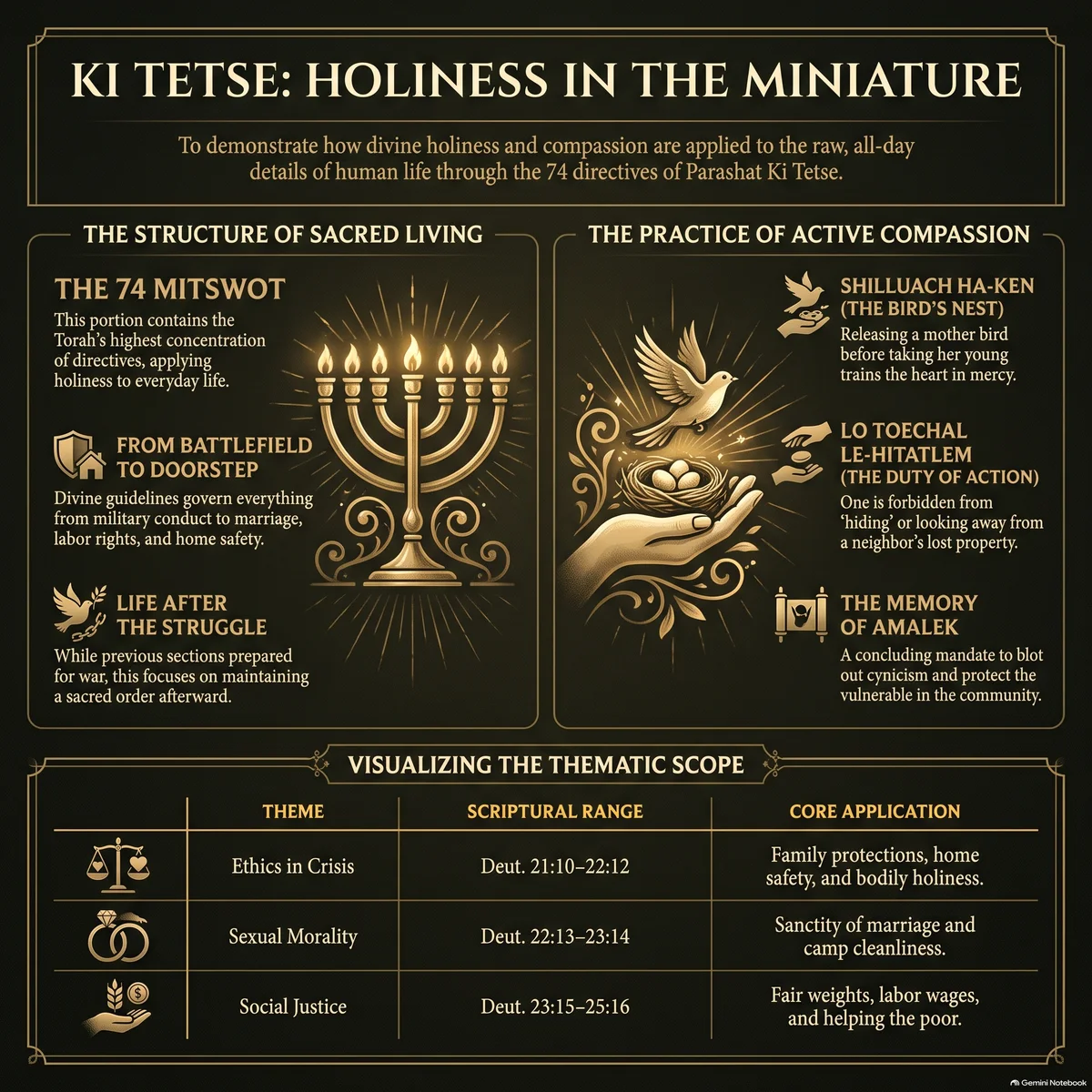
Where Shoftim orders the great societal structures — judges, kings, priests, prophets — Ki Tetse zooms in on the raw, everyday reality. Nearly every command in this parasha turns on the same axis: respect for life and for God's order, from the hanged man who must be buried before sunset, to the mother bird who must be released. Whoever is careful in the small things trains the heart that remains faithful in the large ones too.
This attention to detail is not incidental to the great covenant themes but their foundation: justice and mercy that do not hold in the small will not hold in the large either. Ki Tetse thus becomes the practical substructure of what Shoftim established constitutionally.
The 74 mitswot of Ki Tetse are not isolated rules but a coherent way of life: chessed here becomes not an occasional act of kindness but the standard against which every daily action is measured — from the building of a roof to the contents of a merchant's bag.
A — Word study: Shilluach ha-Ken (שִׁלּוּחַ הַקֵּן) — the command of the bird's nest
When someone finds a bird's nest along the way with young or eggs and the mother sitting on them, one may not take the mother together with the young. One must first let the mother go free and only then may take the young (Deut. 22:6-7). Drash: this is one of the few mitswot in the Torah — alongside honoring father and mother (Deut. 5:16) — to which the explicit promise of long life is attached: "that it may go well with you, and that you may live long."
Why such a great promise for such a small commandment? It trains the person in rachamim (compassion) against selfish indifference — whoever shows compassion even to a small bird reflects the character of the Creator. This theme of not-ignoring runs wider through the parasha: with the straying donkey (Section C) and with the day laborer's wages (Section D).
B — The parapet and the avoidance of bloodguilt (Deut. 22:8)
Whoever builds a new house is required to make a parapet (ma'akeh) on the flat roof.
"That you may not bring the guilt of blood upon your house, if anyone should fall from it." — Deuteronomy 22:8
Love for the neighbor in the Torah is not a passive feeling but active, preventive care. The failure to take safety measures that leave another exposed to danger is treated by the Torah as a form of negligent guilt — the same bloodguilt logic Shoftim applied to the Eglah Arufah (Deut. 21:1-9).
C — The prohibition against ignoring: the donkey and the garment (Deut. 22:1-4)
If you see your brother's ox or donkey straying or collapsing under its load, the Torah gives one powerful instruction:
"You may not hide yourself — you shall surely help him lift it up again." — Deuteronomy 22:3-4 (Lo toechal le-hitatlem)
Human nature is inclined to look the other way to avoid hassle or lost time. The Torah cuts off this escape route: ignoring the need of one's neighbor — or even his animal — is a breach of the covenant. This theme of not-ignoring what is lost recurs in Yeshua's parables of the lost sheep, the lost coin, and the lost son (Luke 15), and in His own word: "For the Son of Man came to seek and to save the lost" (Luke 19:10).
D — Social honesty: the day laborer's wages and honest weights (Deut. 24:14-15; 25:13-16)
The poor day laborer must receive his wages on the same day, before sunset:
"For he is poor and sets his heart on it. Otherwise he may cry against you to YHWH, and you be guilty of sin." — Deuteronomy 24:15
It is an abomination to YHWH when someone carries two kinds of weight-stones in his bag — a large one for buying and a small one for selling (Deut. 25:13-16; cf. Lev. 19:35-36). Honesty in trade is not a secular matter but a question of holiness.
E — Tzitzit: the four corners of the garment (Deut. 22:12)
Between the prohibition of unlawful mixing (Kil'ayim) and the regulations concerning sexual fidelity stands a single verse about the tassels (tzitzit, H6734) on the four corners of the garment — a tangible reminder of all the mitswot of YHWH (cf. Num. 15:38-40). That same edge or "wing" (kanaf) of the garment recurs when Ruth asks Boaz for protection (Ruth 3:7-9), and when the woman with the flow of blood touches the edge of Yeshua's garment and is healed (Matt. 9:20; Luke 8:43-48) — an echo of Malachi 4:2:
"For you who fear My name, the sun of righteousness shall rise with healing in its wings." — Malachi 4:2
→ Deeper study: Parasha Shoftim — Judges and Officers — the preceding parasha: Israel's four structures of authority
F — Exclusion and grace: the Moabite and the mamzer (Deut. 23:2-4)
Deuteronomy 23:2-4 excludes the mamzer and the Moabite "from the assembly of YHWH." The Torah itself gives the reason for the latter: Moab and Ammon did not meet Israel with bread and water on the way out of Egypt, and hired Balaam to curse Israel (Deut. 23:4) — a national, ethical sanction against hostility, not exclusion on ethnic grounds as such.
The Mishnah (Yevamot 8:3, worked out in Talmud Yevamot 76b-77a) derives from the masculine grammatical form of the command that the prohibition concerns Moabite men only — they led the army and withheld hospitality. A Moabite woman was never included. This is the textual ground on which Ruth's inclusion in the covenant people rests, and on which David's lineage was later defended against Doeg the Edomite (Talmud Yevamot 77a).
Ruth herself voices the real ground of her inclusion: "Your people shall be my people, and your God my God" (Ruth 1:16). She leaves the gods of Moab behind and seeks refuge "under the wings" of YHWH (Ruth 2:12) — the same kanaf that already connected the tzitzit to Boaz's garment in Section E. Faith and turning to God overturn what birth alone would fix.
The same holds for the mamzer (מַמְזֵר, Deut. 23:2) — not a child from any relationship outside marriage, but specifically from incest or adultery, forbidden unions that protect the sanctity of marriage. Here too, exclusion from the assembly and personal grace before YHWH are not the same axis:
"A mamzer who is a Torah scholar takes precedence over an ignorant High Priest." — Mishnah Horayot 3:8
The prophet Isaiah carries this line forward into the messianic age, directly echoing Deuteronomy 23:
"Let not the foreigner who has joined himself to YHWH say, 'YHWH will surely separate me from His people'... To the eunuchs I will give in My house and within My walls a memorial and a name better than sons and daughters; I will give them an everlasting name that shall not be cut off." — Isaiah 56:3, 5
Paul describes the exact same movement in the Renewed Covenant: whoever was by origin a "stranger to the covenants of promise" becomes in the Messiah a "fellow citizen with the saints and member of God's household," because He "has broken down the dividing wall of hostility" (Eph. 2:11-19). The Mishpat (the legal order of Deut. 23) sets the boundary and protects the sanctity of the covenant; YHWH's Chessed reaches across that boundary when a person, like Ruth, turns to Him in faith. This is not a contradiction but the same pattern running through the whole of Scripture — visible also in the inclusion of Rahab the Canaanite in the genealogy of the Messiah (Matt. 1:5).
G — Yibbum and Halitzah: the continuity of the name (Deut. 25:5-10)
When a man dies childless, his brother enters into levirate marriage (Yibbum) with the widow, so that the name of the deceased is not blotted out from Israel. If the brother refuses, the woman publicly removes his sandal and spits before his face (Halitzah). Rabbinic/Traditional Mishnah Yevamot works out this ceremony in detail. This shows the seriousness with which the Torah guards the protection of one who has become vulnerable through death — the same pattern Boaz fulfills when he acts as redeemer for Ruth.
H — Sod: Zachor Amalek — the fight against cynicism (Deut. 25:17-19)
The parasha closes with the urgent command never to forget Amalek:
"Remember what Amalek did to you on the way, when you came out of Egypt, how he attacked you on the way and cut off your rear, all who were feeble behind you, when you were faint and weary, and did not fear God." — Deuteronomy 25:17-18
Rabbinic/Traditional In Jewish tradition, Amalek stands as a symbol of the cold, ruthless cynicism that sows doubt and always attacks the most vulnerable part of the community — not the vanguard, but the stragglers in the rear. The command to remember Amalek is a reminder that a community is truly strong only when it protects its weakest in its midst. This is a Drash/Sod-layer reading, built on the Pshat of the text itself (cf. Ex. 17:8-16; 1 Sam. 15:2-3) — not kabbalistic speculation (cf. Protocol VI.i extension).
Deeper studies on Devar Emet
- Parasha Shoftim — Judges and Officers — the preceding parasha: judges, king, priest, and prophet under the Torah
- What Does the Torah Bring? — hypo nomos versus en nomos, read alongside Galatians 3:13
- Heart-Torah — From Stone to Heart — the Renewed Covenant as deepening, not replacement
- Walk in Grace — chessed as the covenant love that carries the halacha
- Sin, Blood & Forgiveness — Chet, Dam & Kapparah — the curse and the atonement behind Galatians 3:13
Parasha Ki Tetse brings the Torah directly onto the shop floor and into the street:
1 — Do not look away from another's need.
If you see this week that someone needs help — even something practical or a small chore — do not hide yourself (Lo toechal le-hitatlem). Offer your help actively.
2 — Be transparent and honest in your finances.
Examine your dealings. Do you use "two kinds of weights" — for example, acting differently at work than what you profess at home? Pay bills and promises promptly.
3 — Build a "parapet" for the safety of others.
Take responsibility for preventing harm or pain to others. This applies physically, but also digitally and emotionally.
4 — Protect the "rearguard."
Who in your church, family, or neighborhood are the stragglers falling behind? Extend your hand and protect them against the attacks of discouragement.
Each step is a concrete form of the same pattern from Section A: mercy that does not overlook the small, because it is precisely there that the character of YHWH becomes visible.
Precisely in this parasha's hardest applications — a broken marriage, a painful origin, a life full of scars — what James writes holds without qualification: "Mercy triumphs over judgment" (James 2:13). Before we judge another's divorce or remarriage, their origin or their past, the first question for our own heart may be whether we feel mercy toward the one standing before us — just as the Torah itself repeatedly takes the side of the vulnerable.
Avinu Malkeinu — Our Father, our King,
You are the God of the great deliverance, but also the God who has regard for the smallest mother bird and the sweat of the day laborer. We thank You for the richness of Your instructions that teach us to love truly, in deed.
Give us a watchful eye that does not look away from the need of our brother or from the animal beneath its load. Keep us from a hard heart, from false weights, and from the temptation not to keep our promises.
Give us the courage to protect the weak in our rearguard, and fill us with the grace and comfort of Your unshakeable covenant of peace.
Baruch Atah YHWH, who teaches His people in the ways of mercy. Amen.
- TorahDeuteronomy 21:10–25:19; Deuteronomy 21:10-14 (the female captive); Deuteronomy 21:15-17 (the firstborn right of the unloved wife); Deuteronomy 21:18-21 (the rebellious son); Deuteronomy 21:22-23 (the hanged man is cursed of God); Deuteronomy 22:1-4 (prohibition against ignoring strayed livestock); Deuteronomy 22:5 (the cross-dressing prohibition); Deuteronomy 22:6-7 (the command of the bird's nest, Shilluach ha-Ken); Deuteronomy 22:8 (the parapet on the roof); Deuteronomy 22:9-12 (prohibition on mixtures, Kil'ayim, and the tzitzit); Deuteronomy 22:13-29 (virginity and adultery); Deuteronomy 22:22 (stoning for proven adultery); Deuteronomy 23:2 (exclusion of the mamzer); Deuteronomy 23:3-4 (exclusion of the Moabite and Ammonite, with reason); Deuteronomy 23:1-9 (exclusion from the assembly and the posture toward Edom and Egypt); Deuteronomy 23:15-16 (receiving the escaped slave); Deuteronomy 23:18-24 (prostitution money, interest, and vows); Deuteronomy 24:1-4 (divorce provisions); Deuteronomy 24:14-15 (the poor day laborer's wages); Deuteronomy 24:19-21 (gleaning for the poor); Deuteronomy 25:1-3 (limits on corporal punishment); Deuteronomy 25:4 (the threshing ox not to be muzzled); Deuteronomy 25:5-10 (levirate marriage, Yibbum and Halitzah); Deuteronomy 25:13-16 (honest weights and measures); Deuteronomy 25:17-19 (Zachor Amalek, remember Amalek); Deuteronomy 5:16 (honoring father and mother); Deuteronomy 2:5 (prohibition against attacking Edom); Deuteronomy 19:15-21 (the standard of witnesses); Leviticus 19:35-36 (honest weights); Numbers 5:11-31 (the Sotah ritual for suspected adultery); Numbers 6:5 (the Nazirite's hair); Numbers 15:38-40 (the tzitzit).
- ProphetsIsaiah 54:1–10 (Haftarah for Shabbat Ki Tetse); Isaiah 54:5 (your Maker is your husband); Isaiah 54:10 (the covenant of peace does not waver); Isaiah 11:12 (the four wings/corners of the earth); Isaiah 56:3-5 (the foreigner and the eunuch given an everlasting name); Malachi 4:2 (the sun of righteousness and its wings).
- WritingsRuth 1:16 (Ruth's declaration of faith to Naomi); Ruth 2:12 (taking refuge under the wings of YHWH); Ruth 3:7-9 (Ruth and the wing of Boaz's garment); Ruth 4:13-17 (Ruth as ancestress of David).
- Brit ChadashaMatthew 5:21-22, 23-26, 27-32, 33-37, 38-48 (the Sermon on the Mount follows the order of Deut. 23–25); Matthew 19:3-9 & 19:8 (divorce and the hardness of the heart); Matthew 9:20 & Luke 8:43-48 (the woman with the flow of blood touches the tzitzit); Luke 15:1-32 & 19:10 (seeking the lost); Galatians 3:13 (the curse on the tree, Deut. 21:23); Galatians 6:1-10 (bearing one another's burdens); 1 Corinthians 9:8-14 & 1 Timothy 5:18 (the threshing ox applied to the laborer); 2 Peter 2:20-22 (returned to their own vomit); Colossians 3:11-14 (kindness before love, no distinction Jew/Greek); Ephesians 2:11–19 (the broken dividing wall, fellow citizens with the saints); Matthew 1:5 (Rahab and Ruth in the genealogy of the Messiah); James 2:13 (mercy triumphs over judgment).
- Rabbinic/TraditionalRashi on Deut. 21:10, 22:6 & 25:17; Mishnah Chullin 12 (the exposition of Shilluach ha-Ken); Mishnah Bava Metzia 2 (returning lost property); Mishnah Yevamot (the exposition of Yibbum and Halitzah); Mishnah Yevamot 8:3 and Talmud Yevamot 76b-77a (the Moavi/Moavit distinction); Mishnah Horayot 3:8 (the mamzer Torah-scholar above the ignorant High Priest); Talmud Berachot 33b.
- PaRDeSPshat (the casuistic legislation for daily life in the land); Remez (the number 74 mitswot and the repetition of the root shalach); Drash (the lessons of the parapet and not ignoring need); Sod (Yeshua as the Bearer of the Tree who took on the curse, and YHWH as the Eternal Husband of Zion). Talmud, b. Sanhedrin 67b; b. Chagigah 14b. Kabbalistic Sod-content (Zohar, Sefer Yetzirah) explicitly excluded — Protocol VI.i extension.
- ProtocolCanonicity test (VI.i) applied to each concept: Ki Tetse, Chessed/Rachamim, and Zachor Amalek are canonically anchored in Deuteronomy 21–25 (badges); Yibbum and Halitzah are explicitly labeled Rabbinic/Traditional. No use of the Zohar, Sefer Yetzirah, or kabbalistic works. "Renewed Covenant" used, never "new covenant" (VI.ii.a). "Torah-instructions"/"mitswot" used in original text; "law"/"commandments" avoided, or where unavoidable in quotation, accompanied by clarification (VI.ii.b). YHWH used in original text (VI.iii).