Va'etchanan laid the foundation with the Ten Words and the Shema. Ekev builds on that with a different kind of question: what happens when the people actually arrive in the land, become satisfied, and leave the wilderness behind? The title itself is the answer: ekev — not obedience as a prior demand, but the consequence that naturally follows, the way the heel follows the rest of the foot.
"And it shall come to pass, as a consequence of (ekev) your hearing these judgments, keeping and doing them, that YHWH your God will keep the covenant and the steadfast love for you... He humbled you and let you hunger... to make you know that man does not live by bread alone, but by every word that proceeds from the mouth of YHWH." — Deuteronomy 7:12 & 8:3 (paraphrase)
Scope and framework: the parasha has four major thematic movements: the promise of blessing and the warning against pride (Deut. 7:12–8:20) — obedience leads to blessing, but the real test lies not in the scarcity of the wilderness but in the abundance of the land; breaking the myth of one's own righteousness (Deut. 9:1–10:11) — Israel does not receive the land because of her own piety, but because of the wickedness of the peoples present and YHWH's faithfulness to the patriarchs, with the golden calf and the second tablets as proof; what does YHWH ask of you? (Deut. 10:12–10:22) — the core of the Torah-demand: fearing, walking, loving, serving, and keeping the mitswot; and the choice of the land and the promise of the rain (Deut. 11:1–11:25) — the contrast between Egypt and Canaan, closing with the second portion of the Shema.
The connection with the preceding parasha is close. Parasha Va'etchanan ended with the Shema and the great commandment of love — the "what" of the covenant relationship. Ekev answers the question that inevitably follows: how does a redeemed people respond once it no longer has to depend on daily manna, but builds its own houses, plants its own vineyards, and becomes satisfied? That same question returns, in reversed wording, in section A below — where the very title words of this parasha, ekev, turn out to form the lasting axis between blessing and curse.
Note: Parasha Ekev falls within the Shiv'ah d'Nechemta — the "Seven Shabbats of Comfort" between Tisha B'Av and Rosh Hashanah Rabbinic/Traditional. Where Va'etchanan carried the first of these seven (Shabbat Nachamu, Isa. 40), Ekev carries the second. The haftarah from Isaiah 49 opens with the complaint of the exiles:
"But Zion says: YHWH has forsaken me, my Lord has forgotten me. Can a woman forget her nursing child... Yet even if these forget, I will not forget you. Behold, I have engraved you on the palms of My hands." — Isaiah 49:14-16 (paraphrase)
Remez — canonical resonance: the haftarah mirrors the parasha in a remarkable, reversed way. In the parasha, Moses solemnly warns the people: "beware lest you forget YHWH your God" (Deut. 8:11) — the danger is that a satisfied people forgets its Deliverer. But in the haftarah, the perspective reverses: when the people themselves imagine they are forgotten in exile and oppression, YHWH swears that He can never forget them. Both movements share the same verb — שָׁכַח (shakach, H7911, "to forget") — but in opposite directions, and that is precisely the comfort: the forgetfulness lies with humanity, never with YHWH.
When Yeshua is tempted in the wilderness by the adversary to turn stones into bread, He does not resist with reasoning of His own, but with a direct quotation from this very parasha:
"But He answered and said, It is written: Man shall not live by bread alone, but by every word that proceeds from the mouth of God." — Matthew 4:4 (quoting Deuteronomy 8:3)
Where the wilderness generation of Israel still received the manna with complaint and distrust (see section B), Yeshua demonstrates the complete dependence on YHWH's spoken word that Deuteronomy 8 presents as the intended lesson of the wilderness test. He does not fulfil a new revelation here, but the very lesson Moses himself already held before the people.
Circumcision of the heart — Paul on Deuteronomy 10:16
The apostle Paul, in Romans 2, reaches directly back to this parasha's badge-concept, mul-levav, to define the essence of covenant faithfulness:
"For he is not a Jew who is one outwardly, nor is circumcision that which is outward in the flesh; but he is a Jew who is one inwardly, and circumcision is that of the heart, in the Spirit, not in the letter." — Romans 2:28-29 (cf. Deut. 10:16)
Paul does not here replace physical circumcision with a spiritual equivalent detached from the Torah — he reaches back to an expression Moses himself already used, centuries before Paul. The full development of this concept follows in section E below.
James 2: faith that becomes a footstep
James' well-known argument that "faith without works is dead" (Jas. 2:26) carries the very same logic as the title word of this parasha. Ekev presupposes no faith that remains a conviction in itself, but a faith whose footstep — the deed — follows as naturally as the heel follows the foot. James explicitly names Abraham (Jas. 2:21-23), the same patriarch whose covenant is, in section C below, the ground on which Israel receives the land — not because of its own righteousness, but issuing in a faith that acts.
Parasha Ekev reminds us that obedience to YHWH is not a legalistic condition for earning God's love, but a grateful "heel-response" (ekev) to His covenant faithfulness. The greatest test of faith lies not in the lack of the wilderness, but in the abundance of the land. True Torah-obedience asks for no outward pretense or self-righteous pride, but a circumcised heart that does justice to the orphan, the widow, and the stranger.
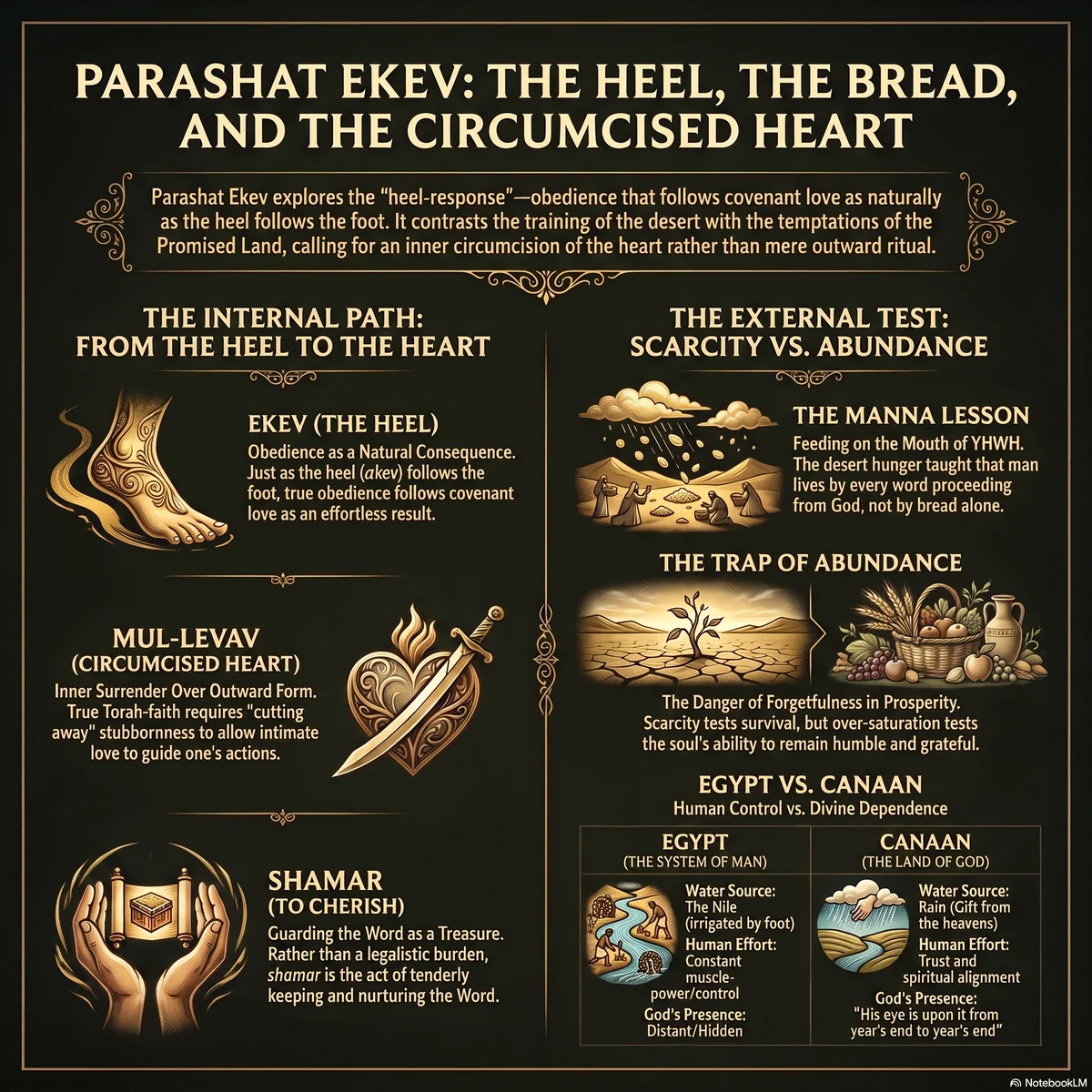
Every layer of this parasha returns to the same axis: ekev, the consequence that follows. Obedience brings blessing (section A), but the wilderness itself was already training in dependence (section B) — precisely in view of the temptation of the abundance yet to come. When the people possess the land, they may not boast of their own righteousness (section C): the history of the golden calf and the second tablets proves the opposite (section D). What YHWH truly asks is not an outward performance but a circumcised heart (section E) — and the land itself, dependent on rain from heaven, is the daily, tangible sign of that (section F).
A — Word Study: Ekev & Akev — the heel and the footstep
The same root underlies the birth of Jacob: "his hand held the heel (akev) of Esau" (Gen. 25:26). As a conjunction ekev means "as a consequence of" or "because" — it presupposes a movement: as the heel follows the rest of the foot, so blessing and protection follow in the track of the one who puts the mitswot into practice. The word-picture is deliberately physical: to read ekev is to see someone walking hard on the heels of the one ahead — following as closely as possible on the instructions of the Torah. Obedience in the Torah is never an abstract intellectual idea, but a physical step on the road.
Remez — the literary hook of the parasha: the title word ekev not only opens the parasha (Deut. 7:12) but also closes the first thematic movement — in reversed direction. Set both verses side by side:
| Blessing — Deuteronomy 7:12-13a | Curse — Deuteronomy 8:20 |
|---|---|
| "It shall come to pass, as a consequence of (ekev) your hearing these judgments, keeping and doing them, that YHWH will keep the covenant and the steadfast love which He swore to your fathers under oath. He will love you, bless you, and multiply you." | "As the nations that YHWH destroys before you, so you too shall perish, as a consequence of (ekev) your not having been obedient to the voice of YHWH your God." |
The same title-root thus brackets both sides of the parasha's first movement as a literary hook: ekev as blessing-upon-hearing opens it, ekev as curse-upon-not-hearing closes it. This is no accident of translation but a deliberate structural signature — the parasha says in its own name what it teaches in substance: consequence follows response, in both directions.
The blessing itself becomes concrete: YHWH "will love you, bless you, and multiply you — the fruit of your womb, the fruit of your land... your cattle and the young of your flock" (Deut. 7:13, paraphrase); Israel will be "blessed above all peoples; there shall not be a male or female barren among you or among your livestock" (Deut. 7:14), and "YHWH will take away from you all sickness" (Deut. 7:15). This is no isolated promise but the direct continuation of the covenant with Abraham: the same promise of multiplication that YHWH swore to Abraham (Gen. 15:5; 17:2; 22:17) returns here as concrete, earthly reality for his offspring. Deuteronomy 8:1 repeats the purpose explicitly: "that you may live, multiply, and go in and possess the land" — and 8:7-9 pictures the land itself as a land of wheat, barley, vines, figs, pomegranates, olive oil and honey, "a land in which you will lack nothing."
Immediately after this promise of blessing comes an equally sharp warning: the carved images of the nations, with their silver and gold, may not be brought into one's house — whoever does so becomes cherem himself (Deut. 7:26). Rabbinic/Traditional Where some translations soften this to "under the ban," the Jewish Study Bible renders it here as "cursed" — which conveys the weight of the Hebrew חֵרֶם (cherem, H2764) more sharply than the neutral "ban": the same word that elsewhere means "irrevocably devoted to YHWH" (see the study Chukat) turns here against whoever brings the desirable things of an idol into his house.
Canonical This same first movement contains a strikingly practical detail that tempers the promise of blessing: YHWH will not drive out the nations all at once, "lest the wild beasts grow too numerous for you" (Deut. 7:22). Too rapid a victory would leave a power vacuum in which nature — and with it, danger — would multiply faster than Israel could settle and steward the land. The blessing is thus deliberately staged, not out of doubt in YHWH's power, but out of care for the land itself: possession must grow at the pace at which it can be inhabited and guarded.
Remez — a second Shema: Deuteronomy 9:1 opens the third movement of the parasha with the same two words with which Va'etchanan opened its heart: שְׁמַע יִשְׂרָאֵל ("Hear, Israel" — Shema Yisrael), here followed by: "today you shall cross the Jordan." Where Deuteronomy 6:4 calls for hearing YHWH's unity, 9:1 calls for hearing a concrete, imminent task. The word study Shema Yisrael and parasha Va'etchanan develop the first use of this call further; here it sounds not as new revelation but as its practical follow-through — hearing that becomes a concrete step (see also the study Walking).
B — The wilderness test and the manna (Deut. 8:1-6)
The forty years in the wilderness were no wasted time, but a deliberate education by YHWH:
"And you shall remember the whole way that YHWH your God has led you these forty years in the wilderness, to humble you and to test (nassah) you, to know what was in your heart." — Deuteronomy 8:2 (paraphrase)
God gave the manna daily. No one could stockpile it for years. The purpose: to learn that material means (bread) are merely instruments, but that the living, creative word of YHWH (davar) is the true source of life — the very text Yeshua Himself quotes in Step 3 above.
Precisely at the hinge point between the wilderness test and the warning against pride stands a verse that has taken on a life of its own in Israel's practice of prayer: "You shall eat and be full, and you shall bless YHWH your God for the good land He has given you" (Deut. 8:10). Rabbinic/Traditional This verse is the direct foundation of the Birkat Hamazon — the grace recited after the meal — whose second blessing explicitly gives thanks for the land: the liturgy thereby fulfils, word for word, what Moses commands here. The same movement also opens the shorter blessing before the meal (ha-motzi). Eating thus never becomes a neutral act, but a continually renewed acknowledgment: the land, the bread, and the fullness are received, not earned.
Remez-speculative Deuteronomy 8:15 calls the wilderness a place of "fiery serpents, scorpions" — real, literal dangers that YHWH allowed to pass. This same word pair strikingly recurs in Luke 10:19, where Yeshua gives His seventy sent-out disciples authority "to tread on serpents and scorpions." It cannot be demonstrated that Deuteronomy 8:15 itself already intends a spiritual power — the Pshat speaks of real wilderness creatures — but the specific, rare word combination in Yeshua's statement can be read as a deliberate echo: the very dangers the wilderness generation survived because of YHWH's protection become, in Yeshua, the image of spiritual authority. This remains here explicitly a linguistic Remez, not an established fact about the nature of the creatures in Deuteronomy 8 itself.
Moses then paints the land of streams, wheat, figs, olive oil and copper — but adds a sharp prophetic diagnosis:
"When you have eaten and are full, and have built beautiful houses and live in them... beware then that your heart does not become lifted up, and you say: My own power and the strength of my hand have gained me this wealth." — Deuteronomy 8:12-14, 17 (paraphrase)
Moses uses not one but two words for power here: koach (muscular strength) in verse 17, and חַיִל chayil (H2428 — wealth, might, also: an army) in verse 18: "for it is He who gives you power (chayil) to get wealth." Chayil is elsewhere the same word for a military force — Moses thereby unmasks economic prosperity for what it truly is: a form of power that, like military might, comes from YHWH's hand and not from one's own merit.
This is the central reversal of the whole parasha: not the scarcity of the wilderness, but the abundance of the land, is the heaviest test. The study Remember — which carries these very verses (Deut. 8:11-14) as its own scripture text — develops this further: remembering (zakhar) is never passive but an active reorientation that prevents drifting away (shakach, see the Haftarah section above).
C — No righteousness of our own (Deut. 9:1-6)
Israel will enter the land and drive out mighty nations (the Anakim). Moses warns in advance against the conclusion that would seem obvious:
"Do not say in your heart... Because of my righteousness YHWH has brought me to possess this land — whereas it is because of the wickedness of these nations that YHWH drives them out before you." — Deuteronomy 9:4 (paraphrase)
YHWH gives two reasons why Israel receives the land: because of the wickedness of the nations present, and to confirm the promise to Abraham, Isaac, and Jacob. Israel is bluntly called by Moses a "stiff-necked people" (am kesheh-oref, Deut. 9:6). Grace does not arise from the excellence of the people but from the faithfulness of the Covenant God.
Brit Chadasha — the wild olive tree (Rom. 11:17-21): Paul draws this very lesson forward to the believers from the nations grafted into the olive tree of Israel:
"Do not boast against the branches. And if you boast: you do not carry the root, but the root you... Do not be arrogant, but fear." — Romans 11:18, 20 (paraphrase)
What Moses here says to Israel — no righteousness of one's own, only divine faithfulness — Paul repeats, word for word in substance, to the grafted-in nations. The lesson of Deuteronomy 9 is thus no dated warning to a single generation, but a lasting principle every generation and every newcomer to the covenant must hear anew.
D — The golden calf and the second tablets (Deut. 9:7–10:11)
To decisively refute the claim of one's own righteousness, Moses recalls the lowest point at Horeb: while God gave him the stone tablets, the people bowed to the golden calf.
Moses draws the line tightly: "Remember, do not forget, how you provoked YHWH your God to wrath in the wilderness... even at Horeb you provoked YHWH to wrath, so that YHWH was angry enough with you to have destroyed you" (Deut. 9:7-8, paraphrase) — literally the greatest wrath described anywhere in Deuteronomy. And it did not stop at Horeb: in the same breath Moses also lists Taberah, Massah, and Kibroth Hattaavah as places where the people provoked YHWH to wrath (Deut. 9:22) — the very same craving-history the study Beha'alotcha treats at length under the concept ta'avah. Self-righteousness, then, is no isolated lapse of Moses' rhetoric, but a pattern repeated throughout the whole wilderness journey.
The role of the Mediator: YHWH wanted to destroy the people, but Moses cast himself down for forty days and nights and prayed — without eating or drinking (Deut. 9:9, 18) — for the people and for Aaron (Deut. 9:18-20). YHWH goes even further than destruction alone: He offers Moses to make of him a nation greater and mightier than Israel (Deut. 9:14). This offer sounds like a request for Moses' consent, but it is not: YHWH had already fully seen through the people — Moses himself testifies that he "was afraid of the anger and hot displeasure with which YHWH was wrathful against you, wanting to destroy you" (Deut. 9:19). The offer opens a space for intercession rather than being a vote whose outcome remains genuinely open. Moses' intercession is therefore no idle prayer, but a deliberate renunciation of his own gain — the same self-denial already shown in parasha Shelach at a comparable offer (Num. 14:12).
Brit Chadasha — Yeshua's intercession for Peter: the same pattern of targeted, personal intercession for one failing man recurs in Yeshua. Just before Peter's denial, Yeshua tells him: "Simon, Simon, behold, satan has demanded to sift you all like wheat. But I have prayed for you that your faith not fail. And you, when you have turned back, strengthen your brothers" (Luke 22:31-32, paraphrase). As Moses prayed for Aaron despite his part in the golden calf, Yeshua prays for Peter before his denial — in both cases not to excuse the failure, but to ensure the fall is not the end.
The continuation of this pattern: the Renewed Covenant generalizes what Moses and Yeshua modeled into a mandate for the whole assembly: "if anyone sees his brother sinning a sin not leading to death, he shall ask, and God will give him life" (1 John 5:16, paraphrase); "he who turns a sinner from the error of his way will save a soul from death and cover a multitude of sins" (Jas. 5:19-20, paraphrase). What in Moses and Yeshua was singular, exalted intercession becomes here the ordinary practice of the community: no judgment of the erring brother, but intercession that saves him.
Rabbinic/Traditional The rabbinic tradition holds the concept of taryag mitzvot — the 613 mitswot as an undivided whole, not a selection to one's own liking. This connects to the fivefold call in section E below: shamar concerns the whole that is kept, not a part that suits.
Remez-speculative Moses explicitly records that God wrote the first stone tablets "with His finger" (Deut. 9:10) — unchangeably engraved in stone. Centuries later, when a woman caught in adultery is brought before Him, Yeshua writes not in stone but in the dust of the earth with His finger (John 8:6, 8) — a surface as changeable as one gust of wind can make it. Both fingers write judgment upon sin; but where the one set of tablets is smashed at the very sight of that same sin (Deut. 9:17), the other hand lets the accusation fall away. This is a conceptual, not a textual, parallel — the link lies in the image of "God's finger writing," not in a direct cross-reference — but it strikingly traces the movement from stone to heart that section E below develops further.
The second tablets (Deut. 10:1-5): God commands Moses to cut two new stone tablets. Where the first tablets were entirely God's work (both stone and script), the second tablets are a collaboration: Moses cuts the stone, God writes the words. This is the image of restoration after sin — the covenant is renewed at the meeting point of human repentance and divine grace, not as a second chance earned but as the continuation of the same chessed that Va'etchanan already showed at the Ten Words.
Moses fasts twice forty days and nights at Horeb (Deut. 9:9, 18). Centuries later, Elijah does the same: fed by a single meal from the hand of the Angel of YHWH, "he walked in the strength of that food forty days and forty nights, to the mountain of God, Horeb" (1 Kings 19:8) — the same mountain. And Yeshua fasts forty days and nights in the wilderness before His temptation (Matt. 4:2), and appears again for forty days to His disciples after His resurrection, before ascending (Acts 1:3). Three figures, the same number three times, two of them on the same mountain — an Echo linking Torah (Moses), Prophets (Elijah), and Brit Chadasha (Yeshua), precisely the pattern Protocol IV offers as a test. Notably: it is the same mountain Horeb where, in 1 Kings 19:11-13, Elijah hears the qol demamah daqqah — the anchor text of the study Hear.
A contrasting number: at the giving of the Torah at Horeb, after the sin of the golden calf, 3,000 Israelites died by the sword of the Levites (Ex. 32:28). At the first Shavuot after Yeshua's ascension, 3,000 people came to faith through the outpouring of the Holy Spirit (Acts 2:41). The law on stone tablets brought forth death where the heart remained unchanged; the Torah written on the fleshly tablets of the heart — the promise of Jeremiah 31:33, developed further in the study Heart-Torah — brought forth life.
Sod Moses had to ascend the mountain twice. Yeshua too knew two distinctive mountain moments: the temptation in the wilderness, where the adversary asks Him for a bow of the knee in exchange for all the kingdoms of the world (Matt. 4:8-10) — an offer strikingly reminiscent of the people's bow before the golden calf, here refused — and the transfiguration on the mountain, where Moses himself, together with Elijah, appears glorified beside Yeshua (Matt. 17:1-8). The full development of this second mountain moment already appears in parasha Va'etchanan, section F; here the first half of the pattern is added: where the Israelites succumbed to idolatry at their first testing, Yeshua withstands that very same temptation at His own first testing, thereby restoring representatively what went wrong at Horeb, before — as a second parallel to Moses' second ascent — appearing in glory.
E — Ma-Ahavah: what does YHWH ask of you? (Deut. 10:12-22)
Moses poses the classic question:
"And now, Israel, what does YHWH your God ask of you, but to fear YHWH your God, to walk in all His ways, to love Him, and to serve YHWH your God with all your heart and with all your soul; to keep the commandments of YHWH and His statutes, which I command you today?" — Deuteronomy 10:12-13 (paraphrase)
Rabbinic/Traditional The Talmud (b. Menachot 43b) notes that the word for "what" (מָה, Mah) can be re-read as מֵאָה (Me'ah, "a hundred"), from which the tradition of the hundred daily blessings (Me'ah Berachot) arose. This is explicitly not gematria — the Mispar Hecherchi of Mah (45) and Me'ah (46) differ — but a classical rabbinic al tikrei re-reading (re-vocalizing the same consonants), cited here explicitly as a Rabbinic-Traditional application, not as a canonical fact about the text itself.
| The demand of YHWH (Deut. 10:12-13) | Meaning for the walk |
|---|---|
| 1. To fear YHWH (Leyir'ah) | Deep reverence for God's holiness |
| 2. To walk in all His ways (Lalechet) | Reflecting God's character in deeds — see the study Walking |
| 3. To love Him (Le'ahavah) | Passionate bondedness |
| 4. To serve Him (La'avod) | Devotion with heart and soul |
| 5. To keep His mitswot (Lishmor, from shamar) | Guarding and tending what one has received — not command-compliance but careful stewardship, see the study Hear |
Root term: שָׁמַר shamar (H8104) — "to guard, to tend." Point 5 of the table above is often rendered in western translations as "to keep the commandments," which activates a juridical-hierarchical frame. Shamar, however, describes — as in Genesis 2:15 (humanity "tending and keeping" the garden) — a pastoral, nurturing movement, not oversight out of duty but carefully keeping alive what one has received in love. The fivefold call of Deuteronomy 10:12-13 is thus not a chain of five separate obligations, but a single moving line: reverence that walks, that loves, that serves, and that finally guards.
Directly after the fivefold call comes the inward condition that alone makes it possible: "circumcise then the foreskin of your heart, and be no longer stiff-necked" (Deut. 10:16). Deuteronomy 30:6 adds the other side: "YHWH your God will circumcise your heart" — human responsibility and divine initiative standing side by side, neither cancelling the other. See badge 02·TOE above, and Step 3 for Paul's application of this in Romans 2:28-29.
Justice for the vulnerable (Deut. 10:18-19): YHWH's holiness translates directly into social ethics — He "executes justice for the fatherless and the widow, and loves the stranger (ger), giving him bread and clothing. Therefore you also shall love the stranger, for you were strangers in the land of Egypt yourselves." This verse is precisely the canonical text on which the concept ger is anchored in the study Position of the Soul: the vulnerable outsider whose protection flows directly from Israel's own remembered experience of being strangers.
F — Sod: Egypt versus the land of the rain (Deut. 11:10-12)
Moses makes a profound prophetic comparison between Egypt and the Promised Land:
"The land you are going to possess is not like the land of Egypt... where you sowed your seed and watered it with your foot, like a vegetable garden. But the land you are crossing over to possess is a land of hills and valleys, that drinks water by the rain of heaven." — Deuteronomy 11:10-11 (paraphrase)
Egypt is a system of human control: water was pumped by muscle-power and irrigation systems, dependent on the Nile. Canaan is a land over which YHWH Himself constantly keeps His eye, "from the beginning of the year to the end of the year" (Deut. 11:12). Living in the land of God means giving up the illusion of human control — one cannot force the rain with one's foot. Rain in the Torah is the symbol of the Spirit and the divine blessing that descends when the relationship is pure; the land itself is thus, day by day, the tangible counterpart of the circumcised heart of section E — both elude human manufacture and call for trust.
Further Studies on Devar Emet
- Remember — The Hem of His Garment — Deuteronomy 8:11-14 as scripture text, zakhar versus shakach
- Heart-Torah — From Stone to Heart — Jeremiah 31:33, the promise behind the second tablets
- Hear — Understanding the Voice of YHWH — shamar and the qol demamah daqqah at Horeb
- Shema Yisrael — The Greatest Commandment — the first use of the call that returns in 9:1
- Walking — The First Step After the Voice — halak, the second demand of Deuteronomy 10:12
- Position of the Soul — the concept ger, anchored on Deuteronomy 10:18
- Parasha Va'etchanan — the preceding parasha: Ten Words, Shema, and the mountain of transfiguration
- Parasha Devarim — the opening book of Moses' final addresses
Ekev brings the focus back to our daily conduct and our inner motivation:
1 — Remember the source of your success.
If you achieve a success this week at work, in your studies, or in your family, be alert to expose directly the thought "my own strength has achieved this" (Deut. 8:17). Explicitly give the honor to YHWH.
2 — Examine the foreskin of your heart.
Where are you stiff-necked? Where do you refuse to listen to correction from God or from people around you? Ask YHWH to cut away the hard layer around your heart, so that you may be moved again (Deut. 10:16).
3 — See the stranger and the weak.
YHWH loves the stranger, the orphan, and the widow (Deut. 10:18-19). This week, seek one very concrete way to stand by or practically serve someone on the margins, someone who does not feel at home, or someone in need.
4 — Do not live by bread alone.
Take conscious time every day to feed yourself with the Word of God before feeding yourself with the news, social media, or the busyness of the day (Deut. 8:3). Learn that His speech is your true sustenance.
Each of these four steps is a concrete form of the same pattern from sections B and E: obedience not as outward pressure, but as the heel that naturally follows a circumcised heart.
Avinu Malkeinu — Our Father, our King,
We thank You that Your eye rests on our lives from the beginning of the year to its end. We thank You that Your blessing does not depend on our own supposed righteousness, but on Your unshakeable covenant faithfulness.
Forgive us the moments when, in our prosperity and rest, we forgot that every breath and every blessing comes from Your hand. Cut away the hardness of our heart and make us soft, moved, and obedient.
Grant that we may walk in the footsteps of Yeshua — that we may not live by bread alone, but by every word that proceeds from Your mouth. Teach us to do justice to those who have no voice, and to love the stranger as You loved us when we were strangers.
Baruch Atah YHWH, who opens the heavens and feeds His people with the Word of Life. Amen.
- TorahDeuteronomy 7:12-13 (ekev, blessing upon obedience); Deuteronomy 7:13-16 (multiplication, health, no barrenness); Deuteronomy 7:22 (staged conquest because of wild animals); Deuteronomy 7:25-26 (cherem/cursed at idol-possession); Deuteronomy 8:1 (life and multiplication as purpose); Deuteronomy 8:1-6 (wilderness test and manna, nassah); Deuteronomy 8:3 (not by bread alone); Deuteronomy 8:7-9 (the land of wheat, barley, olive oil and honey); Deuteronomy 8:10 (foundation text of the Birkat Hamazon); Deuteronomy 8:11-18 (warning against pride in abundance); Deuteronomy 8:15 (fiery serpents, adders and scorpions); Deuteronomy 8:17-18 (koach and chayil); Deuteronomy 8:20 (ekev as curse-upon-not-hearing); Deuteronomy 9:1-6 (no righteousness of our own, stiff-necked people); Deuteronomy 9:7-8 (the greatest wrath); Deuteronomy 9:7-21 (the golden calf and Moses' intercession); Deuteronomy 9:9, 18 (twice forty days without bread or water); Deuteronomy 9:10 (the finger of God on the first tablets); Deuteronomy 9:14 (YHWH's offer to Moses to make him a greater nation); Deuteronomy 9:19 (Moses' own testimony of the wrath he had seen through); Deuteronomy 9:22 (Taberah, Massah, Kibroth Hattaavah); Deuteronomy 10:1-5 (the second tablets); Deuteronomy 10:12-13 (what does YHWH ask of you — the fivefold call); Deuteronomy 10:16 (circumcision of the foreskin of the heart); Deuteronomy 10:18-19 (love for the orphan, widow, and stranger); Deuteronomy 11:10-12 (Egypt watered by foot vs. the land that drinks heaven's rain); Deuteronomy 30:6 (YHWH who circumcises the heart); Genesis 15:5, 17:2, 22:17 (the promise of multiplication to Abraham); Genesis 25:26 (etymology of akev/Jacob); Numbers 14:12 (the comparable offer to Moses in parasha Shelach); Exodus 32:28 (3,000 dead at the golden calf).
- ProphetsIsaiah 49:14-51:3 (Haftarah Shabbat Ekev); Isaiah 49:14-16 (Zion not forgotten, engraved on the palms); 1 Kings 19:8 (Elijah's forty days to Horeb); 1 Kings 19:11-13 (the qol demamah daqqah, the same mountain); Jeremiah 4:4 (circumcision of the heart); Jeremiah 31:33 (Torah written on the heart).
- Brit ChadashaMatthew 4:1-4 (Yeshua quotes Deut. 8:3 at the temptation); Matthew 4:2, 8-10 (forty days of fasting, the bow of the knee refused); Matthew 17:1-8 (the transfiguration on the mountain, Moses and Elijah); Luke 10:19 (authority over serpents and scorpions); Luke 22:31-32 (Yeshua's intercession for Peter); John 8:6, 8 (Yeshua writes with His finger in the dust); Acts 1:3 (forty days after the resurrection); Acts 2:41 (3,000 come to faith at Shavuot); Romans 2:25-29 (circumcision of the heart by the Spirit); Romans 11:17-21 (the wild olive tree, no claim to one's own righteousness); James 2:14-26 (faith shown by works/footsteps); James 5:19-20 (whoever turns back a sinner saves a soul from death); 1 John 5:16 (intercession for a brother who sins); 2 Corinthians 3:3 (the fleshly tablets of the heart).
- Rabbinic/TraditionalRashi on Deut. 7:12 (explaining ekev as the light commandments one tramples with the heel); Talmud, b. Menachot 43b (al-tikrei re-reading of Mah/Me'ah, Deut. 10:12, explicitly not gematria); Jewish Study Bible on Deut. 7:26 ("cursed" for cherem); the Birkat Hamazon liturgy as fulfilment of Deut. 8:10; the "Seven Shabbats of Comfort" (Shiv'ah d'Nechemta) between Tisha B'Av and Rosh Hashanah; the concept taryag mitzvot (613 mitswot as an undivided whole).
- PaRDeSRabbinic hermeneutical framework. Talmud, b. Sanhedrin 67b; b. Chagiga 14b. Kabbalistic Sod-content (Zohar, Sefer Yetzirah) explicitly excluded — Protocol VI.i extension.
- Source Material (fourth enrichment round)A transcript of an Erev Shabbat service (Ekev, 2026) was screened. The table liturgy (Kiddush, bread blessing, family blessing) was set aside — not study material. The main teaching connects ekev to Romans 8:31-39 via a personal illustration by the speaker (a river-rafting trip), excluded as a personal anecdote from a named living teacher; its underlying sovereignty claim (that blessing bears no direct relation to human response) also sits in tension with the very conditionality ekev carries in the text, and was not adopted. A series of textual points supplied directly by Serge was tested and incorporated: the blessing catalogue of Deut. 7:13-16 tied to the Abraham promise (section A); the JSB rendering "cursed" for cherem, Deut. 7:26 (section A); the staged conquest on account of wild animals, Deut. 7:22, given its own standing apart from the earlier Remez footnote (section A); Deut. 8:10 as the foundation text of the Birkat Hamazon (section B); koach/chayil, Deut. 8:17-18 (section B); the greatest-wrath wording of Deut. 9:7-8 extended to Taberah/Massah/Kibroth Hattaavah in Deut. 9:22, linked to parasha Beha'alotcha (section D); and the clarification that Deut. 9:14 is not a genuine vote but intercession-space, read alongside Moses' own testimony in Deut. 9:19 (section D). Not adopted: the suggestion that the dust Moses threw into the brook (Deut. 9:21) pictures grace for the nations — the text specifies no destination "to the nations" for this brook, and the stronger parallel (Ex. 32:20, the people themselves made to drink the dust) is a judgment-ordeal upon Israel itself, not an outward-facing image of grace.
- ProtocolCanonicity test (VI.i) applied to every concept: ekev, mul-levav, shamar, cherem, koach/chayil, and the promises of multiplication and health are canonically anchored in Deuteronomy 7-10; Deuteronomy 9:14, 9:19, and Luke 22:31-32 are direct scripture texts (canonical, not speculation); the Mah/Me'ah re-reading, taryag mitzvot, and the JSB translation choice at cherem are explicitly labeled Rabbinic/Traditional; the finger-in-stone/finger-in-dust comparison and the bow-of-the-knee parallel at the temptation remain labeled Remez-speculative and Sod respectively, not canonical fact. A proposed Remez at Deut. 9:21 (dust-in-the-brook as grace for the nations) was judged insufficiently textually supported and not included. No use of Zohar, Sefer Yetzirah, or kabbalistic works (VI.i extension). "Renewed Covenant" used, never "new covenant" (VI.ii.a). YHWH used in original text (VI.iii). No current political prophecy interpretation included — explicitly tested and excluded in the third and fourth enrichment rounds.