Walking, praying, glorifying — three layers of the same path
This study does not stand alone. Walking is the movement of life as a whole — the direction in which you live. Prayer is the axis of communication within that walk: seeking access, asking, pleading, listening. Glorifying is one specific direction of movement within prayer — not asking, but transferring honor. This study deals with access itself; for the honor-axis it deliberately points to the existing, deepening study. → See the deepening study Glorify — The Halacha of Judah
A small nuance up front. In the Psalm superscriptions, tefillah (prayer) and tehillah (praise) sometimes stand side by side as related, not strictly hierarchical categories — Psalms 17, 86, 90, 102, and 142 carry the heading tefillah; Psalm 145 carries tehillah. Glorifying is thus both a sub-movement of prayer and, in the language of the Psalms themselves, a category of its own alongside it. Both readings are canonically defensible; this study follows the first because praise is functionally always a form of speaking to YHWH.
The reason does not lie with man — Ephesians 2:18
Prayer does not begin with the right words, but with an opened way that man did not make himself:
"For through him we both have access by one Spirit to the Father."
Ephesians 2:18 Canonical · G4318Three elements stand in a single sentence: the Son opens ("through him"), the Spirit carries ("by one Spirit"), the Father receives ("to the Father"). This is not a later theological construction but the explicit grammar of the text itself — and it is the organizing principle of this entire study.
Prayer is not a formula. Right before the Lord's Prayer, Yeshua himself warns against empty repetition: "And in praying, do not heap up empty phrases as the Gentiles do, for they think that they will be heard for their many words" (Matt. 6:7). The Greek here uses battalogeo (βαττολογήσητε, G945) — a rare word, possibly onomatopoeic for stammering, contentless babble. The word occurs only once in the entire Greek NT. Canonical · Matt. 6:7 · G945
Access is not a key you forge yourself by finding the right sentence. Access is a given way, opened by One, carried by One, received by One.
Tabernacle projection — the curtain
If prayer were an object in the Tabernacle, it would not be the altar of incense — that is glorifying's object, the continual fragrance of praise (Ex. 30:1–8; Heb. 13:15). Prayer is rather the curtain itself, the place of the mercy seat, where YHWH spoke: "There I will meet with you, and from above the mercy seat... I will speak with you." Canonical · Ex. 25:22
"Therefore, brothers and sisters, since we have confidence to enter the Most Holy Place by the blood of Jesus, by the new and living way that he opened for us through the curtain, that is, through his flesh... let us draw near with a sincere heart in full assurance of faith."
Hebrews 10:19–22 CanonicalThe curtain once separated; now it has become the way itself. That is exactly the movement of prayer: not a closed door behind which YHWH lives, but an opened way along which he lets himself be approached.
Right after Pinchas's act in Numbers 25, Numbers 28–29 gives a complete calendrical overview of korbanot — not an incident, but a lasting rhythm of drawing near. That rhythm is the subject of the Halacha section below. → See the full treatment of korban and the tamid rhythm in Parashat Pinchas
Translation loss: "prayer" is not a single word in Hebrew
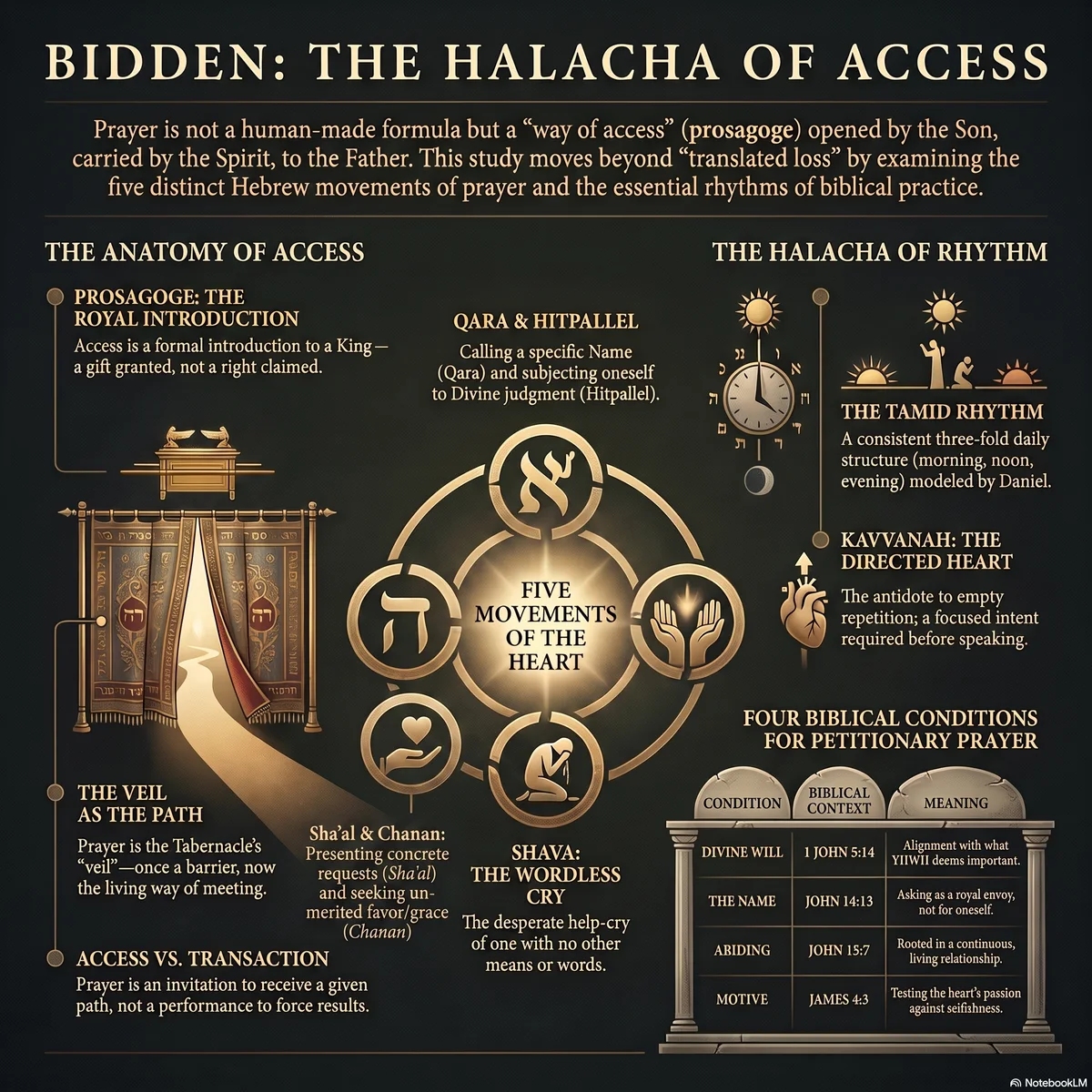
Why this study cannot settle for a single word study. Just as "praise" compresses at least seven Hebrew verbs (see Glorify), "prayer" compresses at least five distinct movements into one English word. Each verb describes a different direction of the heart, not a synonymous feeling. Translation Loss
Pictographic analysis — פלל (palal). Paleo-Hebrew: Pe (mouth, speech) and Lamed (shepherd's staff, authority, "toward") — twice. The picture: the mouth bowing under the shepherd's staff, speech submitting to another's authority. That is exactly what the Hitpael form already says grammatically — hitpallel is bringing oneself under judgment, not making a demand. Pictography is illustrative, not proof in itself; here it confirms what the grammar already establishes. Remez · Jeff Benner
The axis with Glorify
Prayer and glorifying are neither synonyms nor opposites, but two directions on the same axis. Prayer (qara, sha'al, chanan) moves predominantly from man toward YHWH — asking, pleading, seeking access. Glorifying (yadah, halal, zamar) moves from YHWH back out into the world — making his deeds known, displaying his glory. Both are halacha, a way that you walk; neither replaces the other, and Jonah's towdah-vow from inside the fish (Jonah 2:9) shows how closely they lie together: plea and vow of praise in a single breath. → See the seven verbs of praise in the deepening study Glorify
Father, Son, Spirit — Echad, not Greek ontology
The Ephesians 2:18 structure (Foundation) raises a question: how do Father, Son, and Spirit relate to one another in prayer? This study deliberately does not answer that question with the later ecclesial framework of "persons" and "one indivisible essence" — that is Greek philosophical language (ousia, hypostasis), post-biblical and not anchored in Hebrew. Instead, this study grounds the structure where it belongs: in the Shema and in Genesis.
Fixed times — the halacha of rhythm
The Torah establishes this rhythm right after Pinchas's act: Numbers 28:3–8 gives the tamid offering, the daily lamb of morning and evening — a word that shares its root with "continual, perpetual" (H8548). Not occasional devotion, but a structure that brings the people near to YHWH afresh every day. Canonical · Num. 28:3–8 · H8548 → See the full offering rhythm in Parashat Pinchas
"Evening, morning, and at noon, I will complain and moan. He will hear my voice."
Psalm 55:17 CanonicalDaniel prays three times a day, with his windows open toward Jerusalem — even under threat of death he does not change that rhythm Canonical · Dan. 6:11. The Talmud explains the three-times-daily prayer rhythm in direct relation to the tamid: "the prayers were instituted corresponding to the tamid offerings" (tefillot k'neged temidin tiknum) — as against the other, equally transmitted view that the prayer times descend from the patriarchs. Rabbinic Tradition · b. Berakhot 26b The Amidah (Shemoneh Esreh, "Eighteen Blessings") is the classic Jewish liturgical filling-in of this rhythm Rabbinic Tradition — the fixed form in which later Jewish practice brings together the tamid, Daniel 6, and Psalm 55.
The Shema — fixed text and the undivided heart
Within that fixed rhythm one text stands central, spoken morning and evening since Moses first uttered it: the Shema (Deut. 6:4) — "Hear, O Israel: YHWH our God, YHWH is one." Grammatically this is not a petition but a declaration: shema (שָׁמַע, H8085) calls for hearing and orienting, not for asking. Yet for three thousand years it has been woven into the very same breath as the prayer rhythm itself — it is prayed, not merely read. Canonical · Deut. 6:4 · H8085 → See the full word study Shema Yisrael
Precisely a text this fixed and this often repeated carries the risk Yeshua himself warns against: battalogeo, empty repetition without heart (Matt. 6:7, see Foundation). Rabbinic tradition knows this same risk and names its antidote with its own word: kavvanah (כַּוָּנָה), the directed intention of the heart during prayer. The Mishnah relates that the pious of old waited an hour before they began to pray, so as first to direct their hearts. Rabbinic Tradition · Mishnah Berakhot 5:1 Fixed words and a living heart, then, do not exclude one another — fixed words without kavvanah do.
Priestly blessing — prayer as mediated access
YHWH gives Aaron and his sons a fixed, received formula of blessing to speak over the people — not self-chosen words, but a given form Canonical · Num. 6:24–26. This is the priestly, mediated form of access: someone else speaks the blessing over the people on YHWH's behalf. This pattern — mediated access, not a self-chosen form — is exactly the role Hebrews 7:25 ascribes to Yeshua, and connects to his identity as Priest within the Priestly covenant (Num. 25; Jer. 33).
Asking and receiving — the conditions
Yeshua promises generously: whoever asks, receives. The Greek in Matthew 7:7 uses a present-tense imperative (aiteite, zeteite, krouete) that does not describe a single request but a persistent posture — keep asking, keep seeking, keep knocking. Canonical · Matt. 7:7
"Ask, and it will be given you. Seek, and you will find. Knock, and it will be opened for you."
Matthew 7:7 CanonicalThat is not a blank check. Scripture itself bounds this promise with four conditions — not to weaken it, but to show what "asking" means in the biblical sense.
| Condition | Text | What it means |
|---|---|---|
| According to his will | 1 John 5:14–15 | The desire aligns with what YHWH considers important — not a private agenda seeking a signature. |
| In the Name of Yeshua | John 14:13 | Not a formula, but asking on his behalf — as an envoy speaks in the name of his king, not for himself. |
| Abiding in him | John 15:7 | The promise is tied to an abiding relationship, not to a stand-alone request. |
| The motives of the heart | James 4:3 | Requests that arise from one's own passions are not granted — the heart is tested, not only the words. |
Three examples from Scripture show how this works — not as theory, but as a way. A father does not give his child a snake when it asks for fish: if earthly, fallible fathers already give good gifts, how much more the Father in heaven Canonical · Matt. 7:9–11. A man knocks shamelessly at his friend's door in the middle of the night, and receives what he asks because of his persistence Canonical · Luke 11:5–8 — the same persevering character as the verb form in Matthew 7:7. And Paul asks three times for deliverance from "a thorn in the flesh," and receives instead an answer that surpasses his request: "My grace is sufficient for you" Canonical · 2 Cor. 12:8–9. Receiving, then, is not always the same as getting what was asked — sometimes the answer is greater than the question.
| Prayer as transaction | Prayer as access (Eph. 2:18) | |
|---|---|---|
| Source | One's own wording, formula, repetition | An opened way — through the Son |
| Goal | Forcing the right outcome | Being heard by the Father |
| Means | The volume or piety of the words | The Spirit, who carries even the inexpressible |
| Posture | Performance — prayer as one's own merit | Receiving — access already given |
Practical rhythm — how do you practice this? A possible rhythm, built from canonical anchors:
• Every morning: qara — calling on the Name directly before the day begins (cf. Ps. 5:3).
• Evening, morning, and noon: the Daniel rhythm (Ps. 55:17; Dan. 6:11) — a fixed, repeated moment, not improvisation.
• Before speaking: kavvanah — directing the heart, not partway through (cf. Mishnah Berakhot 5:1).
• In need without words: shava — the assurance that an inexpressible groan still arrives (Rom. 8:26, see Deeds).
• When interceding for another: hitpallel, as Moses did for the people (Ex. 32:11) — submitting yourself to his judgment on another's behalf.
This rhythm is a suggestion, not a prescription — here too, halacha is a way you walk, not a law you check off.
Moses — hitpallel for a people that did not deserve it
After the golden calf, Moses does not demand but pleads — he throws himself on YHWH's faithfulness of character, not on the people's right Canonical · Ex. 32:11–14.
Remez — 515, Rabbinic Tradition. Later, when Moses himself pleads to enter the land, Deuteronomy 3:23 opens with va'etchanan ("and I pleaded") — the Hebrew hero-word of this study. The Midrash counts, on the basis of this word's gematria (400+1+6+8+50+50 = 515), that Moses had by then prayed 515 times — the same number as the gematria of tefillah itself (400+80+30+5 = 515). Source: Devarim Rabbah 11:10. This is both a linguistic and a thematic connection (both words concern prayer), and is therefore permitted as corroborating evidence per Protocol III — but explicitly Rabbinic Tradition, not a canonical claim. Rabbinic Tradition · Devarim Rabbah 11:10
Hannah — sha'al, and the name that testifies to it
Hannah asks (sha'al) for a son, and names him Samuel — "for I have asked him of YHWH (sha'ul)." As with Judah in Glorify, the name itself carries the verb of the prayer. Canonical · 1 Sam. 1:20,27
Daniel — fixed times under threat of death
Even after the decree against prayer takes effect, Daniel does not change his rhythm: three times a day, windows open toward Jerusalem Canonical · Dan. 6:11. The halacha of rhythm here outweighs mortal danger.
Yeshua — Our Father, and the high-priestly prayer
Yeshua teaches his talmidim to pray directly to the Father — "Our Father, who art in heaven" (Matt. 6:9–13) — and himself prays, just before his arrest, a long priestly prayer for his disciples and for all who would believe through them (John 17). This is the same priestly role Hebrews 7:25 describes. Canonical · Matt. 6:9–13; John 17
The Spirit pleads, the Son pleads — one movement, two bearers. Paul writes that the Spirit "pleads for us with groanings too deep for words" — the Greek here uses the compound verb hyperentynchano (ὑπερεντυγχάνει, G5241), literally "to plead on behalf of" — a word that occurs nowhere else in the entire Greek NT. Eight verses later Paul uses the simpler form of the same verb, entynchano (ἐντυγχάνειν, G1793), for Yeshua: he "always lives to plead for them" (Heb. 7:25 uses the same stem; cf. Rom. 8:34). Two bearers of the same pleading — the Spirit from within, the Son before the throne — and the phrase for the prayer itself is alalētos (ἀλάλητος, G215, "inexpressible"), a word that likewise occurs only once in the entire Greek NT. Canonical · Rom. 8:26–27 · G5241 / G215
Stephen — the Son who stands, not sits. Everywhere else in the Greek NT, the risen Yeshua is seen seated at the right hand of God — the posture of a finished work. Stephen, dying under the stones, sees him standing (Acts 7:55–56) — the only place in Scripture where this happens. He does not pray to the Father at that moment, but directly to the Son he sees: "Lord Yeshua, receive my spirit" — and then repeats, almost word for word, Yeshua's own words from the cross: "Lord, do not hold this sin against them" (Acts 7:59–60; cf. Luke 23:34,46). Canonical · Acts 7:55–60
Echo — from Sinai to the throne
The pattern "access through a mediator" runs through the whole canon: Moses pleading for the people on the mountain (Torah); Daniel persevering in a fixed rhythm despite the decree (Prophets); and Yeshua who "always lives to plead," while the Spirit simultaneously pleads from within with inexpressible groanings (Greek NT). Three canonical layers, one pattern — Echad, the unity of Scripture that interprets itself.
- Of the five — qara, hitpallel, sha'al, chanan, shava — which movement does your prayer rarely make? What would it cost to make it this week?
- Do you notice in yourself the tendency to search for the right words or the right length, as if that determines the outcome? What changes when you see prayer as an already-opened way, not as a performance?
- Does your prayer have a fixed rhythm, or is it purely spontaneous? What would the three-times-daily pattern of Psalm 55 and Daniel 6 mean concretely for your week?
- Romans 8:26 promises that an inexpressible groan still arrives. Is there a moment when you thought your prayer "did not get through" because you had no words? What changes with that realization?
- Does your need today lie with access and pleading (prayer), or with transferring honor (glorifying)? Both are halacha — neither replaces the other. → Continue to the deepening study Glorify