In the thematic walk of hearing → seeing → understanding → bearing fruit, Journey 3 marks a transition: the stranger becomes bride (בִּינָה, Binah). But before there can be understanding, there must first be knowing — and not the western knowing of facts, but the Hebrew יָדַע (yada, H3045): the knowing that arises out of fellowship, devotion, and surrender.
The Torah first uses yada in Genesis 4:1 for the most intimate union there is — and the Prophets use that same root for the knowledge of God Himself. Devar Emet opens its own study guide with Hosea's complaint: "My people are destroyed for lack of knowledge (da'at)." This study finally gives that concept its own foundation.
After this study you will understand:- You know the difference between yada (relational, experiential knowing) and the western concept of "knowing" (propositional factual knowledge).
- You understand why Genesis 4:1 is the first occurrence of yada in the Torah, and what this says about the nature of knowing.
- You recognise the difference between grasped knowing (Genesis 3:7, 22) and received knowing (Genesis 4:1) — the same root, two opposite outcomes.
- You recognise how YHWH's knowing of humanity (Jeremiah 1:5, Amos 3:2) always precedes humanity's knowing of YHWH.
- You can connect Hosea 4:6 and 6:6 to the core of Devar Emet's own mission.
- You see how Balaam (Numbers 24:16) and the Greek concept of gnosis (1 Cor. 8:1) show that knowledge without love is not true da'at.
- You know how knowing takes practical shape as halacha: relational engagement over information-gathering.
Read the texts below slowly. Do not let the words merely pass through your mind, but ask yourself: do I know YHWH as I am known, or do I only know about Him?
Before I formed you, I knew you
Every halacha of knowing begins not with the person who seeks to know YHWH, but with YHWH who already knew the person. Jeremiah does not receive his calling as a reaction to his fitness, but as the disclosure of a knowing that already existed before his existence.
בְּטֶרֶם אצרך (אֶצָּרְךָ) בַבֶּטֶן יְדַעְתִּיךָ וּבְטֶרֶם תֵּצֵא מֵרֶחֶם הִקְדַּשְׁתִּיךָ נָבִיא לַגּוֹיִם נְתַתִּיךָ
"Before I formed you in the belly, I knew you (yeda'ticha); before you came out of the womb, I sanctified you; I ordained you a prophet to the nations."
Jeremiah 1:5 · Canonical · H3045 · Jer. 1:5The verb is yada (H3045) — the same word the Torah uses for the most intimate human union. YHWH did not know Jeremiah the way an archivist knows a file, but the way a lover knows the other: from within, before any achievement, before any proof of fitness.
This is the unshakable ground of every halacha of knowing: the initiative never lies with the person. Amos confirms the same pattern from another angle: "You only have I known (yadati) of all the families of the earth" (Amos 3:2) — not omniscience in general, but covenant election. Knowing, in the Hebrew Scriptures, is never neutral registering. It is YHWH binding Himself.
I know you by name
What begins one-sidedly with Jeremiah becomes reciprocal with Moses. On the mountain, after the sin of the golden calf, Moses does not ask for power or a sign — he asks to remain known, and to be allowed to know.
"YHWH said to Moses: ...for you have found grace in My sight, and I know you by name (va'edaacha b'shem)."
Exodus 33:17 · Canonical · H3045 · Ex. 33:12–17Moses' own request a few verses earlier is the mirror image of this: "Show me now Your way, that I may know You (v'eda'acha)" (Ex. 33:13). Knowing in the Torah always runs in two directions at once — and the human side begins only as an answer to the divine side.
The Psalms confirm precisely this reciprocity: "And those who know Your name (yod'ei shmecha) will put their trust in You" (Ps. 9:10, H3045). YHWH knows Moses by name (Ex. 33:17) — and those who in turn know His Name answer that knowing with trust. Knowing and trusting are, in the Tenach, not two separate steps but one and the same movement. Canonical · H3045 · Ps. 9:10
From knowing-that to knowing: the deepening of understanding
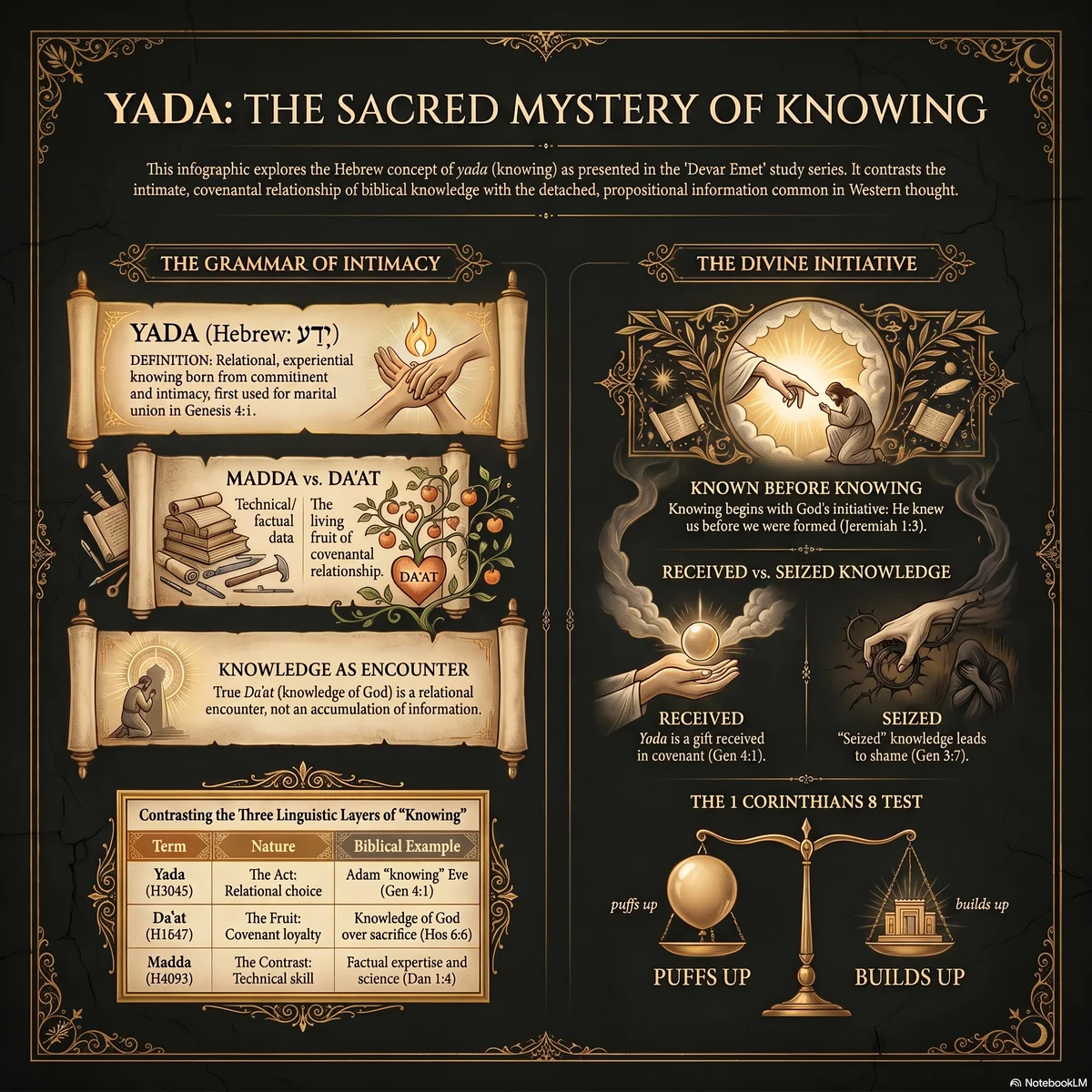
Translation Loss · יָדַע (H3045) — The English "to know" is predominantly cognitive: it concerns holding a proposition to be true. Whoever "knows that God exists" does not thereby have a relationship with Him. Translation Loss
Yada describes something different: knowing through fellowship, experience, and surrender. It is the word the Torah uses for marital union (Gen. 4:1) and for the knowledge of God (Hos. 6:6) — not because Scripture makes no distinction between the two, but because both require the same depth of personal involvement.
Restoration: for yada/da'at, do not simply use "know" — use "know through relationship" or "relational knowing," and never read "knowledge of God" as information, but as encounter.
The three layers of Knowing
To understand the reach of יָדַע, it helps to see the action, the fruit, and the contrast side by side:
"The beginning of wisdom (chochmah) is the fear of YHWH, and the knowledge of the Holy One (da'at kedoshim) is understanding (binah)."
Proverbs 9:10 · Canonical · H1847 · H998 · Prov. 9:10Proverbs here equates da'at and binah — the knowledge of the Holy One is understanding. This is no coincidence for this place in the study walk: Journey 3, of which this study forms the first step, carries as its Hebrew name בִּינָה (Binah). Knowing therefore does not precede understanding as a separate, preparatory phase — Scripture itself identifies them with each other.
The Contrast: Grasped versus Received Knowing
Before Genesis 4:1, the Torah places an opposite form of yada — and the two stand deliberately over against each other in the text.
"And the eyes of them both were opened, and they knew (vayede'u) that they were naked..."
Genesis 3:7 · Canonical · H3045 · Gen. 3:7"Behold, the man has become like one of Us, to know good and evil (lada'at)..."
Genesis 3:22 · Canonical · H3045 · Gen. 3:22This is the same root, but an opposite movement. Genesis 2:25 says just before the fall that the man was naked "and they were not ashamed" — the text deliberately builds a mirror: unashamed not-knowing before the fall, ashamed knowing afterward. This yada is not received but grasped — precisely the serpent's promise: "you will become like God" (Gen. 3:5). Its fruit is not intimacy but shame (3:7), and YHWH's own verdict in 3:22 makes the consequence explicit: this form of knowing leads to exile from the Tree of Life, not to access to it.
Compare this with Genesis 4:1: the same root, yada, but now received within the covenant of marriage — and the fruit is life (conception), not shame. Two forms of the same verb, two opposite outcomes: grasped knowing ends in exile; received knowing ends in fruit. Canonical · Gen. 2:25, 3:5–7, 22, 4:1
The Contrast: Da'at is not Gnosis
This same pattern — grasped knowledge versus received knowledge — returns in the New Testament. The Greek gnosis (G1108) is itself already corrected there when it becomes detached from love. Paul writes to Corinth:
"We know that we all have knowledge (gnosis). Knowledge puffs up, but love (agape) builds up... But if any man love God, the same is known (egnostai) of him."
1 Corinthians 8:1–3 · Canonical · G1108 · G1097 · 1 Cor. 8:1–3Paul inverts the relationship: not "I know God, therefore I have knowledge," but "I love, therefore I am known by Him." This is exactly the same distinction this study walk already holds to in refusing kabbalistic speculation — knowledge that detaches itself from the canonical, relational ground becomes an end in itself, and precisely thereby loses its value as da'at.
My people are destroyed for lack of knowledge
Hosea voices YHWH's accusation with a sharpness few other texts match: "My people are destroyed for lack of knowledge (da'at); because you have rejected knowledge, I will also reject you, that you shall be no priest to me." Canonical · H1847 · Hos. 4:6
This is not a call for more Bible knowledge in the western sense — Israel had the Torah, the priests, the sacrificial system. What was missing was da'at: the living, relational engagement with YHWH that alone gives the rituals meaning.
"For I desired mercy (chesed), and not sacrifice; and the knowledge of God (da'at Elohim) more than burnt offerings."
Hosea 6:6 · Canonical · H1847 · Hos. 6:6Hosea 6:6 is the sharpest summary of the whole halacha of knowing: da'at Elohim is not set against sacrifice because sacrifice is wrong, but because sacrifice without da'at becomes an empty shell. Yeshua quotes this text twice in Matthew (9:13; 12:7) — not as a correction of the Torah, but as a restoration of its intent.
Yeshua defines eternal life not as correct doctrine about God, but as a sustained, relational state of knowing: "And this is life eternal, that they might know (ginoskosin) You, the only true God, and Jesus Christ, whom You have sent." The halacha of knowing is therefore not one component of the spiritual life — it is the spiritual life.
Knowing does not begin with effort but with stillness: "Be still, and know (u-de'u) that I am God" (Ps. 46:10, H3045). Before there can be relational knowing, one's own striving must first come to rest — the same movement already described in the study Hear at the "qol demamah daqqah," the sound of a shattering stillness. Knowing and hearing share the same ground: silence first, then understanding.
Halachic application: three concrete exercises
1 · Praying for encounter, not information. Before you study a passage of Scripture, pray first in Moses' own words: "Show me Your way, that I may know You" (Ex. 33:13). Study without this prayer quickly becomes madda instead of da'at.
2 · The 1 Corinthians 8 test. When you judge someone based on an opinion or conviction, test yourself: does my knowledge build up in love, or does it only puff myself up? Knowing without love is gnosis, not da'at.
3 · The connection with Behold. Connect this halachic line to the study Behold: where chazah keeps the gaze fixed on YHWH's loveliness, yada adds reciprocity — knowing is never one-way traffic, and beholding without knowing remains at a distance.
Testimonies of Relational Knowing
Throughout the canon, YHWH shows what it means to be known and to know — and, in one stark counter-example, what remains when knowledge becomes detached from love.
Directly after the sin of the golden calf, at the moment the covenant is at stake, Moses does not ask for strategy or protection. He asks for encounter: "Show me now Your way, that I may know You, and that I may find grace in Your sight."
YHWH's answer confirms what was already true: "You have found grace in My sight, and I know you by name." The knowing here is no reward for Moses' perseverance — it already existed before he asked for it. His question is the answer to something that already was. Canonical · Ex. 33:13, 17
Counter-example — Balaam knows, but does not love. In the study Behold we already saw how Balaam describes himself as "one who knows the knowledge of the Most High (v'yode'a da'at Elyon)... who beholds the vision of the Almighty" (Num. 24:16, H1847/H3045). His da'at was real — and yet his heart remained fixed on reward. This is the mirror of 1 Corinthians 8: knowledge without love puffs up, but does not build up. Canonical · Num. 24:16
Counter-example — Mighty works without being known. Yeshua himself speaks the sharpest version of this pattern in the Sermon on the Mount. People who prophesied in His name, cast out demons, and did many mighty works — real, visible spiritual ministry — hear: "I never knew you (oudepote egnon hymas); depart from Me, you who practice lawlessness (anomia)" (Matt. 7:21–23, G1097, G458).
This is the sharpest counterpart to Exodus 33:17 above: where Moses hears "I know you by name," these hear "I never knew you" — the same verb (ginosko/yada), the opposite outcome. Mighty works "in His name" are no proof of being known; crying "Lord, Lord" (Matt. 7:21) is not relationship. The same lesson as with Balaam — now from the mouth of the Messiah himself. Canonical · G1097 · Matt. 7:21–23
Counter-example — Present at the light, absent from the appointment. The parable of the ten virgins (Matt. 25:1–13) repeats the pattern of Matthew 7:23, but with a sharper Greek term: where Yeshua there says oudepote egnon (from ginosko), here it is ouk oida hymas — "I never knew you" (G1492, not G1097). Oida carries no processual, relational weight the way ginosko does; it denotes something that was never even perceived or registered. The foolish virgins are not rejected because their relationship weakened — there never was one.
The difference between the wise and foolish virgins lies not in how much they suffered or endured, but in presence at the moed (מוֹעֵד, H4150) — the Bridegroom's appointed moment. This is the same movement as yada elsewhere in this study: not knowledge that is earned, but intimacy built by showing up again and again. The weekly Shabbat is exactly this practice in miniature — see Shabbat Covenant for the full treatment. Canonical · G1492 · Matt. 25:12 · H4150
Where Jeremiah 1:5 describes a one-time, pre-birth knowing, David paints the same knowing as a continuous, all-encompassing reality: "O YHWH, You have searched me and known me (vateda)... Such knowledge (da'at) is too wonderful for me; it is high, I cannot attain it."
David does not respond with fear of this all-knowing gaze, but with wonder. This is the fruit of yada when it is received rather than feared: no loss of control, but rest. Canonical · Ps. 139:1, 6
Jeremiah's calling does not begin with his fitness but with YHWH's prior knowing: "Before I formed you in the belly, I knew you; before you came out of the womb, I sanctified you."
Knowing here precedes forming — not the other way around. Jeremiah's entire prophetic identity rests on a relationship older than his own existence. Canonical · Jer. 1:5
Through Hosea, YHWH speaks the covenant promise to unfaithful Israel, in the language of a betrothal: "I will betroth you to Me forever; I will betroth you to Me in righteousness and in justice, in lovingkindness and in mercy. I will betroth you to Me in faithfulness; and you shall know YHWH (v'yada'at et-YHWH)."
The betrothal does not end in a ceremony, but in knowing. This is exactly the language of Journey 3 — stranger becomes bride — and connects with the already-built studies on the Heavenly Wedding. Canonical · Hos. 2:19–20
Paul, with his flawless Pharisaic knowledge of the Torah, revalues everything: "Yes doubtless, and I count all things but loss for the excellency of the knowledge (gnosis) of Christ Jesus my Lord..." — and formulates his life's goal not as knowing more, but as: "that I may know Him (tou gnonai auton)."
The same man who knew the Scriptures better than almost anyone places all that madda subordinate to the one relational ginosko. Canonical · Phil. 3:8, 10
From Moses to Paul, the line is unchanged: knowing begins with YHWH who knows, is answered in relationship, and only becomes da'at when carried by love. Without that love, even the most impressive vision — as with Balaam — remains fruitless.
VIII · The Monday-morning Test — Practical Application
Knowing is not pious theory — it is the choice, this week, to remain in relationship with someone instead of merely forming an opinion about them.
On Monday morning it is easy to reduce people to positions: a colleague to his opinion, a family member to his choice, a believer to his theology. That is madda — information about someone. But the halacha of yada asks for something costlier: attention, time, and the willingness to be surprised by who someone really is.
This week, concretely: Choose one person you disagree with or would rather keep at a distance. Ask them one sincere question this week to get to know them — not to convince them. Then pray Exodus 33:13 aloud over yourself: "Show me Your way, that I may know You."
- The difference between yada (relational knowing) and madda (expertise). Which of the two dominates your daily engagement with the Scriptures?
- YHWH's knowing of you precedes everything (Jer. 1:5). Does that change how you view your own fitness or unworthiness?
- Spiritual knowledge is not an achievement of study alone, but the fruit of relationship — Balaam proves that knowledge without love remains fruitless.
- "Knowledge of God" is not a collection of correct statements, but a continuous, reciprocal encounter (John 17:3).
- Test your own Bible study: does it build up in love, or does it puff up in being right (1 Cor. 8:1)?
- Pray deliberately for da'at Elohim this week before you pray for insight into a specific question.