We often quickly reduce "understanding God's voice" to the individual and psychological — an inner impression, a feeling. But Scripture draws a different dynamic. When Elijah waits for YHWH on Horeb, He does not come in the wind, not in the earthquake, not in the fire — the three signs He Himself used at Sinai to mark His presence (Exodus 19). He comes in qol demamah daqqah: the sound of a shattering silence.
This study frames hearing YHWH not as a mystical skill but as halacha — a trainable, daily walk. The key word is שָׁמַע (shema): hearing that by definition carries response within it. Whoever says shema without doing has, according to the Hebrew language, not truly heard.
After this study you will understand:- Why YHWH withdraws from wind, earthquake, and fire on Horeb — and what the qol demamah daqqah says about that
- How YHWH's drawing (mashak) precedes all hearing — and why the voice does not sound in the chol, yet the initiative to leave it never lies with the person either
- What shema (H8085) truly means: three movements — perceiving, investing, acting — in one word
- The difference between shema and shamar (H8104), and why western translations narrow both down to "obey"
- What na'aseh ve'nishma (Exodus 24:7) teaches about the reversed order of doing and hearing
- How the conscience makes the same co-witnessing movement of the Spirit felt as Romans 8:16 — and why this is not a self-standing inner voice, but testimony within the boundaries of the Word
- How Yeshua's sheep recognize His voice (John 10:27) — and what that says about how you grow in recognition
- What forms the voice of YHWH takes in Scripture — dream, vision, angelic visit, prophetic word, written word — so you don't elevate one form as the only norm
- Why the Spirit's indwelling is not the same as being filled — and why that difference explains why the voice sometimes falls silent even though YHWH has not left
- Three concrete exercises to train your spiritual hearing in daily life
This study builds on the word study Shema Yisrael, which works out shema as confession of faith (Deuteronomy 6:4) — echad, the oneness of YHWH, and the love that flows from it. This study does not repeat that foundation but builds on it: from the confession of who God is to the practice of how you learn to understand Him. Read Shema Yisrael first if possible.
- 1 Kgs. 19:9–13 Elijah on Horeb — wind, earthquake, fire, and then the silence.
- Exodus 24:7 Na'aseh ve'nishma — we will do and we will hear.
- Exodus 33:18–23 Moses in the cleft of the rock — YHWH's character proclaimed.
- John 10:27 My sheep hear My voice, and I know them, and they follow Me.
- 1 Sam. 3:9–10 Speak, YHWH, for Your servant hears.
"After the fire came a sound of a thin silence. And it happened, when Elijah heard it, that he wrapped his face in his mantle."
1 Kings 19:12–13 · מְלָכִים אIn Hebrew thought, hearing is never a neutral, biological event. שָׁמַע — shema — by definition carries a response within it, positive or negative. Adam and Eve "heard the voice of YHWH" in the garden — and hid themselves (Genesis 3:8). The very first use of the word is already telling: shema is never mere registration of sound; it is always already an existential movement.
But before we can arrive at that movement, we must first understand the condition. For whoever seeks YHWH in the spectacle — in the wind, the earthquake, the fire — is looking in the wrong place. Elijah did that. We often do too.
Three Layers — Source, Condition, and Response
To understand hearing as halacha, we place it in a larger frame — three distinct but inseparable layers:
| Layer | Concepts | Function | Key verse |
|---|---|---|---|
| The Source | Voice קוֹל | YHWH speaks — through His revealed Word, not through arbitrary inner impressions. The Word is the map within which His voice sounds. | Exodus 33:19; John 10:3–5 |
| The Condition | Silence דְּמָמָה | The active reduction of noise — letting wind, earthquake, and fire (crisis, emotion, busyness) pass without seeking God in them. | 1 Kings 19:11–12; Psalm 46:11 |
| The Response / Action | Shema — hearing-and-doing שָׁמַע | The ongoing movement of orienting and acting. Not hearing as an antechamber to doing, but hearing as doing. | Exodus 24:7; 1 Samuel 3:9–10 |
The voice is what sounds. The silence is the space in which it can be heard. Shema is what happens when it truly gets through. Three layers, one movement — and Scripture refuses to separate them.
Echo — Qol Devarim: the Source has a name. "The Source" in the table above is not inarticulate sound. At Sinai itself, קוֹל (qol) and דְּבָרִים (devarim, plural of davar, H1697) stand together in a single sentence: "YHWH spoke to you out of the midst of the fire; a voice of words (qol devarim) you heard, but you saw no form, only a voice" (Deuteronomy 4:12). Voice, word, and hearing — precisely the three layers of this study — stand here canonically together. Tellingly, this verse sits in the middle of the very book called Devarim, which opens with "these are the words that Moses spoke" (Deut. 1:1) — see the study Parasha Devarim. Shema, then, is never merely hearing bare sound: it is always already directed at davar, a word with content that carries history — and that word, once heard, canonically issues in the first step (see the study Walking).
Back to the Mountain of the Covenant
Elijah finds himself at a low point. He has just won a spectacular victory over the prophets of Baal on Mount Carmel (1 Kings 18), but instead of national repentance, a death threat from Jezebel follows. Elijah flees — not just anywhere, but forty days and nights to Horeb, the mountain where Moses received the Torah. He literally returns to the birthplace of the covenant.
In the surrounding cultures, storm gods like Baal spoke through thunder, lightning, and earthquakes. Elijah, fresh from his Carmel victory, expects YHWH to intervene the same way: spectacular, overwhelming, unmistakable.
Notice what Elijah's flight actually is: not a self-chosen quest for reflection, but a movement that overtakes him — fear and exhaustion drive him into the wilderness, forty days long, all the way to the mountain of the covenant. This is no coincidence. It is a first instance of what this study will later call "the drawing" (mashak): YHWH moving the soul out of the ordinary, busy world (chol), even before there is any conscious, directed hearing. See the section below.
The text is built chiastically — a literary structure that forces the reader to shift focus:
A: A great, strong wind tore the mountains — but YHWH was not in the wind.
A′: After the wind came an earthquake — but YHWH was not in the earthquake.
A″: After the earthquake came a fire — but YHWH was not in the fire.
C: And after the fire: the sound of a thin silence.
The climax is not at A, A′, or A″ — those three are systematically denied. The climax is at C, the axis of the chiasm. Three times the expectation is built up with the classic Sinai signs from Exodus 19:16–18 (thunder, lightning, fire, a trembling mountain) — and three times radically rejected as the place of YHWH's presence.
The Hebrew קוֹל דְּמָמָה דַקָּה (qol demamah daqqah) is often translated as "a still small voice" or "a gentle whisper" — but that softens the text. Literally: the sound of a thin/fine silence. Qol (H6963) is voice or sound; demamah (H1827) is silence or calm; daqqah (from daq, H1851) is thin, fine, refined. Not emptiness — a sound that is silence.
Remez — Paleo-Hebrew (Jeff A. Benner): שָׁמַע consists of Shin, Mem, and Ayin. Shin: teeth, consuming, fire that takes in. Mem: water, chaos, the turbulent mass. Ayin: eye, truly seeing. Read as a story: hearing begins with consuming what comes through the chaos, until what is said is truly seen. This is Remez-layer — illustrative, not canonical explanation in itself, but a striking echo of the pattern in 1 Kings 19: there too the hearer passes through wind (chaos/Mem) and fire (consuming/Shin) before truly seeing — knowing — (Ayin).
The parallel with Exodus 19 is no coincidence. Elijah stands on the very same mountain where the Sinai theophany took place. But where the people at Sinai feared the thunder, lightning, and trembling mountain and kept their distance (Exodus 20:18–19), Elijah is invited to the opposite: not staying away from the spectacle, but stepping into the silence that follows it. Same mountain, same signs — but a different invitation. The Echo continues into Exodus 33, where Moses, on that same mountain, asks: "Please, show me Your glory" (verse 18) — and YHWH answers not with a spectacle, but with the proclamation of His Name and character: gracious, merciful, patient, abounding in lovingkindness and faithfulness (Exodus 34:6).
Why Doesn't the Voice Sound in the Chol? — Two Layers of Hearing
There is an apparent tension in what this study has said so far. On the one hand: the voice does not sound in the chol — the ordinary, busy, everyday life — but only in the silence of the midbar, far from home, on the mountain. On the other hand, na'aseh ve'nishma (further on, in the Halacha section) teaches that hearing often arises through going, not before it. But if hearing arises through walking, mustn't something already have been heard before you leave the chol? And if the voice doesn't sound in the chol — what awakens the ear enough to start walking?
The answer does not lie in some hidden, early stage of shema that the person would already possess. It lies in a different Hebrew root: מָשַׁךְ (mashak, H4900 — to draw).
Mashak — the drawing of YHWH. "With lovingkindness I have drawn you" (Jeremiah 31:3 — in the same breath as the promise of the renewed covenant, two verses later). "Draw me, we will run after You" (Song of Songs 1:4). The same movement has a word for the cord by which one is drawn: חֶבֶל / עֲבוֹת (chevel / avot, H2256 / H5688) — "I drew them with cords of a man, with bands of love" (Hosea 11:4). In the Renewed Covenant this is helkō (ἑλκύω, G1670): "no one can come to Me unless the Father who sent Me draws him" (John 6:44).
The initiative therefore never lies with the person. The soul does not leave the chol because it listened well enough to find its own way to the wilderness — it is drawn. Shema, the fine hearing, is not the cause of leaving the chol, but its fruit. Elijah's flight to Horeb, described above, is precisely this: not a self-chosen quest, but a movement that overtakes him.
This immediately resolves why the voice does not sound in the chol while the hearing is nevertheless already set in motion there: it is not the person who hears in the chol, it is YHWH who draws from the chol. Only across the border, in the midbar, does the hearing become fine enough to discern the qol demamah daqqah. There is thus no first hearing that precedes the drawing — the drawing precedes all hearing.
The drawing from within — Romans 8:15–16. In the Renewed Covenant, mashak takes on an indwelling form. Paul writes that whoever receives the Spirit thereby receives a cry within — "Abba, Father" — and that "the Spirit Himself bears witness with our spirit that we are children of God" (Romans 8:16). The Greek verb is symmartyreō (συμμαρτυρέω, G4828) — to co-witness, to testify jointly. The Spirit does not call from outside; He testifies from within, so closely woven into the human spirit that His witness feels like one's own longing. The restless desire to pray, the pull toward YHWH before there are even words — that is itself already the fruit of the drawing, not the start of a self-generated search. The same movement as Hosea 11:4 and John 6:44, now indwelling and continuous.
Remez — Midbar and Davar. The Hebrew מִדְבָּר (midbar, wilderness) shares its three-letter root ד־ב־ר with דָּבָר (davar, word). Linguistically, then, the wilderness is not coincidentally the place where the voice sounds — it is related to "the place of the word." Isaiah 40:3 captures this exactly: קוֹל קוֹרֵא בַּמִּדְבָּר — "a voice (qol) crying in the wilderness (bamidbar)." The same qol that sounds on Horeb sounds here as announcement.
This pattern deliberately repeats in the Renewed Covenant. John the Baptist does not cry out in the temple or the city, but in the wilderness (Matthew 3:1–3) — whoever wants to hear him must first leave the chol of the cities behind. And before Yeshua's ministry begins, He is led into the wilderness for forty days (Matthew 4:1) — the same movement as Elijah's forty days to Horeb.
In summary: hearing has two interlocking layers, not a straight line. First the coarse drawing (mashak) that moves the soul out of the chol — YHWH's initiative, not the person's. Then the going itself, in which the chol is peeled away. Then the fine hearing (shema in its full meaning) that can only sound in the midbar. And then — this is the spiral of na'aseh ve'nishma — a deeper going that opens a still deeper hearing. Not "first understand, then do," nor simply "first do, then understand," but an ongoing interplay that always begins again with YHWH who draws.
The complete framework of chol, midbar, and kodesh — the four spaces in which a soul can stand, and the mechanism of YHWH's drawing versus the self-woven cord of decay (Proverbs 5:22) — is worked out in the foundation study Drawn — the Position of the Soul before YHWH. This study does not assume that framework, but builds on the hearing-portion of it.
Shema (שָׁמַע, H8085) — Three Movements in One Word
The Hebrew verb shama has no direct English translation, because it carries three layers of meaning that we pull apart into separate words:
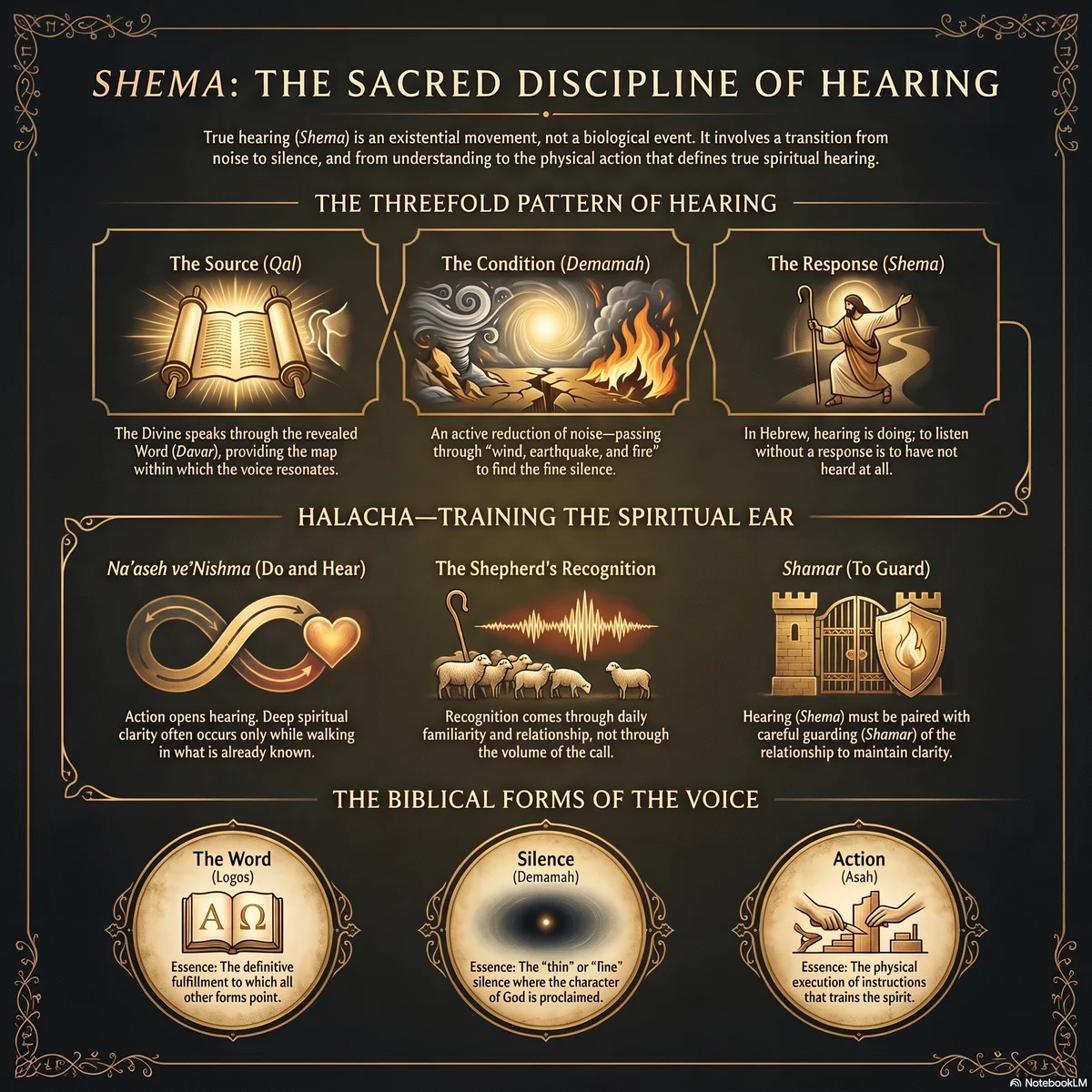
In Old Hebrew there is no separate word for "obey" in the sense of following an order. When YHWH asks for obedience, the text simply uses shema. Understood biblically, listening without doing is not listening at all — biologically you may have registered sound, but shema you have not done.
Translation loss: shema (H8085) versus shamar (H8104). Both are often rendered in western translations with the same word "obey" — but they are two fundamentally different movements. Shema is orienting, attuning, directing yourself toward the voice. Shamar is guarding, cherishing, carefully holding on to what has already been received — as a shepherd guards his flock (Genesis 2:15, Adam "working and keeping" the garden). In Deuteronomy 6 both verbs stand side by side as a twofold covenant movement: hear (shema) and keep (shamar). So it is not quite accurate to say there is "no other word for obey" — there are two words, and neither means legal duty-fulfillment under threat of sanction. Both are relational: one is the attunement, the other the caring faithfulness that follows.
These two words together — shema and shamar — give a fuller picture than the English "obey" can ever carry. Shema without shamar is a moment of attunement without durability. Shamar without shema is dutiful routine without a living relationship. Hearing, as this study means it, carries both within it: the orientation and the perseverance.
Shema in two directions — Deuteronomy 9:19, 23. Shema is not only a movement from the person toward YHWH. After the sin of the golden calf, Moses writes: "For I was afraid of the anger and hot displeasure... but YHWH heard (וַיִּשְׁמַע, vayishma) me that time also" (Deuteronomy 9:19) — the same verb shama, now with YHWH as subject. Four verses further on, in the same chapter, stands the mirror image: the people had precisely not "listened (shema) to His voice" (9:23) — the very cause of the crisis Moses is now praying about. Shema, then, is no hierarchical one-way traffic: it is a relational attunement that flows just as much from YHWH toward whoever intercedes for another as from the person toward YHWH. The same pattern as "it is never about you" above — Moses' shema-receiving intercession serves the people, not himself.
Remez — Psalm 32:8, three verbs on one thread. "I will instruct you (sakal, H7919) and teach you (yarah, H3384) in the way you should go; I will counsel you (ya'ats, H3289), My eye upon you." Yarah is the same root as Torah (H8451) — to teach is thus literally "to give Torah." Ya'ats is the same root as Yoetz, "Wonderful Counselor" (Isaiah 9:6). Hearing in its full sense is thus never an isolated word — it stands in a cluster of teaching, directing, and counseling, all three rooted in the same relational guidance.
The pierced ear — Exodus 21:5–6; Deuteronomy 15:16–17. The Torah contains the law of the willing servant: one who may be freed after six years of service, but who chooses out of love for his master, his wife, and his children to stay, declares it: "I love my master, my wife, and my children; I will not go out free." His master then brings him to the doorpost and pierces his ear with an awl. This organ — the ear, the very instrument of shema — is physically marked as a sign of lasting, voluntary devotion.
This is the sharpest biblical image of what "hearing" means in this study: not a one-time event, but a hearing permanently marked by a choice made out of love. Paul and Peter, following this pattern, call themselves bondservants — doulos — of Yeshua (Romans 1:1; 2 Peter 1:1): not forced servitude, but choosing to remain out of love, exactly like the eved who has his ear pierced.
Contrast — What Hearing Is Not
To sharpen shema, you must distinguish it from what it is often confused with. It is not psychological self-perception ("I feel an impression"), not a mystical gift for a select few, and not a replacement of the revealed Word by an inner voice that claims authority in itself. Shema is always directed — toward the voice of YHWH as it sounds in His Word and, in line with that, in life. An inner prompting that runs contrary to Scripture is by definition not shema. Nor is it an intellectual achievement: Paul writes to the Corinthians that his message did not rest on persuasive words of wisdom, but on the demonstration of the Spirit and of power, "so that your faith would not rest in the wisdom of men, but in the power of God" (1 Corinthians 2:1–5).
Correction: Psalm 46:10 — "Be still." The Hebrew command is הַרְפּוּ (harpu), the plural imperative of raphah (H7503) — "let go, let drop, cease striving." Not a call to inner calm as such, but a command to release one's own grip: "Let go, and know that I am God." This connects closely to the movement on Horeb — not clinging to the noise of one's own effort, but letting go so that the demamah, the silence, gets room.
The Forms of the Word
Horeb shows one form of the voice — the qol demamah daqqah, after wind, earthquake, and fire. But Scripture knows more forms. Hebrews itself summarizes this: "God, who at various times and in various ways spoke in time past to the fathers by the prophets, has in these last days spoken to us by His Son" (Hebrews 1:1–2). Whoever expects only the silence-on-the-mountain misses the other, equally canonical forms in which YHWH speaks.
| Form | Hebrew / Greek | Canonical example |
|---|---|---|
| Audible voice | קוֹל qol | Moses at the burning bush (Exodus 3:4); Samuel as a boy (1 Samuel 3); Elijah in the demamah (1 Kings 19) |
| Dream | חֲלוֹם chalom, H2472 | Joseph, son of Jacob (Genesis 37; 40–41); Solomon at Gibeon (1 Kings 3:5); Joseph, husband of Mary (Matthew 1:20; 2:13) |
| Vision | חָזוֹן / מַרְאָה chazon H2377 / mar'ah H4759 | Isaiah's throne vision (Isaiah 6); Ezekiel's visions; Peter on the roof at Joppa (Acts 10:9–16); John on Patmos (Revelation 1) |
| Angelic visit | מַלְאָךְ malach | Gideon at the winepress (Judges 6:11–24); Mary in Nazareth (Luke 1:26–38) |
| Prophetic word through a person | נָבִיא navi | The whole prophetic corpus — "Thus says YHWH"; Nathan confronting David (2 Samuel 12) |
| Written word | כָּתַב katav | The tablets of the Ten Words, written by YHWH Himself (Exodus 31:18); the writing on the wall (Daniel 5) |
| The Son — the definitive Word | λόγος logos | Hebrews 1:1–2 — not one form alongside the others, but the fulfillment to which all other forms point |
Urim and Thummim — canonical, but historical. The Urim and Thummim (Exodus 28:30) were a real priestly instrument by which the high priest could request YHWH's decision — the exact mechanism is not described in Scripture and remains unknown. This was a provision bound to the priesthood and the Temple, not a method to be re-enacted today with substitute objects. It is canonical as a historical fact; it is not a halachaic practice to be repeated.
This variety of forms is not a reason to look for a sign everywhere — that leads to noise, not clarity. It is a reason not to elevate one form as the only norm. Whoever waits only for audible voices may miss a dream. Whoever attends only to dreams may walk past the written Word that is already there. The constant through all the forms is not the form itself, but the Voice that speaks through it — and that Voice never contradicts itself against what has already been revealed.
It is never about you — it is about His kingdom. Look again at the examples in the table: none of these forms serves a private desire detached from the covenant. Joseph's dream pointed toward the salvation of an entire people, not his own status. Solomon, in his dream, asked for wisdom to govern the people — not for wealth for himself; he received that wealth precisely because he did not ask for it (1 Kings 3:9–13). Peter's vision on the rooftop opened the door of the kingdom to the nations. The writing on the wall in Daniel was judgment on a kingdom, not a personal message about prosperity. When a dream, prompting, or "sign" happens to confirm exactly what you already wanted for yourself — a car, a promotion, a relationship — with no covenant content or orientation toward YHWH's kingdom, there is a strong chance that your own desire is being mistaken for His voice. This is the same pitfall addressed further on in this section: the most dangerous voice is your own. So test not only whether something resembles a form from the table, but especially what it serves — your comfort, or His kingdom.
Na'aseh ve'Nishma — Doing Opens Hearing
At the covenant-making at Sinai, Israel answers the words of the Torah with a unique Hebrew phrase, right after the book of the covenant is read aloud:
נַעֲשֶׂה וְנִשְׁמָע — "We will do, and we will hear."
Exodus 24:7Our western logic says: first hear and understand, then decide whether to do. The biblical model reverses this. Na'aseh (from asah, H6213 — to do, to make) stands before nishma (from shama, H8085 — we will hear). Not because understanding is unimportant, but because the deepest layers of God's voice often only come through while you are already walking in what you already know.
This is not a case for blind action without discernment. It is a correction of the idea that you always need full clarity before taking a step. Whoever waits for the last word before carrying out the first word will often never move.
So when you want to understand God's voice, you don't always have to wait for a new, mysterious prompting. It often begins with actually carrying out what already sounds clearly in the revealed Word. Action opens hearing — not as merit, but as spiritual law.
The awakened ear — Isaiah 50:4–5. יָעִיר בַּבֹּקֶר בַּבֹּקֶר, יָעִיר לִי אֹזֶן, לִשְׁמֹעַ כַּלִּמּוּדִים — "He awakens (ya'ir, from עוּר, H5782) morning by morning, He awakens My ear to hear (lishmoa, shema) as those who are taught" (limmudim — the same root as talmid, disciple). The Servant of Isaiah 50 does not train himself into a practiced hearing; YHWH awakens it, day after day, with the same repetition already described by na'aseh ve'nishma above. Verse 5 continues: "Adonai YHWH opened My ear, and I was not rebellious" — the mirror image of the people who, in Deuteronomy 9:23, precisely did not listen (see the Concept section above).
Verse 10 carries the line back to this study's foundation: "Who among you fears (yare, H3372 — reverent awe, not panic-driven fear) YHWH, and hears (shema) the voice of His Servant — even one who walks in darkness and has no light." No spectacle, no light — only a voice to trust. The same pattern as the qol demamah daqqah on Horeb.
Indwelling and Filling — Why the Voice Sometimes Falls Silent
A practical question arises: if YHWH's Spirit permanently dwells in the believer, why does hearing sometimes feel so quiet? The answer does not lie in His absence, but in a distinction Scripture itself makes.
Two different things. Whoever belongs to YHWH is permanently sealed with His Spirit (Ephesians 1:13; 4:30) — that is indwelling: one-time, irreversible, possession. But Paul also gives an ongoing command, in a verb form that implies repetition: "be filled with the Spirit" (Ephesians 5:18). Indwelling is possession; filling is governance. You can possess the Spirit and still, hour after hour, drown Him out with your own agenda.
Paul also gives the test that keeps "being filled" from becoming a vague matter of feeling: "the fruit of the Spirit is love, joy, peace, patience, kindness, goodness, faithfulness, gentleness, self-control" (Galatians 5:22–23). Not goosebumps during worship, but fruit that is visible to others, over time. This is the same test as earlier in this section: does it serve your comfort, or is it recognizable as His character?
Do not quench the Spirit — 1 Thessalonians 5:19. This command of Paul's is the shamar-side of hearing: not actively resisting what has already been given. Unconfessed sin and a half-given heart do not mute the voice because YHWH stops speaking, but because one's own life fills the demamah with noise. So if the voice seems weak, the first question is not "why is He silent," but "what noise have I allowed."
The Conscience — Where the Testimony Becomes Felt
Up to this point, this study has treated shema as orientation toward a voice from outside: the Word, the Shepherd. But there is a place where that same co-witnessing movement becomes felt from within — the conscience (syneidesis, G4893).
Symmartyreō, twice — Romans 8:16 and 9:1. The same Greek verb from the bridge section above returns. In Romans 8:16, the Spirit Himself bears witness with our spirit to our adoption. In Romans 9:1, Paul writes: "my conscience bears me witness in the Holy Spirit" — here the conscience is the organ in which that same co-witnessing movement becomes felt, this time not as confirmation of sonship but as a touchstone of sincerity. Two applications of one pattern: the Spirit does not testify beside the person, but within, at different points of the inner life.
Guard your heart — Proverbs 4:23. מִכָּל־מִשְׁמָר נְצֹר לִבֶּךָ — literally: "above all that is guarded, guard your heart." The main verb is not shamar but natsar (נָצַר, H5341 — likewise to guard, to keep), with mishmar (מִשְׁמָר, H4929 — a noun from the shamar root itself) as its object. Two related roots for watchfulness in one sentence: guard (natsar) what must itself already be guarded (mishmar). This is not a separate line alongside shamar, but an intensification of it — exactly at the point this study places the conscience: the heart as the most closely guarded point of the inner life, because, in the words of this verse, from it flow the springs of life.
Yeshua Himself confirms this same voice-recognition from another angle: "Everyone who is of the truth hears My voice" (John 18:37) — the same combination of hearing (akouō) and voice (phōnē) as in John 10:3 and 10:27, now applied to whoever loves the truth. Whoever abides in His word — a continuous, shamar-like verb form — knows the truth, and the truth sets free (John 8:31–32). This is not a self-standing inner voice detached from the Word: the conscience co-witnesses within the boundaries the Word has already set, not alongside or above it.
This also corrects a common framing: it is not that obedience "earns" YHWH's blessing, as a transaction. The Torah-instruction written on the heart (Jeremiah 31:33) is not an external law code to be satisfied in order to receive something — it is the very life-structure of the relationship itself. The conscience that condemns does not act as prosecutor on behalf of a legal system, but as the place where the Spirit lets one feel that orientation (shema) has come loose from what is already known. When the heart does not condemn, there is confidence to draw near (1 John 3:19–21) — not because something has been earned, but because nothing stands in between.
Echo — Isaiah 51:7, shema and Torah-in-the-heart. שִׁמְעוּ אֵלַי יֹדְעֵי צֶדֶק, עַם תּוֹרָתִי בְלִבָּם — "Hear (shim'u, shema) Me, you who know righteousness, the people in whose heart is My Torah" (Isaiah 51:7). The same combination as above: shema is not aimed at an external law code, but at a Torah already planted within — the same promise as Jeremiah 31:33, given a few chapters earlier through another prophet, here canonically confirmed in Isaiah. Note the precision: the parallel Isaiah 51:4 ("hiqshivu... ha'azinu") does not use shema but qashab (H7181) and azan (H238) — related but not identical verbs for "listening." Only verse 7 is canonically a shema-verse; verse 4 belongs to the same listening-family, not to the same root.
The Voice of the Shepherd
In John 10, Yeshua builds directly on this shema-pattern — and gives it a personal face: "My sheep hear My voice, and I know them, and they follow Me" (John 10:27). This is no loose metaphor but a precise description of shepherding practice in first-century eastern culture, and its details carry theological weight.
How do sheep recognize their shepherd's voice? In the ancient Levant, several shepherds sometimes shared one well or sheepfold for the night — the flocks mingled. In the morning, each shepherd called his own sheep, and only those sheep followed him — not because he called louder than the others, but because his voice was familiar to them. John 10:3–5 describes this exactly: the sheep know his voice, but a stranger's voice they will not follow, for they do not know the voice of strangers.
This recognition does not arise from a single, impressive moment. It grows through daily, familiar, often unremarkable interaction: the early morning, the call by name, the scent, the rhythm of the voice over months and years. Exactly as shema already showed in Genesis 3:8 — hearing is never neutral, and it grows in a relationship, not in a one-time contact.
This explains why Elijah on Horeb needed the silence to hear, and why Yeshua's sheep recognize His voice amid strange voices: both require a familiarity that does not arise in one spectacular moment, but in repeated, daily exposure to the same voice. Na'aseh ve'nishma and "My sheep hear My voice" are two sides of the same walk: doing trains the ear, and the trained ear recognizes the Shepherd ever faster, even amid the noise of strange voices.
This is also why understanding God's voice is never a matter of catching "the right signal" once, but of a lifelong, growing familiarity with how YHWH speaks — through His Word, through His character as revealed to Moses (Exodus 33–34), and through the voice of the Shepherd who knows His sheep by name.
Warning: the most dangerous voice is your own. The more familiar you become with hearing, the greater the risk that your own will disguises itself as God's voice — especially when that will happens to coincide with what you already wanted. Scripture warns explicitly against this: "Test the spirits, whether they are of God" (1 John 4:1), and Jeremiah opposes prophets who "speak a vision of their own heart, not from the mouth of YHWH" (Jeremiah 23:16). A reliable test: shema that truly comes from YHWH never stands at odds with what His Word already reveals, and rarely calls for isolation from community or revealed testing. Whoever consistently hears "God's voice" confirming exactly what he already wanted would do well to question himself most sharply here.
Elijah — from exhaustion to renewed mission (1 Kings 19:9–18). As soon as Elijah hears the qol demamah daqqah, he covers his face with his mantle — reverence, not fear. Immediately afterward, YHWH asks the same question as before: "What are you doing here, Elijah?" But now no repetition of the complaint follows — Elijah receives a concrete, practical assignment: anoint Hazael, anoint Jehu, anoint Elisha (verses 15–16). Hearing in the silence was never meant for spiritual consumption. It flows into renewed mission. Whoever truly does shema never walks away from the silence empty-handed.
Moses — character over spectacle (Exodus 33:18–23). On that same mountain, generations earlier, Moses asks: "Please, show me Your glory." YHWH places him in the cleft of the rock and covers him with His hand as He passes by — Moses may not see His face, but he hears the proclamation of His Name: "YHWH, YHWH, God, merciful and gracious, patient and abounding in lovingkindness and faithfulness" (Exodus 34:6). As with Elijah, the voice reveals not primarily power, but character. This is the canonical ground of what it means that YHWH makes Himself known in word, not in spectacle.
Samuel — the ear that learns to hear (1 Samuel 3:1–10). As a young temple servant under Eli, Samuel hears a voice three times that he does not recognize — he must learn what shema means in practice, step by step, guided by an elder who already knows the pattern. Only the third time does Eli recognize what is happening and teach Samuel the answer: "Speak, YHWH, for Your servant hears." Shema is visible here as something that grows — not a gift you have or don't have, but a hearing that develops through devotion and, not unimportantly, with the help of others further along the same walk.
Three figures, three moments, one line: hearing rarely begins with full clarity. It begins with availability — standing at the mountain, waiting in the cleft of the rock, or, as a child in the temple, answering when called.
VIII · The Monday Morning Test
Understanding God's voice does not begin with waiting for a new signal, but with na'aseh: this week, do one concrete instruction you've long known from Scripture but haven't yet carried out — before asking for new guidance. Also, deliberately reduce one source of noise: at a fixed time each day, for at least ten minutes, put your phone away and remain in silence without immediately filling it with prayer words. Afterward, write down in a few sentences what you noticed — not to force an experience, but to train your hearing through repetition, as Samuel learned to recognize what he heard.
Take one of these questions with you into the day. They are meant to be lived with, not answered quickly.
Sod — when there are no words left. This study has been about hearing. But there are nights when there is nothing to hear and nothing to say — only a sigh with no content. Paul does not call that failure: "the Spirit helps our weaknesses... the Spirit Himself makes intercession for us with groanings which cannot be uttered" (Romans 8:26). The Greek στεναγμοῖς ἀλαλήτοις (stenagmois alalētois) literally means: groanings without language. In such moments the whole movement of this study turns around — not you training to hear Him, but Him interceding from within, in a language that needs no translation: "He who searches the hearts knows what the mind of the Spirit is" (Romans 8:27). Shema does not have to be achieved then. It is, for a while, carried.
"Your ears shall hear a word behind you, saying, 'This is the way, walk in it,' whenever you turn to the right hand or to the left."
Isaiah 30:21 · יְשַׁעְיָהוּHearing never closes in on itself. It always points onward, to the way — to the walking that follows what has been heard.
- Scripture1 Kings 18–19; Exodus 3:4; 19:16–18; 20:18–19; 21:5–6; 24:3–7; 28:30; 33:18–23; 34:6–7; Genesis 2:15; 3:8; 37; 40–41; Deuteronomy 4:12; 6:4; 9:19, 23; 15:16–17; Judges 6:11–24; 1 Kings 3:5, 9–13; 2 Samuel 12; Proverbs 4:23; Psalm 32:8; 46:10; Isaiah 6; 30:21; 40:3; 50:4–5, 10; 51:7; Jeremiah 23:16; 31:3, 33; Daniel 5; Hosea 11:4; Song of Songs 1:4; Proverbs 5:22; Matthew 1:20; 2:13; 3:1–3; 4:1; Luke 1:26–38; John 6:44; 8:31–32; 10:3–5, 27; 14:17; 18:37; Acts 10:9–16; Romans 8:15–16, 26–27; 9:1; 1 Corinthians 2:1–5; Galatians 5:22–23; Ephesians 1:13; 4:30; 5:18; 1 Thessalonians 5:19; Hebrews 1:1–2; 1 John 3:19–21; 4:1; Revelation 1; 1 Samuel 3:1–10.
- Forms of the WordTable overview based on categories Scripture itself names (Hebrews 1:1–2; Numbers 12:6–8). Each form is separately covered canonically; the table adds no extra-biblical category.
- HebrewBrown–Driver–Briggs Lexicon: shama (H8085), shamar (H8104), qol (H6963), davar (H1697), demamah (H1827), daq (H1851), raphah (H7503), asah (H6213), sakal (H7919), yarah (H3384), ya'ats (H3289), mashak (H4900), chevel (H2256), avot (H5688), natsar (H5341), mishmar (H4929), yare (H3372), qashab (H7181), azan (H238), ur (H5782). Strong's Concordance.
- Greek NTThayer's Greek Lexicon — ἀκούω (akouō, G191), used in John 10:3, 27 and 18:37 for hearing the voice; ἑλκύω (helkō, G1670), "to draw," John 6:44; συμμαρτυρέω (symmartyreō, G4828), "to co-witness," Romans 8:16 and 9:1; συνείδησις (syneidesis, G4893), "conscience," Romans 9:1; στεναγμοῖς ἀλαλήτοις (stenagmois alalētois), "groanings which cannot be uttered," Romans 8:26. United Bible Societies Greek NT, 5th edition.
- Paleo-HebrewJeff A. Benner, Ancient Hebrew Lexicon of the Bible (2005). Pictographic analysis of shama (Shin-Mem-Ayin) — Remez layer, not canonically binding.
- Cultural-HistoricalShepherding practices in the first-century Levant — shared sheepfolds and voice recognition, as background to John 10.
- Further ReadingShema Yisrael — The Greatest Commandment (word study, Deuteronomy 6:4) — the foundation this study builds on. Drawn — the Position of the Soul before YHWH (foundation study) — the full framework of chol, midbar, and the drawing of YHWH. Parasha Devarim (parasha study) works out the qol devarim formula of Deuteronomy 4:12 from the perspective of the spoken word itself.