Ya'ad (יָעַד, H3259) — to betroth oneself, to make an appointment at a fixed time and place. This is the root behind the word moed (H4150) — God's appointed times. YHWH makes the appointment. He determines when, where, and how. The only question is: do you appear?
A halacha study is a verb study: not "what do I believe about the feasts" but "do I do what the verb asks." The verb here is appearing — concretely, this year, on His clock. The Zadok calendar indicates when. The omer counting is the route. The 2026 anchor dates are the dates.
After this study you will understand:- You know ya'ad (H3259) as to betroth/appear and understand how this irrevocably defines the moadim as marriage appointments — not a religious calendar but a covenant calendar.
- You can explain why the Hebrew day begins at sunset and what that concretely means for when a moed begins.
- You understand the calculation principle of the omer: the day after the weekly Shabbat within the Unleavened Bread week, per Leviticus 23:15.
- You know the 2026 anchor dates: Bikkurim 19 April and Shavuot 7 June — and why the Zadok calendar is leading over the rabbinic calendar here.
- You recognise from Matthew 7 and 25 the seriousness of not appearing — anomia as living as though God's appointed times do not matter.
Read Leviticus 23:4–16 slowly. Note the verb YHWH uses for the times and ask yourself: is this a calculation or an appointment?
The initiative lies with Him
Leviticus 23:4 opens with a fundamental announcement: "These are the appointed times of YHWH (moadei YHWH), holy assemblies, which you shall proclaim at their appointed times." The times are of YHWH — not of Israel, not of the synagogue, not of the church. He fixes them. He invites. And the invitation has a name that leaves no doubt.
אֵלֶּה מוֹעֲדֵי יְהוָה מִקְרָאֵי קֹדֶשׁ אֲשֶׁר-תִּקְרְאוּ אֹתָם בְּמוֹעֲדָם
"These are the appointed times of YHWH — holy assemblies — which you shall proclaim at their appointed times."
Leviticus 23:4 · Canonical · H4150 · H7121The verb tikre'u otam (you shall proclaim them) describes a public announcement — not as a subject of debate but as a fait accompli of God's agenda. The foundation of this halacha study is: YHWH is the host. He has a calendar. He has made appointments. The question is not whether we agree — the question is whether we appear.
Genesis 1:14: "Let there be lights in the expanse of the heavens… for signs, and for appointed times (lemoadim)." The sun, moon, and stars are not decorative — they are the clock of God's calendar. YHWH has structured creation itself as a time indicator for his appointments. Whoever lives on God's clock lives in sync with the creation order. Canonical · Gen. 1:14 · H4150
Ya'ad — the verb behind the moed
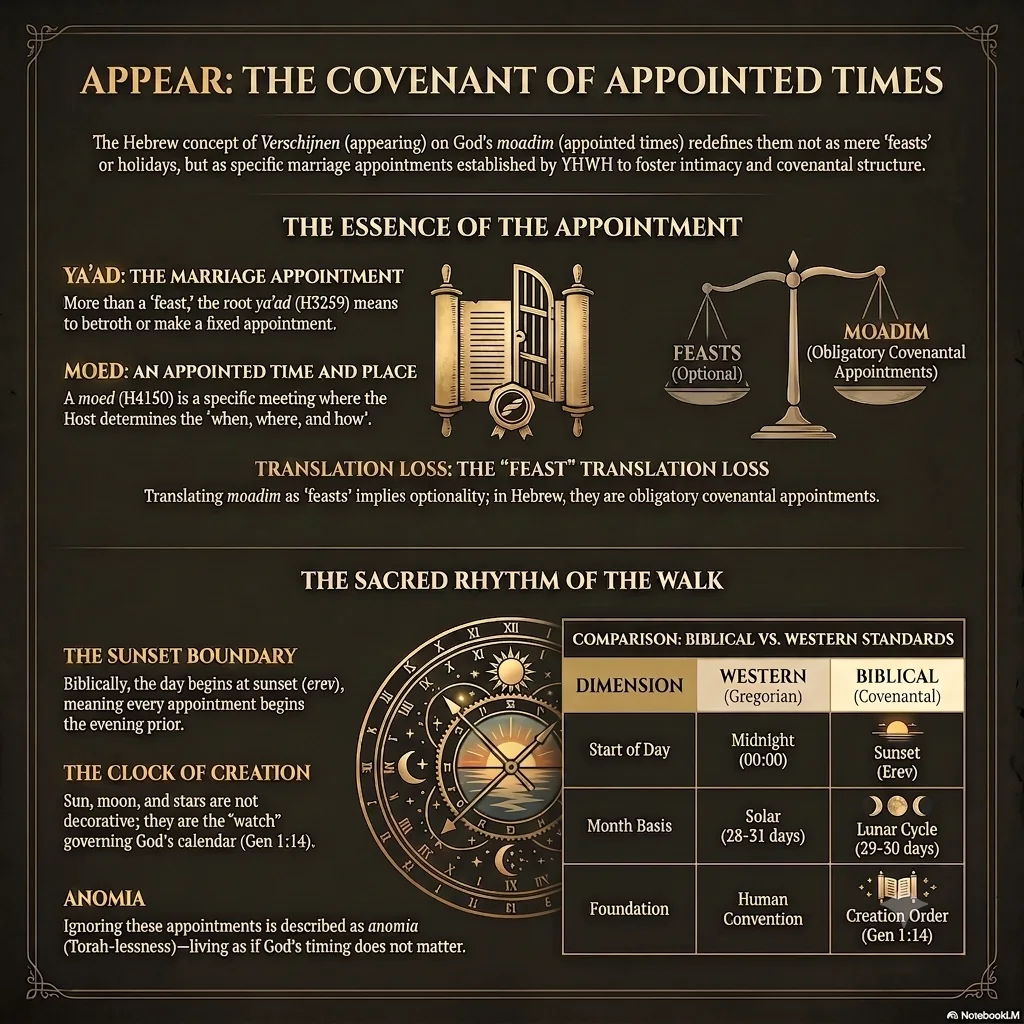
Translation Loss · מוֹעֵד (H4150) — Most Western translations render moadim as "feasts" (NBG, HSV, KJV). That is a serious translation loss. Moed (H4150) means primarily: appointed time, appointed place, assembly — from the root ya'ad (H3259): to betroth oneself, to make an appointment. A feast is something you celebrate when you feel like it. An appointment is something you have committed yourself to. The difference is everything. Translation Loss · H4150 · H3259
Corrective formulation: always use "appointed times" or "appointments with YHWH" as a translation of moadim. When a citation contains "feasts," add: "the word 'feasts' translates the Hebrew moadim — appointed meeting times, not voluntary celebrations."
Similar reduction: the Greek Septuagint translates moadim as heortai (feasts) — an understandable choice for a Greek-speaking audience, but the covenant depth of ya'ad is lost in it. The New Testament uses the same Greek term in citations, causing the "feast language" to carry through into modern translations and preaching. Translation Loss
The structure of appearing
The conditional promise stands in Leviticus 23:2: YHWH explicitly ties his presence to the moadim. Whoever assembles at the appointed times meets Him. Whoever stays away misses the appointment. This is not a penalty clause but a relationship description: appointments only work when both parties are present. The halachic structure of appearing has three concentric layers: knowing when, knowing how the day counts, and knowing how the omer counting works.
Layer 1 — When does the day begin?
Genesis 1:5 defines the day: "and there was evening and there was morning, the first day." The Bible counts from evening to morning — not from midnight to midnight. This has direct consequences: Pesach begins 14 Nisan at sunset; the Shabbat begins Friday evening; every moed begins the evening before it. Whoever goes to a Shabbat gathering on Saturday before the evening meal is already late: the Shabbat began Friday evening at sunset. Canonical · Gen. 1:5
Layer 2 — Which calendar is leading?
Layer 3 — How does the omer counting work?
Leviticus 23:15–16 gives a precise instruction: "You shall count from the day after the Shabbat — seven complete weeks. Until the day after the seventh Shabbat you shall count fifty days."
The text says: mimochorat haShabbat — the day after the Shabbat. Per the Zadok calendar this is the weekly Shabbat that falls within or directly after the Chag HaMatzot week. The firstfruits sheaf (Bikkurim) is brought on the first day after that Shabbat — always a Sunday. From there you count 49 days (7 weeks), and on the 50th day: Shavuot. Canonical · Lev. 23:15–16 · H6016
The rabbinic calendar interprets "Shabbat" as the first high Shabbat of Chag HaMatzot (15 Nisan), so the omer always begins on 16 Nisan and Shavuot always falls on 6 Sivan — a fixed date, not a variable day after an actual weekly Shabbat. Rabbinic · contextual reference
Three scenarios of appearing — and not appearing
Acts 2:1 opens with a detail that most readers skip: "When the day of Pentecost (Shavuot) arrived, they were all together in one place." They were together — at the moed, at the appointed time. Not by chance. Not spontaneously. They had kept the appointment.
The result: the Spirit descended, the nations heard in their own languages, three thousand people came to faith. Shavuot was the moed at which the Torah was given at Sinai — and the moed at which the Spirit was poured out. The disciples knew this. They appeared. And YHWH fulfilled his appointment. Canonical · Acts 2:1 · Lev. 23:15–16
Ten virgins wait for the bridegroom. All slept. But five had brought oil — five had not. When he came at midnight, five went in, five were locked out. The bridegroom said: "I do not know you."
The Greek ouk oida hymas — "I do not know you" — is the echo of Matthew 7:23, where Yeshua says the same to people who prophesied and worked miracles. The Hebrew equivalent is yada (H3045) — marital intimacy. Intimacy built by being present at the appointed times. Five virgins were involved with the bridegroom — but had not cultivated the habit of being ready on His clock. The moadim are the oil lamps of the walk. Canonical · Matt. 25:1–13
Yeshua says: "Depart from Me, you who work anomia." The Greek anomia (G458) = a + nomos (Torah): Torah-lessness. Not moral decay, not criminality — but living as though the Torah-guidance does not matter. And what is the very first foundation of the Torah for the relationship with YHWH? The moadim — the appointed times of Leviticus 23.
The judgment does not come from the absence of miracles or prophecy — those were there. The judgment comes from the absence of yada: the intimacy built by appearing at the appointed times. Whoever lives on their own clock and ignores the moadim practises anomia — even if they speak in tongues. Canonical · Matt. 7:23 · G458 · H3045
The three scenarios describe one movement from three angles: the disciples who appear and receive the Spirit. The five virgins who think they are ready but live on the wrong clock. And the working believers of Matthew 7 who never came to know YHWH through the appointments He had made. Appearing is not a pious ritual — it is the structure of covenant intimacy.
The 2026 anchor dates — concrete this year
Autumn dates depend on the first visible moon from Jerusalem. The above are approximations per the Zadok structure. Rabbinic equivalents may differ by 1–2 days.
VIII · The Monday-morning Test — Practical Application
YHWH has a calendar. The next moed is known. The only question this study asks is: are you going? Not: will you go someday. But: which next moed is in your calendar? This year, this date, this week of preparation? Concrete step: Note the next moed from the 2026 calendar above in your agenda. Set a reminder for one week before the date. And read Leviticus 23 on that day. That is appearing.
- Moed means appointment, not feast. How does that word change your relationship to the moadim?
- Five virgins had oil, five did not — while all were involved with the bridegroom. How do you recognise this distinction in your own walk?
- "The feasts are for Jews, not for me." How does ya'ad as a covenant term answer that conviction?
- Anomia in Matthew 7:23 — had you previously connected that word to missing the moadim?
- After the YHWH feasts, purification, appearing — what is the central insight you take away?
- In what way has your view of the calendar changed? Regarding Easter, Christmas, Pentecost?
- What step do you take this year concretely: attending a seder, counting the omer, celebrating Shavuot?