Every month, twelve times a year, a sound rings out in the Tanakh that receives barely any attention next to the great yearly feasts: the trumpets over the offerings at the start of the new month. Rosh Chodesh — "head of the month" — is the most underrated rhythm of the biblical calendar. Not a pilgrimage feast, not a day of rest like Shabbat, and yet a fixed, recurring moment that Scripture keeps naming from Moses to Revelation.
This study lays bare the canonical ground of Rosh Chodesh: the chodesh root that means renewal, the offerings and trumpet blasts the Torah does prescribe, and the prohibition on work the Torah explicitly does not prescribe. It marks precisely where the canonical text gives way to rabbinic custom — and builds three strong bridges to studies already on this site: the Zadok Calendar, the Shabbat Covenant, and Yom Teruah.
After this study you understand:- You know the canonical ground of Rosh Chodesh (Num. 28:11–15; Num. 10:10) and the exact difference between what is and is not commanded.
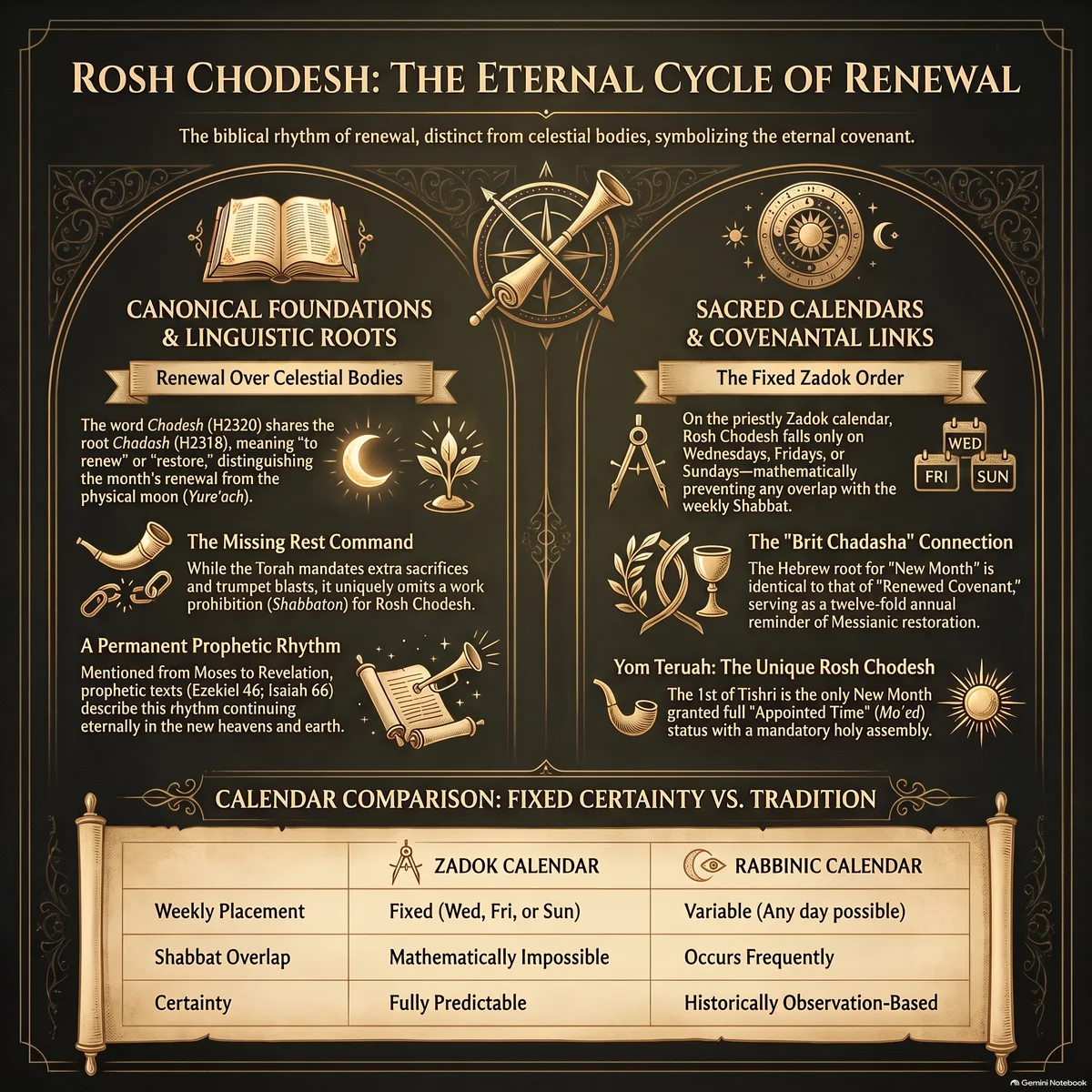
- You understand the chodesh root (H2320, from chadash H2318 — to renew) and the linguistic distinction from yare'ach (H3394, the physical moon).
- You can pinpoint exactly why no canonical prohibition on work exists, and what Amos 8:5 does and does not prove.
- You recognize the monthly application of the Zadok Calendar principle (every Rosh Chodesh on Wednesday, Friday, or Sunday — never on Shabbat).
- You see the linguistic link between chodesh (renewal of the month) and the Brit Chadasha (the renewed covenant) — the same Hebrew root.
- You understand why Yom Teruah is a special Rosh Chodesh, and how Rosh Chodesh relates to Shabbat.
- You know what the monthly renewal concretely means for your walk.
Read the four Scripture passages below slowly — preferably aloud. Before reading, ask yourself: what connects these texts? What pattern do they repeat?
The canonical text ground
וּבְרָאשֵׁי חָדְשֵׁיכֶם תַּקְרִיבוּ עֹלָה לַיהוָה
"On the first day of your months, you shall present a burnt offering to YHWH."
Numbers 28:11 Canonical · H2320This linguistic distinction, however, is no proof that lunar observation never mattered: the historical reason chodesh means "renewal" lies precisely in the moon's periodic return. The Torah itself nowhere specifies how the beginning of the chodesh is established — whether by observing the first crescent (the later rabbinic practice) or by a fixed solar calculation (the Zadok-priestly practice, see ⑤ Anchoring). It is on that point that the traditions diverge — not on the word chodesh itself.
What the Torah does and does not command
Two young bulls, a ram, seven yearling lambs as a burnt offering, plus a sin-offering goat — in addition to the daily offering. Canonical · Num. 28:11–15
The silver trumpets (chatzotzerot) sound over the offerings "as a memorial before your God" — explicitly named alongside the yearly feasts. Canonical · Num. 10:10
Where the Torah institutes a day of rest, it uses "shabbaton"/"kol melacha" (Shabbat, Yom Kippur) or "melechet avodah" (Pesach, Sukkot). For Rosh Chodesh this term is entirely absent. Canonical · contrast Lev. 23 / Num. 28
A striking detail: Rosh Chodesh does not even appear in the mo'edim list of Leviticus 23 — that list contains Shabbat, Pesach/Matzot, Bikkurim, Shavuot, Yom Teruah, Yom Kippur, and Sukkot, but not Rosh Chodesh. The only canonical instruction stands apart, in Numbers 28 and Numbers 10. Canonical · Lev. 23 (absence) · Num. 28; 10
From temple service to exile to eternity
The new-moon offerings are no one-time Sinai instruction that fades away — they run as a fixed service-line through the entire history of temple and priesthood: the Levites received an assigned task at the new-moon offerings under David (1 Chr. 23:31), Solomon built them into his temple schedule (2 Chr. 2:4; 8:13), Hezekiah restored them after decline (2 Chr. 31:3), and the returned exiles restored them as the very first act of rebuilding, before the temple's foundation itself was even laid (Ezra 3:5–6). Nehemiah then fixes their provision as a lasting communal obligation (Neh. 10:33). Canonical · 1 Chr. 23:31 · 2 Chr. 2:4; 8:13; 31:3 · Ezra 3:5–6 · Neh. 10:33
Outside the temple, Rosh Chodesh carried a recognizable social character: the royal court held a feast (1 Sam. 20:5), people visited a prophet on this day for teaching or counsel (2 Kings 4:23), and trade came to a standstill — not because the law commanded it, but because custom brought that about. Amos 8:5 exposes precisely this: greedy merchants impatiently waiting for "the new month to be over" so they can sell again. The text condemns their greed, not the existence of a legal rest command — it actually confirms that no such command existed, since the merchants themselves count the hours until the custom is over. Canonical · 1 Sam. 20:5 · 2 Kings 4:23 · Amos 8:5
That same social custom could, however, degenerate into empty religiosity. Isaiah pronounces a harsh judgment on behalf of YHWH: "Your new moons and your appointed feasts My soul hates... I cannot endure [iniquity and the solemn assembly]" (Isa. 1:13–14). Hosea announces that YHWH will, as judgment, cause "her feast days, her new moons, and her sabbaths" to cease (Hos. 2:11). Both texts unmistakably confirm the weight of Rosh Chodesh as a recognized holy time — while warning at the same time that an outwardly kept rhythm without justice is rejected by YHWH. Canonical · Isa. 1:13–14 · Hos. 2:11
Translation flag · Psalm 81:3 — "new moon" or "new month"? "Blow the trumpet at the new month [chodesh], at the full light [keseh], on our feast day." Many translations render chodesh here as "new moon" — exactly the translation choice this study already questions in ① The Ground. The Hebrew itself makes the distinction within this very verse: chodesh (month-renewal) stands next to keseh (a different word, which does refer to the moon's phase — the full light). The two terms side by side in one sentence confirm that the biblical text treats chodesh and the visible moon phase as two distinct concepts. Translation loss · chodesh ≠ "moon"
Ezekiel's temple vision fixes that the inner east gate remains shut on the six working days, but opens on both Shabbat and Rosh Chodesh (Ezek. 46:1–3) — two distinct, each self-standing holy times, each with its own opening ritual. Isaiah lifts this rhythm into eternity: in the new heaven and new earth, all flesh will come to worship "from new month to new month, and from sabbath to sabbath" (Isa. 66:23). The monthly rhythm, then, does not stop at fulfillment — it continues into the eternal state. Canonical · Ezek. 46:1–3 · Isa. 66:23
Paul names the yearly feasts, the new-moon days (chodashim), and the sabbaths in one breath a "shadow of the things to come, but the substance belongs to Christ" (Col. 2:16–17) — and adds that no one is to judge in this matter. Rosh Chodesh is not singled out or condemned here; it stands beside Shabbat and the yearly feasts in exactly the same category. Canonical · Col. 2:16–17
One Hebrew root, two renewals
This is no typological guess but a direct, verifiable linguistic fact: chodesh (H2320, "month/renewal") and chadash (H2318, "new/to renew" — the root behind Brit Chadasha, the renewed covenant of Jer. 31:31 and Luke 22:20) share the exact same three-letter Hebrew stem ח-ד-שׁ. Every monthly chodesh is literally the same word as the renewal the covenant itself carries. Canonical · H2320 · H2318 · Jer. 31:31 · Luke 22:20
Where the yearly feasts commemorate great, one-time saving acts, Rosh Chodesh is the small, recurring rhythm that brings believers back, twelve times a year, to that same renewal — no new offering, no new atonement, but a repeated reminder of what has already been permanently renewed in Yeshua. Canonical · Col. 2:16–17 (application)
Melchizedekian priesthood and calendar stability: an attractive but typological — hence Remez — connection links Yeshua's imperishable priesthood "after the order of Melchizedek" (Heb. 7) to the unchanging, mathematically stable Zadok Calendar that once guarded the new-moon offerings. The canonical text of Hebrews 7 stands firm; the specific link to calendar stability is a homiletical, not a textual, claim.
"Sun of Righteousness" (Mal. 4:2) and the fourth day of creation: the same treatment applies — Malachi's Messianic title is canonical, the link to the Zadok Calendar's solar anchor is Remez-typology, not a direct textual claim. Speculative-Remez · both connections
Three misunderstandings that distort the rhythm
The popular-theological reading: Rosh Chodesh is a "little Shabbat" with a comparable prohibition on work.
The Scriptural contrast: nowhere in Numbers 28 or Leviticus 23 does the term shabbaton or kol melacha appear for Rosh Chodesh. What is canonically commanded — offerings and trumpet blasts — stands apart from any obligation to rest. Amos 8:5 shows a social custom, not a legal text. Canonical · contrast Num. 28 / Lev. 23
The popular-theological reading (sometimes voiced as criticism): keeping a monthly rhythm tied to the lunar cycle resembles the veneration of celestial bodies.
The Scriptural contrast: the Torah nowhere ties Rosh Chodesh to the moon as an object of worship — the offerings and trumpets are directed "to YHWH" (Num. 28:11), not to a celestial body. In fact, the Torah explicitly forbids worship of sun, moon, and stars (Deut. 4:19; 17:3). Rosh Chodesh marks time; it worships no celestial body. Canonical · Num. 28:11 · Deut. 4:19; 17:3
The popular-theological reading: without a temple and offering service, Rosh Chodesh has no meaning left at all.
The Scriptural contrast: the offerings themselves were tied to the temple, but the rhythm of monthly renewal existed before the temple even did (1 Sam. 20, long before Solomon) and remains canonically in force into the eternal state (Isa. 66:23). Colossians confirms: a shadow of what is coming, not an abolished institution — and no one is to judge in this matter. Canonical · 1 Sam. 20 · Isa. 66:23 · Col. 2:16–17
Connection I — Rosh Chodesh on the Zadok Calendar: never on Shabbat
The Zadok Calendar reckons with four quarters of exactly 91 days (30+30+31), themselves exactly 13 weeks. That means every Rosh Chodesh of the year falls on a mathematically fixed weekday pattern — and never on Saturday.
| Month of the quarter | Length | Day 1 (Rosh Chodesh) |
|---|---|---|
| 1, 4, 7, 10 (Tekufah) | 30 days | Wednesday |
| 2, 5, 8, 11 | 30 days | Friday |
| 3, 6, 9, 12 | 31 days | Sunday |
The Rosh Chodesh of the 1st, 4th, 7th, and 10th month coincides with a tekufah — a seasonal transition (spring/summer/autumn/winter) — and thereby carries extra weight. The seventh-month tekufah is precisely Yom Teruah. Canonical · Gen. 1:14 · Lev. 23 (arithmetic, see also zadok-calendar.html)
Connection II — Rosh Chodesh versus Shabbat: two rhythms, no competition
Shabbat is weekly, instituted at creation itself (Gen. 2:2–3), with a complete prohibition on work. Rosh Chodesh is monthly, priestly-liturgically instituted (Num. 28), without a prohibition on work. Ezekiel 46:1 names them explicitly side by side — two distinct, self-standing holy times that need never overlap (certainly not on the Zadok Calendar) and never replace one another either. See Shabbat Covenant for the full treatment of the weekly rhythm. Canonical · Gen. 2:2–3 · Ezek. 46:1
Connection III — Yom Teruah: the Rosh Chodesh that is itself a moed
Yom Teruah (1 Tishri) is the only Rosh Chodesh that is also a full-fledged moed in Leviticus 23 — with its own holy convocation, apart from the ordinary monthly offerings. It is precisely here that the two lines meet: the monthly rhythm (Rosh Chodesh) and the yearly feast rhythm (the mo'edim) touch on this one day. See Yom Teruah — The Wake-Up Call of the King for the full treatment, including the same Zadok Calendar table from that feast's own perspective. Canonical · Lev. 23:23–25 (only Rosh Chodesh with moed status)
Connection IV — The rabbinic elaboration around Rosh Chodesh
Later Jewish tradition added a number of practices that give the day a distinct liturgical accent in synagogue and home, without canonical textual grounding:
- An exemption from work for women, with a midrashic explanation that women were exempted on this day because they refused to give their jewelry for the golden calf (Exod. 32). Rabbinic-Traditional · Mishnah Pesachim; j. Pesachim 4:1; midrashic tradition
- A prohibition on fasting. Rabbinic-Traditional · Megillat Ta'anit
- Reciting Hallel (usually "half Hallel") and an additional Musaf prayer. Rabbinic-Traditional · synagogue liturgy after the temple's destruction
- Omitting Tachanun (the penitential prayer). Rabbinic-Traditional · Geonic period
These points give the day liturgical color, but none carry a Torah anchor — precisely as consistently distinguished for the other feasts on this site.
Questions for reflection
Questions for personal reflection or fellowship
- Rosh Chodesh carries no prohibition on work, yet does carry offerings and trumpet blasts. What does that say about the difference between a day you must keep and a day you get to celebrate?
- Isaiah and Hosea warn that Rosh Chodesh could degenerate into empty religiosity. Where in my own rhythm does outward form creep in without justice?
- Chodesh and Brit Chadasha share the same Hebrew root. Does that change how I look at the start of a new month?
- If someone asked me whether keeping the new month isn't "Jewish" or "legalistic" — what would I say in one sentence?
The speakable testimony
Speakable faith — for when it is asked
"Rosh Chodesh, for me, is not a mandatory day of rest and not a legalistic rule — Scripture doesn't impose that either. It's the monthly reminder that God is a God of renewal: the same Hebrew root that names the new month also names the renewed covenant Yeshua instituted. Twelve times a year I get a fixed moment to return to that renewal — not to earn it, but to acknowledge it."