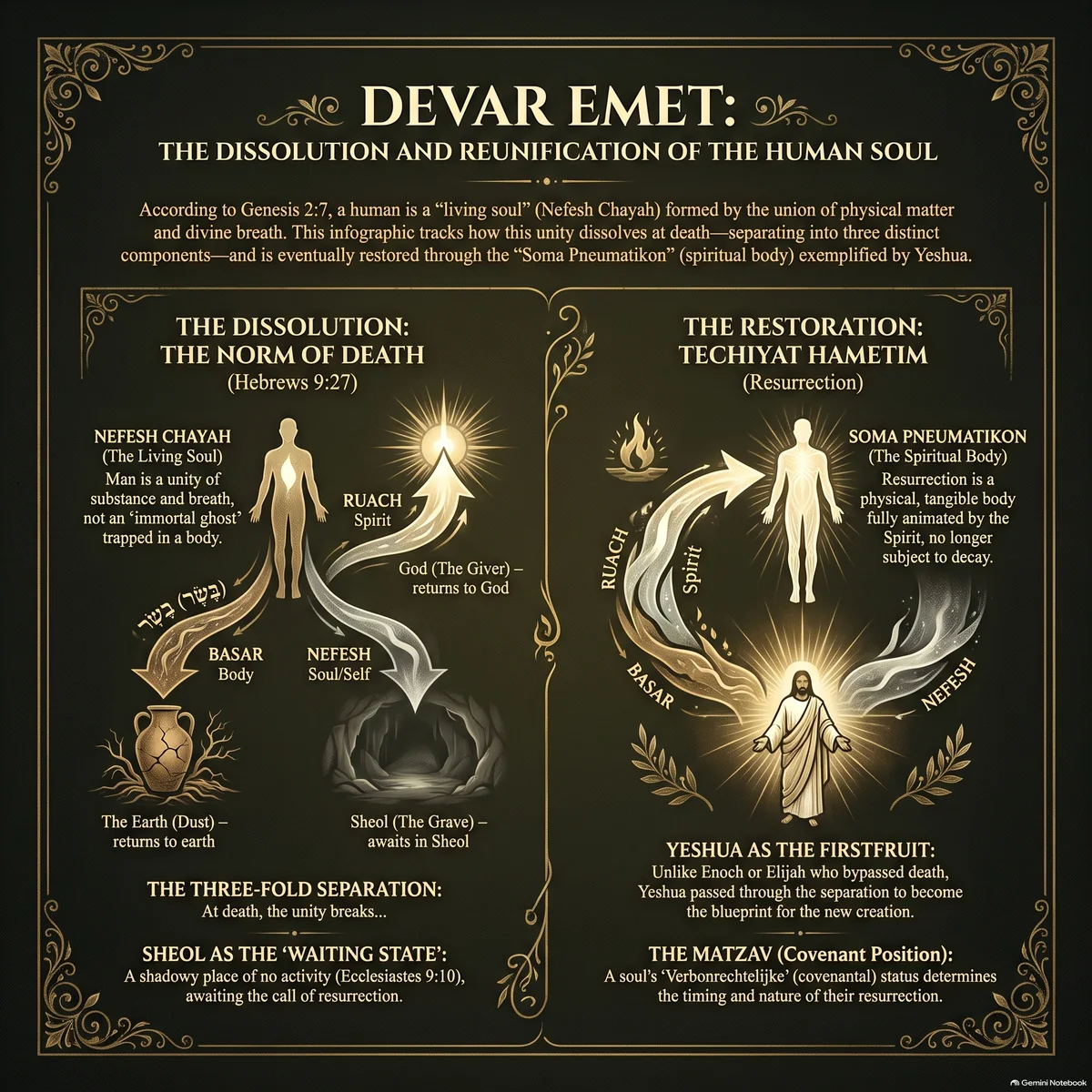
When a person dies, the unity of nefesh chayah from Genesis 2:7 ceases to exist as a unity. Basar (the body) returns to the earth. Ruach (the breath of life) returns to God, who gave it. Nefesh (the person, the conscious self) descends into Sheol — not annihilation, yet not full chaim either. This is the norm Hebrews 9:27 establishes: "it is appointed for man to die once." Yet Scripture also records canonically marked exceptions to that norm — Enoch, Elijah, the rapture of the living — and a final, definitive reuniting: the resurrection, in which Yeshua Himself is the firstfruits.
This foundational study brings that whole scheme together: where the three components of man go, when, and under what conditions — including the question of how matzav (the covenant position of the soul, from the foundational study Drawn — the Position of the Soul before YHWH) determines what canonically happens at death.
After this study you will understand:- You know the threefold division of basar, nefesh and ruach at death, and why nefesh in the Tanakh is not a Greek, immortal little soul.
- You understand Sheol as a waiting state, not a final destination or annihilation.
- You know the distinction between soma psuchikon and soma pneumatikon, and how Yeshua's resurrection is the firstfruits of it.
- You know why Enoch, Elijah and the rapture are canonically marked exceptions to the norm of Hebrews 9:27 — not a contradiction of it.
- You understand what the second death does and does not textually establish.
- You can apply the matzav cross-reference: how covenant position (Chol/Midbar/Kodesh) determines what happens at death and which resurrection category applies.
- You understand why Romans 6:5 describes baptism as a real union with both Yeshua's death and resurrection — a guarantee, not a symbolic remembrance.
Read Genesis 2:7 and Ecclesiastes 12:7 one after the other. Note what is joined together, and what comes apart again at death.
Drawn — the Position of the Soul before YHWH · the matzav scheme that is cross-referenced with this scheme in part ④.
The Overview — Seven Conditions of Basar, Nefesh and Ruach
The overview below summarizes the entire study in seven canonically distinct conditions — from Adam before the fall to the second death — arranged in five groups: the unbroken and the fallen state, the separation that is the norm, the canonical exceptions to it, the restored state, and the permanently sealed state.
| Condition | Basar (body) | Nefesh (soul) | Ruach (spirit) |
|---|---|---|---|
| Adam before the fall | dust + breath, psuchikon-unfallen | nefesh chayah, not yet cut off | directly from God, unbroken |
| Man after the fall (norm) | returns to dust (Gen. 3:19) | Sheol — waiting state | returns to God (Eccl. 12:7) |
| Enoch / Elijah / rapture | directly transformed — no separation | no separation | no separation |
| Resurrection (general) | soma pneumatikon | reunited, atoned | fully animated (Rom. 8:11) |
| Yeshua — incarnation | real basar, via Mary, outside the Adam line | nefesh chayah, without inherited sin | the Ruach Himself, unbroken |
| Yeshua — death and resurrection | fully through the separation (the grave) | temporarily Sheol (Ps. 16:10 / Acts 2:27) | to the Father (Luke 23:46) → first soma pneumatikon |
| Second death | — | permanently separated from the Source | — |
Two conditions share the same soma-psuchikon nature (1 Cor. 15:46), but not the same relationship to death: Adam before the fall had the Tree of Life within reach; man after the fall is cut off from it (Gen. 3:24).
Genesis 2:17: spiritual breach immediately at the transgression, physical dying only later. This hinge point is developed in the word study Life & Death.
At death, the unity of nefesh chayah (Gen. 2:7) comes apart into its three components — the norm Hebrews 9:27 establishes: "it is appointed for man to die once."
Hebrews 9:27 formulates the norm; Scripture itself marks these three cases as a textual deviation from it, not a contradiction.
Yeshua does not bypass the separation as Enoch and Elijah do — He passes through it fully, first, and comes out of it first (1 Cor. 15:20).
Ezekiel 37 mirrors Genesis 2:7 exactly: first the basar restored, then the ruach breathed in, then the graves (Sheol) opened. What is already accomplished in Yeshua is still future for the believer — soma pneumatikon, conformed to His glorified body (Phil. 3:21).
The only condition in this scheme the text does not indicate as reversible.
Genesis 2:7 — The Unity That Forms Man
Nefesh chayah is not a separate, third component alongside dust and breath, but the result of the two together. 1 Thessalonians 5:23 explicitly confirms the threefold nature in the Renewed Covenant: "may your whole spirit, soul and body (pneuma, psychē, sōma) be kept blameless" (paraphrase) — the same trinity, now in Greek.
The Threefold Division at Death
In the Tanakh, nefesh is not the immortal little soul that exists apart from the body — the word primarily denotes the whole living, breathing being, and can even denote a corpse (נֶפֶשׁ מֵת, "nefesh met," Lev. 21:11; Num. 6:6). Whoever reads nefesh as a Greek-Platonic little soul imports a foreign concept into the Hebrew text.
Sheol — The Waiting State
"For You will not abandon my nefesh to Sheol." — Psalm 16:10 (paraphrase)
Genesis 37:35 (Jacob: "I will go down to my son, mourning, to Sheol"), Psalm 30:4, and Psalm 89:49 confirm the same picture. Ecclesiastes 9:10 explicitly characterizes Sheol as a waiting state without activity: "there is no work, no plan, no knowledge, no wisdom in Sheol." Sheol is therefore not a final destination and not annihilation, but a shadowy waiting place for the nefesh, awaiting the resurrection. This is also why Psalm 16:10 is applied directly, messianically, to Yeshua's resurrection in Acts 2:27: not a flight into Sheol, but the return from it.
Ezekiel 37 — The Exact Mirror of Genesis 2:7
Ezekiel 37 is, literally in the text, the mirror of Genesis 2:7: first the dry bones become flesh and sinew again (basar restored), then the ruach is breathed in — and only then, in Ezekiel 37:12-13, are the graves (Sheol) opened and does "My people" come up out of them. The same order as Genesis 2:7, now applied to what fell apart after death. This is the canonical ground for Techiyat HaMetim (תְּחִיַּת הַמֵּתִים) — the rabbinic collective term for this fact, which is itself already textually established in Isaiah 25:8, 26:19, and Daniel 12:2.
From Soma Psuchikon to Soma Pneumatikon
Romans 8:23 explicitly places the renewal of the body still in the future: the believer already receives the redemption of the spirit (rebirth) and the ongoing renewal of the soul (Rom. 12:2), but "groan within ourselves, awaiting... the redemption of our body" (paraphrase). The same Ruach who, in Ezekiel 37, revives the dry bones, is the One who "will also give life to your mortal bodies" (Rom. 8:11, paraphrase).
Enoch, Elijah, and the Rapture — Exception, Not Contradiction
Hebrews 9:27 formulates the norm: "it is appointed for man to die once" (paraphrase). Scripture itself, explicitly, points to two categories of exception.
With Enoch and Elijah, the body does not go through the threefold division of part ① — no dust returning separately, no ruach going back separately, no nefesh descending into Sheol. The body is taken away directly. Paul describes exactly the same mechanism for a future, collective event, and calls it himself a musterion — a mystery:
"Behold, I tell you a mystery: we shall not all sleep, but we shall all be changed, in an indivisible moment, in the twinkling of an eye, at the last trumpet... for this perishable must put on imperishability." — 1 Corinthians 15:51-53 (paraphrase)
2 Corinthians 5:4 states it most sharply: "not that we want to be unclothed, but clothed upon, so that what is mortal may be swallowed up by life" (paraphrase). Three canonically distinct cases of the same underlying fact: with Enoch and Elijah already accomplished, individually; with the rapture still future, collectively; with most people, by way of the detour through Sheol and the resurrection. (Elijah's later, renewed connection to the end times — among others Mal. 4:5 — is left out of consideration here.)
The Second Death
Where mawet, in the norm of part ①, is the universal, reversible consequence of sin, the Renewed Covenant points to a second, further category: ὁ θάνατος ὁ δεύτερος, "the second death" (G2288 + G1208, named four times: Rev. 2:11; 20:6, 14; 21:8).
"Then death and Hades were thrown into the lake of fire. This is the second death: the lake of fire." — Revelation 20:14 (paraphrase)
Revelation 21:8 fills this in concretely: the cowardly, unbelievers, the detestable, murderers, the sexually immoral, sorcerers, idolaters, and all liars have their part in this lake of fire and sulfur — "this is the second death" (paraphrase). The list functions not as an exhaustive catalogue but as a sample list of what the text elsewhere summarizes as life without turning back to YHWH — the same moral categories already established by Deuteronomy 30 and Ezekiel 18 for mawet in general (part ①), now applied to its definitive, second form.
The second death lies, textually, after the resurrection and after the judgment — a different position than the first, universal mawet. Where the first death is canonically reversed (Techiyat HaMetim), the second death is not indicated in the text as reversible: it is the sealing of the state in which someone enters the judgment.
On the precise nature of the second death — definitive annihilation/non-existence, or ongoing conscious separation — canonical interpreters differ. The text itself calls it "death," which fits annihilation; at the same time, Revelation 20:10 explicitly uses, for satan, the beast, and the false prophet, "tormented day and night forever and ever." This study sets out the distinction without presenting either position as Devar Emet's canonical pronouncement.
The Etz Chaim (Tree of Life) from Genesis 3:24 returns in Revelation as the reward for the one who overcomes (Rev. 2:7; 22:14) — the same overcomers of Revelation 2:11, who suffer no harm from the second death, are the people who once again gain access to the Tree of Life that was sealed off since Genesis 3:24.
Yeshua — The Two Canonical Deviations That Confirm the Norm
Yeshua's constitution deviates canonically at two points from every other human being — not by bypassing the norm as Enoch and Elijah do, but by passing through it fully and coming out of it first.
His resurrection is the first full soma pneumatikon: not like Enoch and Elijah (who bypass the separation), but someone who does pass through it and comes out of it first — hence "firstfruits" (1 Cor. 15:20, 23), the pattern, not merely an early example of it.
"For if we have become united with Him in the likeness of His death, we shall also be in the likeness of His resurrection." — Romans 6:5 (paraphrase)
This verse lifts the pattern of being-firstfruits above a mere parallel into a guarantee. The Greek symphytoi (σύμφυτοι) — literally "grown together," as a grafted branch grows together with the trunk — describes baptism not as a symbolic remembrance but as a real union with both Yeshua's death and His resurrection (Rom. 6:3-4). Because He has passed through the full threefold division of part ① and come out of it as firstfruits, whoever is "grown together" with Him in His death is thereby equally assured of His resurrection — not as a separate event that happens to fall to the believer as well, but as the organic continuation of the same, single pattern.
"Beloved, now we are children of God, and it has not yet been made known what we shall be. But we know that, when He appears, we shall be like Him, for we shall see Him as He is." — 1 John 3:2 (paraphrase)
After His resurrection He had a tangible body with flesh and bones, which ate (Luke 24:39, 42-43), and at the same time a body no longer bound to the physical limitations of the fallen creation. Philippians 3:21 promises that the body of the believer will be "conformed" to this glorified body. Where Genesis 2:7 composed chaim out of dust and breath, the resurrection composes chaim anew — now out of a glorified body and the Ruach, without the fragility that has belonged to the dust since Genesis 3:19.
The First and the Last Adam
"The first man Adam became a living soul; the last Adam a life-giving Spirit." — 1 Corinthians 15:45 (paraphrase)
The chaim inherited through procreation from Adam is nefesh-chayah life — mortal, bound to the flesh, subject to soma psuchikon. The chaim the "last Adam" gives does not come through the birth line but through a second birth: "that which is born of the flesh is flesh, and that which is born of the Spirit is spirit" (John 3:6, paraphrase). Two births, two sources of chaim: the first through Adam and the womb, mortal and soma-psuchikon; the second through the Ruach and faith, destined for the soma pneumatikon.
What This Scheme Is Not
The Matzav Cross-Reference — What Happens at Death, by Covenant Position
The "norm" of part ① is not identical for everyone. What happens at death — and which resurrection category applies — depends on matzav, the covenant-legal position of the soul (see Drawn — the Position of the Soul before YHWH). This is not simply a binary of "accepted Yeshua / not accepted" — matzav has gradations.
| Matzav at death | What canonically happens | Resurrection category |
|---|---|---|
| Nochri (Chol) — lives without covenant contact | Ezekiel 18: judged by the way of the soul itself at the moment of death, not by the label it started with | Unfathomable (Rom. 11:33; Gen. 18:25) — no automatic inclusion, no automatic exclusion; if not previously drawn: the later, general resurrection before the great white throne (Rev. 20:11-15) |
| Ger (Midbar) — travels along, no Echad act yet accomplished | The same uncertainty as the Nochri, but already within reach of the Voice (Num. 9:15-23) | Same as Nochri, unless the Echad act still follows before death |
| Am Midbar (Outer Court) — saved by the Blood, "frozen" at Kadesh Barnea, without oil | Saved, yet stationary; "I never knew you" (Matt. 7:23) is the formal closing of a door they themselves kept shut | The only Outer Court status the matzav study explicitly identifies as "eschatologically lost," despite the Blood — foolish virgins (Matt. 25) |
| Ger Toshav (Outer Court) — keeps the holiness instructions, in motion | Shamar-walk, on the way to the Kodesh boundary; relationally closest to the actual crossing | Part of the hope of the first resurrection, provided the Passover link (Josh. 5:10-12) is accomplished before death |
| Judah (Kodesh, State II) — Torah-observant, Ammi, Bridegroom not yet acknowledged | Already Ammi, not Lo-Ammi — but "heart-chamber cold" without the living Blood acknowledged (Luke 15:28) | Romans 11:26 — "all Israel will be saved"; Zechariah 12:10 — the ultimate recognition of "Him whom they pierced"; canonically already within the Kodesh space, but the crisis remains unresolved until that recognition takes place |
| Ephraim (Kodesh, State III) — Blood acknowledged, Torah-lifestyle still developing | Nourished by grace; the Anomia crisis (Torah-lessness) not yet overcome | Part of the first resurrection |
| Kallah (Kodesh, State I) — full integration, Echad | Heart-relationship and active shamar-guarding united | First resurrection (Rev. 20:4-6) — "over these the second death has no power" |
"Over these the second death has no power" (Rev. 20:6) applies to those who have a part in the first resurrection — a matzav-bound promise, not an automatism for everyone who has ever lived.
Am I living this week from the knowledge that my basar is mortal, my ruach borrowed, and my nefesh destined for restoration — or am I living as though this life is all I have?
Name one concrete area in which that knowledge should change your behavior — how you use time, how you handle fear of death, how you walk the shamar-walk of your own matzav. Bring that into prayer this week, not as an abstraction but as a specific choice.
Reflection Questions
- Does it change anything for you that nefesh in the Tanakh is the whole living being, not a separate little soul that "inhabits" your body?
- What does the realization that Sheol is a waiting state — not a final verdict — do to the way you think about believers who have died?
- Enoch and Elijah are exceptions, not an example to strive for. In what way might longing for an exception distract you from faithfulness within the norm?
- Honestly, where do you stand in the matzav scheme of part ④ — and what concrete step goes with that?
PaRDeS Summary
Genesis 2:7 forms man from dust and the breath of life into a living soul. At death, that unity comes apart: dust to the earth, spirit back to God, soul to Sheol.
Ezekiel 37 mirrors Genesis 2:7 exactly — the resurrection is the reversal of the separation, in the same order.
Matzav determines, not merely in theory but in practice, what happens at death — this is not an abstract scheme but a call to a concrete, guarded walk.
Yeshua passes through the full separation as firstfruits — the resurrection is not an announcement but an already-accomplished pattern, awaiting its completion in the believer.
- TorahGenesis 2:7 (nishmat chaim, nefesh chayah); Genesis 2:17 (Mot Tamut); Genesis 2:25; Genesis 3:19, 24 (Etz HaChaim sealed off); Genesis 5:24 (Enoch taken away); Genesis 37:35 (Jacob to Sheol); Leviticus 21:11; Numbers 6:6 (nefesh met); Numbers 9:15-23; Numbers 16:22; 27:16 (God of the spirits of all flesh); Deuteronomy 29:29.
- Prophets & Writings2 Kings 2:11 (Elijah taken up); Job 34:14-15 (the borrowed breath of life); Psalm 16:10 (nefesh not abandoned to Sheol); Psalm 30:4; Psalm 89:49; Ecclesiastes 9:10; 12:7 (the spirit returns to God); Isaiah 25:8; 26:19; Ezekiel 18; Ezekiel 37 (the dry bones); Daniel 12:2; Zechariah 12:1, 10; Malachi 4:5 (left out of consideration).
- Brit ChadashaLuke 1:35 (the incarnation); Luke 15:28; Luke 23:46; Luke 24:39, 42-43; John 3:6; Acts 2:27; Romans 5:12; Romans 6:3-5 (symphytoi — grown together with death and resurrection alike); Romans 8:11, 23; Romans 11:26, 33; Romans 12:2; 1 Corinthians 15:20, 44-53; 2 Corinthians 5:4, 21; Galatians 5:17; Philippians 3:21; 1 Thessalonians 4:16-17; 5:23; Hebrews 4:15; Hebrews 9:27; Hebrews 11:5; 1 John 3:2; Matthew 7:23; Matthew 25; Revelation 2:7, 11; Revelation 20:4-6, 10, 11-15; Revelation 21:8; Revelation 22:14.
- Cross-referenceMatzav scheme, soul statuses (Nochri, Ger, Am Midbar, Ger Toshav, Judah, Ephraim, Kallah) and the Kadesh Barnea/Passover link drawn from the foundational study "Drawn — the Position of the Soul before YHWH." Word roots (chaim, mawet, Mot Tamut, Etz Chaim) drawn from the word study "Life & Death — Chaim & Mawet."
- PaRDeSRabbinic hermeneutical framework. Talmud, b. Sanhedrin 67b; b. Chagiga 14b. Kabbalistic Sod content (Zohar, Sefer Yetzirah) explicitly excluded — Protocol VI.i extension.
- ProtocolCanonicity test (VI.i) applied to every concept. Techiyat HaMetim explicitly labeled Rabbinic/Traditional for an otherwise canonical fact. The precise nature of the second death explicitly identified as canonically undecided. The matzav cross-reference explicitly confirms that this is not "two-ways" theology (VI.i, VI.iii).