When Yeshua tells the woman at the temple, "Go, and sin no more" (John 8:11), He is not speaking about breaking isolated rules. He speaks from within a covenant reality in which sin is a rupture of relationship with the Creator, in which blood is the appointed carrier of atonement, and in which forgiveness is not a distant write-off but an active, restoring movement of YHWH Himself. This study traces the three concept-clusters — sin, blood and forgiveness — as one coherent whole, following the PaRDeS method.
Learning Goals- Know the distinction between chet, pesha and awon, and why "awon = anomia" is an imprecise equation.
- Be able to explain Leviticus 17:11 as the canonical foundation of "why blood is necessary."
- Distinguish the Hebrew vocabulary of forgiveness (nasa, kasah, salach, machah) from the western notion of "writing off."
- Connect the two-goat typology of Yom Kippur (Lev. 16) to Yeshua as the fulfilment of both kapporah and nasa.
A — Three Words for the Ruptured Act
The judges had seven hundred chosen men who could sling a stone at a hair and not miss ("chata").
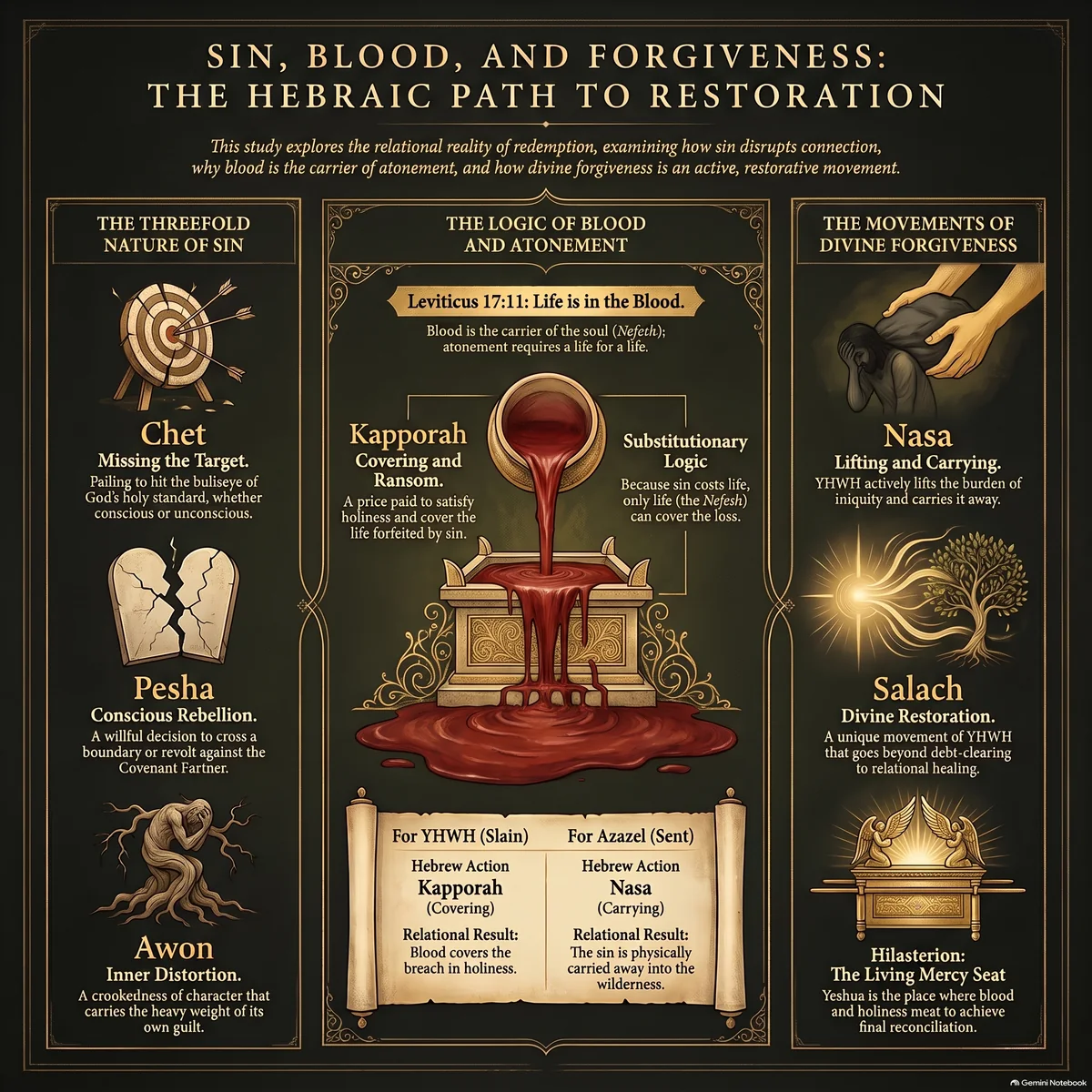
— Judges 20:16 (paraphrase) · earliest non-cultic use of the chet root, the literal athletic imagePopular comparison tables line up Chet/Pesha/Awon against Hamartia/Parabasis/Anomia without distinction. This is imprecise. Anomia (ἀνομία, G458 — "without-Torah") is canonically the closer Greek counterpart to pesha (wilful transgression, cf. 1 John 3:4) than to awon. For awon, the stronger canonical NT bridge runs through adikia (ἀδικία, G93 — unrighteousness): "all adikia is hamartia" (1 John 5:17). Awon itself has no tight one-to-one Greek equivalent — the word carries both act and guilt-weight, something Greek splits into two separate words.
| Concept | Hebrew / Greek | Core Feature |
|---|---|---|
| Sin | Chet / Hamartia | Missing the mark — falling short of the standard, conscious or unconscious |
| Transgression | Pesha / Parabasis (·Anomia) | Consciously crossing a boundary — rebellion against authority |
| Iniquity | Awon / Adikia | The inner twisting and the guilt that flows from it |
Every transgression (pesha) is sin (chet), but not every sin is a conscious transgression — a distinction decisive for section D below.
B — Wilful versus Unwitting
The Torah draws a sharp distinction in accountability. Canonical
"For if we sin willfully after we have received the knowledge of the truth, there no longer remains a sacrifice for sins." — Hebrews 10:26 (paraphrase)
Hebrews 10:26 echoes Numbers 15:30 almost word for word — not a new teaching, but the continuation of the same Torah principle in the Brit Chadasha.
B2 — A Third Category: Conscious Sin from Weakness
Shegagah (ignorance) and beyadah ramah (wilful contempt) are not the only two options. Numbers 15:30-31 describes beyad ramah not as "conscious sinning" in general, but specifically as contempt: "he has reviled the word of YHWH" (H1442, gadaph — to revile, to scorn). Beyad ramah is a gesture of triumph, the raised hand of someone winning — not the struggle of someone losing a fight against themselves. Canonical
Between the two lies a real, third category: conscious of the sin, willing to resist, and yet falling because the flesh pulls harder than the resistance. Paul describes exactly this:
"For what I am doing, I do not understand. For what I will to do, that I do not practice; but what I hate, that I do... O wretched man that I am! Who will deliver me from this body of death?" — Romans 7:15, 24 (paraphrase)
Galatians 5:17 names this outright warfare: "the flesh lusts against the Spirit, and the Spirit against the flesh; and these are contrary to one another, so that you do not do the things that you wish" (paraphrase). This is the same flesh (basar/sarx) identified elsewhere in this study as the place where Yeshua bore sin (Rom. 8:3) — seen here from the other side: not the flesh that bears sin in Him, but the flesh that pulls toward sin in the believer. This struggle lacks the unrepentant contempt of Hebrews 10:26-29 ("trampled the Son of God underfoot... insulted the Spirit of grace") and therefore does not fall under beyad ramah.
For this category, Hebrews 10:26 does not apply as exclusion — instead, the standing invitation applies: 1 John 1:9 is written to believers, for ongoing confession, not a one-time transaction. Hebrews 4:15-16 adds that Yeshua Himself can "sympathize with our weaknesses" (H770, astheneia) — no reason to stay away from the throne of grace, but every reason to draw near "to obtain mercy and find grace to help in time of need" (paraphrase).
C — Why Blood: Leviticus 17:11
This is the canonical anchor verse of the entire theology of blood: "For the nefesh (H5315, life/soul) of the flesh is in the blood (dam, H1818), and I have given it to you upon the altar to make atonement (kipper, from kafar, H3722) for your nefesh, for it is the blood that makes atonement by means of the nefesh." Blood is no arbitrary cultic symbol — it is the carrier of life itself. Atonement therefore never costs less than life.
Kapporah (from kafar, H3722) carries the double meaning "to cover" and "to pay a ransom" — hence Yom Kippur, the Day of Atonement. The offering's blood does not merely cover the surface; it pays the price that YHWH's holiness requires against the life forfeited by sin.
"And according to the Torah almost all things are purified with blood, and without shedding of blood there is no forgiveness." — Hebrews 9:22 (paraphrase)
C2 — Chok or Mishpat: Is "Life for Life" Explicable?
Leviticus 17:11 opens with כִּי (ki — "for"): "I have given it to you upon the altar to make atonement... for it is the blood that makes atonement by means of the nefesh." That is striking. A true chok (like the red heifer, Num. 19) is given no reason in the Torah — one submits to it without demanding an explanation. Here the text itself supplies a reasoning, which places this verse closer to mishpat (explicable law) than to chok, even though its deepest layer — like every statute that touches YHWH's own character — remains partly inaccessible (Deut. 29:29).
From these three texts follows the logic of substitution: if sin costs life, only life can cover that loss. Animal blood works temporarily — it carries real life — but not completely, because animal life does not carry the value of image-bearing human life. Hence Heb. 10:4: "it is not possible that the blood of bulls and goats could take away sins." Leviticus 17:11 is therefore not an unfathomable statute, but a deeply grounded law — partly explicable from man's being made in the image of God, partly pointing toward a depth that exceeds reason without contradicting it.
D — The Vocabulary of Forgiveness
"Forgiveness" in Hebrew is not a single concept, but a cluster of four movements: Canonical
Greek: aphiemi (ἀφίημι, G863) — "to send away, to release," the word Yeshua uses in the Lord's Prayer (Matt. 6:12) and that John uses in 1 John 1:9. Related: aphesis (ἄφεσις, G859) — "release," the same word Yeshua uses in Luke 4:18 for the release of captives — forgiveness as jubilee-release, not bookkeeping write-off.
E — Torah as the Knowledge of Sin Canonical
Without the Torah, chet is invisible as a category — not because the act itself would then be harmless, but because the standard by which to recognise deviation is missing. Paul says it directly:
"For by the Torah is the knowledge of sin... I had not known lust, except the Torah had said, You shall not covet." — Romans 3:20, 7:7 (paraphrase)
This is no indictment of the Torah — Paul asks the question explicitly and rejects the answer: "Is the Torah then sin? Certainly not" (Rom. 7:7a, paraphrase). The Torah does not cause sin; it diagnoses it, the way light does not cause dirt but makes it visible. John draws the definition tightly: "whoever commits sin also commits anomia, for sin is anomia" (1 John 3:4, paraphrase) — literally: sin is Torah-lessness, a life detached from the direction the Torah points to. This confirms from another angle what section A above already established: anomia belongs canonically with pesha/chet, not apart from it.
F — The Many Forms of Sin: Mouth and Mind Canonical
Chet is not confined to the visible act. Scripture points equally to the tongue and the mind as places where the mark is missed:
James traces how this inner movement unfolds: "when lust has conceived, it brings forth sin; and sin, when it is finished, brings forth death" (Jas. 1:15, paraphrase). This is the same line as Romans 6:23 (section C2) — death as an organic endpoint — but traced here from within: the thought (Prov. 24:9) becomes desire, desire conceives the act, the act completed brings forth death. Chet, then, often begins long before it becomes visible.
John carries the thought-line from Proverbs 24:9 even further: "whoever hates his brother is a murderer" (1 John 3:15, paraphrase). This is no exaggeration but the same chet-logic running through this whole section: the act (murder) and the inner disposition (hatred) miss the same mark — one visible, the other hidden, but both chet.
A — Pictographic Reading of Chet Remez-speculative
The letters of חֵטְא: Chet (originally a fence/wall — separation, boundary), Tet (a coiled basket or serpent — enclosure, contained evil), Aleph (ox — strength, leadership). Read as a picture-story: strength that lets itself be enclosed within a boundary that does not belong to it — the strength (Aleph) that lets itself be "wrapped" (Tet) by a wall that cuts it off from the mark (Chet). This is not proof, but an illustrative reading that supports the core meaning — deviation from the intended course.
A2 — Chet as Fence: Keeping Out and Keeping In Remez-speculative
The letter chet ח itself carries, in its oldest paleo-Hebrew form, the image of a fence or tent-wall — two upright posts with a crossbar, a woven hedge around an enclosed courtyard. A fence always does two things at once: it keeps something in that needs protecting, and it keeps something out that does not belong. That second function — the keeping-out — is exactly where chet, as the first letter of חֵטְא, carries its heaviest weight: sin is what the fence should have excluded, yet it broke through anyway. The boundary meant to protect has been breached.
This reversal also works the other way, and here the canonical anchoring is stronger: sin itself builds a fence — not one that protects, but one that excludes. After the first chet in Scripture, YHWH stations the cherubim with the flaming sword "to guard the way to the tree of life" (Gen. 3:24) — man is literally kept out of the sanctuary of the garden. Isaiah states it directly in words, needing no pictograph at all: Canonical
"But your iniquities have separated you from your God, and your sins have hidden His face from you, so that He will not hear." — Isaiah 59:2 (paraphrase)
Chet, pictographically read, is thus both the fence sin should have been kept out by and the image of what sin itself produces: a fence that keeps man outside the sanctuary. This double meaning is reversed in the Sod layer — Yeshua tears open exactly that fence.
B — Gematria: Chet and Chai Remez-speculative
An exact match, not an approximation — and thematically strongly connected: the same number that carries "life" also carries the word for the act that threatens life. This is presented here as corroborating, not as standalone proof (Protocol III), and fits the canonical fact of Leviticus 17:11: the nefesh (life) is in the blood — chet and chai touch precisely at the point where sin costs life.
C — The Two Goats of Yom Kippur Canonical
Leviticus 16 describes two goats that together form one act of atonement — not two separate rituals, but one movement in two parts:
| Goat | Hebrew | Act |
|---|---|---|
| For YHWH | שָׂעִיר לַיהוה | Slaughtered; its blood is brought into the Holy of Holies — kapporah (Lev. 16:15-16) |
| For Azazel | שָׂעִיר לַעֲזָאזֵל | Sent away alive into the wilderness, bearing the iniquities of the people — nasa (Lev. 16:21-22) |
One ritual, two canonical movements: kapporah (covering through blood) and nasa (bearing away). This distinction returns in the Sod layer as the key to how Yeshua fulfils both.
D — Echo: The Blood on the Doorpost Canonical
At Pesach (Ex. 12:13) the blood on the doorposts protects not through magical power, but because it visibly testifies that a life — a nefesh — has already been given in place of the life inside the house. The same nefesh-for-nefesh logic of Leviticus 17:11 is already at work here, centuries before the Sinai legislation was codified — an early, canonical Echo within the Torah itself.
E — Engraved Versus Written: The Reversed Horns of the Altar Canonical
The horns of the altar are, in the offering system, the place where atoning blood is applied — the priest's finger brings blood there to cover (Lev. 4:7, 18; 16:18). Jeremiah reverses this image:
"The sin of Judah is written with a pen of iron, engraved with the point of a diamond, upon the tablet of their heart, and upon the horns of your altars." — Jeremiah 17:1 (paraphrase)
Precisely the place meant to carry blood for covering here instead carries the sin itself — indelibly engraved, not with ink that can fade but with a diamond point. The contrast with Jeremiah 31:33 is sharp and canonically anchored in the same prophet: where 17:1 sees sin engraved on the heart and on the horns that should have carried atonement, 31:33 promises that YHWH Himself will write His Torah on the heart. The same two surfaces — heart and altar — move from carrying indelible guilt to carrying indelible Torah-direction. This is not two unrelated texts, but one movement: from the engraved to the written, from horns without blood to horns finally covering what they were meant for.
A — Blessing, Curse and the Nature of Sin's "Activation"
In Leviticus 26 and Deuteronomy 28 the relationship between man and YHWH is covenant-structured. Blessing (berakah) follows shema — not "hearing and obeying" as command-following, but orientation: the continual attuning of life to YHWH's direction Translation Loss (shema, H8085 — to orient, not: command-following under threat of sanction). Curse (kelalah) is not an external penalty arbitrarily imposed, but the organic consequence of a life cut off from the Source of Life — whoever misses the mark (chet) effectively cuts themselves off from the source of blessing.
Grace (chessed/charis) is not a free pass to keep sinning, but the power to be acquitted and to change. Grace works at the intersection of teshuvah (turning, see the canonically anchored study Teshuvah) and emunah (trusting faith). Titus 2:11-12 puts it this way: the grace that has appeared "teaches" us to deny ungodliness — grace trains, it does not numb.
B — When YHWH Hands Over
Romans 1:24-28 describes a pattern in which YHWH "gives over" a person who persistently and with a high hand chooses sin, to their own desires. This is not active punishment from a distance, but the withdrawal of protective and corrective grace where it is continually refused — the person then experiences the full, natural consequences of their own course. (This description concerns the textual pattern of Romans 1; it is not a statement about the inner state of any specific person.)
C — The State Before the Drawing
Ephesians 2:1-12 and John 8:34 depict the state of man before YHWH's initiative: spiritually dead through trespasses and sins, a slave to sin, alienated from the commonwealth of Israel and without hope. Precisely in that state of incapacity YHWH takes the initiative (John 6:44) — He seeks out, convicts through the Ruach, and calls to teshuvah.
This slavery is no vague metaphor but a real reign-structure, still a genuine danger even after liberation: "Let not sin therefore reign in your mortal body, that you should obey it in the lusts thereof" (Rom. 6:12, paraphrase). Paul writes this to believers, not to the unconverted — chet remains a pretender to the throne asking for reign in the body, even once a person has already been sought out and drawn. This is exactly why section B2 in the Pshat layer (the inner struggle) connects directly here: it is one and the same battle, seen from two angles.
D — Sin as Collective: People and House
Sin and forgiveness in Scripture are not exclusively an individual account. Solomon's temple prayer explicitly acknowledges this for the whole people:
"Then hear You in heaven, and forgive the sin of Your people Israel, and bring them again to the land which You gave to their fathers." — 1 Kings 8:34 (paraphrase)
The same book shows the shadow side of this collective reality: "and this thing became sin to the house of Jeroboam, even to cut it off, and to destroy it from the face of the earth" (1 Kings 13:34, paraphrase) — a single act that clings to an entire house, an entire dynasty, and ultimately leads to its downfall. Chet is thus not only a personal category: it can attach itself to a family, a lineage, a nation — and forgiveness operates on that same level. Whoever prays "forgive the sin of Your people" is not praying a sum of individual prayers, but acknowledging that a people, like a person, has a matzav — a position — before YHWH's face.
Where in my week do I miss the mark — not as an isolated mistake, but as a direction that has drifted from YHWH's orientation for my life?
Choose one concrete area (a habit, a reaction pattern, a neglected conversation with YHWH) and name it out loud in prayer this week as chet — not a vague sense of guilt, but a precise name. Then speak out YHWH's salach over that specific point (1 John 1:9), and thank Him concretely for the blood already shed for that sin — not as a formula, but as personal acknowledgment that the price is already paid.
A0 — The Fence Torn Open
The reversal announced in the Remez layer (section A2) finds its fulfilment here. What sin had erected — the separation between man and the Holy of Holies, made visible in the temple veil — tears open at the moment of Yeshua's death: "And behold, the veil of the temple was torn in two, from top to bottom" (Matt. 27:51, paraphrase). Canonical Hebrews deliberately draws the conclusion: believers now have "boldness to enter the Holiest... by a new and living way which He consecrated for us, through the veil, that is, His flesh" (Heb. 10:19-20, paraphrase). The fence that chet had raised is opened by the very flesh and blood identified as kapporah in section C above.
A — Hilasterion: The Word That Carries the Kapporet
When Paul writes in Romans 3:25 that YHWH publicly displayed Yeshua as hilasterion (ἱλαστήριον, G2435), he is not simply using a word for "atonement." It is precisely the Greek word the Septuagint uses in Exodus 25:17 for the kapporet — the atonement cover on the ark, the place where the blood of Yom Kippur was sprinkled. Yeshua is here canonically presented as the very place where blood and holiness meet — the living mercy seat.
"Behold! The Lamb of God who takes away the sin of the world!"
— John 1:29 (paraphrase)The Greek verb here, airo (αἴρω), "to lift up, to carry away," is the natural translation of the Hebrew nasa — the same word used for the goat that carries the iniquities into the wilderness for Azazel (Lev. 16:22), and that Isaiah 53:11-12 uses: the Servant "bears" (nasa) their iniquities. John the Baptist, consciously or not, invokes the full Yom Kippur picture.
John 1:29 is often read as though Yeshua has already, actually and automatically, taken away the sin of the world for everyone — so that every person, regardless of response, is already saved. This is a misreading of the text. What is canonically indicated here is the sufficiency of the offering for the whole world, not its automatic application to every individual. The same nasa/kapporah logic described in Pshat section D — salach, YHWH's forgiveness, received at the intersection of teshuvah and emunah — remains fully in force here. John 3:36 sets it out sharply: "he who believes in the Son has everlasting life; and he who does not believe the Son shall not see life, but the wrath of God abides on him" (paraphrase). The Lamb bears sin away as a provision for whoever places themselves, in teshuvah and emunah, under that kapporah — not as a substitute for that response.
B — One Offering, Once
Where the two goats of Yom Kippur were needed year after year — because animal blood carries the nefesh of the animal, not the full value of a human life — Yeshua's offering is canonically "once for all" (Heb. 9:12, 10:10). In His own Person He unites what at Yom Kippur still had to be divided between two animals: He is the kapporah (the blood that enters the Holy Place, Heb. 9:12) and the nasa (He bears sin away, outside the camp, Heb. 13:11-12).
B2 — The Flesh That Bears Sin
Leviticus 17:11 — the anchor verse of the whole study — names not only dam and nefesh, but also basar (בָּשָׂר, H1320, "flesh"): "the nefesh of the flesh is in the blood." The flesh is the carrier of the life that is in the blood — and it is precisely that flesh in which the Brit Chadasha sees sin borne and condemned.
"For what the Torah could not do in that it was weak through the flesh, God did by sending His own Son in the likeness of sinful flesh, on account of sin: He condemned sin in the flesh." — Romans 8:3 (paraphrase)
Peter reaches back for the same nasa-language as Isaiah 53:12 (LXX: anaphero, ἀναφέρω — to bear, to offer up) when he writes: "who Himself bore our sins in His own body on the tree" (1 Pet. 2:24, paraphrase). Nasa in Hebrew, anaphero in Greek, basar in Leviticus 17:11 — three words, one line: the flesh is not a bystander at the atonement, it is the place where it happens. This connects to what was already said about the veil: "through the veil, that is, His flesh" (Heb. 10:20).
Not with the blood of goats and calves, but with His own blood He entered the Most Holy Place once for all, having obtained eternal redemption.
— Hebrews 9:12 (paraphrase)This is no break with the Torah-logic of Leviticus 17:11, but its full, canonical fulfilment: the nefesh of the flesh is in the blood, and it is precisely the nefesh of Yeshua — freely given — that carries the final atonement (Isa. 53:10, "when His nefesh has made itself an offering for guilt").
B3 — The Advocate
Alongside hilasterion (section A), the Brit Chadasha holds a second, complementary image: Yeshua not only as the place of atonement, but as the advocate who continues to act after atonement has been made.
"My little children, these things I write to you, that you may not sin. And if anyone sins, we have an Advocate with the Father, Yeshua Christ the righteous." — 1 John 2:1 (paraphrase)
The Greek parakletos (Advocate) describes someone who comes alongside — not someone who denies the guilt, but someone who presents the price already paid. John continues directly with hilasterion-language in the next verse (1 John 2:2) — the two images stand side by side in the Brit Chadasha, not one after the other: Yeshua is at once the offering that atones and the Advocate who keeps pleading after the fall. This is precisely why Pshat section D above could say that 1 John 1:9 is written to believers, for ongoing confession — the Advocate stands not once, but continually, alongside His own.
Sod here is not a mystical number or a hidden code, but the quiet wonder that the Hebrew vocabulary of sin, blood and forgiveness — chet, dam, kapporah, nasa, salach — had for centuries already carried the exact shape of what would become visible in Yeshua. The language waited for its fulfilment, not the other way around.
C — Tav: The Sign at the End of the Fence
The last letter of the Hebrew alphabet, tav ת, closes the circle chet opened in Remez section A2. Where chet is pictographically a fence, tav — in its oldest form two crossed sticks — is the sign placed at such a boundary: a mark, a signature, a covenant seal. Canonical This is not a pictographic guess: the two-letter word תָּו is an attested biblical noun.
Go through the midst of the city, through the midst of Jerusalem, and put a mark (tav) on the foreheads of the men who sigh and cry over all the abominations that are done within it.
— Ezekiel 9:4 (paraphrase)Ezekiel 9:4 uses tav as the sign that separates who is spared from judgment and who is not — functionally the same fence-logic as chet, but as a sign rather than a wall. Job uses the same word for his own signature under an oath (Job 31:35, "tavi" — my mark).
When Yeshua calls Himself the Alpha and Omega in Revelation — "the beginning and the end" (Rev. 1:8; 21:6; 22:13) — He reaches for the same polarity aleph and tav occupy in the Hebrew alphabet: the first and the last letter. The cross on which He dies thus carries, in light of Ezekiel 9, the mark of exactly that: the sign of those spared on the side of judgment, placed on the boundary between death and life.
- TorahGenesis 2:17 (death as consequence of separation); Genesis 9:5-6 (blood and the image of God); Leviticus 4 (shegagah, unwitting sin); Leviticus 4:7, 18; 16:18 (blood on the horns of the altar); Leviticus 16 (Yom Kippur, the two goats); Leviticus 17:11 (nefesh in the blood); Leviticus 19 (Num. 19, the red heifer as chok); Leviticus 26 (blessing and curse); Exodus 12:13 (blood on the doorposts); Exodus 34:7 (nasa avon); Numbers 15:30-31 (beyadah ramah); Deuteronomy 28 (blessing and curse); Deuteronomy 29:29 (the hidden and the revealed things); Judges 20:16 (chet, literally "to miss"); 1 Kings 8:34 (collective forgiveness for the people); 1 Kings 13:34 (sin clinging to a house); Job 31:30 (sin with the mouth); Psalm 32:1 (kasah); Psalm 39:1 (bridling the tongue); Psalm 59:12 (the sin of the mouth); Proverbs 24:9 (the thought as sin); Isaiah 43:25 (machah); Isaiah 53:10-12 (nasa, the Servant bears iniquity); Jeremiah 17:1 (sin engraved on heart and altar-horns).
- Brit ChadashaMatthew 6:12 (aphiemi); Luke 4:18 (aphesis); John 1:29 (airo — the Lamb bears sin away); John 3:36; John 6:44; John 8:11, 34; Romans 1:24-28; Romans 3:20 (knowledge of sin through the Torah); Romans 3:25 (hilasterion); Romans 6:12 (sin reigning in the body); Romans 6:23; Romans 7:7 (the Torah makes lust known); Romans 7:15, 24 (the inner struggle against the flesh); Romans 8:3; Galatians 5:17 (flesh against Spirit); James 1:15 (lust conceives sin, sin brings forth death); 1 John 3:15 (hatred as murder); Ephesians 2:1-12; Titus 2:11-12; Hebrews 4:15-16 (sympathizing with our weaknesses); Hebrews 9:12, 22; Hebrews 10:1-4, 10-14, 19-20, 26-29; Hebrews 13:11-12; 1 Peter 2:24; 1 John 1:9; 1 John 2:1 (the Advocate); 1 John 3:4; 1 John 5:17.
- PaRDeSRabbinic hermeneutical framework. Talmud, b. Sanhedrin 67b; b. Chagiga 14b. Kabbalistic Sod-content (Zohar, Sefer Yetzirah) explicitly excluded — Protocol VI.i extension.
- Source materialDevar Emet study design, tested against Protocol VI.i and canonically anchored in Torah and Brit Chadasha.
- Secondary literatureBDB, HALOT and Jeff Benner (Ancient Hebrew Research Center) for the paleo-Hebrew pictographs of chet and tav.
- ProtocolCanonicity test (VI.i) applied to every concept. No use of Zohar, Sefer Yetzirah or kabbalistic works. YHWH used in original text (VI.iii). Torah-directions/mitswot used instead of "law"/"commandments" (VI.ii.b).