The word "love" is the most used and most misunderstood word in human language. We use it for coffee, for friends, for God — and mean something different each time. The Bible does not do that. Biblical Hebrew knows at least five distinct words for what we compress into one concept. Behind each word lies a whole world.
This study opens the word love along the four levels of the PaRDeS method: from the literal meaning to the deepest Messianic revelation. We begin at the ground — the letters themselves — and work our way up until we stand at the place where ahavah, chessed and agapè converge in one person.
After this study you will understand:- What the difference is between ahavah (active love) and chessed (covenant faithfulness), and why that distinction changes your life
- How the letters of the Hebrew word for love already tell the story of the incarnation
- Which five forms of love the Bible distinguishes, and what each type says about God's character
- Why Paul's definition of love is not a description of feelings, but a character profile
- How Bethesda, Mount Moriah and Psalm 136 all tell the same thing about God's love for you
- What the limit of chessed is — when covenant protection ceases to apply and what it means when someone deliberately chooses to stand outside the covenant
This study is structured according to the PaRDeS method — four ascending layers of meaning. For most readers it is sufficient to go through the study linearly. Do you want to first understand how a word study is structured and what to expect from each layer? Click the button below.
"I have loved you with an everlasting love; therefore I have drawn you with lovingkindness."
Jeremiah 31:3 · יִרְמְיָהוּ — Ahavat Olam · אַהֲבַת עוֹלָםThis verse stops the world. Not because it sounds beautiful, but because it makes a claim no other word in human language can carry. God says — through the mouth of Jeremiah, in the darkest period of Israel's history, while the people are on the verge of going into exile — not: "I once loved you." He says: everlasting love. Always. Without beginning, without end, without exception.
But do we actually understand what the word "love" truly means? If love is a feeling, then God is a feeling. And a feeling can come and go — influenced by what you ate last night, by how much sleep you had. But God is not a feeling. He is a being. And therefore His love is not a feeling. It is His nature.
What is Love? — The Definition
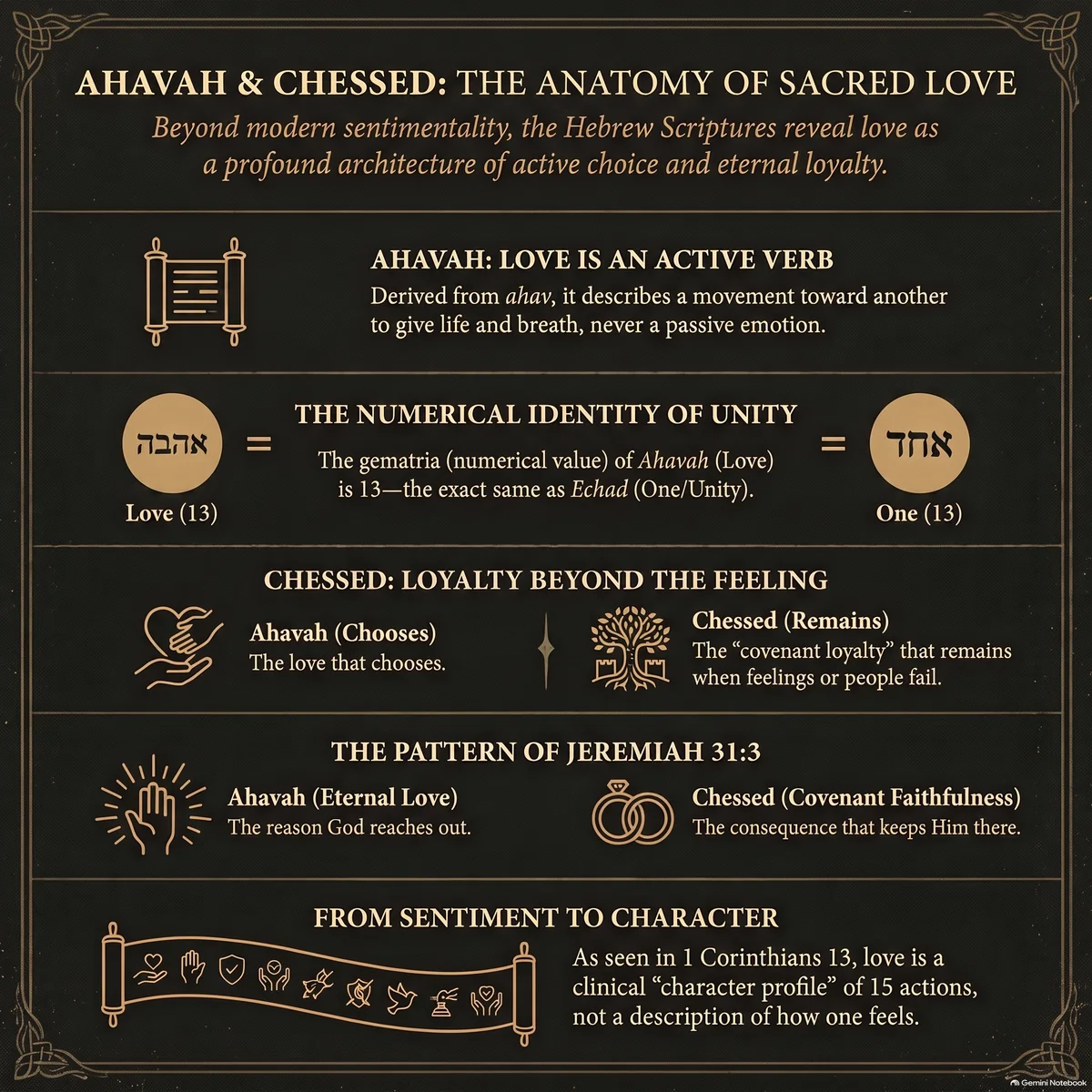
Biblical Hebrew has no abstract concept of "love" that stands apart from action. The core word is אַהֲבָה — ahavah — derived from the verb אָהַב (ahav). It is a noun that always describes an active reality, never a passive emotion.
The Five Forms of Love
The Bible does not know one kind of love. Each type has its own weight, its own vulnerability, its own depth.
| Form | Hebrew | Greek NT | Nature | Biblical example |
|---|---|---|---|---|
| Divine love | אַהֲבָה / חֶסֶד | Agapè (G26) | Unconditional, self-sacrificing, covenantal | John 3:16; Jer. 31:3 |
| Friendship | רֵעוּת | Philia (G5373) | Reciprocal bond on shared values | David & Jonathan (1 Sam. 18:1) |
| Motherly love | רַחֲמִים | Storgè (Rom. 12:10) | Physically connected, from the womb | Isaiah 49:15 |
| Covenant passion | דּוֹד | Agapè (Eph. 5:25) † | Passionate longing within covenant; bride to bridegroom | Song of Songs 1:2; 4:10 |
| Covenant faithfulness | חֶסֶד | Eleos (G1656) ‡ | Faithfulness that remains when feelings falter | Ruth 1:8; Psalm 136 |
† DOD & THE GREEK NT
Dod (דּוֹד) describes passionate longing within a covenant relationship — always bride to bridegroom, never apart from covenant. The NT has no separate word for this dimension: the writers deliberately use Agapè also for marital love (Eph. 5:25 — "Husbands, love your wives as Christ loved the church"). In doing so, romantic love is subsumed into the covenant dimension — exactly the same movement that Dod already describes in Hebrew. The Greek word Eros — often used as an equivalent in popular tradition — appears nowhere in the Bible. The NT writers deliberately avoid the word; it carries Platonic connotations of desire as an upward human force, which stands in tension with the biblical theology of love as gift.
‡ CHESSED & THE GREEK NT
Eleos (ἔλεος, G1656) is the word the Septuagint (LXX) uses more than 170 times to translate Chessed, and it is the closest NT equivalent (Luke 1:50, 72 — the Magnificat, which draws directly from the covenant language of the Tanach). Yet it does not fully cover the meaning: Eleos in the NT shifts toward mercy-after-failure, while Chessed is broader — present before any guilt, purely from covenant faithfulness. That Greek falls short here is not a translation problem but a theological signal: Chessed describes a reality for which the Greek language has no category of its own. This underlines why Hebrew remains irreplaceable for certain biblical concepts.
Rachamim — The Womb as Mirror
The Hebrew word for compassion — רַחֲמִים (rachamim) — is directly connected to the word for womb: רֶחֶם (rechem). Motherly love is the only human love that cannot be explained. It exists before the child deserves it. God uses this image in Isaiah 49 deliberately as a mirror of His own love — and then adds: even that love can fail. Mine cannot.
Jonathan Cahn tells: "We laid our baby in the middle of our bed. In the middle of the night my wife wakes up startled. She sees me lying where the baby was. No trace of the baby. She panics — pushes me off the bed. The child was resting quietly in the crib. The mother lets nothing, absolutely nothing, come between her and her child."
This is rachamim. And God says in Isaiah 49: even if a mother forgets — I do not forget. I have engraved you on the palms of My hands.
The Letters of Ahavah — What the Pictograms Tell
In Paleo-Hebrew every letter was a pictogram. The root אהב tells a story in three images:
The Strong One bends down, gives breath, and builds a house. This is ahavah. And it is precisely what God did in the incarnation: the Almighty bowed His glory, gave breath to dead humanity, and built a dwelling among us. John 1:14 — "The Word became flesh and dwelt among us" — is the pictographic definition of ahavah.
Gematria — The Numerical Connections
Ahavah (13) = Echad (13): Where true love is present, echad arises — one flesh, one covenant, one people, one God. The Shema is the ultimate love declaration. Chessed (72): Equal to the 72 Names of God — His covenant faithfulness is as multifaceted as His own character. Ahavat Olam: the love (13) that transcends the world (146) is the only constant that connects the transient to the eternal. Paul writes: "Love never fails."
Ahavah versus Chessed — The Crucial Distinction
אַהֲבָה Ahavah is the love that chooses. It is emotional, active, intentional — the love of the bridegroom for the bride, of the parent who consciously chooses for the child. It can be kindled, and it can wane.
חֶסֶד Chessed is the love that does not stop. It is covenantal, faithful, indissoluble. Not dependent on feeling. Jonathan Cahn calls it: "the love that continues when Ahavah wavers."
The pattern in Jeremiah 31:3: "With everlasting love (ahavat olam) I have loved you — therefore I have drawn you with lovingkindness (chessed)." Ahavah is the reason. Chessed is the consequence that remains — even when you fail.
What Our Bible Translations Conceal
Here lies one of the most serious translation losses in all of church history. The word חֶסֶד — chessed — appears more than 250 times in the Tanach. And virtually every English Bible translation renders it with a word that fundamentally misses the meaning.
Look at what happens when you read Jeremiah 31:3 in common translations: "therefore I have drawn you with lovingkindness." The word lovingkindness sounds gentle. Benevolent. It evokes the image of a kindly grandfather giving you a sweet. But chessed is not lovingkindness. Chessed is the covenant faithfulness of a God who gives His own Son because He is bound to His word — not to His feeling.
| Translation | Rendering of חֶסֶד | What is lost |
|---|---|---|
| KJV | lovingkindness / mercy | "Lovingkindness" is poetic but suggests a warmth dependent on feeling. "Mercy" reduces chessed to grace-after-failure, while chessed is also present without prior sin. |
| NIV | unfailing love / steadfast love | Closer to the meaning, but still misses the covenant dimension: chessed is not simply "unfailing love" — it is faithfulness because a covenant has been made. |
| ESV / NASB | steadfast love | The covenantal character. The unbreakable faithfulness that flows from a covenant that was entered into, not from a mood. |
The English phrase that comes closest is covenant loyalty. But no standard translation uses it consistently. As a result, millions of believers read Psalm 136 — "for his steadfast love endures forever" — and hear a vague warmth, while the Psalmist sings about a legally holy, unbreakable covenant faithfulness that upholds the world.
This is not an academic footnote. It touches the core of how people understand God. A God of "lovingkindness" can be lost when you have a bad day. A God of chessed cannot be lost — unless you deliberately leave the covenant. The difference between those two images of God is the difference between fear and freedom.
Hosea and Gomer — the most confronting love story: God instructs Hosea to marry a woman who will betray him. Gomer leaves Hosea for other men. She sinks into shame. And then God says: "Go and take her back. Buy her free." (Hosea 3:1)
This is not ahavah at that moment — there are no butterflies. This is chessed: the covenant faithfulness that returns, not because the other deserves it, but because the covenant is holy. God says: "This is how I relate to Israel." And to you.
Moses before the Golden Calf — Ahavah and Chessed in collision: In Exodus 32 Israel makes the Golden Calf while Moses is still on the mountain. God is angry and says to Moses: "Let Me alone, that My anger may burn against them and I may destroy them." (Ex. 32:10). This is the moment where ahavah — God's electing, choosing love — hits its limits. The people have broken the covenant. The reason for the love seems gone.
But Moses stands firm. He pleads with God and reminds Him of His own promises: "Remember Abraham, Isaac, and Israel, Your servants, to whom You swore by Yourself." (Ex. 32:13). He does not appeal to the people's behavior. He appeals to the covenant. To the chessed.
And then something remarkable: "And the LORD relented from the disaster that He had spoken of bringing on His people." (Ex. 32:14). God returns — not because the people deserve it, but because the covenant is holy. This is the cooperative movement of ahavah and chessed: the ahavah was wounded by disobedience, but the chessed held firm. Moses understood this. He did not speak to God's feeling. He spoke to God's faithfulness.
Paul's Definition — 15 Characteristics
1 Corinthians 13 is not a lyrical poem. It is a clinical definition. And when you dissect the 15 characteristics, you see: none of them are about how love feels, but about how love acts toward the other.
"Love is patient, love is kind. Love does not envy. Love does not boast, it is not arrogant."
1 Corinthians 13:4Paul writes this with Leviticus 19:18 in mind: "Love your neighbor as yourself." For him love is the fulfillment of the entire Torah (Rom. 13:10). Every characteristic is a Torah-directive — not as law, but as character that works from within.
Paul on letting go — which form of love is this? In 1 Corinthians 7, Paul makes one of the most pastorally layered statements about love in all of the renewed covenant. He writes that a believer is bound to their marriage — but adds: if an unbelieving partner wants to separate, "let him go. In such cases the brother or sister is not bound." (1 Cor. 7:15). And elsewhere he acknowledges that adultery breaks the covenant foundation of a marriage.
Which form of love is this? It is not the absence of chessed. It is chessed in its most mature form: covenant faithfulness that respects the freedom of the other. Chessed does not force. It does not crush. It holds — but when the other leaves the covenant space and will not return, letting go is sometimes the deepest act of love possible. Love that does not let go when holding on destroys the other is no longer love. It is possession.
Whoever rejects God steps outside the chessed. God's covenant faithfulness is not a magical protective layer surrounding everyone regardless of their attitude. Chessed is covenantal — and a covenant requires two parties. When someone deliberately and persistently rejects the covenant, refuses God's love, and chooses to stand outside His protection, there comes a moment where the chessed loses its sheltering effect. Not because God ceases to love — His ahavah still reaches — but because the other has deliberately left the covenant space.
This is what Paul means in Romans 1:24 when he writes: "God gave them over." That giving over is not a vengeful action. It is the holy consequence of a choice. God forces no one to accept His chessed — but outside the chessed one stands exposed to the judgment that creation itself carries for those who live against their Creator. God's love is not boundless in the sense of consequence-free. It is eternal in the sense of being offered — but it does not compel.
This makes God's chessed all the more overwhelming: He offers it knowing that many will reject it. His love is not less because it can be refused. It is precisely more — for only a love that fully respects the freedom of the other is truly love.
The Triangle of Love
Ahavah chooses. Chessed remains. Agapè sanctifies. Human love can never be complete without the divine source — but divine love manifests precisely through human choice and human faithfulness.
Love does not ask "what do I need?" but "what can I give?" Two people who need each other as proof of love are like two deer seeking the same quarry — they compete. True love rises above the need. We do not fall into love. We rise toward love.
Bethesda — The House of Chessed
In John 5, Yeshua heals a paralyzed man at the pool of Bethesda. The name Bethesda literally means Beit Chessed — the House of God's Covenant Faithfulness. The man had waited 38 years. Every time the waters stirred, someone else stepped in before him. And then Yeshua stands before him. He does not ask who is to blame. He asks one thing: "Do you want to be healed?"
"He is lying in the House of God's love and does not know it. The love of God stands before him and he asks whether someone can help him into the water."
Jonathan Cahn · on the man at BethesdaThe Sod of Bethesda: the person who waits for years in the House of God's love without knowing it. The chessed surrounds him all that time. He thinks the healing is in the water. But the healing is the Man standing before him. That Man stands before you too.
The First Use of Ahavah — The Deepest Hint
Genesis 22:2 — the first time ahavah appears in the Bible: "Take your son, your only son whom you love, Isaac, and go to the land of Moriah and offer him there." A father bringing his only beloved son to death.
The first revelation of ahavah in Scripture is a type of John 3:16. God the Father — Abraham the father. The only beloved son — Isaac. Moriah — the place where the Temple would later stand, and where Yeshua would be crucified. The first use of love in the Bible sketches the entire plan of redemption. Ahavah is the introduction to the cross, hidden on the first pages of the Torah.
Psalm 136 — The Repetition as Revelation
Psalm 136 repeats one phrase 26 times: כִּי לְעוֹלָם חַסְדּוֹ — for His chessed is everlasting. This is the song sung the night Yeshua went to Gethsemane (Matt. 26:30). The Hallel — the Psalm cycle of the Passover meal — ended with Psalm 136. Yeshua sang "His chessed is everlasting" while knowing what awaited Him. He sang about God's faithful love — and went to express that love on the cross. Not because He felt it. Because it is His nature.
The Tabernacle Projection
If ahavah were an object in the Tabernacle — which object would it be? It is the Ark of the Covenant. The ark contains the stone tablets — the Torah, which Paul calls the fulfillment of love (Rom. 13:10). But on top of the ark sits the Mercy Seat — כַּפֹּרֶת (kaporet). The Torah (chessed as obligation) lies within. Grace (chessed as offering) covers it from above. And between the cherubim, above the mercy seat, God's presence appears. There — precisely there, in the space between law and grace — dwells ahavah.
✦ The Sod Conclusion
The deepest revelation of ahavah is not a definition. It is a person. Yeshua is the Aleph — the strong leader — who bends down (Heh) and builds a house (Bet). He is the living expression of the three letters. And the chessed is what holds Him to the cross when the pain is unbearable. Not the feeling. The faithfulness to the covenant He has made with us.
You are not loved because you deserve it. You are loved because He is who He is. And His chessed is everlasting.