Revelation 20 speaks six times of "a thousand years" — the only place in the canonical Scripture where this span of time is explicitly attached to Mashiach's reign. Yet this vision does not stand alone: it builds on a network of promises running through the whole Tanakh — Isaiah's vision of a Jerusalem the nations stream toward, Zechariah's promise of a King over all the earth, and the rest shared by the Ark, the seventh day of creation, and the Shoot from the root of Jesse.
This study tests what is canonically demonstrable about the millennial Kingdom, sharply distinguishes it from the eternal state of Revelation 21, and shows how this promise was already prepared in the Torah and the Prophets — before a single Greek word was written about it.
By the end of this study you will:- Know the single canonical anchor text for "the thousand years" (Rev. 20:1–6) and why "millennial Kingdom" is itself a popular-theological summary, not a Biblical name.
- Understand the distinction between chadash (Isa. 65 — renewed, with death and marriage still present) and kainos (Rev. 21 — qualitatively new, without death), and use it to sharply distinguish the Kingdom from the eternal state.
- Recognize the menuchah line — the rest running from the Ark through Isaiah 11 to the Kingdom — as canonically grounded Remez, not free association.
- Correctly label the six-thousand-year world pattern (b. Sanhedrin 97a) as Rabbinic/Traditional, never as canonical chronology.
- Recognize three less-obvious Scriptural patterns — Melchizedek's king-priesthood as the first mention of Jerusalem, Ezekiel's temple river alongside Revelation's river of life, and the eighth-day structure of Shemini Atzeret — as canonically grounded Remez, not coincidental parallels.
- Know why this study, despite its popular overlap, uses no Kabbalistic sources (Zohar, Sefer Yetzirah) — and why premillennialism is presented here as one interpretive framework, not the only reading.
Read Isaiah 11 and Revelation 20 in full beforehand — both texts are read together in this study.
John writes Revelation as a "companion in the tribulation" from the island of Patmos, exiled under Roman oppression: I, John, your brother and companion in tribulation, and in the kingdom and patience of Yeshua, was on the island called Patmos.Revelation 1:9 The thousand years are therefore not written from a place of calm reflection, but from a community under pressure — a vision of restoration given to those who at that moment saw nothing of restoration at all.
That pattern is not new with John. Isaiah prophesies centuries earlier, amid the Assyrian threat under kings Uzziah through Hezekiah, of a coming Prince of Peace and a Jerusalem the nations stream toward (Isa. 2:2–4; 9:6). Zechariah prophesies after the Babylonian exile, during the difficult rebuilding of the second temple, of the day YHWH will be King over all the earth (Zech. 14:9). Three prophetic voices, three moments of national crisis, one promise that refuses to be pressed down by the circumstances in which it is spoken.
The name itself does not appear literally in Scripture. Revelation 20:2–7 repeats the Greek chilia etē (χίλια ἔτη, "a thousand years", from χίλιοι — chilioi, G5507) six times — a span of time, not a proper name for an era. "Millennial Kingdom" is a theological summary, not a Biblical term. Restored phrasing: speak preferably of "the thousand years" or "the thousand-year reign" (Rev. 20:4) when precision matters, and use "millennial Kingdom" deliberately as a non-canonical working title — the same move made with "renewed covenant" instead of "new covenant" (Protocol VI.ii.a).
The Torah opens with a rhythm that carries the whole of Scripture: six days of work, one day of rest. Thus the heavens and the earth were finished... and God rested on the seventh day from all His work.Genesis 2:1–3 The same rhythm returns on a larger scale in the sabbatical and jubilee years: seven times seven years, followed by the fiftieth year of release and restoration. Then you shall cause the trumpet of the jubilee to sound... and you shall consecrate the fiftieth year.Leviticus 25:8–13
Psalm 90 uses these exact words for YHWH's timescale: For a thousand years in Your sight are like yesterday when it is past.Psalm 90:4 Peter cites this pattern directly when he writes that one day with the Lord is as a thousand years (2 Pet. 3:8) — not a closed chronology, but a canonical indication that YHWH's timescale follows a structure of completion and rest, not endless duration.
Rabbinic/Traditional The Talmud builds on this a six-thousand-year world pattern: two thousand years of tohu (chaos), two thousand years of Torah, two thousand years of the days of Mashiach (b. Sanhedrin 97a). This is explicitly not canonical chronology — Scripture itself gives no date — and is cited here only as Jewish tradition, with no reference whatsoever to the Zohar or Sefer Yetzirah, which fall outside the permitted source hierarchy (Protocol VI.i extension).
Before the Torah ever uses the name "Jerusalem," the place appears as Salem, and there, for the first time in Scripture, kingship and priesthood converge in one person: And Melchizedek king of Salem brought out bread and wine; he was the priest of God Most High.Genesis 14:18 Psalm 110 takes up this exact pattern for the Mashiach: You are a priest forever according to the order of Melchizedek.Psalm 110:4 That Revelation 20:6 calls the saints "priests of God and of Mashiach" who at the same time "reign as kings" is thus no new combination — it is the return of the very first pattern Jerusalem ever carried, in the Torah's first mention of the city.
What is still broken now becomes visible precisely through the contrast with what is promised. Paul frames the present struggle not as a struggle against people: We do not wrestle against flesh and blood, but against principalities, against powers... against spiritual wickedness in high places.Ephesians 6:12 Set against that is the turning point of Revelation 20: Then I saw an angel coming down from heaven... he laid hold of the dragon, that serpent of old, who is the Devil and Satan, and bound him for a thousand years.Revelation 20:1–3 The diagnosis of the present, then, is not that humanity could live perfectly if only circumstances were good enough — it is that a specific, spiritual opposition is still actively at work right now.
Isaiah's image of the wolf and the lamb, the leopard and the young goat, the lion eating straw (Isa. 11:6–9) is not a sentimental nature scene — it is a diagnosis of what is still broken now. That creation itself is still torn becomes visible precisely because the text promises the opposite. Paul gives that waiting creation an actual voice: The creation was subjected to futility... in hope that the creation itself also will be delivered from the bondage of corruption... For we know that the whole creation groans and labors with birth pangs together until now.Romans 8:19–23 What is image in Isaiah is, in Paul, no metaphor — a creation that is literally waiting.
Matthew 25:31–46 gives, in the same vein, the criterion by which nations are at some point judged: their attitude toward "the least of these" brothers of Yeshua. This study deliberately takes over only the bare canonical core of that criterion here — not a fully worked-out systematic scheme of nations, timelines, or marks, which the source material for this study did contain and which does not pass the canonicity test as an established fact.
The question of who actually remains to inhabit the Kingdom is the same question raised by Hosea's distinction between Ammi ("My people") and Lo-Ammi ("not My people") — not a fixed ethnic or national boundary, but a covenant status before YHWH. The study Drawn — the Position of the Soul works this distinction out fully; here it is enough to see that the judgment of Matthew 25 does not introduce a new theme, but asks the same question that runs through the whole of Scripture: do you stand, regardless of origin, in Ammi or in Lo-Ammi?
The core of this study is a distinction that popular theology often loses: Isaiah 65 and Revelation 21 do not describe the same moment.
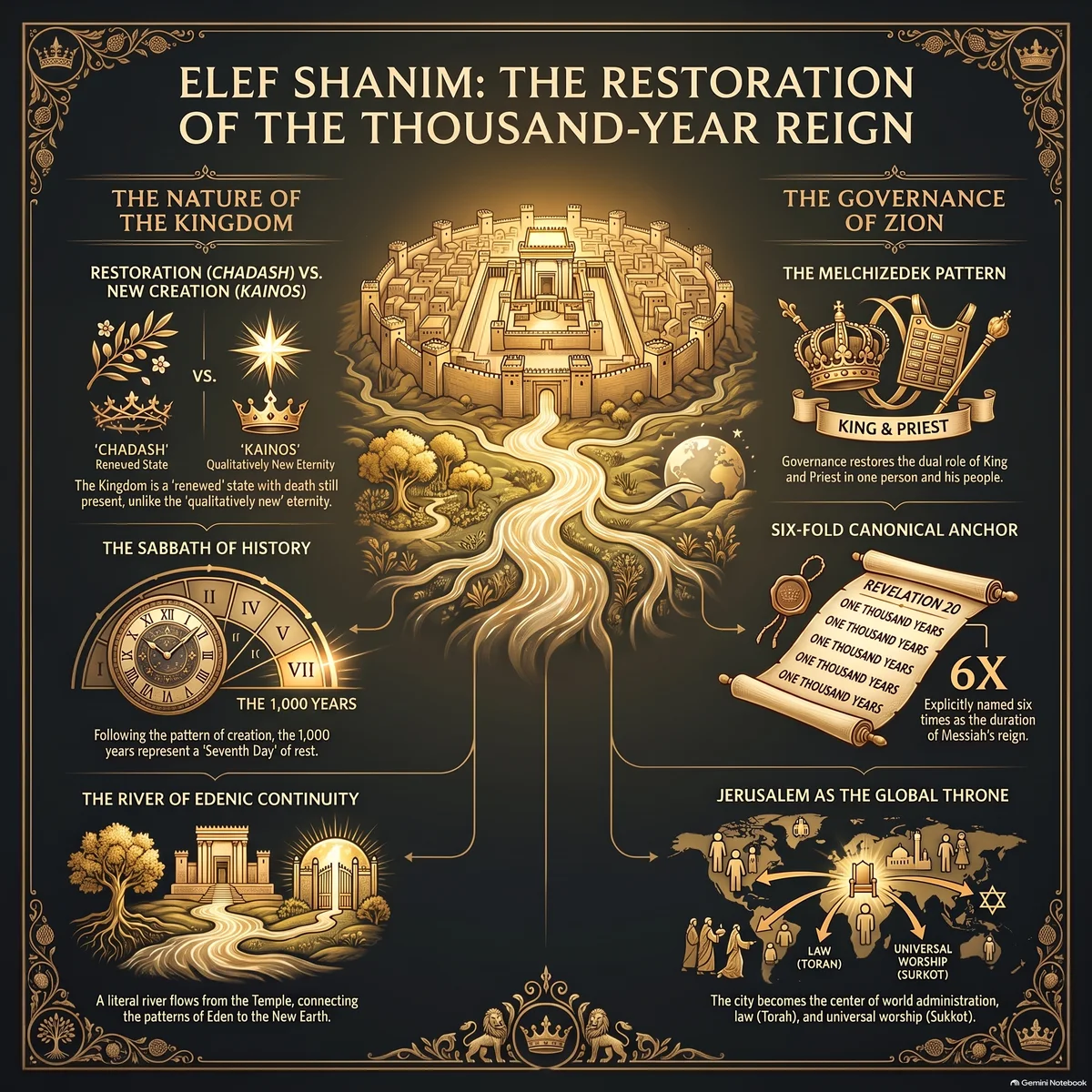
Isaiah 65:17–25 uses chadash — renewed, restored, not necessarily replaced (the same root as Ps. 51:12, "renew a steadfast spirit"). In this vision death is still present, even if at an old age (Isa. 65:20); people build houses, plant vineyards, marry and have children (65:21–23). Revelation 21:1,4 uses kainos — qualitatively new — and explicitly excludes death altogether: And God will wipe away every tear from their eyes; there shall be no more death.Revelation 21:4 Isaiah 65 thus describes a partially-restored creation — the millennial Kingdom — as a foretaste of the full renewal that only follows in Revelation 21, not the same moment under a different name.
Within that partially-restored era, Jerusalem is the center of world government: At that time Jerusalem shall be called The Throne of YHWH, and all the nations shall be gathered to it, for the name of YHWH.Jeremiah 3:17 The same image returns in Isaiah's swords-into-plowshares (Isa. 2:2–4) and in Zechariah's proclamation that YHWH will be King over all the earth (Zech. 14:9). The study Territory of Israel works out why Eretz in Scripture is never an interchangeable location but a covenant witness in its own right — that remains fully true in the Kingdom: it is no accident that it is Jerusalem specifically; it is the same ground YHWH already bound Himself to in the Torah.
That Jerusalem here is a center of government and not merely of worship fits what the study The Kingdom of Israel establishes about malchut (H4438): a Biblical Kingdom always rests on four inseparable pillars — Melech (King), Am (people), Eretz (territory), and Torah (life-structure). The Kingdom is not an abstract spiritual state but precisely this: Mashiach as Melech, the restored nations as Am, Jerusalem and the earth as Eretz, and Torah literally going out from Zion (Isa. 2:3). Where any one of these four pillars is dropped — for instance by making the Kingdom purely inward or heavenly — the Kingdom itself becomes unrecognizable.
This promise, moreover, is not a new pledge alongside the covenants already in place, but their continuation. The study The Covenants traces the unbroken line from Eden to restoration; the Kingdom is that very line becoming visible — including the Renewed Covenant of Jeremiah 31:31–34, which returns in Section ⑤.
A fourth, less-noticed prophetic layer describes this same era from within — and this image does not begin with Ezekiel, but on the very first pages of the Torah: A river went out of Eden to water the garden, and from there it parted and became four riverheads.Genesis 2:10 Ezekiel draws, for the Kingdom, the same river again: a stream flowing out from under the temple threshold, growing wider the further it goes, with trees on either side whose leaves are "for healing" (Ezek. 47:1–12). Revelation 22:1–2 draws this same image a third time, for the eternal state: A river of water of life... and on either side of the river, the tree of life... and the leaves of the tree were for the healing of the nations.Revelation 22:1–2 Three texts, three eras — Eden, the Kingdom, the eternal state — one river flowing through the whole of Scripture from beginning to end, carrying the same chadash/kainos distinction between the middle and the final fulfillment. The land itself even visibly changes shape: All the land shall be turned into a plain... but Jerusalem shall be raised up and shall remain in her place.Zechariah 14:10 — a literal, topographical confirmation of the mountain of YHWH's house Isaiah already spoke of above.
Even more hidden is the pattern of the eighth day. Sukkot lasts seven days — the same number as the seven-and-the-thousand-years structure from Section ②, and the same seven days Zechariah 14 prescribes as an annual celebration in the Kingdom (Section ⑤). But the Torah deliberately adds a separate, eighth gathering, detached from the seven before it: On the eighth day you shall have a holy convocation... it is a sacred assembly.Leviticus 23:36 Seven days of Sukkot, followed by an eighth day that falls outside those seven — the same structure as the thousand years of the Kingdom, followed by an eternal state that falls outside any reckoning of time (Rev. 21–22, no longer described in "days" at all). The Torah already carried this distinction in its own annual calendar, centuries before Revelation wrote it out in a vision.
The same promise carries a word that reaches back further than Isaiah's own time. When Isaiah writes of the Shoot from the root of Jesse — and His resting place shall be gloriousIsaiah 11:10 — he uses menuchah (H4496), the very word used for the Ark itself: This is My resting place forever; here I will dwell, for I have desired it.Psalm 132:14 (cf. 132:8) The rest of the Kingdom is the same rest YHWH already claimed at the Ark — not a new theme, but the continuation of a line running through the whole of Scripture.
The central text itself: And they lived and reigned with Mashiach for a thousand years... they shall be priests of God and of Mashiach, and shall reign with Him a thousand years.Revelation 20:4,6 Who reigns here is not an open question: the study King of Israel shows that Yeshua reigns as the lawful Davidic throne-heir, per the kingship protocol of Deuteronomy 17 and the promise of 2 Samuel 7:16 that David's throne would stand forever. The "reigning with" of Revelation 20 is thus not a replacement of that throne-right but an extension of it to those who share in it with Him.
That a Davidic king would reign was already announced within the Torah itself, through the mouth of a non-Israelite seer who was trying to prophesy the opposite: A Star shall come out of Jacob; a Scepter shall rise out of Israel.Numbers 24:17 Balaam's oracle dates from centuries before there was even one king in Israel. Ezekiel repeats and anchors this same prospect specifically for the Kingdom, immediately after the vision of the two sticks becoming one: They shall no longer be two nations, nor shall they ever be divided into two kingdoms again... David My servant shall be king over them, and they shall all have one shepherd; they shall also walk in My judgments.Ezekiel 37:15–25 The reunification of Judah and Israel is thus not a separate matter alongside Mashiach's reign — it is the shape that reign takes: one people, under one Shepherd-King.
This "reigning with" is not an isolated statement — it runs as a line through the Renewed Covenant: If we endure, we shall also reign with Him.2 Timothy 2:12 Those who receive abundance of grace and of the gift of righteousness will reign in life through the One, Yeshua Mashiach.Romans 5:17 Paul calls the same prospect in Romans 8:17 a joint-heirship, "if indeed we suffer with Him, that we may also be glorified together." Revelation 1:5–6 and 5:9–10 anchor this already before chapter 20: believers are made "a kingdom, priests," and will "reign on the earth." Even judging finds a place within this reign: Do you not know that the saints will judge the world?1 Corinthians 6:2–3 The exact moment at which believers receive this position — before, during, or after the tribulation — is worked out in the Second Coming study and is not repeated here.
What happens at the start of this era and what happens at its end stand side by side in the same canonical anchor text: satan is bound (Rev. 20:1–3) and, after the thousand years, released for a short time (Rev. 20:7–10). That even under the visible, perfect government of Mashiach a portion of humanity allows itself to be deceived again is not an incidental detail — it is a canonical indication that outward order by itself does not renew the human heart. That is precisely why the Renewed Covenant (Jer. 31:31–34) is not about better outward circumstances, but about a Torah written on the heart.
The annual obligation nations carry during this era connects directly to the existing Sukkot study: And it shall come to pass that everyone who is left of all the nations... shall go up from year to year to worship the King, YHWH of hosts, and to keep the Feast of Tabernacles.Zechariah 14:16–19 What in the Torah was an annual reminder of YHWH's Dwelling among Israel becomes, in the Kingdom, a universal, required celebration. This is no isolated feast: the study The YHWH Feasts shows that Sukkot is the seventh and final of the moedim of Leviticus 23 — the crown of a cycle that teaches YHWH's rhythm across the whole year. That precisely this feast becomes universal in the Kingdom is no coincidence but the completion of that cycle.
The Kingdom begins with swords beaten into plowshares (Isa. 2:4). That image is not a distant prospect that only becomes relevant then — it is an invitation to make the same move now, on a small scale.
Where are you still carrying a "sword" right now — an unforgiven word, a kept grudge, a relationship on edge — that you have not yet beaten into a plowshare? Name that one person and that one conflict specifically. Take one concrete, visible step toward peace this week — a message, a conversation, a restitution — not as a general resolution, but as a specific act tied to a name and a date.
- Which "sword" are you still carrying that you have not yet beaten down — and who would be first to notice if you had laid it down?
- The rest (menuchah) of the Kingdom follows completed work, not avoidance. Where are you seeking rest right now that is really avoidance?
- Eden's task — avad and shamar — awaits worldwide fulfillment. What is your small, local share in that, this week?
Whoever takes such a step this week already practices the logic of the rest that is coming — a rest that, as the next paragraph shows, never stands alone.
Here every line of this study converges. YHWH places the man in the garden "to work it (avad) and to keep it (shamar)" (Gen. 2:15) — the same two verbs that later, literally, become the task of the Levites at the Tabernacle: "to do the service (avodah) of the tabernacle... and to keep the charge (mishmeret)" (Num. 3:7–8). The first man already carries a priestly task, in a garden with the royal river of Section ④. Melchizedek, king and priest of the very first Jerusalem (Section ②), carries exactly that same double task. Revelation 20:6 closes the circle: the saints are "priests of God and of Mashiach" who at the same time "reign as kings." The millennial Kingdom, then, is no new design — it is Eden's own task, deferred for ages, finally carried out on a world scale.
- TorahGenesis 2:1–3 (the seventh day, the creation rhythm of work and rest); Genesis 2:10 (the river out of Eden); Genesis 2:15 (avad/shamar — the priestly task of the first man); Genesis 14:18–20 (Melchizedek, king-priest of Salem, the first mention of Jerusalem); Numbers 3:7–8 (avodah/mishmeret — the same roots as Levitical tabernacle service); Numbers 24:17 (Balaam's oracle — the star out of Jacob); Leviticus 23:36 (Shemini Atzeret, the eighth day as a separate assembly); Leviticus 25:8–13 (the sabbatical and jubilee rhythm, cyclical rest and restoration).
- ProphetsIsaiah 2:2–4 (swords into plowshares, Jerusalem as center); Isaiah 9:6 (the Prince of Peace); Isaiah 11:6–10 (the restoration of nature and the menuchah of the Shoot); Isaiah 65:17–25 (chadash — the partially-restored era); Jeremiah 3:17 (Jerusalem as YHWH's throne); Jeremiah 31:31–34 (the Renewed Covenant on the heart); Ezekiel 37:15–25 (the two sticks reunited, David My servant as King); Ezekiel 47:1–12 (the river from the temple); Zechariah 14:4,9,10,16–19 (YHWH King over all the earth, the topographical elevation of Jerusalem, the obligation of the Feast of Tabernacles); Psalm 90:4 (elef shanim — a thousand years in YHWH's sight); Psalm 110:4 (Priest according to the order of Melchizedek); Psalm 132:8,14 (the Ark as YHWH's menuchah).
- Renewed CovenantRevelation 1:9 (John on Patmos, the historical speaking situation); Revelation 20:1–15 (satan bound and released, the thousand-year reign, the judgment before the great white throne); Revelation 21:1,4 and 22:1–2 (kainos — the eternal state, no more death, the river and the tree of life); 2 Peter 3:8 (the citation of Psalm 90:4); Romans 8:19–23 (the groaning creation); 2 Timothy 2:12, Romans 5:17, Romans 8:17, Revelation 1:5–6, Revelation 5:9–10, 1 Corinthians 6:2–3 (reigning and judging with Mashiach); Hebrews 6:5 (the powers of the age to come); Matthew 25:31–46 (the criterion of "the least brothers," bare canonical core); Ephesians 6:12 (the present spiritual struggle as diagnosis of the now).
- Rabbinic/Traditionalb. Sanhedrin 97a — the six-thousand-year world pattern (2000 tohu, 2000 Torah, 2000 days of Mashiach), explicitly labeled as non-canonical tradition, not Scriptural chronology.
- Source MaterialSupplementary teaching material ("Eindtijd Actueel, part 34 — The Millennial Kingdom") was tested against Protocol VI. Usable and incorporated: the Jerusalem-as-world-center text series, the chadash/kainos distinction between Isaiah 65 and Revelation 21, the menuchah line, and the texts on reigning with Mashiach and satan's binding — including the reunification of Judah and Israel (Ezek. 37:15–28), which had been flagged usable in the first selection pass but not yet incorporated. Excluded for failing the canonicity test (VI.i) or lacking canonical grounding: numerical population calculations for the great tribulation (no Scriptural figure); named present-day nations as "sheep nations"; the pre-tribulation rapture of the church presented as settled fact rather than as one timeline framework among others; the full mark-of-the-beast/144,000 chronology scheme around Matthew 25; an unsourced personal opinion of the author about an increase in supernatural gifts; and a promotional announcement for a follow-up session. Divine-name substitutions ("the LORD") were corrected to YHWH, and "Jesus" to Yeshua (Protocol VI.iii).
- PaRDeS HermeneuticsPshat (Revelation 20:1–6 as the single explicit anchor text for the thousand years); Remez (elef shanim in Psalm 90:4, the six-days-seventh-day pattern, the menuchah root linking the Ark, Isaiah 11, and the Kingdom, Melchizedek's king-priesthood as the first mention of Jerusalem, the eighth-day structure of Shemini Atzeret as a calendar pattern for the transition from Kingdom to eternal state); Drash (the judgment of Matthew 25 as a mirror for the present, the Monday Morning Test); Sod (Eden's avad/shamar task from Gen. 2:15, which through Melchizedek and Revelation 20:6 arrives at the saints as priest-kings — the rest that follows completed work, carried by the three preceding layers, not speculative in advance). Talmud, b. Sanhedrin 97a — explicitly labeled, not canonical. Kabbalistic Sod-content (Zohar, Sefer Yetzirah) excluded — Protocol VI.i extension. Premillennialism — the framework in which the millennial Kingdom is tied to Revelation 20 — is presented here as one interpretive framework within messianic eschatology, not the only possible reading (see also Parashat VaYelech).
- ProtocolCanonicity test (VI.i) applied: "millennial Kingdom" is labeled as a popular-theological summary of the canonical chilia etē (Rev. 20). Chadash (H2318) and kainos (G2537) are distinguished with Strong's numbers (VI.ii.a analogue). YHWH and Yeshua used in original text, never "the LORD" or "Jesus" (VI.iii). No use of the Zohar, Sefer Yetzirah, or kabbalistic works. No gematria argument was added where no thematic link existed (e.g. elef and menuchah share no meaningful numerical-value relationship; this is deliberately not presented as a "connection"). The exact timing of believers' rapture/glorification is deliberately not addressed in this study — that distinction is worked out in the Second Coming study, to avoid repetition and conflicting framing. `shemini-atzeret` appears in `themas.json` (walk my3) but has no study page of its own in `studies.json` — this study therefore references the Torah commandment itself (Lev. 23:36) rather than a non-existent study page.