Where VaYelech closed with the command for Moses to write a Song and teach it to the people (Deut. 31:19-22), Ha'azinu opens with the singing of that very Song. Just before he dies, Moses calls heaven and earth as witnesses (cf. Deut. 31:28) and sings the Shirat Ha'azinu — one of the two great poetic songs of the Torah, laid out on the scroll in two balanced columns.
The Song of Moses is a covenantal legal instrument in poetic form: it ratifies before the heavenly court what the prose of Deuteronomy had already established — blessing for faithfulness, curse for abandoning the Torah — and functions itself as a witness that will speak to (or against) the people in later generations (Deut. 31:21).
Scope and framework: the parasha carries four major thematic movements: the cosmic summons and the Unshakable Rock (Deut. 32:1-14) — Moses calls heaven and earth to listen, reveals YHWH as HaTzoer, perfect and righteous, and recalls how YHWH found and carried Israel in the wilderness; apostasy through abundance — Jeshurun grew fat (Deut. 32:15-18) — the moment the people are blessed, they kick back and chase after other gods; the judgment and Hasteir Panim (Deut. 32:19-35) — YHWH sees the betrayal, hides His face (the same root satar as in VaYelech), and announces He will provoke Israel to jealousy through "those who are not a people"; and the final deliverance and the call to the nations (Deut. 32:36-52) — when all human strength is gone, YHWH has compassion on His servants and calls the nations to rejoice with His people.
Ha'azinu is the hinge between the leadership transfer of VaYelech and Moses' final blessing in V'Zot HaBerachah: the Song is the voice Moses leaves behind once his personal presence is gone — not his own word, but the Word that has heaven and earth as witness.
Note: the fixed haftarah for Ha'azinu is David's song in 2 Samuel 22 — nearly word-for-word identical to Psalm 18. When Ha'azinu falls on Shabbat Shuvah (the Shabbat between Rosh Hashanah and Yom Kippur, Rabbinic/Traditional in name), the Hosea 14 / Micah 7 / Joel 2 combination is read instead — the same haftarah as VaYelech.
"YHWH is my rock (sal'i) and my fortress and my deliverer, my God, my rock (tsuri), in whom I take refuge." — 2 Samuel 22:2-3
Remez — canonical continuity: David opens his own song, at the close of his life, with exactly the same Rock-language that opens and closes Moses' song (Deut. 32:4,15,18,30,31). Both songs are sung by a great leader looking back over a lifetime of God's faithfulness amid human failure — Moses at his death, David after his wars. The shared Rock motif confirms that HaTzoer is not an incidental image but a fixed, recurring character-name of YHWH throughout the canon.
The Rock is Messiah Yeshua
"...and all drank the same spiritual drink. For they drank from the spiritual Rock that followed them, and the Rock was the Messiah." — 1 Corinthians 10:4 (cf. Deut. 32:4,15,18,30,31)
In 1 Corinthians 10, Paul reaches straight back to Ha'azinu's characterization of YHWH as the Rock who accompanied Israel through the wilderness and provided water (Ex. 17:6; Num. 20:8-11). The very title Moses applies to YHWH five times in this Song, Paul canonically applies to Yeshua — not as a later addition, but as the identification of the Rock that had accompanied Israel all along. See Yeshua — Who Is He? for the full Messianic line.
The Remnant by Grace, Not by Works
"So too at the present time there is a remnant, chosen by grace. But if it is by grace, it is no longer on the basis of works; otherwise grace would no longer be grace." — Romans 11:5-6
Before Paul quotes Deut. 32:21's jealousy-provoking in Romans 11:11, he first lays the foundation: has YHWH rejected His people? "By no means" (Rom. 11:1). As proof he cites Elijah's complaint that he alone was left, and God's answer that He had kept for Himself 7,000 men who had not bowed the knee to Baal (Rom. 11:2-4, quoting 1 Kings 19:10,18). The remnant exists not because it performed better, but by gracious election — precisely the logic the whole parasha already carries: Jeshurun's fall is not a breach of contract but an abandonment of the Rock who carried him (see Core above).
Disciplined to Provoke the Nations
"But I ask, did Israel not understand? First Moses says: I will make you jealous of those who are not a nation; with a foolish nation I will make you angry." — Romans 10:19 (quoting Deut. 32:21)
"So I ask, did they stumble in order that they might fall? By no means! Rather, through their trespass salvation has come to the Gentiles, so as to make Israel jealous." — Romans 11:11 (cf. 11:13-14)
Paul quotes Deut. 32:21 not as proof that YHWH rejects Israel, but as the hidden counsel behind the present moment: the same jealousy-provoking movement by which YHWH sought to correct Israel becomes, in the Renewed Covenant, the instrument by which the nations are brought in — with the goal that Israel, seeing the blessing upon "those who are not a nation," would itself be provoked to jealousy and so return. Romans 11:11-14 makes the purpose explicit: temporary and redemptive, never final. See Grafting In — The Wild Olive Branch for the full treatment of this Romans 9-11 line.
No Gentile gate: this temporary, redemptive inclusion of the nations never replaces Israel's own place. The New Jerusalem has twelve gates, each named after a tribe of Israel (Rev. 21:12-14) — no gate carries the name of a nation or a later institution. The promise to Israel is neither withdrawn nor renamed; the nations enter through those same gates, not through a separate entrance of their own.
The Spirit of Stupor
"God gave them a spirit of stupor, eyes that would not see and ears that would not hear, down to this very day." — Romans 11:8 (quoting Deut. 29:4 / cf. Isa. 29:10)
Paul adds David's own words to this: "Let their table become a snare and a trap... let their eyes be darkened so that they cannot see" (Rom. 11:9-10, quoting Ps. 69:23-24). This is not arbitrary hardening, but the same mirroring logic as Hasteir Panim in Deut. 32:20 (see Connections §D): one who turns from the light eventually receives what he chose. Yet even this hardening — as Rom. 11:11 immediately confirms — is never the final word.
The Cosmic Joy of the Nations
"And again it is said, Rejoice, O Gentiles, with his people." — Romans 15:10 (quoting Deut. 32:43)
The close of the Song (Deut. 32:43) calls the nations to rejoice together with Israel, because YHWH avenges Himself on His adversaries and brings atonement for His land and His people. Paul quotes this line directly as proof that the joy of the nations was already embedded in the Torah itself from the beginning — not a later expansion of the plan, but the very outcome the Song of Moses had already pointed toward.
Continuation: the Hasteir Panim prophecy from VaYelech (Deut. 31:17-18, satar H5641) returns in this Song at Deut. 32:20 — "I will hide My face from them." See Yeshua — Who Is He? and Connections §D below for the full line.
Human abundance leads to forgetfulness, but YHWH as the Unshakable Rock breaks through judgment and brings, in the end, cosmic reconciliation.
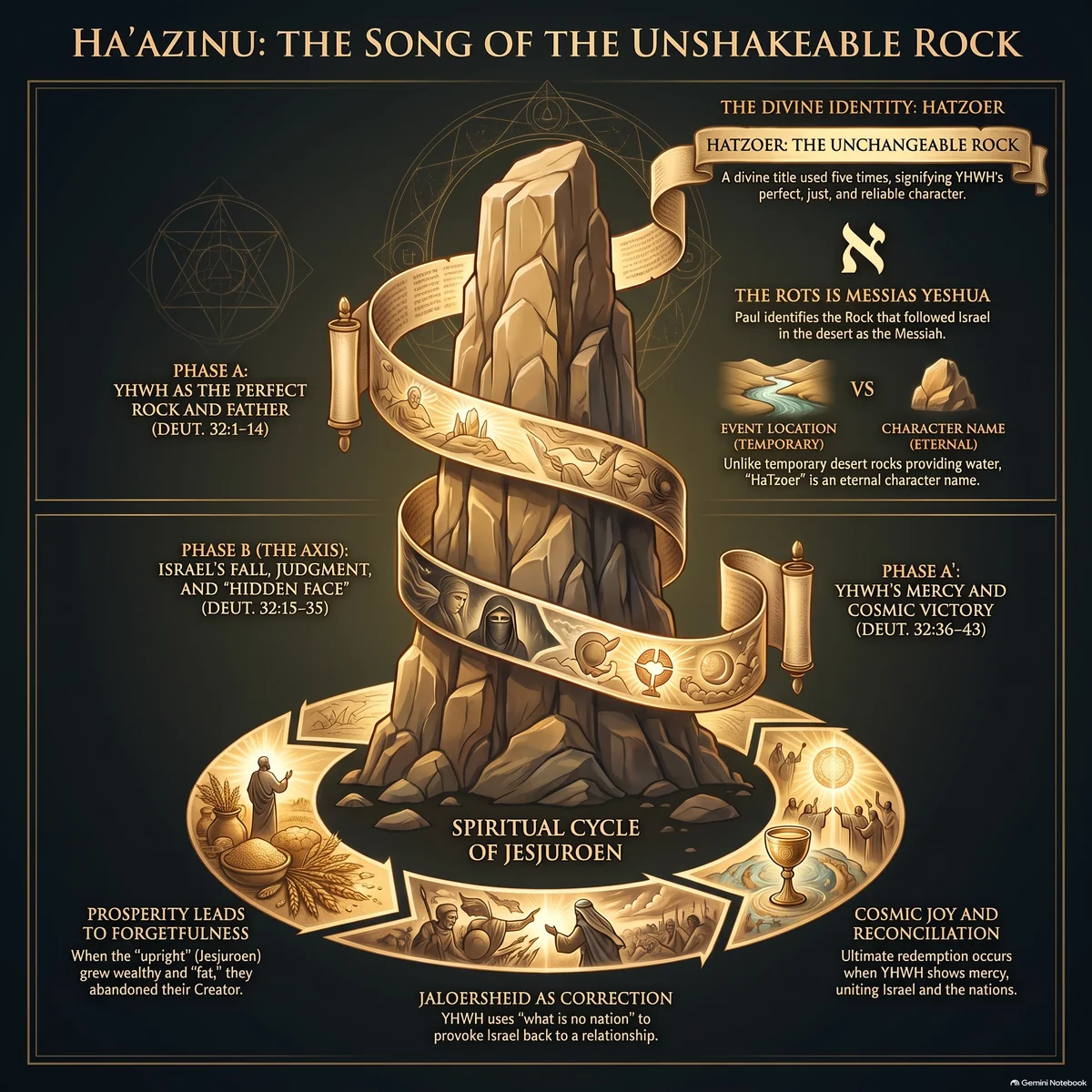
Ha'azinu holds up a mirror to humanity: the tragic cycle of one who cries out to God in distress, but the moment blessing and abundance break through ("Jeshurun grew fat"), kicks back and strays. Yet this is not a story that ends at judgment. The Rock that held back the flood and, at the same time, gave the fruitful rain remains the very same Rock that finally brings His people and the nations together in reconciliation.
Ha'azinu teaches that judgment is never YHWH's final word over His people: He "relents" when He sees their strength is gone (Deut. 32:36) — not an unpredictable mood swing, but the fixed outcome, bound to His own character (HaTzoer), of the entire Song.
The blessing-and-curse structure of the Song is often read as a bare legal system: obey the law and be blessed, break the law and be punished. That translation loss must be corrected: this is Torah instruction within a relational covenant — Jeshurun's fall is not a breach of contract but an abandonment of the Rock who carried him (Deut. 32:15,18), and the restoration at the end is not a mechanical reward but the compassion of a God who "has compassion on His servants" (Deut. 32:36).
A — HaTzoer (הַצּוּר) — the character-name, distinguished from the event-Rock
In this Song, YHWH is named with the definite article as HaTzoer five times — not merely a rock, but The Rock: unchanging, righteous, reliable. This is a character-name, not a reference to a single event. Distinguish it from Parasha Chukat, where tsur (Ex. 17:6, Horeb) and sela (Num. 20:8, Meribah) name specific rocks from which water came forth. Ha'azinu takes that image and elevates it into a lasting title for YHWH Himself.
Paleo-Hebrew layer (illustrative, not proof): the letters of צוּר read as Tzade (fishhook — one who grasps or is grasped), Vav (hook/connector), and Resh (head/man) — an image of what a person holds onto and binds himself to. This supports, but does not prove, the character portrait of HaTzoer as the fixed ground to which a person clings.
B — The chiastic structure of the Song
Remez The Song displays a recognizable A-B-A movement: (A) YHWH as the perfect Rock and Father (v. 1-14) → (B) Israel's apostasy and judgment (v. 15-35) → (A') YHWH's compassion and victory (v. 36-43). The axis of this structure sits around verse 36 — "when He sees that their strength is gone, He will have compassion on His servants" — precisely the hinge from judgment to grace. This division is a literary observation, not an explicit textual claim, and is labeled accordingly.
C — Jeshurun grew fat (Deut. 32:15)
"But Jeshurun grew fat, and kicked — you grew fat, thick, and sleek — then he forsook God who made him and scoffed at the Rock of his salvation." — Deuteronomy 32:15
Canonical Jeshurun (יְשֻׁרוּן, H3484, from yashar — "the upright one") is a canonical honorific for Israel, also used in Deut. 33:5, 26 and Isa. 44:2. The Song's irony is sharp: precisely the "upright one" kicks back the moment he grows fat and prosperous. Not an external legal accusation, but an internal contradiction between name and conduct.
Drash: this pattern of spiritual satiation leading to forgetfulness is not exclusively an Israelite problem. See also Torah — The Father's Instruction for the broader line that the Torah instructions are meant relationally, not as a performance system one can "check off" and forget during prosperity.
D — Hasteir Panim returns (Deut. 32:20) — continuation of VaYelech
"I will hide My face from them; I will see what their end will be." — Deuteronomy 32:20
This is the same root satar (H5641) doubled as an infinitive absolute in Parasha VaYelech (Deut. 31:17-18, "hide, yes surely hide"). Where VaYelech spoke the prophecy, Ha'azinu shows the prophecy in motion within the Song itself — not a new theme, but the direct continuation of the same canonical word. See Yeshua — Who Is He? for the line into Isaiah 8:14,17.
E — Provoking to jealousy (Deut. 32:21) — contrast with Pinchas' qinah
"They have made Me jealous with what is no god... I will make them jealous with those who are no people." — Deuteronomy 32:21
This root qana (H7065) is the same root Parasha Pinchas describes as qinah — there, it is the fiery, exclusive devotion of a man acting on YHWH's behalf (Num. 25:11). Here, it is YHWH Himself who, having first been provoked, repays in kind: a mirroring, not an arbitrary, response. Both forms share the root but not the direction — human qinah is devotion toward YHWH; God's qana in Ha'azinu is the righteous consequence of covenant unfaithfulness.
Echo: see Step 3 above for the full treatment of how Paul reads this verse in Romans 10-11 as the key to the temporary, redemptive role of the nations.
F — Sod: the Noah parallel and the circle of the Torah
Speculative Remez Counted from the end, Ha'azinu is the second-to-last... rather, the second parasha of the Torah counted backward — and thus corresponds thematically with Noah, the second parasha from the beginning. Both texts deal with judgment God brings upon the earth, and both explicitly place the responsibility with humanity: Genesis 6:11-12 states that mankind destroyed the earth through its way of life, not God; Ha'azinu likewise states that Israel itself destroys the covenant blessing and loads the curse upon itself (Deut. 32:5, "they have dealt corruptly with Him, they are no longer His children"). Even the imagery mirrors: Moses' song opens with teaching that "drops like rain" (Deut. 32:2) — the opposite image of the flood that bursts from that same heaven in Noah (Gen. 7:11). This structural observation rests on canonically verifiable texts, but the suggested chiastic envelope of the Torah as a whole is a literary-interpretive observation, not an explicit textual claim.
Tabernacle projection: if this Song were an object in the Tabernacle, the closest match is the Testimony (edut) in the Ark — not the Rock itself. Moses, after all, commanded that the scroll be placed beside the Ark as a witness (Deut. 31:26, VaYelech); the Song serves the same function, now carried in the mouth of the people instead of stored in a chest. See Two Witnesses — Torah and the Prophets.
Echo — the future mourning and cleansing: the Sod-level of this Song finally points ahead to the moment when Israel will "look on Him whom they have pierced" and mourn for Him as for an only child (Zech. 12:9-10), followed by a fountain opened against sin and uncleanness for the house of David and the inhabitants of Jerusalem (Zech. 13:1). This is the canonical completion of the A' movement in Deut. 32:36-43: not merely victory over enemies, but the people's own inward return to their Rock.
G — Heaven and Earth as Legal Witnesses (Deut. 32:1)
"Give ear, O heavens, and I will speak, and let the earth hear the words of my mouth." — Deuteronomy 32:1
Canonical The summons to heaven and earth is not poetic scenery but a fixed, legal covenant formula — the same one used in Deut. 4:26, 30:19, and 31:28. The Torah itself states the principle behind these two witnesses: "on the evidence of two witnesses or of three witnesses the charge shall be established" (Deut. 19:15). The Song thus opens as a formally filed lawsuit of YHWH against (and ultimately for) Israel, with heaven and earth as the required witnesses — a case that, once opened, is not bound to one moment but stretches over the whole of Israel's history: covenant faithfulness, apostasy, exile, and restoration are all read within that same, permanently valid testimony (cf. Deut. 31:21, "this song shall confront them as a witness"). See Two Witnesses — Torah and the Prophets for the full treatment of this witness principle.
H — "Their Rock Had Sold Them" (Deut. 32:29-31)
"How could one have chased a thousand, and two have put ten thousand to flight, unless their Rock had sold them, and YHWH had given them up?" — Deuteronomy 32:30
Moses does not read military defeat here as chance or as a simple imbalance of strength, but as an inverted oracle: a disproportionate defeat signals the withdrawal of HaTzoer Himself. This connects directly to the Torah's own distrust of military self-sufficiency: a king of Israel "shall not acquire many horses for himself... lest he cause the people to return to Egypt in order to acquire many horses" (Deut. 17:16). The principle of HaTzoer from §A above carries through here: not weaponry, but the Rock Himself is the only legitimate source of outcome in battle.
Parasha Ha'azinu challenges us to align our walk with the Unshakable Rock and to guard against spiritual forgetfulness in seasons of abundance:
1 — Test your "Jeshurun level".
Examine this week where prosperity, comfort, or routine has made you spiritually lax. Write down three specific blessings you've come to treat as a given, and deliberately give thanks for them this week.
2 — Let your teaching drip like dew.
"My teaching shall drop as the rain, my speech shall distill as the dew" (Deut. 32:2). Speak this week not like a devastating hailstorm or a harsh verdict over others, but gently and constructively — especially when you must correct someone.
3 — Be a "jealousy-provoking" witness.
Let your walk this week be so full of peace and obedience to the Spirit that others — believer or not — grow hungry for the God you serve, rather than repelled by an attitude of condemnation.
4 — Build deliberately on the Rock.
When a hard decision or an emotional storm hits this week, stop relying on human calculation, networks, or your own strength. Withdraw into prayer and say out loud: "YHWH is my Rock, whose work is perfect."
Every step is a concrete expression of Ha'azinu itself: opening the ears to the voice of the Rock, and letting the walk flow like a blessing on the earth rather than like a devastating storm.
Avinu Malkeinu — Our Father, our King,
You are HaTzoer — the Unshakable Rock, whose work is perfect and whose ways are entirely just. We bow before Your greatness and confess that You are a God of truth, without any injustice.
Forgive us for the moments when, like Jeshurun, we have grown fat and forgetful in our abundance and gone our own way. Do not hide Your face from us, but let Your teaching drop like the rain and Your words flow like the dew over our hearts.
Let us be a jealousy-provoking witness of Your goodness this week, and lead us through Yeshua, our Rock and our Redeemer, to the moment when heaven and earth will rejoice together — Israel and the nations united — in Your final compassion.
Baruch Atah YHWH, HaTzoer, whose work is perfect and who does not forsake His people forever. Amen.
- TorahDeuteronomy 32:1-52; Deuteronomy 32:1 (the opening formula, heaven and earth as legal witnesses); Deuteronomy 32:1-2 (the cosmic summons and the dew metaphor); Deuteronomy 32:4,15,18,30,31 (HaTzoer, the fivefold Rock title); Deuteronomy 32:5-6 (Israel's corruption against God's faithfulness); Deuteronomy 32:10-14 (YHWH finding, encircling, and carrying Israel in the wilderness); Deuteronomy 32:15 (Jeshurun grew fat); Deuteronomy 32:20 (Hasteir Panim, direct continuation of Deut. 31:17-18); Deuteronomy 32:21 (provoking to jealousy through "no people"); Deuteronomy 32:22-25 (the fire judgment); Deuteronomy 32:29-31 (military defeat as inverted oracle: "their Rock had sold them"); Deuteronomy 32:35-36 (vengeance and compassion); Deuteronomy 32:36-43 (the final deliverance); Deuteronomy 32:43 (the call to the nations to rejoice); Deuteronomy 31:19-22,26,28 (VaYelech: the command to write the Song and the witness formula); Deuteronomy 19:15 (the witness principle: the charge is established by two or three witnesses); Deuteronomy 17:16 (the royal prohibition on multiplying horses, contrasted with trust in HaTzoer); Genesis 6:11-12 and 7:11 (the Noah parallel); Exodus 17:6 and Numbers 20:8 (tsur/sela, the event-Rock of Chukat); Numbers 25:11 (qinah at Pinchas, contrast source); Deuteronomy 33:5,26 (Jeshurun elsewhere).
- Prophets2 Samuel 22:1-51 (Haftarah, the Song of David); Hosea 14:2-10, Micah 7:18-20, Joel 2:15-27 (alternate Haftarah on Shabbat Shuvah); Isaiah 8:14,17 (satar at the stone of stumbling); Isaiah 29:10 (the spirit of stupor, quoted by Paul in Rom. 11:8); Isaiah 44:2 (Jeshurun elsewhere); Zechariah 12:9-10 (the future mourning over Him whom they have pierced); Zechariah 13:1 (the opened fountain against sin and uncleanness); 1 Kings 19:10,18 (Elijah and the 7,000 who did not bow to Baal, quoted by Paul in Rom. 11:2-4).
- WritingsPsalm 69:23-24 (David's words on darkened eyes, quoted in Rom. 11:9-10).
- Brit Chadasha1 Corinthians 10:1-4 (the Rock that followed Israel, canonically identified as the Messiah); Romans 10:19 (direct quote of Deut. 32:21); Romans 11:1-6 (the remnant by grace, not by works); Romans 11:8-10 (the spirit of stupor); Romans 11:11-14 (the temporary and redemptive purpose of the jealousy-provoking); Romans 15:10 (quote of Deut. 32:43); Revelation 15:3 (the song of Moses and of the Lamb, foreshadowed in Parasha VaYelech); Revelation 21:12-14 (the twelve gates of the New Jerusalem, named after the tribes of Israel — no Gentile gate).
- Rabbinic/TraditionalThe name "Shabbat Shuvah" for the alternate haftarah occasion; the placement of Ha'azinu in the annual reading cycle just before Sukkot.
- Source materialSupplementary aliyah-based teaching material on Parashat Ha'azinu (from ingeestenwaarheid.nl) was tested against Protocol VI. Excluded for failing the canonicity test (VI.i, step 1) or lacking canonical grounding: a cosmological "Foundation Stone / axis mundi" passage about the navel of the world (Ancient Near Eastern background mythology, not a Biblical concept); a reference to personal prophetic visions (2020-2022) and an external, self-published book; and an etymological claim about Shaddai ("my breasts") based solely on an online translation tool rather than a recognized lexical source — the etymology of Shaddai is disputed in the scholarly literature and is not presented here as settled fact. The observation of the Shirat Ha'azinu as a thematic chiastic mirror of Parashat Noach has been retained, rewritten, and independently grounded (Connections §F), with an explicit speculative-Remez label. The wordplay between bin/banah and natsar/yatsar (v. 10) has been corrected from a suggested etymological kinship to a recognized Hebrew stylistic device (paronomasia). Erroneous rendering of the divine Name ("God", "the Lord") has been consistently corrected to YHWH (Protocol VI.iii). The speculative link between the seven substances from the Rock (Deut. 32:13-14) and the "seven Spirits of God" (Isa. 11:2; Rev. 4:5) has, where relevant elsewhere on the site, been labeled speculative Remez and is not repeated here as settled fact. A second source video, "Are Judgments Coming Upon Jerusalem?" (Deut. 32:29-39, also ingeestenwaarheid.nl), was largely rejected: a blood-curse doctrine holding the Jewish people collectively and permanently responsible for Yeshua's death is excluded outright, not merely labeled — this reading runs directly against Devar Emet's own anti-replacement-theology stance and has historically been a load-bearing doctrine behind antisemitism. Six unsourced, present-day "evidence points" for current judgment (claims about military policy and contemporary Israeli society, among others) were likewise excluded: they fail the canonicity test (none of it is stated in Deut. 32:29-39 itself) and are, besides, sweeping, unsupported claims about identifiable groups. What was retained, independently verified canonically, and rewritten: Deuteronomy 32:29-31 (Connections §H) and Zechariah 12:9-10 / 13:1 (Connections §F). A third source video, "Ha'azinu Brit Chadashah" (B'nai Shalom, 2026), proved largely usable: the liturgical Shabbat opening, personal anecdotes, and a digression on the Passover Zeroa were not retained (outside the scope of this parasha, resp. non-canonical homiletics); Romans 11:1-10 and Revelation 21:12-14 were retained (Step 3).
- PaRDeS HermeneuticsPshat (the Song as covenantal legal instrument, the historical circumstances of Moses' departure); Remez (the chiastic structure of the Song, the Noah parallel, the paleo-Hebrew layer of tsur, military defeat as inverted oracle); Drash (Jeshurun's fall as a warning against spiritual satiation, the jealousy-provoking witness); Sod (the Song as an enduring witness beside the Ark, the Tabernacle projection onto the Testimony, the future mourning and cleansing of Zech. 12-13). Talmud, b. Sanhedrin 67b; b. Chagigah 14b. Kabbalistic Sod content (Zohar, Sefer Yetzirah) explicitly excluded — Protocol VI.i extension.
- ProtocolCanonicity test (VI.i) applied to every concept: HaTzoer, Jeshurun, and the provoking-to-jealousy (qana) are canonically grounded in Deuteronomy 32 with Strong's numbers. No use of the Zohar, Sefer Yetzirah, or kabbalistic works. "Torah instruction" used in place of unqualified "law"/"commandments" (VI.ii.b). YHWH used in the site's own text, never "God" or "the Lord" without explanation (VI.iii). The hypo nomos/en nomos distinction is not separately developed here, since Romans 10-11 in this context is not about that contrast but about the provoking of Israel to jealousy — the full hypo/en-nomos treatment remains with What Does the Law Bring?. HaTzoer is explicitly distinguished from the event-Rock (tsur/sela) of Parasha Chukat, to prevent conflating a character-name with a one-time event.