Va'etchanan and Ekev emphasized shema — attentive, orienting hearing. Re'eh adds seeing: the active, discerning beholding of the real consequences of a choice. The verse opens in the singular — one person looking — and shifts to the plural lifneichem, "before you all": every eye carries responsibility for the shared choice.
"See, I set before you today a blessing and a curse: the blessing, if you listen to the mitzvot of YHWH, your God... and the curse, if you do not listen..." — Deuteronomy 11:26-28 (paraphrase)
Scope and boundaries: the parasha unfolds in five main lines: the proclamation of blessing and curse (Deut. 11:26-32) — the ceremony on Mount Gerizim and Mount Ebal by the Jordan; the centralization of worship (Deut. 12:1-32) — removing the Canaanite high places and bringing offerings only to "the place that YHWH will choose" (Ham-Makom); guarding the purity of the faith (Deut. 13:1-18) — warnings against false prophets, enticing family members, and apostate cities; the holy people and the sanctification of life (Deut. 14:1–15:23) — the food laws (kashrut), the tithes (ma'aser), and the year of release (shemitah); and the three pilgrimage feasts (Deut. 16:1-17) — Passover, Shavuot, and Sukkot, when all Israel gathers before YHWH's face.
The connection to the preceding parasha is close. Parasha Ekev closed with the contrast between Egypt and the land that drinks the rain of heaven — a land that requires trust rather than human control. Re'eh builds on that: now that the land is in sight, the question becomes concrete — how does that trust take shape, in a proclamation of blessing and curse, in one chosen place of worship, and in the daily, tangible choices around the table, possessions, and feast?
Note: as the third of the Shiv'ah d'Nechemta (Seven Sabbaths of Comfort) between Tisha B'Av and Rosh Hashanah Rabbinic/Traditional, Isaiah 54 is read. Zion is addressed in her deepest distress and restored.
"O you afflicted one, tossed with tempest, and not comforted, behold, I will set your stones in fair colors... And all your children shall be taught by YHWH, and great shall be the peace of your children." — Isaiah 54:11, 13 (paraphrase)
Remez — canonical connection: Re'eh warns of the devastation that follows idolatry and covenant breach. The haftarah shows the reverse side: even when the people are tossed by storms because of their unfaithfulness, YHWH raises Zion up again with a lasting covenant of grace (chasdei David ha-ne'emanim, Isa. 55:3). Where Re'eh calls for keeping the feasts and bringing the tithes to the chosen place, Isaiah 55 calls people to come and drink and eat freely at God's abundant table of grace — the same joy, now without the condition of one's own possessions.
"Whoever eats My flesh and drinks My blood abides in Me, and I in him." — John 6:56
Not seeing, but hearing and testing
Where Re'eh calls for sharp sight, John warns of the reverse danger: discernment that goes by impression and persuasiveness rather than by what has truly been heard from YHWH. The same movement as the test of the prophet in Deuteronomy 13 returns in the Renewed Covenant:
"Beloved, do not believe every spirit, but test the spirits, whether they are of God; because many false prophets have gone out into the world... By this we know the spirit of truth and the spirit of error." — 1 John 4:1, 6
Here too the test is not the impressive but the content: does the spirit confess that Yeshua the Messiah has come in the flesh? As in Deuteronomy 13, the reliability of a message is determined not by how convincing it appears, but by what it leads to.
No fellowship with idols
Paul, in 1 Corinthians 10, returns to the principle of Ham-Makom — serving YHWH exclusively on His terms — and to the holiness of touching food offered to idols:
"You cannot drink the cup of the Lord and the cup of demons; you cannot partake of the Lord's table and of the table of demons." — 1 Corinthians 10:21
An open hand for the poor
The command of Deuteronomy 15:11 — "open your hand wide to your brother, to your poor" — is used by John directly as a test of true faith:
"Whoever has this world's goods, and sees his brother in need, and shuts up his heart from him, how does the love of God abide in him?" — 1 John 3:17
Parasha Re'eh sets before humanity an unavoidable choice: blessing by taking YHWH's Torah-directions to heart, or curse through self-will and idolatry. God's holiness demands that worship not be scattered according to human whim, but stay centered on the place of His Presence. This holy character permeates all of life: what we eat, how we handle possessions and debts, how much of our income we give back, and how generously we open our hand to the poor.
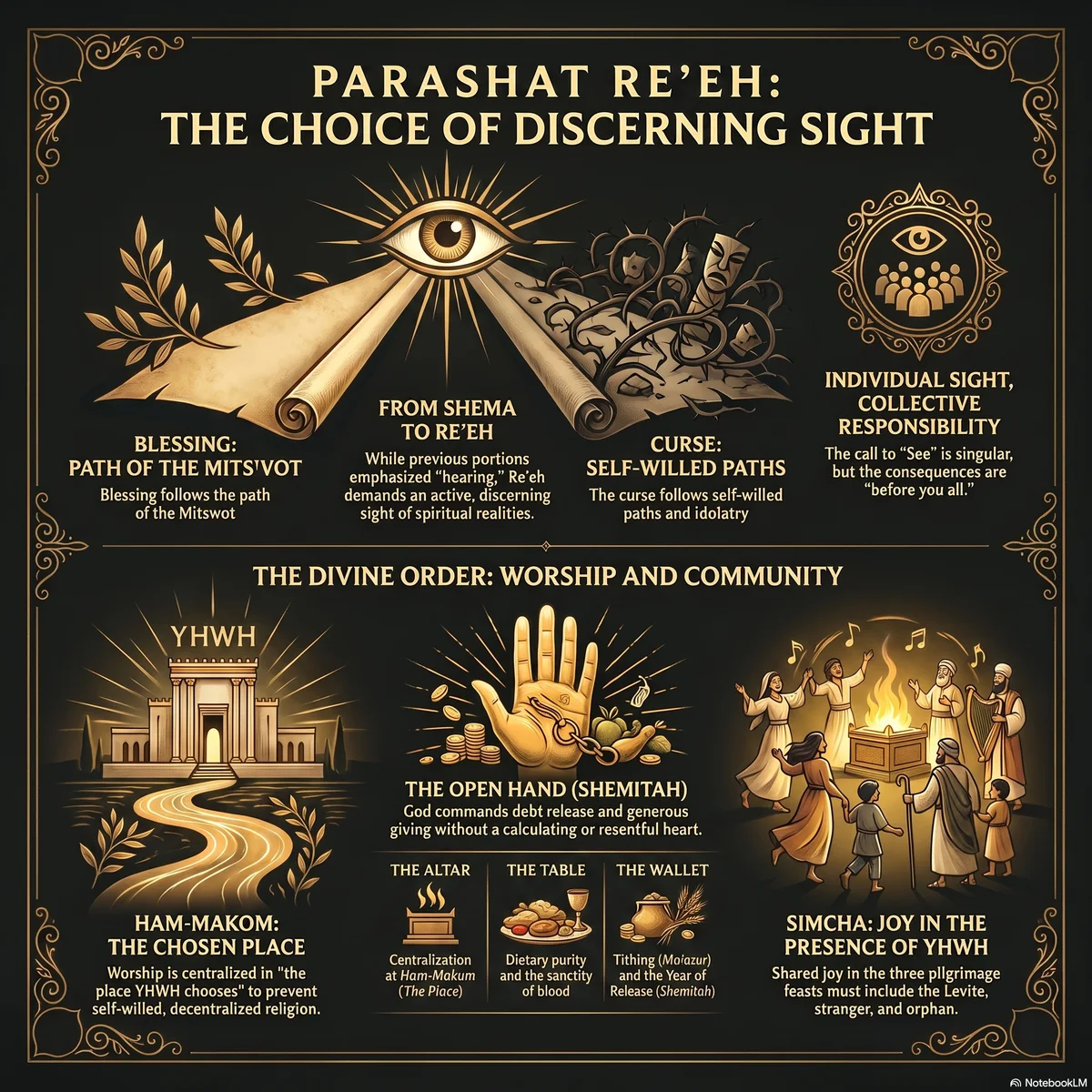
Every layer of this parasha returns to the same axis: seeing and choosing. The proclamation of blessing and curse (part A) is not a threat but a call to see clearly; Ham-Makom (part B) keeps that seeing from fragmenting; the test of the prophet (part C) protects it from deception; the table (part D), the open hand (part E), and the tithes (part G) make it visible in daily life; and the three feasts (part F) celebrate it as a community, before YHWH's face.
This choice is repeated and sharpened later in Devarim, with a call that goes beyond mere information:
"See, I have set before you today life and good, death and evil... I call heaven and earth as witnesses today against you, that I have set before you life and death, blessing and cursing; therefore choose life, that both you and your descendants may live." — Deuteronomy 30:15, 19
From this vantage point, the mitzvot themselves are not a burden that must earn the blessing, but the concrete shape the blessing takes — another way of looking, the real seeing to which Re'eh calls. Whoever sees the Torah-directions as directives flowing from relationship sees them as the way to blessing, not as an obstacle to it.
An important distinction here: the text places blessing and curse side by side, but that does not mean YHWH "imposes" the curse in the same active way He gives the blessing. Where blessing flows from drawing near, the curse is rather the absence of that — the result of His drawing stopping (cf. John 6:44) and of a heart that is not circumcised (Deut. 30:6). Whoever keeps hardening himself against the Torah is given over to that hardening (cf. Rom. 1:24-28, "God gave them over") and so remains in his own captivity. This is a Drash-layer interpretation, not a literal Pshat statement of Deuteronomy 30 itself, but it is a reading that consistently ties together the witness of Torah and the Renewed Covenant.
A — Word study: Re'eh (רְאֵה) versus Shema (שְׁמַע) — the seeing that follows the hearing
Parasha Va'etchanan and Ekev emphasized shema (obedient hearing). Re'eh adds seeing. In the Hebrew world of thought, seeing is beholding the reality of choices — not an abstract idea, but something that stands "before your face" (11:26), tangibly close.
Canonical The ceremony itself is carried out in Joshua 8:30-35 — Joshua left "not a word" of what Moses commanded unread. That same precision returns with Yeshua, who says in Matthew 5:17-19 that not a jot or tittle of the Torah will pass away: He brings it to its full meaning (plēroō, G4137 — rabbinic equivalent maleʾ), not to its abolition. Reading "fulfill" as "settle and close out" is a popular-theological reading that contradicts the text.
This "seeing" of Re'eh does not stand opposed to the hearing of Shema, but builds on it — and it is never a license to go by what looks appealing on the surface. The Torah elsewhere warns precisely against a seeing that becomes detached from hearing: "not to follow after your own heart and your own eyes" (cf. Num. 15:39). The Renewed Covenant confirms that same order: "So then faith comes by hearing, and hearing by the word of God" (Rom. 10:17), and faith is "the evidence of things not seen" (Heb. 11:1). The discerning sight to which Re'eh calls is therefore not seeing with the physical eyes that goes by outward persuasiveness — attractive packaging, an impressive sign — but the spiritual discernment of what has truly been heard from YHWH.
Canonical (numeric) The letter value of רְאֵה (resh 200 + aleph 1 + he 5) is 206 — equal to that of דָּבָר, davar, "word" (dalet 4 + bet 2 + resh 200). This numeric link is not evidence on its own (Protocol III), but functions here as reinforcing support for an already-established thematic line: the discerning seeing to which Re'eh calls is inseparably bound to the davar — the spoken/written word of YHWH (cf. John 1:1, 14, where the Davar itself became flesh). Seeing and hearing/speaking converge in this word pair.
→ Further study: Shema Yisrael — The Greatest Commandment · Behold — From ra'ah to chazah · Torah Fulfilled — plēroō
B — Ham-Makom: the chosen place (Deut. 12:1-14)
The Canaanites served their gods "on the high mountains, on the hills, and under every green tree" (Deut. 12:2) — decentralized, self-willed religion in which everyone made his own sanctuary wherever it suited him. YHWH commands Israel to destroy those altars and sets one principle against it:
"But to the place which YHWH your God will choose out of all your tribes to put His Name there for His dwelling place, you shall seek, and there you shall go" (Deut. 12:5). Three functions: (1) preventing syncretism with Canaanite fertility cults, (2) unity of the twelve tribes around one Throne, (3) no religion of one's own devising — "you shall not do... every man whatever is right in his own eyes" (Deut. 12:8) — but only as pleasing to Him.
How does this work now? Moses repeats the principle of Ham-Makom even more concretely:
"Take heed to yourself that you do not offer your burnt offerings in every place that you see, but in the place which YHWH chooses, in one of your tribes, there you shall offer your burnt offerings, and there you shall do all that I command you." — Deuteronomy 12:13-14
Under the Renewed Covenant, Ham-Makom does not shift to arbitrariness, but to Yeshua Himself and the indwelling of the Spirit (John 4:21-24; 1 Cor. 3:16) — still one chosen "place," now no longer an earthly location but a Person. This is not the abolition of the principle but its fulfillment: worship remains exclusive and centered, not a matter of personal preference.
The parasha also calls for lasting care for those with no inheritance of their own:
"And there you shall rejoice before YHWH your God, you and your sons and your daughters, your menservants and your maidservants, and the Levite who is within your gates, since he has no portion nor inheritance with you... Take heed to yourself that you do not forsake the Levite as long as you live in your land." — Deuteronomy 12:12, 19
This pattern — fully sharing in the covenant's joy without possessing one's own tribal inheritance — is a meaningful typological line to Romans 11:17-24. Believers from the nations are described there as a wild olive branch, grafted into the good olive tree, becoming "partaker with them of the root and fatness of the olive tree" (Rom. 11:17). Being grafted in does not mean the wild branch itself becomes the trunk, nor does it mean Israel's own, distinct place is abolished (Rom. 11:18, 29) — just as the Levite, with no tribal land of his own, nonetheless shares fully in the festal joy through his place within the covenant people, not through his own possessions. Both truths stand together: Israel's covenantal structure remains intact, and whoever is grafted in truly and fully shares in the joy before YHWH's face.
Rabbinic/Traditional Rambam names the rebuilding of the Temple — the final, lasting establishment of Ham-Makom — explicitly as one of the tasks of the Messianic king: he "will rebuild the Temple and gather the dispersed of Israel" and will "motivate the entire world to serve God together" (Mishneh Torah, Hilchot Melachim 11:1, 4). Devar Emet reads this not as a contradiction but as confirmation: the chosen place to which Israel is called in Deuteronomy 12 points forward to its own completion.
→ Further study: Sanctify — From Unclean-Removed to Devoted-To
C — The test of the prophet and idolatry (Deut. 13:1-11)
One of the sharpest passages in the Torah addresses how a prophet is to be judged. Even if a prophet or dreamer announces a sign or wonder that comes true, but then calls the people to serve other gods, he is not to be listened to (Deut. 13:1-3):
"For YHWH your God is testing you to know whether you love YHWH your God with all your heart and with all your soul." — Deuteronomy 13:3 (paraphrase)
The truth of a prophetic message is never proven primarily by the supernatural, but by the content of the teaching: does it lead to devotion to YHWH, or does it lead away from Him? (cf. Galatians 1:8). The same test — content over impression — returns in 1 John 4:1-6 (see Renewed Covenant, step ③).
Rabbinic/Traditional The Mishnah describes the period just before the coming of the Messiah (ikveta de-Meshicha, "the footsteps of the Messiah") as precisely a time in which truth is hidden and deception increases (Mishnah Sotah 9:15). That is exactly the danger against which Deuteronomy 13 warns: not primarily open idolatry, but a voice that presents itself as authoritative while leading away from YHWH.
D — The table and the blood (Deut. 12:23-25; 14:3-21)
In the land, meat may be slaughtered "according to the desire of your soul," but with one absolute limit:
"Only be sure that you do not eat the blood, for the blood is the life; you may not eat the life with the meat." — Deuteronomy 12:23
The blood atones (Lev. 17:11) and therefore may not be consumed at will. The food laws of Deuteronomy 14 set the holy people (am kadosh) apart at the table as well: what enters the stomach reflects God's order in the physical realm, through the distinguishing command between clean (tahor) and unclean (tamee). The text itself speaks here of ritual purity — not of a spiritual identity of animal species, and that distinction is deliberately not abandoned here.
Rabbinic/Traditional Ramban points out that the ground for these food laws is not physical health but holiness: "Be holy, for I am holy" (Lev. 11:44; cf. Deut. 14:2) — the laws serve the well-being of the soul, not the body as such. Making a distinction at the table is thus a daily, embodied reminder of who Israel is, not a dietary regulation.
→ Further study: Purify — Holiness as Distinction
E — The open hand: shemitah and the poor (Deut. 15:1-11)
Every seventh year is the Shnat Shemitah — the year of release. Debts of fellow Israelites are canceled.
| The ideal — Deuteronomy 15:4 | The reality — Deuteronomy 15:11 |
|---|---|
| "Except when there may be no poor among you..." | "For the poor will never cease from the land; therefore I command you, saying, 'You shall open your hand wide to your brother, to your poor and your needy, in your land.'" |
Moses explicitly warns against a calculating heart: as the seventh year approaches, the temptation is to stop lending money out of fear of not getting it back ("beware lest there be a wicked thought in your heart," Deut. 15:9). YHWH commands giving without resentment, for He is the guarantor of the poor.
→ Further study: Loving in Deed and Truth
F — Sod: the three feasts and the joy (Deut. 16:1-17)
The parasha closes with the ordering of the three pilgrimage feasts (Shalosh Regalim): Passover — remembrance of the hurried exodus (the foundation); Shavuot — the feast of firstfruits, later linked to the giving of the Torah and the Spirit; Sukkot — the fulfillment of dwelling in booths and the ingathering of the late fruits.
At Shavuot and Sukkot the Torah explicitly commands this joy before YHWH's face. It is not solitary: son, daughter, servant, Levite, stranger, orphan, and widow must share together in the festal joy. True worship at God's chosen place transcends social class and melts the community into one joyful body.
G — The tithes: layered stewardship (Deut. 14:22-29)
The parasha regulates two destinations for the yearly tithe. In most years it is brought to the chosen place and eaten there "before YHWH your God... that you may learn to fear YHWH your God always" (Deut. 14:23, 26). In the third and sixth year of the seven-year cycle, that same tithe is instead stored within one's own gates, for the Levite — who received no inheritance in the land (Num. 18:21-24) — and for the stranger, the orphan, and the widow (Deut. 14:28-29).
Rabbinic/Traditional The Mishnah (Ma'aserot, Ma'aser Sheni, Pe'ah) names these two destinations Ma'aser Sheni ("second tithe") and Ma'aser Ani ("poor tithe") — useful, organized terminology, but not biblical words in themselves.
Canonical Already before Sinai, Abram gave a tithe of everything to Melchizedek, king-priest of Salem (Gen. 14:20) — a lasting pattern of acknowledging that one's income ultimately comes from YHWH, not a Mosaic legal statute. This parasha is not the place for the full treatment of this theme: the study Giving works out ma'aser (מַעֲשֵׂר, H4643) from root to application, including Malachi 3:10 and the radical surrender in Acts 4.
→ Further study: Giving — Beforehand, Not Afterward
Further study on Devar Emet
- Shema Yisrael — The Greatest Commandment — the hearing on which Re'eh's seeing builds
- Behold — The One Desire — from ra'ah (fleeting seeing) to chazah (focused beholding)
- Sanctify — From Unclean-Removed to Devoted-To — the inner side of Ham-Makom
- Purify — Holiness as Distinction — the food laws of Leviticus 11 worked out
- Loving in Deed and Truth — the open hand for the poor, anchored in 1 John 3:17
- Giving — Beforehand, Not Afterward — ma'aser from root to application
- Torah Fulfilled — plēroō, the Torah brought to its full intent
- Parasha Ekev — the preceding parasha: the land that drinks the rain of heaven
Parasha Re'eh calls us to examine our choices and posture sharply this week:
1 — See the choice before you.
Don't make your decisions this week on autopilot. Pause at a concrete ethical or relational choice and ask yourself: does this path lead to blessing or to curse?
2 — Don't be swept along by signs and wonders alone.
Don't let yourself be carried away by emotional or spectacular persuasion on TV, online, or in gatherings. Test every teaching against the revealed Word of God.
3 — Open your hand generously.
Is there someone in your circle — a brother, sister, someone poor, or a stranger — who has a financial or practical need? Give generously this week, without calculating the cost beforehand.
4 — Account for what you give back.
Consciously view a portion of what you receive this week — income, time, or something else — as something you give back to YHWH, not out of obligation but as an acknowledgment that it came from Him (Deut. 14:23; Gen. 14:20).
5 — Serve God on His terms, not your own.
Examine your own worship. Are there areas where you serve God in a way that suits you best (an "own mountain"), rather than submitting to the order of His Word and His congregation?
Each of these five steps is a concrete form of the same pattern from parts A and B: seeing clearly, and letting that seeing lead to a choice for the place and manner that YHWH Himself appoints.
Avinu Malkeinu — Our Father, our King,
Open our eyes that we may see clearly (Re'eh) and choose the way of blessing. Guard us against the temptation to serve You according to our own understanding or the patterns of the world around us.
Give us an undivided heart that does not turn aside to idols, however impressive their traces may seem. Give us a wide, open hand for our neighbor, the poor, and the stranger, knowing that all we possess we have received from Your hand.
Fill us with the deep joy of Your feasts and renew us at the table of Your Covenant, through Yeshua, our Passover Lamb and our Redeemer.
Baruch Atah YHWH, who sets blessing before those devoted to Him and makes His Name dwell in our midst. Amen.
- TorahDeuteronomy 11:26–16:17; Deuteronomy 11:26-28 (blessing and curse set forth); Deuteronomy 12:2-8 (Ham-Makom, destruction of the pagan high places, not doing what is right in one's own eyes); Deuteronomy 12:23-25 (the prohibition on eating blood); Deuteronomy 13:1-5 (the testing of the prophet and dreamer); Deuteronomy 14:1-21 (food laws, clean and unclean); Deuteronomy 14:22-29 (the tithes — Ma'aser Sheni and Ma'aser Ani); Deuteronomy 15:1-11 (the year of release, Shemitah, and opening the hand to the poor); Deuteronomy 16:1-17 (the three pilgrimage feasts: Passover, Shavuot, Sukkot); Genesis 14:20 (Abram gives Melchizedek a tithe, before Sinai); Numbers 18:21-24 (the Levite without his own inheritance); Leviticus 17:11 (the blood as atonement); Deuteronomy 30:6, 15, 19 (choose life — the blessing/curse choice repeated and sharpened); Deuteronomy 12:12-14, 19 (Ham-Makom made concrete, and lasting care for the Levite).
- ProphetsIsaiah 54:11–55:5 (Haftarah Shabbat Re'eh); Isaiah 54:11-13 (restoration of Zion); Isaiah 55:1-3 (the free water and the everlasting covenant); Malachi 3:10 (the tithing test, developed in the study Giving).
- Renewed CovenantJohn 6:35-56 (Yeshua the Bread of Life); 1 Corinthians 10:14-22 (no share in the table of demons); Galatians 1:8 (testing the message); 1 John 3:16-18 (opening the hand to the brother in need); Matthew 5:17-20 (plēroō — the Torah brought to its full intent); Luke 6:38 and 2 Corinthians 9:6 (the sowing-and-reaping principle, developed as application, not as a literal guarantee); John 6:44 and John 4:21-24 (the Father's drawing; worship in spirit and truth); 1 Corinthians 3:16 (the indwelling of the Spirit as Ham-Makom); Romans 1:24-28 (God giving people over to hardening); Romans 11:17-24, 29 (the wild olive branch grafted into the good olive tree, without abolishing Israel's own place); 1 John 4:1-6 (testing the spirits — content over impression); Romans 10:17 (faith comes by hearing); Hebrews 11:1 (faith as the evidence of things not seen).
- Rabbinic/Trad.Rashi on Deut. 11:26 (the use of the singular form Re'eh addressed to the individual); Mishnah Zevachim (on the central sacrificial service at Shiloh and Jerusalem); Sifre Devarim on Deut. 12; Mishnah Ma'aserot / Ma'aser Sheni / Pe'ah (the terminology for the tithes in Deut. 14:22-29); Mishnah Sotah 9:15 (ikveta de-Meshicha — the period just before the coming of the Messiah); Rambam, Mishneh Torah, Hilchot Melachim 11:1, 4 (the tasks of the Messianic king: rebuilding the Temple, gathering Israel); Ramban on Leviticus 11:44 / Deuteronomy 14:2 (the food laws as sanctification of the soul, not a health regulation).
- PaRDeSPshat (the legislation on worship, food, tithes, and feasts at Moab); Remez (the singular Re'eh against the plural lifneichem; Genesis 14 before Sinai); Drash (testing the prophet by the Torah, not by wonders; the giving-back principle from Malachi 3 as application); Sod (Ham-Makom as a typological reference to Yeshua and the indwelling of the Spirit). Talmud, b. Sanhedrin 67b; b. Chagigah 14b. Kabbalistic Sod-content (Zohar, Sefer Yetzirah) explicitly excluded — Protocol VI.i extension. Gematria Re'eh=Davar (206) verified via the letter values themselves and presented solely as reinforcing support for an existing thematic link (Protocol III) — not via Sefer Yetzirah or Zohar. Mishnah Sotah 9:15, Rambam (Hilchot Melachim 11), and Ramban (Lev. 11:44/Deut. 14:2) verified against the primary source and labeled Rabbinic/Traditional.