Devarim ended with a leader sending someone else fearlessly into the land. Va'etchanan opens one verse later with that same leader, himself empty-handed, pleading for that very land. This parasha forms the spiritual heart of the book of Deuteronomy: Moses' most personal prayer flows directly into the foundational bedrock of Israel's life of faith — the repetition of the Ten Words (Deut. 5) and the proclamation of the Shema (Deut. 6).
"I pleaded (va'etchanan) for grace with YHWH at that time: Lord YHWH... let me cross over, I pray, and see that good land... But YHWH was very angry with me because of you and would not listen to me. And YHWH said to me: That is enough (rov-lach); speak to Me no more of this matter." — Deuteronomy 3:23-26 (paraphrase)
Scope and boundaries: the parasha unfolds in four movements: Moses' personal plea to cross the Jordan, YHWH's refusal and the charge to encourage Joshua, followed by an urgent call to obedience without adding or subtracting anything (Deut. 3:23 – 4:40); the establishment of three cities of refuge east of the Jordan (Deut. 4:41-43) and the introduction to the proclamation of the Torah (Deut. 4:44-49); the repetition of the Ten Words (Aseret ha-Dibrot) at Horeb/Sinai and Moses' role as mediator between YHWH and the people trembling before the fire (Deut. 5:1-33); and the Shema with the great commandment of love for YHWH, the sharp warning against the idols of Canaan, and the proclamation of God's covenant faithfulness (chessed) to those who love Him (Deut. 6:1 – 7:11).
The connection with the preceding parasha is close. Parasha Devarim closed with the observation that the very first word of this parasha — וָאֶתְחַנַּן — is Moses' own plea, spoken just after he sent Joshua fearlessly into the land (Deut. 3:22-23). Va'etchanan therefore does not open with a new revelation, but with the man the previous parasha left behind: a leader who had just encouraged someone else, and who now, with all the courage he had, stands pleading for a threshold that is being denied him. See section F below for the full development of this transition.
Note: Va'etchanan is invariably read on the first Shabbat immediately after Tisha B'Av, the day of mourning for the destruction of the Temple. This Shabbat is known in tradition as Shabbat Nachamu (שַׁבַּת נַחֲמוּ), taken from the opening word of the haftarah from Isaiah 40 Rabbinic/Traditional. Where Shabbat Chazon (at Devarim) brought the warning, Shabbat Nachamu brings the first of seven "haftarot of comfort" running through to Rosh Hashanah.
"Comfort, comfort My people, your God will say. Speak to the heart of Jerusalem, and proclaim to her that her struggle is over, that her iniquity is pardoned." — Isaiah 40:1-2 (paraphrase)
Remez — canonical connection: a substantive thread runs between parasha and haftarah. In the parasha, Moses pleads for grace (chanan) but is told he may not enter the land; yet from the top of Pisgah he is given sight of the whole land (Deut. 3:27). Isaiah, for his part, sounds the trumpet of comfort over a people who must pass through the wilderness: "in the wilderness prepare the way of YHWH" (Isa. 40:3). Where Moses' personal wish comes to a halt at the threshold, YHWH guarantees through Isaiah that His word stands forever — "the grass withers... but the word of our God stands forever" (Isa. 40:8) — and that He will shepherd His people and carry the lambs in His arms (Isa. 40:11). That image is a direct echo of the same fatherly carrying Devarim already described (Deut. 1:31), and it is the answer to the plea for grace with which Va'etchanan opens: what Moses is not given is promised to the whole people. This very haftarah text is applied to himself, centuries later, by one specific messenger — see section A below for that canonical thread.
In Mark 12, a scribe comes to Yeshua and asks which commandment is the very first and most important of all. Yeshua does not answer with a new directive, but quotes directly the pivot of this very parasha:
"The first of all the commandments is: Hear, O Israel! The Lord our God, the Lord is one. And you shall love the Lord your God with all your heart, with all your soul, with all your mind, and with all your strength. This is the first commandment." — Mark 12:29-30 (cf. Matthew 22:37; Deut. 6:4-5)
Where Scripture quotations in this study read "the Lord" — as above, taken from the standard translation of Mark 12 — this renders, in the Hebrew source verse (Deut. 6:4), the personal name יהוה (YHWH), traditionally not pronounced. Devar Emet leaves quotations from existing translations intact, but consistently uses YHWH in its own text — as throughout the rest of this study.
Yeshua adds no new commandment here; He points to what already resounded on the plains of Moab. The "first commandment" of the Renewed Covenant is, quite literally, the heart of Va'etchanan.
Yeshua carries this line forward Himself: "If you believed Moses, you would believe Me, for he wrote about Me. But if you do not believe his writings, how will you believe My words?" (John 5:46-47). Whoever truly hears what Moses says in this very parasha — the Shema, the great commandment — is already being prepared to recognize Yeshua. It is not two separate paths of faith, but one continuous line.
Sod · Chanan and the Temptation in the Wilderness
When Yeshua is tempted by the adversary in the wilderness, He repels every attack by quoting exclusively from Deuteronomy — and mostly from this very parasha:
- "Man shall not live by bread alone, but by every word that comes from the mouth of God" (Matt. 4:4 ← Deut. 8:3).
- "You shall not tempt YHWH your God" (Matt. 4:7 ← Deut. 6:16).
- "You shall fear YHWH your God, worship Him, and serve Him only" (Matt. 4:10 ← Deut. 6:13).
Yeshua embodies the obedient Israelite who does not merely recite the word of Va'etchanan, but wields it as a shield in the wilderness. The mitzvah of Deuteronomy 6:13 is, in Him, no external rule but living reality — including the element of fear/reverence the verse itself names, which section C below develops canonically.
Parasha Va'etchanan reveals that the relationship between YHWH and Israel does not rest on human merit or coercion, but on unearned grace (chanan) and a mutual covenant of love (ahavah): through the repetition of the Ten Words and the proclamation of the Shema, YHWH calls His people to undivided devotion — a hearing that leads to doing, anchored in the heart and passed on from generation to generation.
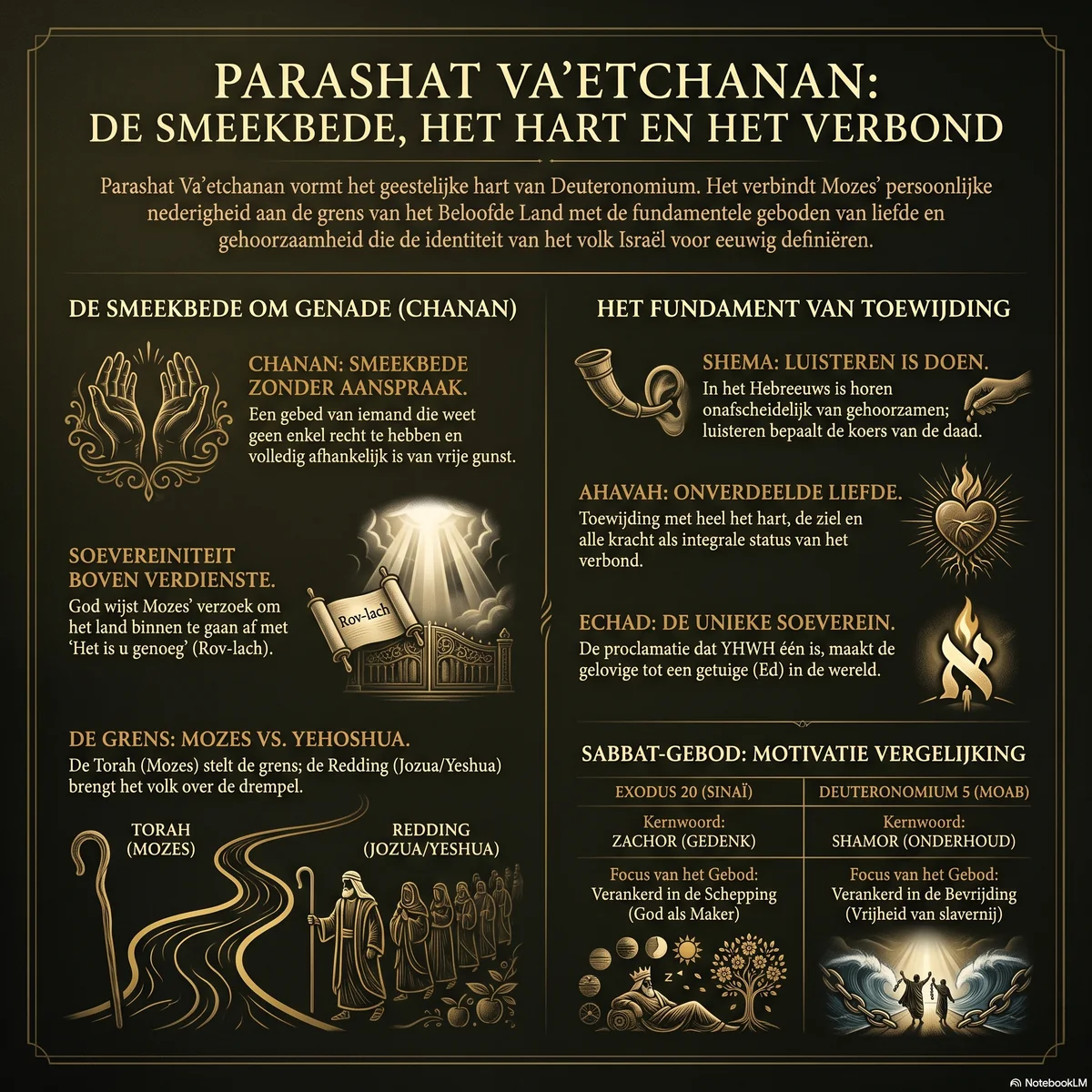
Every layer of this parasha returns to that same axis. Moses pleads and receives not a right, but grace in another form (section A). The people tremble before the fire at Horeb, and YHWH wishes that reverence to become lasting (section C). And the Shema, right between those two movements, calls for a love that encompasses the whole of life (section B). Chanan, yirah, and ahavah are not three separate themes in Va'etchanan, but three phases of the same covenantal movement.
A — Word Study: Va'etchanan & Chanan — Pleading Without Claim
In Hebrew, chinnun (supplication) is the prayer of someone who knows he has no right whatsoever to make a claim — the beggar who stretches out empty hands to the king. Rashi observes that even a righteous man who could appeal to his own good deeds nonetheless approaches God only with chinnun, a free request for favor Rabbinic/Traditional.
Remez — gematria as reinforcing evidence: the gematria (Mispar Hecherchi) of וָאֶתְחַנַּן is 515, the same as תְּפִלָּה (tefillah, "prayer") — a connection the rabbinic tradition draws explicitly in Devarim Rabbah 11:10 Rabbinic/Traditional. This number does not stand alone: it reinforces a thematic link the text itself already carries — Moses' plea is the paradigm of prayer without claim — and is therefore cited here only as supporting evidence, not as a standalone argument (Protocol III).
Canonical contrast — Rov-lach: Moses prays fervently: "let us cross over, I pray" (Deut. 3:25). YHWH's answer is resolute: rov-lach — "that is enough for you; speak to Me no more of this matter" (Deut. 3:26). Here YHWH's sovereignty lies exposed: grace is not a right that can be forced. Yet God does not refuse Moses in anger; He gives him sight from Pisgah (see section F) and commissions him to commission Joshua.
This is precisely the pattern developed in the study Pray — The Halacha of Access: that study itself carries the Hebrew title וָאֶתְחַנַּן and takes Deuteronomy 3:23 as one of its anchor texts. Where Pray maps the full halachic breadth of prayer — the five verbs, the Ephesians 2:18 structure of access, the tamid-rhythm from Parasha Pinchas — this parasha shows where that word chanan has its first, canonical ground: in the mouth of Moses himself, at the threshold of the land.
Moses pleads for grace (va'etchanan) and does not receive it in the form he asked. Centuries later, another messenger already carries that same root in his name: Yochanan — "John," who actually sees the Kingdom dawn. What is more, when priests ask him who he is, Yochanan applies this very parasha's haftarah directly to himself: "I am the voice of one crying in the wilderness: make straight the way of YHWH" (John 1:23, quoting Isa. 40:3; cf. Matt. 3:3, Mark 1:3, Luke 3:4-6). What Moses announced at the edge of the land is carried out, at the edge of the Jordan, by a bearer of his own key word.
Canonical echo — Paul's own chanan-moment: the pattern of Moses' plea returns in Paul. Three times he begs YHWH to remove "a thorn in the flesh"; three times the answer is not rov-lach but something deeper: "My grace is sufficient for you, for My power is made perfect in weakness" (2 Cor. 12:7-9). Just as Moses does not receive entry to the land but does receive sight from Pisgah, Paul does not receive the deliverance he asked for but a greater grace behind it. From Moses to Paul, chanan is thus never a guaranteed outcome — but it is always a guaranteed, if different, grace.
B — The Shema: Unity and Devotion (Deut. 6:4-5)
The foundation of Jewish faith-life, and the "first commandment" Yeshua quotes in Step 3.
Root term: שָׁמַע shema (H8085). Biblical Hebrew has no separate word for "to obey" — listening without doing is not truly hearing. Where Western translations read "obey" as if it meant compliance under compulsion, shema describes an orientation: attuning, responding, letting what one hears set the course. The study Hear and the word study Shema Yisrael develop this further.
Echad (אֶחָד — H259): "one, unique, indivisible." YHWH is not one idol among others, as in the pantheon of Canaan, but the only true Sovereign. The great commandment (Deut. 6:5): love (ahavah) with the whole heart (will and mind), the whole soul (life and breath), and all one's strength ("muchness"/possessions). The study Loving in Deed and Truth — itself built on this very anchor verse, Deuteronomy 6:5 — works out how this love becomes concrete halacha, not a feeling.
Remez — large letters in the Torah scroll: in the Torah scroll, two letters of Deuteronomy 6:4 are traditionally written enlarged: the Ayin (ע) of Shema and the Dalet (ד) of Echad. Together they form the word עֵד (Ed, H5707), "witness" Rabbinic/Traditional. By proclaiming the Shema, the believer stands as a witness to God's oneness in the world — canonically the same concept the study Two Witnesses (key word עֵד, H5707) develops for Torah and Prophets together.
That same witness-language returns in a different register: Moses calls "heaven and earth to witness" against the people this very day (Deut. 4:26; cf. Deut. 30:19; 31:28) — a fixed Deuteronomic formula in which creation itself testifies to the covenant, alongside the people who themselves become witnesses through the Shema. And YHWH, for His part, remains equally bound: He "will not forget the covenant of your fathers, which He swore to them" (Deut. 4:31). The testimony thus runs in two directions: creation and people testify against Israel in unfaithfulness; YHWH's own oath testifies for Israel upon return (see section E below).
C — Horeb and Sinai: The Ten Words Repeated (Deut. 5)
Moses repeats the Ten Words (Aseret ha-Dibrot) for the new generation. Comparing Exodus 20 and Deuteronomy 5, a difference stands out in the Sabbath commandment:
| Exodus 20 (Sinai) | Deuteronomy 5 (Moab) |
|---|---|
| זָכוֹר (Zachor — "remember") Anchored in creation: "for in six days YHWH made the heavens and the earth" (Ex. 20:8, 11). |
שָׁמוֹר (Shamor — "keep/guard") Anchored in liberation: "you shall remember that you were a slave in the land of Egypt... therefore YHWH your God commanded you to keep the Sabbath day" (Deut. 5:12, 15). |
Keeping the Sabbath, then, is not only a pause to consider God as Maker of the universe, but an active celebration of freedom: a redeemed people no longer rules over servants, but grants rest — "that your male and female servant may rest as well as you" (Deut. 5:14). The study Shabbat Covenant develops these two anchors further as a single sign of relationship, not an obligation.
Three smaller, canonically traceable differences between the two versions of the Ten Words reinforce the same picture: at the Sabbath and honor-your-parents commandments, Deuteronomy adds the singular "as YHWH your God commanded you" (Deut. 5:12, 16) — not a collective rule, but a personal address. The ninth word shifts from עֵד שָׁקֶר (ed shaqer, "lying testimony," Ex. 20:16) to עֵד שָׁוְא (ed shav, "empty/worthless testimony," Deut. 5:20) — forbidding not only lying, but needless slander as well. And the tenth word adds "his field" (sadehu) to what one may not covet (Deut. 5:21) — fitting for a generation about to possess land.
From Dread to Lasting Reverence (Deut. 5:5, 23-29)
Deuteronomy 5 does not conceal the people's reaction: at the theophany on Horeb — fire, darkness, cloud, voice — the people literally draw back. They ask Moses to act as mediator from now on, "for this great fire will consume us; if we hear the voice of YHWH our God any longer, we shall die" (Deut. 5:25, paraphrase).
Root term: יָרֵא yare (H3372) — "for you were afraid (yereitem) because of the fire" (Deut. 5:5). The same root Devarim already used to reject the fear of man (Deut. 1:17, 21, 29 — see the study Devarim) here describes the people's response to the theophany itself. This is no contradiction: in the Tanakh, yare is never primarily fear-driven panic, but an orientation of reverent — here: overwhelmed — awe. The distinction does not lie in the word itself, but in its direction: fear of man (Kadesh-Barnea, Devarim) undermines trust; reverence for YHWH (here) is trust's very foundation.
YHWH does not respond to this reaction with correction, but with approval — and with a longing: "oh, that they had such a heart in them, that they would fear Me and keep all My mitzvot always, that it might go well with them and their children forever" (Deut. 5:29, paraphrase). That is the heart of this parasha in miniature: the dread of the moment (pachad-like, physical, real) is not the goal — the goal is that this very reverence (yirah) becomes a lasting, lifelong orientation that flowers into shamar (keeping/doing, section C above) and, two chapters later, into ahavah (love, section B). Pachad at the mountain thus grows, in the parasha's own inner logic, into yirah as a way of life, and from there into love.
Hebrews 12 quotes this very moment — Moses himself says there, "I am exceedingly afraid and trembling" (Heb. 12:21) — and does not present it as an outdated "old covenant" phenomenon, but carries the line forward: "our God is a consuming fire" (Heb. 12:29), canonically the same expression as Aesh Ochlah in section E below. Yeshua's own warning also stands in that line — "do not fear those who kill the body... but rather fear Him who is able to destroy both soul and body" (Matt. 10:28; cf. Luke 12:5) — reverence for YHWH as something that touches the ultimate, not a side issue.
Where this movement canonically arrives, John says: "perfect love casts out fear" (1 John 4:18). This does not contradict the "Drash — Boundary" below, but confirms it: reverence is not the final destination, but the road by which the heart arrives at love — exactly the pachad-yirah-ahavah movement this parasha itself already makes, from Deuteronomy 5 to Deuteronomy 6.
The longing YHWH voices here — that the whole people would draw near as Moses did, needing no intermediary — is answered centuries later, canonically, in the promise of the Renewed Covenant: "I will put My Torah within them, and write it on their hearts... for they shall all know Me, from the least of them to the greatest" (Jer. 31:33-34). What the people dared not attempt at Horeb is exactly what the Renewed Covenant promises to everyone: no mediator needed to know YHWH. The study Renewed Covenant develops this further.
Drash — Boundary What this study does not adopt is the notion that YHWH deliberately uses dread as an instrument of formation, comparable to — though the opposite of — how the adversary uses fear. That is a generalization that goes further than Deuteronomy 5 itself states: the text describes a response to a real theophany and God's approving reaction to it, not a means God deploys apart from that one, unique event at the mountain. What the text does support is that reverence for the awe-inspiring holiness of YHWH — however that reverence arises — need never remain paralyzing, but is meant to mature into lasting reverence and love.
Chuqqim u-mishpatim — the parasha's rhetorical signature: the word-pair "statutes and judgments" (חֻקִּים וּמִשְׁפָּטִים) recurs at least ten times (Deut. 4:1, 5, 8, 14, 40; 5:1, 31; 6:1, 17, 20, 24; 7:11). This is no idle repetition, but exactly the shema→shamar movement already uncovered above: hearing that turns into keeping/doing. In ten different places, the parasha essentially says what it itself already is — listening that does not exhaust itself in words.
D — The Cities of Refuge and the Learning Generation (Deut. 4:41-43)
In the middle of the address on obedience and the proclamation of the Ten Words, Moses sets apart three cities of refuge (Arei Miklat) on the east side of the Jordan: Bezer, Ramoth, and Golan. Cities of refuge offer protection to anyone who has killed a neighbor by accident, without intent (Num. 35:9-15). This shows that the Torah is not an abstract, cold legal system, but from the outset provides a place of refuge for human fallibility and grace (chanan) — freedom and justice go hand in hand.
Drash — The Names as Application It is striking that Moses here designates three cities of refuge himself — while the three western cities of refuge are designated only after the conquest, by Joshua (Josh. 20:7). The names of both sets of three each carry their own weight. Bezer ("fortress/stronghold" — BDB), Ramoth ("heights"), and Golan (usually "enclosure/district" via the root g-w-l, though Gesenius reads a different root as "exile") — the cities Moses himself assigns — speak of protection amid the struggle of this present life. Kedesh ("holiness"), Shechem ("shoulder"), and Hebron ("bond," from chaver, "to join") — the cities Joshua assigns, after the conquest — speak rather of what characterizes life in the land itself. Without presenting this as settled doctrine, the contrast does strikingly capture two sides of the same refuge: protection along the way, fellowship upon arrival.
E — Idolatry and the Jealous God (Deut. 4:15-24; 7:1-6)
Moses emphatically reminds the people: "you saw no form on the day YHWH spoke to you at Horeb out of the midst of the fire" (Deut. 4:15). God cannot be captured in images of wood or stone — images reflect human imagination; the Voice calls to a relationship.
YHWH is "a consuming fire, a jealous God" (El Kanna). This jealousy is not human envy, but the protective, fiery love of a Bridegroom who will not allow His bride to seek her salvation among destructive idols — canonically the same expression Hebrews 12:29 quotes (see section C). The study Sanctify develops this theme — separation versus mixture — further, through Uzzah and Saul.
"But YHWH has taken you and brought you out of the iron furnace, out of Egypt, to be a people of His own inheritance" (Deut. 4:20). This rare expression occurs only three times in the Tanakh — here, in Solomon's temple prayer (1 Kings 8:51), and in Jeremiah (Jer. 11:4) — always describing Egypt as the smelting furnace in which Israel was formed. Isaiah uses the same image for refining: "I have refined you, but not as silver; I have tested you in the furnace of affliction" (Isa. 48:10). Egypt was not meaningless suffering, but the crucible in which a collection of families was forged into one people — purposed, not accidental.
Immediately after this warning, Deuteronomy 4:25-31 gives the Torah's first explicit prophetic pattern: dispersion followed by restoration. "You will soon utterly perish from the land... YHWH will scatter you among the peoples" (Deut. 4:25-27, paraphrase) — but immediately after: "But from there you will seek YHWH your God, and you will find Him if you seek Him with all your heart and with all your soul... for YHWH your God is a merciful God; He will not leave you nor destroy you, nor forget the covenant of your fathers which He swore to them" (Deut. 4:29, 31).
This does not make the chanan of section A conditional after all. Chanan remains, even here, not a right the person earns through returning — it is YHWH's own covenant faithfulness (chessed) and the oath He swore to the fathers (Deut. 4:31) that guarantee the restoration, not the quality of the human return itself. What is true is that a people can lose the land it was given — the gift was never a guarantee apart from the covenant relationship. Both truths stand here side by side without cancelling each other out: unearned grace at the beginning (section A), and a real, serious covenant responsibility that does not simply persist apart from the people's heart. Nearly every prophet after Moses develops this pattern further — dispersion, wholehearted return, restoration.
F — Sod: Pisgah and the Future Deliverer
Moses' plea was larger than what he received: he did not ask simply for "the land," but for "that good hill country and Lebanon" (Deut. 3:25) — two separate regions, the central hill country (the later heartland of Judah and Samaria) and the northern Lebanon range, together the full north-south extent of the promised inheritance. What he actually gets to see from Pisgah is smaller: Gilead as far as Dan, all Naphtali, Ephraim and Manasseh, all Judah as far as the sea, the Negev and the Jordan plain (Deut. 34:1-3) — a generous view, but not the full scope of his original request. Chanan remains, here too, no guarantee of the exact form requested (see section A), but a broader goodness than a flat refusal.
The parasha's transitional verse — "so we remained in the valley opposite Beth-peor" (Deut. 3:29) — deliberately places Moses' plea and the address that follows on the very spot where Israel had recently sinned with Baal-Peor (Num. 25), and where Pinchas' qin'ah brought the plague to a halt (see the study Pinchas). The repetition of the Ten Words and the Shema thus does not sound on neutral ground, but exactly at the site of the most recent covenant breach — a geographic signal that forgiveness and renewal, not removal, are the way forward.
Moses may not enter the land, but must climb to the top of Pisgah (Deut. 3:27). He sees the land in its full breadth, but the crossing is reserved for Joshua (יְהוֹשֻׁעַ — Yehoshua). Moses represents the Torah that identifies sin and sets the boundary; the Torah by itself cannot carry a person across the threshold of rest. It is Yehoshua — whose name is essentially identical to Yeshua, "YHWH is salvation" — who leads the people through the water and brings them into the inheritance. What Moses beholds from a distance, Yeshua brings to fullness (cf. Heb. 4:8-9; John 1:17). The study Territory of Israel develops the land promise itself further.
Centuries later, Moses' longing is canonically fulfilled: on the mount of transfiguration he stands — together with Elijah — actually beside Yeshua, in the land (Matt. 17:1-8; Mark 9:2-8; Luke 9:28-36). What was impossible in Deuteronomy 3:25 does not become a right granted retroactively here, but a greater fulfillment: not earthly Canaan, but the glorified Son Himself.
Remez — Sod, Not Current Prophetic Interpretation Revelation 11 describes two end-time witnesses who act "in the spirit and power" of Moses and Elijah: they can turn water to blood and strike the earth with plagues like Moses (Ex. 7:14 – 12:30; Rev. 11:6), and shut the sky against rain and bring forth fire from their mouths like Elijah (1 Kings 17:1; 2 Kings 1:10; Rev. 11:5-6). They too share the pattern of this parasha: they do not themselves see the full breakthrough of the Kingdom, but only prepare the way for it (Rev. 11:7-12) — chanan that, just as with Moses, does not conform to the form requested but does conform to a greater purpose. This is explicitly identified here as typological pattern (Sod), not as an explanation of current events.
The Loop with Devarim Closed: Devarim closed with the observation that the first word of this parasha is Moses' own plea (see Step 1 and the study Devarim, section F). That plea is answered here, canonically, in section A: not with the land, but with the view from Pisgah and with the Word Moses then passes on to all Israel — the Ten Words, the Shema, the great commandment. What is withheld from Moses personally, the whole people receives through him.
Further Studies at Devar Emet
- Pray — The Halacha of Access — itself carries the Hebrew title וָאֶתְחַנַּן and takes Deuteronomy 3:23 and 6:4 as anchor texts
- Shema Yisrael — The Greatest Commandment — the full word study of Deuteronomy 6:4
- Loving in Deed and Truth — Deuteronomy 6:5 developed as halacha
- Remember — The Hem of His Garment — Deuteronomy 6:8-9, tzitzit, and binding as a sign
- Shabbat Covenant — Sign of Relationship — the Zachor/Shamor thread of section C
- Two Witnesses — Torah and Prophets — the same key word עֵד as the Shema remez in section B
- Renewed Covenant — Restoration, Not Replacement — the answer to the longing of Deuteronomy 5:29
- Parasha Pinchas — the qin'ah that halted the sin at Beth-peor
- Parasha Devarim — the preceding parasha, whose closing word already announces this opening word
Va'etchanan calls us not merely to confess the Shema as dogma, but to integrate it into daily life:
1 — Talk About It in Your House (Deut. 6:7).
This week, deliberately choose one moment at a meal or at the start of the day not merely to talk about the news of the day, but to share a spiritual principle or a word of Scripture with those in your household or circle.
2 — Bind It as a Sign on Your Hand and Forehead (Deut. 6:8).
Let your actions (hands) and your thoughts (forehead/mind) be steered by love for God. When facing a difficult decision, ask yourself: does this reflect my undivided devotion to YHWH? (See also the study Remember on this binding as a lasting sign.)
3 — Write It on the Doorposts (Deut. 6:9 — mezuzah).
Guard the thresholds of your life. What do you let into your house through screens, conversations, or influences? Be a watchman at the door of your heart and household.
4 — Beware of Forgetting in Prosperity (Deut. 6:10-12).
When you eat and are full, "take care that you do not forget YHWH." This week, take daily time for explicit gratitude for everyday provision.
Each of these four steps is a concrete form of the same pattern from section C: reverence that does not paralyze, but translates into a daily, watchful love.
Avinu Malkeinu — Our Father, our King,
Thank You for Your unearned grace (chanan) that surrounds us when we stand before You empty-handed. We confess with our whole heart: YHWH is our God, YHWH is one.
Teach us to love You with all our heart, all our soul, and all our strength. Engrave Your words deep in our hearts, that they may not remain mere theory or outward ritual, but become visible in our actions, our homes, and our walk in the street.
Let the reverence that sometimes overwhelms us never paralyze, but let it mature into a lasting, loving trust — just as You Yourself desired for the people at the mountain. Grant us the rest of Your Shabbat, the comfort of Your presence, and the courage, following in the footsteps of Yeshua, to walk obediently through the wilderness into the promised inheritance.
Baruch Atah YHWH, who loves His people Israel and gives the Torah of life. Amen.
- TorahDeuteronomy 3:23-26 (Va'etchanan, Moses' plea); Deuteronomy 3:25 (that good hill country and Lebanon); Deuteronomy 3:26-27 (Rov-lach, Pisgah); Deuteronomy 3:22-23 (transition from Devarim); Deuteronomy 3:29 (the valley opposite Beth-peor); Deuteronomy 4:1-2 (add nothing, take nothing away); Deuteronomy 4:15-24 (no images, consuming fire, El Kanna); Deuteronomy 4:20 (the iron furnace); Deuteronomy 4:25-31 (dispersion and restoration, YHWH's oath to the fathers); Deuteronomy 4:26 (heaven and earth as witness; cf. Deut. 30:19; 31:28); Deuteronomy 4:41-43 (the three cities of refuge); Numbers 35:9-15 (cities-of-refuge legislation); Numbers 25 (Baal-Peor); Deuteronomy 5:1-33 (the Ten Words, Aseret ha-Dibrot); Deuteronomy 5:5 (yare before the fire); Deuteronomy 5:12, 14-16 (Shamor, Sabbath as sign of liberation, singular address); Deuteronomy 5:20 (ed shav, empty testimony); Deuteronomy 5:21 (sadehu, the field added); Deuteronomy 5:25 (the people ask for a mediator); Deuteronomy 5:29 (YHWH's longing for lasting reverence); Deuteronomy 6:4-5 (the Shema and the great commandment of love); Deuteronomy 6:6-9 (impressing it upon the heart, mezuzah); Deuteronomy 6:10-16 (warning against forgetting; Deut. 6:13 and 6:16 quoted in the wilderness temptation); Deuteronomy 7:1-6 (separation from idols); Deuteronomy 4:1,5,8,14,40; 5:1,31; 6:1,17,20,24; 7:11 (chuqqim u-mishpatim refrain); Exodus 20:8, 11, 16-17 (Zachor, Sabbath as sign of creation, basis for comparing the ninth/tenth words); Deuteronomy 1:17, 21, 29 (yare in Devarim, fear of man); Deuteronomy 34:1-3 (the view Moses actually receives).
- ProphetsIsaiah 40:1-26 (Haftarah for Shabbat Nachamu); Isaiah 40:1-2 (Nachamu, nachamu ami); Isaiah 40:3 (voice in the wilderness, applied to himself by Yochanan); Isaiah 40:8 (the word of our God stands forever); Isaiah 40:11 (YHWH as the shepherd who carries); Isaiah 48:10 (refined in the furnace of affliction); Jeremiah 11:4 (the iron furnace); Jeremiah 31:33-34 (the Renewed Covenant, Torah in the heart); Joshua 20:7 (the three western cities of refuge: Kedesh, Shechem, Hebron); 1 Kings 8:51 (the iron furnace, Solomon's temple prayer); 1 Kings 17:1 (Elijah shuts the sky); 2 Kings 1:10 (fire with Elijah).
- Brit ChadashahMark 12:28-34 (the first commandment, the Shema quoted by Yeshua); Matthew 22:34-40 (the great commandment); John 5:45-47 (whoever believes Moses believes Me); Matthew 4:1-11 & Luke 4:1-13 (temptation in the wilderness, Yeshua quotes Deut. 6:13, 6:16, 8:3); Matthew 10:28 & Luke 12:5 (fear Him who can destroy soul and body); Hebrews 12:18-21 (Mount Sinai, Moses' own fear); Hebrews 12:29 (our God is a consuming fire, echoing Deut. 4:24); Hebrews 4:8-9 (Joshua and the true rest); John 1:17 (Torah through Moses, grace and truth through Yeshua); John 1:23 (Yochanan quotes Isa. 40:3 of himself; cf. Matt. 3:3, Mark 1:3, Luke 3:4-6); Matthew 17:1-8, Mark 9:2-8 & Luke 9:28-36 (the transfiguration on the mountain, Moses and Elijah beside Yeshua); 2 Corinthians 12:7-9 (Paul's own plea and the grace he receives); 1 John 4:18 (perfect love casts out fear); Revelation 11:5-7 (the two witnesses in the spirit and power of Moses and Elijah).
- Rabbinic/TraditionalRashi on Deuteronomy 3:23 (chinnun as unearned grace); Devarim Rabbah 11:10 (gematria of va'etchanan, 515, equal to tefillah); Talmud, tradition of the enlarged Ayin and Dalet in the Shema as the word Ed/Witness; Mishnah Berachot (recitation of the Shema).
- PaRDeSRabbinic hermeneutical framework. Talmud, b. Sanhedrin 67b; b. Chagigah 14b. Kabbalistic Sod-content (Zohar, Sefer Yetzirah) explicitly excluded — Protocol VI.i extension.
- Source MaterialA supplied study draft (Devar Emet format, Va'etchanan.docx) was tested against Protocol VI.i: the structure (Parasha/Haftarah/Brit Chadashah/Core/Connections/Application/Prayer), the chanan word study, the Shema development, and the Zachor/Shamor comparison were adopted and canonically grounded. Two corrections were applied: the phrase "constitution of Israel's faith" was replaced with "bedrock of Israel's life of faith" to avoid the legal frame on Torah (Protocol VI.ii.b), and quotations reading "the Lord" received the required note that this renders YHWH (Protocol VI.iii). A second source — a transcript titled "Does God Use Fear?!" (Deut. 5:19–6:3) — was tested and only partly incorporated: the canonical observations that the people genuinely feared at Sinai (Deut. 5:5) and that YHWH wished that posture to be lasting (Deut. 5:29), along with the Scripture references cited (Matt. 10:28; Luke 12:5; Heb. 12), were independently rebuilt within section C. The transcript's core claim — that YHWH deliberately uses fear as an instrument of formation — was not adopted: this contradicts the concept of yare already established on this site ("an orientation of reverent trust, not fear-driven panic") and its explicit treatment in the study Devarim, and stands as an unlabeled Drash-generalization too far removed from what Deuteronomy 5 itself supports. The transcript's personal source (an unnamed teacher) is not cited as an authority, in keeping with the prohibition on personal anecdotes from named living teachers. A third source — "Va'etchanan in Spirit and Truth" (five aliyot, from the same origin as the fear transcript) — was tested point by point. Seven elements were, independently rebuilt and canonically grounded, adopted: the Yochanan/chanan name connection (section A), Paul's own plea in 2 Cor. 12 (section A), the transfiguration on the mountain (section F), the cities-of-refuge name typology with explicit Drash labeling (section D), the two witnesses in the spirit of Moses and Elijah with explicit Sod labeling and exclusion of current prophetic interpretation (section F), three textual differences between Exodus 20 and Deuteronomy 5 (section C), and 1 John 4:18 closing the yare translation-loss block (section C). Four elements were not adopted: the suggestion that Moses was primarily punished over Baal Peor (already presented by the source itself as a guess, and without addressing Numbers 20:12-13 as the canonical reason); the claim that Deuteronomy 4:12 has the people "seeing the Voice" (this verse in fact says the opposite — no form, only a voice; the synesthesia effect intended belongs to Exodus 20:18, part of a different parasha); the grammatical reinterpretation of the particle et in Deuteronomy 5:3 (presented by the source itself as personal opinion, not sound without BDB/Strong's support); and the repeated "Torah as the constitution of the whole earth" phrasing along with the core claim that God deliberately uses fear (both run counter to corrections already applied elsewhere in this study).
- Source Material (deepening round)A third source — a video transcript by Monte Judah (Erev Shabbat, Va'etchanan 2026) — was tested. One element was adopted: the John 5:45-47 cross-reference ("if you believed Moses, you would believe Me") at the Mark 12 discussion in Step 3. Not adopted: extensive personal anecdotes by the speaker about his own experience of persecution and career (categorically excluded, personal anecdotes from named living teachers); the discussion of Matthew 23 (scribes/Pharisees as hypocrites) — thematically a side road, this chapter is not part of this parasha's fixed Brit Chadashah reading and does not touch chanan/shema/yare; the text-critical aside on "Zechariah, son of Berechiah" (Matt. 23:35) — factually correct but entirely unrelated to Deuteronomy 3-7; the application concerning "two-or-three witnesses for an accusation" — a different witness-concept than the Ed theme of section B, not anchored in a specific Deut. 3-7 text. In addition, in response to Serge's own deepening questions, seven canonical additions were independently built and grounded: the distinction between the scope of Moses' request (Deut. 3:25, "that good hill country and Lebanon") and the view he actually receives (Deut. 34:1-3); the Beth-peor anchor (Deut. 3:29) against Numbers 25; the iron furnace (kur habarzel, Deut. 4:20) with 1 Kings 8:51, Jer. 11:4, and Isa. 48:10; the warning-and-restoration pattern of Deuteronomy 4:25-31, preserving the unconditional character of chanan (section A) alongside a real covenant responsibility; Jeremiah 31:33-34 as the canonical answer to the longing of Deuteronomy 5:29; the heaven-and-earth-witness formula (Deut. 4:26, 31; cf. 30:19; 31:28) connected to the Ed remez of section B; and the chuqqim-u-mishpatim refrain as the parasha's rhetorical signature. One suggestion — Deuteronomy 5:30 ("return to your tents") as a reference to the ketubah or Feast of Tabernacles — was tested and not adopted: the Hebrew word is אֹהֶל (ohel, an ordinary tent), not סֻכָּה (sukkah, the technical word for Tabernacles); there is no textual ground for the connection. Finally, two Drash name-etymologies in section D were sharpened: Golan as "enclosure/district" is the common reading (BDB/Fürst, root g-w-l) but not the only one (Gesenius reads a different root as "exile"); Hebron was shifted from "friendship" to "bond" (closer to the root chaver, "to join").
- ProtocolCanonicity test (VI.i) applied to every concept: chanan, shema, echad, and ahavah are canonically grounded in Deuteronomy 6; the Ayin/Dalet remez, the gematria of va'etchanan, and the cities-of-refuge name typology are explicitly labeled Rabbinic/Traditional or Drash respectively, not as canonical fact; the application of the two witnesses (Rev. 11) to Moses and Elijah is explicitly labeled as Sod typology, without current prophetic interpretation. No use of the Zohar, Sefer Yetzirah, or kabbalistic works (VI.i extension). "Renewed Covenant" used, never "new covenant" (VI.ii.a). "Torah guidance"/"mitzvot" used in original text; "law"/"commandments" only in quotations, with clarification (VI.ii.b). YHWH used in original text; quotations reading "the Lord" carry a clarifying note (VI.iii). No current political prophetic interpretation included.