Devarim is the fifth and final book of the Torah, and it opens with the simplest and weightiest title of all five: not a deed, not a place, but words. The entire book is one long farewell address by Moses, spoken shortly before he dies, to a generation that will itself cross the Jordan. Where the earlier books mostly tell what God did, this book mostly tells what Moses says on God's behalf — and that is exactly why every word here carries weight.
"These are the words that Moses spoke to all Israel, beyond the Jordan, in the wilderness, in the Arabah, opposite Suph, between Paran, Tophel, Laban, Hazeroth and Di-Zahab." — Deuteronomy 1:1
Scope and boundaries: the parasha consists of four movements: Moses' review of the appointment of judges, the spies, and the rebellion at Kadesh-Barnea (Deut. 1:1-46); the journey past Edom, Moab and Ammon with the explicit command not to attack their territory (Deut. 2:1-23); the conquest of the kingdoms of Sihon and Og east of the Jordan (Deut. 2:24 – 3:11); and the division of that land among Reuben, Gad and half the tribe of Manasseh, concluded with the encouragement of Joshua (Deut. 3:12-22) — which means Moses' opening address ends at exactly the point where, one verse later, his own personal plea to be allowed into the land begins (Deut. 3:23, the opening of the next parasha, Va'etchanan).
Right after the place names comes a seemingly unnecessary travel note: "from Horeb, by way of Mount Seir, it is eleven days' journey to Kadesh-barnea" (Deut. 1:2). That note is not there to fill in the map — it is there to make the contrast felt: what could have taken eleven days ended up taking thirty-eight years — "the time from Kadesh-barnea until we crossed the brook Zered was thirty-eight years" (Deut. 2:14). Devarim is thus, already in its opening verses, a book about the gap between what was possible and what became reality through unbelief.
A cautious side-thought Remez-speculative: in the Torah, twelve — not eleven — is again and again the number of Israel's completed organization around the land (twelve tribes, twelve spies in Numbers 13, twelve stones at the Jordan in Joshua 4). Eleven days' journey may then be not only "a missed opportunity," but a number just short of the fullness of twelve. Scripture itself never explicitly connects the two, so this remains a supplementary observation, not a load-bearing point.
Note: Devarim is always read on the Shabbat immediately before Tisha B'Av. In rabbinic tradition this Shabbat is called Shabbat Chazon, after the opening word of the haftarah: חָזוֹן (chazon, H2377, "vision"). This is the third and last of the three "haftarot of rebuke," the second of which already sounded at Matot-Mas'ei (Jeremiah 2).
Isaiah opens with a summons that strikingly shares the same root as the name of this parasha itself:
"Hear, O heavens, and listen, O earth, for YHWH has spoken: I have raised and brought up children, but they have rebelled against Me." — Isaiah 1:2
Remez — the same root: "has spoken" here is dibber (דִּבֶּר), the same three-letter stem ד־ב־ר as davar/devarim. Both the name of this parasha and the opening line of its haftarah turn on the same root word: the speaking of YHWH that makes history and creates accountability. Moses' words to Israel and YHWH's words through Isaiah thus stand canonically on the same track: not an optional address, but a summons that demands a response.
Where Devarim ends with encouragement for the road ahead, the haftarah ends with a promise of restoration after judgment:
"Come now, let us reason together, says YHWH: though your sins are like scarlet, they shall be white as snow." — Isaiah 1:18
The pattern of this Shabbat is therefore twofold: rebuke (the rebellion at Kadesh-Barnea in the parasha, the unfaithfulness of Zion in the haftarah) and the promise that rebuke is never the final word.
The opening of the letter to the Hebrews traces a line that begins exactly at "eleh ha-devarim" — "these are the words" — and ends at the Son:
After God spoke long ago, at many times and in many ways, to the fathers by the prophets, He has in these last days spoken to us by the Son. — Hebrews 1:1-2 (paraphrase)
In Hebrew thought, davar is never merely a sound: it is an active reality that sets history in motion — "so shall My word be that goes out from My mouth: it shall not return to Me empty" (Isa. 55:11). Devarim is the book in which Moses, human and servant, passes on this word. It is this same rich, Hebraic meaning of davar that echoes canonically when John writes: "In the beginning was the Word... and the Word became flesh and dwelt among us" (Jn. 1:1, 14). What Moses spoke on God's behalf has, in Yeshua Himself, become the speaking, acting Word.
Devarim also closes, later in the same book, with a text that lays bare the heart of the whole Torah — a text Moses himself already alludes to in this section on the judges (see Step 5C) and which prepares the rest of the book:
"For this commandment... is not too difficult for you, nor is it far off... it is very near you, in your mouth and in your heart, to do it." — Deuteronomy 30:11, 14
Paul reaches back in Romans 10:6-9 quite literally to these words from Devarim to show that "the near word" now testifies of Yeshua: the same word Israel had always carried with it ultimately points to the confession that Yeshua is Lord. This is canonically not a replacement but a continuation — Paul himself draws the conclusion in so many words: "Do we then nullify the Torah through faith? Certainly not! On the contrary, we uphold the Torah" (Rom. 3:31).
Devarim is the hinge between the wilderness and the land, spoken by one man who will not himself cross over: Moses expounds (be'er) the Torah already given to a generation that must, for the first time, put it into practice — with judges who judge without partiality, enemies who need not be feared, and nations whose borders YHWH Himself has already fixed.
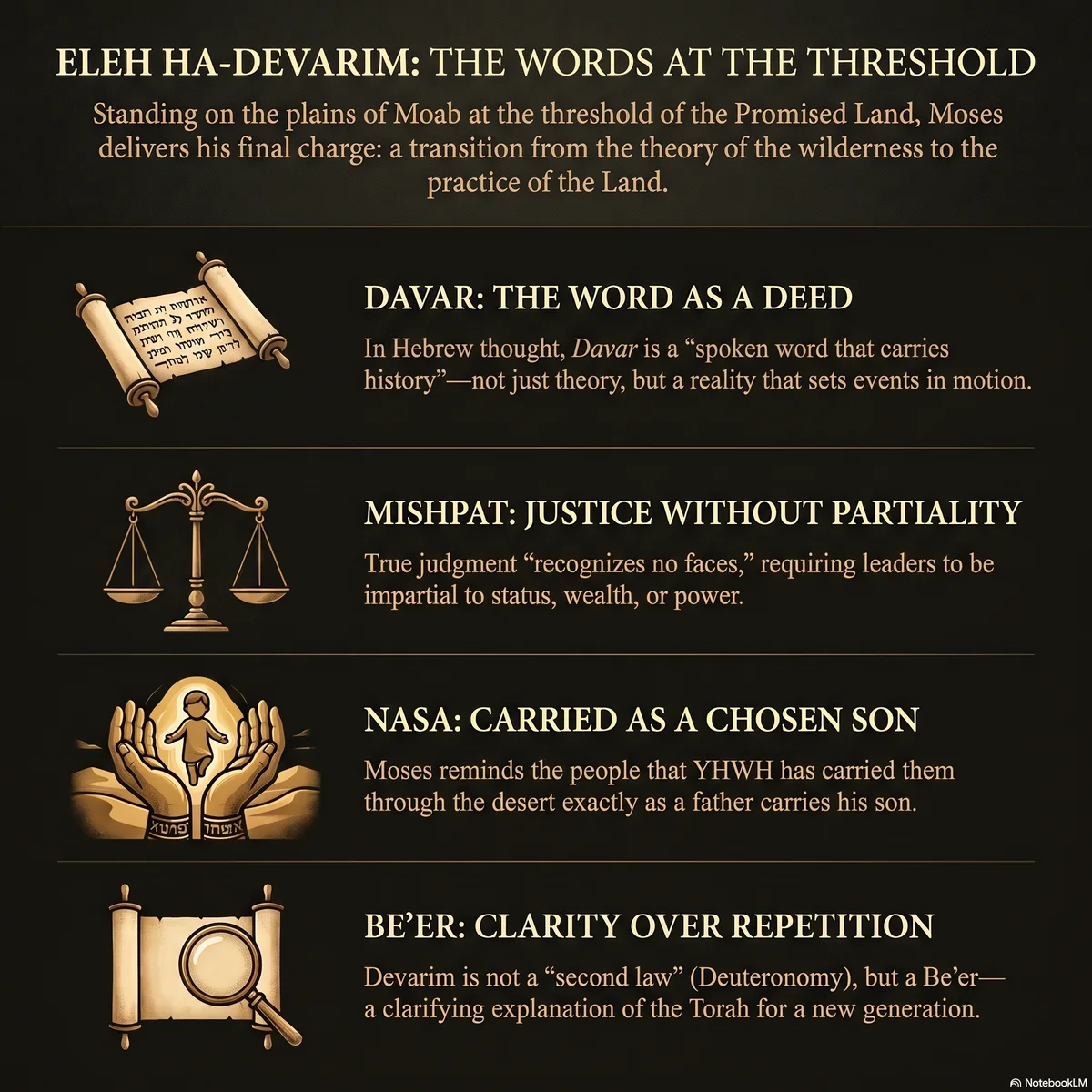
Devarim is not a new revelation, but the first derashah — the first time the Torah itself is explained and applied to a new situation. And it is exactly there that the promise of this book lies: what God has already said and done does not need to be reinvented. It is near enough to do. Every theme of this parasha — the administration of justice, the spies, the borders of the nations, the fall of Sihon and Og — is ultimately a variation on the same question: does Israel trust the word already spoken enough to act on it?
A — Word Study: Devarim versus "Deuteronomy"
The Greek (and, via Latin, English) name "Deuteronomy" comes from the Greek deuteronomion, "second law" — a translation that goes back to Deuteronomy 17:18, where a future king is required to have "a copy of this Torah" made (מִשְׁנֵה הַתּוֹרָה, mishneh ha-Torah, H4932). Mishneh here means "copy, repetition" — not "second" in the sense of a new or different law. The Septuagint translators read this as deuteronomion, "second law," and that mistranslation has clung on, via Latin, in almost every western language.
Root term: מִשְׁנֵה mishneh (H4932, "copy, repetition," from shanah, "to repeat"), Deut. 17:18. Corrected formulation: Devarim is not a new or second Torah, but the same Torah, repeated and explained for a new generation. Where "law" (VI.ii.b) further reduces the Torah to a legal code, be'er — see below — is the canonical verb describing what Moses is actually doing here: not rewriting, but making plain.
"Moses undertook to expound (be'er) this Torah" (Deut. 1:5). The same verb returns in Deuteronomy 27:8, where the words of the Torah are to be written on stones "very plainly." Rabbinic tradition therefore calls Devarim the first derashah — the first exposition and application of the Torah to a new time and situation Rabbinic/Traditional. Canonically it stands firm: Moses adds no new commandment here — he makes visible what was already given.
B — The Place Names of Deuteronomy 1:1: a Canonicity Test in Practice
Deuteronomy 1:1 lists a string of places Moses could not all have reached at once on his forty-year journey, some of which appear nowhere else in the Tanakh as geographic locations. Rashi points out — on the authority of the Sifrei Devarim — that this is not a travel route but a veiled rebuke: out of respect for Israel, Moses names not the sins themselves but the places where they were committed Rabbinic/Traditional.
The most strongly grounded examples: "Di-Zahab" ("enough gold") is explicitly linked in the Talmud to the golden calf (b. Berachot 32a) — Moses is said to have argued before God that the abundant gold Israel carried out of Egypt contributed to that sin. And "Paran" is not mere rabbinic guesswork: Numbers 13:3 literally says the spies were sent "from the wilderness of Paran" — the same history that returns in Step 5C of this study and that is treated at length in parasha Shelach. Here the rabbinic reading thus touches the canonical text itself.
A second, more cautious layer Remez-speculative: unpointed, there is no difference between סוּף (suph, "reed," the name of the Sea of Reeds) and סוֹף (soph, "end," as used in Ecclesiastes 7:2, H5490). Both are spelled identically: s-w-p. This is a well-known kind of Hebrew wordplay, not a settled etymological identity — but it does fit the setting of this parasha: Moses speaks "opposite Suph/Soph," opposite the sea and opposite the end, at the threshold of his own death and the people's passage into the land.
C — Mishpat: Judges Without Partiality (Deut. 1:9-18)
Moses sets three criteria for leaders: chachamim (wise), nevonim (people of understanding) and yedu'im (known/proven, Deut. 1:13). Devarim recounts this appointment without naming Jethro — Exodus 18:13-27 explicitly credits his father-in-law with advising Moses to set up this delegated structure, "so that you will endure" (Ex. 18:23, paraphrase). As often in this book, Devarim emphasizes not the origin of the advice but the responsibility Moses takes for it before the people. He then charges the new judges:
"You shall show no partiality in judgment... for the judgment belongs to God." — Deuteronomy 1:17 (paraphrase)
The Hebrew expression is more direct than "no respect of persons": they shall not let the face of the accused sway them — rich or poor, powerful or weak. James applies exactly this principle when he confronts his congregation over favoring a wealthy member above a poor one (Jas. 2:1-9) — canonically the same Torah norm, now applied within the community of believers.
This same yedu'im requirement — known, proven, already-visible character — returns canonically in the appointment of overseers in the early community: an overseer must not be "a new convert" and must "have a good reputation with those outside the church" (1 Tim. 3:6-7). Both texts point to the same principle: leadership is recognized by already-visible, externally confirmed character, not by self-declared authority. It is also no accident that the Torah does not describe a personal call for each individual judge here, as it does for Moses at the burning bush or — in the Brit Chadasha — for Paul on the road to Damascus (Acts 9:1-22): community leaders are recognized for what is already visible; apostolic calling is received directly.
Root term: יָרֵא yare (H3372). Where "fear" in western translation quickly sounds like panic or anxious retreat, here it means: do not let your judgment be bent by deference to the wrong party. The same root returns at Kadesh-Barnea, where the people do shrink back before the giants (Deut. 1:21, 29) — and at the end of the parasha, where Joshua is called to carry the same word positively: awe of YHWH, not fear of man (Deut. 3:22).
D — Carried Like a Son (Deut. 1:31)
"YHWH your God carried you, as a man carries his son, all the way that you went" (Deut. 1:31). The same image of fatherly carrying returns later in the book with fatherly discipline (Deut. 8:5) — bearing and forming are, in Devarim, no contradiction.
Echo (Torah → Prophets → Brit Chadasha): this same father-son image for Israel runs as a direct line through Scripture: "Israel is My son, My firstborn" (Ex. 4:22) → "as a man carries his son" (Deut. 1:31, this parasha) → "out of Egypt I called My son" (Hos. 11:1) → canonically cited as fulfilled in Yeshua Himself (Matt. 2:15). What is said of corporate Israel is ultimately summed up in the Son.
Tabernacle Projection (Question Cycle IV): if "being carried" were an object in the Tabernacle, it would be the carrying poles of the Ark — בַּדִּים (baddim, H905) — of which it is expressly said that they must never be removed from the rings (Ex. 25:13-15). The Ark, Israel's most holy object, is thus permanently designed to be carried and to carry: exactly the image Moses applies to the people here. YHWH is not a God who must be carried — He is the God who carries.
The generation that was "carried" (Deut. 1:31) is not the same generation that enters the land. Moses points this out further on, explicitly: "your little ones... and your children, who today have no knowledge of good or evil (lo-yade'u tov vara), they shall go in there. To them I will give it, and they shall possess it" (Deut. 1:39). This is no accidental phrase: tov vara — "good and evil" — is the very same Hebrew phrase as "the tree of the knowledge of good and evil" (עֵץ הַדַּעַת טוֹב וָרָע, Gen. 2:9, 17). The one who does not yet possess that distinction — who has not yet become "like God" in the sense of Genesis 3:5 — is precisely the one who enters the land. The generation that did know "good and evil" and turned against YHWH on that basis (the spies, Section C) is the one left outside.
The same pattern returns in the Renewed Covenant, with one important nuance. Yeshua says: "unless you turn and become as little children, you will by no means enter the kingdom of heaven" (Matt. 18:3), and does not turn the children away: "for of such is the kingdom of heaven" (Matt. 19:14). Note the difference in mechanism: in Deut. 1:39 the children enter because they are exempt from the guilt of their generation — not a virtue, but a covenant-legal release. With Yeshua, being like a child is a disposition to be actively pursued — humility, dependence, no striving for status (the context being the disciples' dispute about who is greatest). Both say that one's own knowledge, strength, or status is no ticket of entry into the land or the kingdom — but one is release, the other is calling. Same pattern, two movements.
E — The Nations Around: Borders YHWH Himself Draws (Deut. 2 – 3)
Before Israel takes a single city, the people receive a remarkable command: leave Edom, Moab and Ammon alone, "for I will not give you any of their land, not so much as a footstep, because I have given it to the descendants of Esau/Lot as a possession" (Deut. 2:5, 9, 19, paraphrase). Before the conquest of the Promised Land begins, YHWH first confirms the borders of other nations.
This is more than impartial land policy — it is a promise kept. For Edom it reaches back to a blessing pronounced generations earlier: Isaac's words over Esau, "away from the fatness of the earth shall your dwelling be... and it shall come to pass, when you break loose, that you shall break his yoke from off your neck" (Gen. 27:39-40), is canonically fulfilled in Deuteronomy 2:5 — even the son outside the covenant line receives what was promised him. For Moab and Ammon the line runs even more personally: their ancestor Lot was rescued out of Sodom "when God remembered Abraham" (Gen. 19:29) — their territory in Deuteronomy 2 is thus, generations later, still an outworking of God's faithfulness to Abraham, not to Lot himself. Even the side-branches of the promise turn out to hold firm.
Echo (Torah → Brit Chadasha): this same principle is later universalized within Devarim itself — "when the Most High gave the nations their inheritance... He fixed the borders of the peoples" (Deut. 32:8) — and quoted almost verbatim by Paul at the Areopagus: God "determined their appointed times and the boundaries of their dwelling place" (Acts 17:26). The study on the territory of Israel develops this line further.
Only after this recognition of borders comes the first real victory — and the pattern is always the same: the word precedes the deed, not the other way around. Even before the attack on Sihon, YHWH already speaks the outcome: "see, I have begun to give Sihon and his land over to you; begin to possess it" (Deut. 2:31) — Israel's task is not to fight for an uncertain victory, but to walk into an already-spoken reality. Sihon of Heshbon nevertheless refuses to let Israel pass peacefully, "for YHWH your God had hardened his spirit and made his heart obstinate" (Deut. 2:30) — canonically the same formulation used of Pharaoh before the exodus (Ex. 4:21; 7:3). Og of Bashan, the last of the Rephaim with his bed of nine cubits (Deut. 3:11), falls in the same way — and for him too the word sounds before the battle, in the same refrain that runs through the whole parasha:
"Do not fear him, for I have given him, with all his people and his land, into your hand." — Deuteronomy 3:2 (paraphrase)
This is the very core of davar already uncovered in Section A: the word does not confirm the victory afterward — it creates it beforehand. Israel therefore does not read the conquest as something still to be established, but as something it need only walk into. That exactly two kings fall this way is itself a form of confirmation: Deuteronomy elsewhere fixes the rule that a matter is established only "on the testimony of two or three witnesses" (Deut. 19:15 — see also the study Two Witnesses). Sihon and Og are then cited, again and again, as a fixed pair — proof of YHWH's faithfulness: by Rahab before the spies (Josh. 2:10), by the Gibeonites (Josh. 9:10), and in the psalms of praise (Ps. 135:11; 136:19-20). Two victories that establish the matter before the main conquest west of the Jordan even begins.
Moses finally hands this same "do not fear" directly to his successor: "your eyes have seen all that YHWH your God has done to these two kings... do not fear them, for YHWH your God Himself will fight for you" (Deut. 3:21-22) — a charge God Himself, in almost identical wording, repeats directly to Joshua the moment Moses is gone (Josh. 1:9).
The very same speech in which YHWH tells Joshua "do not fear" (Josh. 1:9) opens, a few verses earlier, with a line that repeats the core of davar from Sections A and D word for word and ties it to the footstep itself: "every place that the sole of your foot will tread (tidroch, from darach, H1869), I have given to you (netativ — perfect tense, already accomplished), as I spoke to Moses (dibarti)" (Josh. 1:3). Speaking, having-already-given, and treading fall together here in a single sentence — exactly the pattern of Deuteronomy 2:31, now repeated at the moment Israel is actually about to tread that word. Darach is, moreover, canonically the root from which derech — "the way" — is built (BDB), the key word of the study Walking. Note well: davar (ד־ב־ר) and halak (ה־ל־ך) share no common root themselves — this connection runs canonically through darach/derech, not through any supposed root-kinship between "speaking" and "walking" itself. The word goes first; the footstep enters what has already been spoken.
F — Sod: the Threshold, and the Bridge to Va'etchanan
Devarim is spoken "beyond the Jordan" (Deut. 1:1) — exactly the place where Mas'ei ended, "in the plains of Moab, by the Jordan, opposite Jericho" (Num. 36:13). Where Mas'ei closed with a border-circle that begins and ends at the Dead Sea, Devarim opens at that same threshold, seen from the other side: no longer the borders of the land, but the words the people need in order to cross that threshold.
Paul reads the crossing of the Sea of Reeds canonically as a baptism: "our fathers... all passed through the sea, and all were baptized into Moses in the cloud and in the sea" (1 Cor. 10:1-2). And John joins water, Spirit and blood as a threefold witness in Yeshua Himself: "This is He who came by water and blood... not by the water only, but by the water and the blood. And it is the Spirit who testifies... there are three that testify: the Spirit, the water and the blood; and these three agree" (1 Jn. 5:6, 8).
Some translations (including the King James Version) insert a clause between verse 6 and verse 8 about "three that bear record in heaven: the Father, the Word, and the Holy Ghost." This is the well-known "Comma Johanneum" — a reading absent from the earliest Greek manuscripts and added to the Latin text only centuries later. This study therefore cites only the textually undisputed verses 6 and 8.
The sharpest Sod lies in the page-turn itself: Devarim ends with Moses encouraging Joshua — "do not fear, for YHWH Himself will fight for you" (3:22). The very first word of the next parasha, Va'etchanan, is וָאֶתְחַנַּן ("and I pleaded," Deut. 3:23) — Moses' own, personal plea to be allowed into the land after all, a plea that is refused (Deut. 3:26-27). Just after sending another man in unafraid, the great leader himself, with all the courage he just gave Joshua, stands begging to cross that very same threshold. Devarim is thus, right to its final verse, a book of words that carry further than the speaker himself.
Strikingly, in that same verse Moses gives his own explanation for that refusal: "YHWH was angry with me because of you and would not listen to me" (Deut. 3:26) — an explanation he had already given earlier in this parasha: "YHWH was also angry with me for your sakes" (Deut. 1:37). Both times Moses points to the people. Yet when YHWH explained it to him directly at the time, it sounded different: "because you did not believe Me, to sanctify Me in the eyes of the children of Israel" (Num. 20:12) — Moses' own act at the rock, not the people. Devarim does not smooth over this tension. Moses tells the story as he himself carried it, and that is not necessarily the same as how YHWH explained it to him at the time. In precisely the book where the word creates reality (Sections A, E), this is an honest reminder that even Moses' own words are an interpretation — carried, human, and no less true for it, but not the final word either.
Related Studies on Devar Emet
- Parasha Mas'ei — the preceding parasha; the borders and the cities of refuge, spoken at the same threshold
- Parasha Shelach — the history of the twelve spies, which Moses reviews here
- Territory of Israel — the borders YHWH has assigned both to Israel and to the nations around it
Devarim asks this week that we move from theory to walk — exactly what Moses himself models:
1 — Be a be'er this week.
Choose one passage of Scripture you know well and deliberately, clearly explain it to someone else this week — a child, a friend, a colleague. Not repeating what you know, but making it visible and understandable, as Moses did.
2 — Judge without partiality.
Is there a situation this week where you have to form a judgment — about a colleague, a family member, a news story? Ask yourself honestly whether you are letting "someone's face" sway you before you judge the matter itself.
3 — Trace where your fear comes from.
Notice a decision this week that you make out of fear rather than trust. Name concretely which fear of man lies behind it, and consciously lay it before YHWH before you choose.
4 — Respect a boundary that is not yours.
Just as Israel had to leave the land of Edom, Moab and Ammon alone, there may be a territory — a task, a relationship, a decision — that God has assigned to someone else and not to you. This week, consciously recognize one such boundary, and respect it, rather than involving yourself in it.
Deuteronomy 3 closes with an encouragement for Joshua, not with a new law: a final reminder that Devarim, from beginning to end, is a book of spoken words that carry — further than the speaker himself.
Avinu Malkeinu — Our Father, our King,
Thank You that Your word is never far away, but near us, in our mouth and in our heart, to do it. Teach us, like Moses, to make Your Torah plain for those who come after us, without adding to it or taking away from it.
Give us judges' hearts that let no one's face outweigh the truth, and free us from the fear of man that leaves the land unpossessed. Remind us that You carry us, as a father carries his son, on every road we walk — and that the boundaries You have assigned to others are as much Yours as the boundaries You have given us.
And where we, like Moses, one day stand before a threshold we ourselves may not cross, thank You that Your word carries further than we do — until the day that Joshua, and ultimately Yeshua Himself, brings us where You would have us be.
Baruch Atah YHWH, Speaker of the Words and Carrier of Your people. Amen.
- TorahDeuteronomy 1:1 (core verse, place names); Deuteronomy 1:2 (eleven days' journey); Deuteronomy 1:2-5 (be'er, the first derashah); Deuteronomy 1:9-18 (appointment of judges, wisdom/understanding/knowledge, impartial judgment); Deuteronomy 1:17; Deuteronomy 1:19-46 (Kadesh-Barnea, the spies, the rebellion); Deuteronomy 1:31 (carried like a son); Deuteronomy 1:37, 3:26 and Numbers 20:12, 27:14 (the two reasons for Moses' exclusion); Deuteronomy 2:1-23 (Edom, Moab, Ammon, the borders of the nations); Deuteronomy 2:5, 9, 19; Deuteronomy 2:14 (thirty-eight years); Deuteronomy 2:30 (hardening of Sihon's heart); Deuteronomy 2:24 – 3:11 (Sihon and Og); Deuteronomy 2:31 (the word before the deed); Deuteronomy 3:2, 3:11; Deuteronomy 3:12-22 (division of Transjordan, encouragement of Joshua); Deuteronomy 3:21-22; Deuteronomy 3:22-23 (transition to Va'etchanan); Deuteronomy 8:5; Deuteronomy 17:18 (mishneh ha-Torah); Deuteronomy 19:15 (two or three witnesses); Deuteronomy 27:8; Deuteronomy 30:11-14; Deuteronomy 32:8; Genesis 2:9, 2:17 (tree of the knowledge of good and evil, root-echo with Deut. 1:39); Genesis 3:5 ("like God, knowing good and evil"); Genesis 19:29 (Lot saved for Abraham's sake); Genesis 25 (Edom/Esau, background); Genesis 27:39-40 (Isaac's blessing over Esau); Exodus 4:21, 7:3 (hardening of Pharaoh); Exodus 4:22 (Israel as son); Exodus 18:13-27 (Jethro's counsel, background to Deut. 1:9-18); Exodus 25:12-15 (the carrying poles of the Ark); Exodus 32 (the golden calf, background to Di-Zahab); Numbers 13:3 (spies sent out from Paran); Numbers 13-14 (background, parshat Shelach); Numbers 36:13 (closing verse of Mas'ei, geographic anchor point); Joshua 1:3 (the already-given land entered by treading, davar/darach-echo at the crossing); Joshua 2:10 (Rahab names Sihon and Og); Joshua 9:10 (the Gibeonites name Sihon and Og).
- ProphetsIsaiah 1:1-27 (haftarah, Shabbat Chazon); Isaiah 1:2 (dibber, root echo with devarim); Isaiah 1:18 (scarlet made white as snow); Isaiah 55:11 (the word that does not return empty); Hosea 11:1 (out of Egypt I called My son).
- WritingsPsalm 135:11; Psalm 136:19-20 (Sihon and Og in the psalms of praise); Ecclesiastes 7:2 (soph, "end," supporting the mul-suph/soph wordplay).
- Brit ChadashaHebrews 1:1-2 (God who speaks through the Son, an echo of "eleh ha-devarim"); John 1:1, 14 (the Word made flesh); Matthew 2:15 (Hosea 11:1 fulfilled in Yeshua); Matthew 18:3 (become as little children, an echo of Deut. 1:39); Matthew 19:14 (the kingdom belongs to such as these); James 2:1-9 (no partiality, direct application of Deut. 1:17); Romans 10:6-9 (quoting Deut. 30:11-14, the near word testifies of Yeshua); Romans 3:31 (we uphold the Torah); Acts 17:26 (God fixes the borders of the nations, an echo of Deut. 32:8); 1 Corinthians 10:1-2 (the crossing of the sea as baptism); 1 John 5:6, 8 (water, Spirit and blood as witnesses — without the Comma Johanneum of verse 7); Joshua 1:9 (repetition of "do not fear" to Joshua); Acts 9:1-22 (the calling of Paul); 1 Timothy 3:1-7 (overseers, "not a new convert," a good reputation with outsiders).
- Rabbinic/TraditionalRashi on Deuteronomy 1:1, on the authority of Sifrei Devarim 1:1 (the place names as veiled rebukes); Talmud, b. Berachot 32a (Di-Zahab linked to the golden calf); the characterization of Deuteronomy as "first derashah" (general Jewish-traditional usage, not from the Tanakh itself).
- PaRDeSRabbinic hermeneutical framework. Talmud, b. Sanhedrin 67b; b. Chagiga 14b. Kabbalistic Sod-content (Zohar, Sefer Yetzirah) explicitly excluded — Protocol VI.i extension.
- Source MaterialSupplied study draft (Devar Emet format, the first four aliyot of Devarim, Deut. 1:1 – 2:1) — screened against Protocol VI.i. The themes of the threshold, "long enough at this mountain," the judges, the spies, and "carried like a son" were adopted and canonically anchored. The author's personal testimony about a cloud-pillar sighting (2024, during a car journey) was not adopted: unverifiable personal experience, no Scripture, no recognized source. The extended discussion of the cloud pillar in Solomon's Temple was likewise not adopted: canonically accurate, but not rooted in the text of this parasha itself (Deut. 1-3 does not mention the cloud pillar explicitly) and therefore left out to keep the study anchored to its own text. The etymological reading of the place names in Deut. 1:1 as a "paradise" typology (tophel/laban/zahab as white garments and heavenly gold) was not adopted as the primary reading: this is the source author's own interpretation, not grounded in source or tradition. In its place, the canonically stronger Rashi/Sifrei reading was used (Section B), supplemented with a wordplay on mul suph/soph explicitly labelled as Remez-speculative. The framing "under the old covenant it was about law enforcement... Yeshua came to internalize the Torah" has been rewritten (Protocol VI.ii.a, VI.ii.b): rather than positioning Sinai as external-juridical against the Renewed Covenant as internal, this study shows via Deuteronomy 30:11-14 that the inward, heart-oriented posture is already anchored in the Torah itself — the Renewed Covenant deepens, it does not replace. "Law" and "new covenant" have been replaced throughout with "Torah-instruction" and "Renewed Covenant." The use of 1 John 5:7 (the Comma Johanneum) has been corrected: only the textually undisputed verses 6 and 8 are used. Four deeper layers were added in a later session at Serge's prompting, each canonically screened: the eleven-days/thirty-eight-years contrast (Deut. 1:2, 2:14) in Step 1, with an explicitly labelled Remez-speculative side-thought on the number twelve; the word that creates the victory beforehand rather than confirming it afterward (Deut. 2:31), woven into the existing davar line from Section A; the "two witnesses" reading of the fall of Sihon and Og (Deut. 19:15; Josh. 2:10; 9:10; Ps. 135:11; 136:19-20); and God's faithfulness to blessings pronounced earlier over Esau and Lot (Gen. 27:39-40; 19:29) in Section E. A fifth suggestion — a deeper meaning in the name etymology of Sihon and Og — was investigated and not adopted: Strong's proposes "tempestuous" and "round" respectively, but standard reference works (e.g. Holman Bible Dictionary) explicitly call both names "of unknown meaning" — too uncertain to carry a load-bearing point. A fifth addition came from a teaching-session transcript by Monte Judah (Devarim, B'nai Shalom, 2026), screened against Protocol VI.i: the core — Exodus 18 as background to the appointment of judges, and the echo between yedu'im and the overseer requirement of 1 Timothy 3 — was adopted and canonically anchored in Section C. Most of the source (the speaker's personal calling testimony, a polemic against church Christianity, and a pastoral anecdote about Kiddush) was not adopted: unverifiable personal experience and group polemic, respectively — not exegesis of the parasha itself. Finally, the tension between Moses' own explanation for his exclusion (Deut. 1:37; 3:26, "because of you") and YHWH's direct explanation to Moses (Num. 20:12, "because you did not believe Me") has been worked into Section F, closing out the existing discussion of Moses' plea in Deut. 3:23-27. In a later session, at Serge's prompting, the davar-line from Sections A/D was explicitly extended to Joshua 1:3 (Echo-level, Question Cycle IV) in Section F, with an explicit boundary marker that davar and halak share no common root themselves — the connection runs canonically through darach/derech (BDB; Strong's H1869/H1870) — with a cross-link to the study Walking. In the same session, an Echo was added to Section D on Deuteronomy 1:39 — the children who "do not yet know good or evil" and precisely for that reason enter the land — canonically anchored via the exact Hebrew phrase-echo with Genesis 2:9, 2:17 and 3:5 (etz hada'at tov vara), with a Drash-level extension to Matthew 18:3 and 19:14. The difference in mechanism between Deut. 1:39 (juridical-covenantal release from generational guilt) and Matthew (childlikeness as a disposition to be pursued) was explicitly named, to prevent the two texts from being wrongly presented as identical.
- ProtocolDeuteronomy 1:1 treated according to the three-stage test of VI.i: first Pshat (place names as geography), then an explicitly labelled Rabbinic layer (Rashi/Sifrei) and a separately labelled Remez-speculative layer (mul suph/soph) — neither presented as canonical fact. No use of the Zohar, Sefer Yetzirah, or kabbalistic works (VI.i extension). Comma Johanneum (1 Jn. 5:7) excluded on text-critical grounds. Personal, unverifiable testimony excluded. No current political prophecy interpretation included.