Mas'ei is the final chapter of the book of Numbers and thus the last one before Moses's farewell address in Devarim. The parasha opens with a list of travel stations and closes with legislation on boundaries, cities of refuge, and inheritance law — the wilderness period is canonically closed here, and Israel stands literally on the threshold of the promised land.
"These are the stages of the people of Israel, when they went out of the land of Egypt by their armies under the leadership of Moses and Aaron. Moses wrote down their starting points, stage by stage, by command of YHWH, and these are their stages according to their starting points." — Numbers 33:1-2
Scope and boundaries: The parasha consists of four movements: the travel record of the forty years in the wilderness (Num. 33:1-49), the command to purge Canaan and apply the full ban (Num. 33:50-56), the land boundaries and the appointment of tribal leaders (Num. 34), the Levitical priestly cities with the cities of refuge (Num. 35), and finally the refinement of the inheritance law of the daughters of Zelophehad (Num. 36) — closing the book of Numbers "in the plains of Moab by the Jordan at Jericho" (Num. 36:13), literally at the threshold of the land.
Note: on the combined Shabbat of Matot and Mas'ei, this haftarah is read — the second of the three "haftarot of admonition" marking the three weeks leading up to Tisha B'Av.
Jeremiah reminds the people of the wilderness journey recorded in Mas'ei, and sets a stark contrast against it:
"And I brought you into a plentiful land to enjoy its fruits and its good things. But when you came in, you defiled My land... for My people have committed two evils: they have forsaken Me, the fountain of living waters, and hewed themselves cisterns, broken cisterns that can hold no water." — Jeremiah 2:7, 13
Where Numbers 33 records the journey as a chain of repeated exoduses under YHWH's leadership, Jeremiah shows what happens when a people forgets where it came from. The travel record of Mas'ei is not merely geography — it is a testimony that later generations can either remember, or, as Jeremiah shows, forget.
The cities of refuge in Numbers 35 find their canonical echo in the letter to the Hebrews, where taking refuge in God Himself is compared to fleeing to a city of refuge:
"So that by two unchangeable things, in which it is impossible for God to lie, we who have fled for refuge might have strong encouragement to hold fast to the hope set before us." — Hebrews 6:18
The phrase "fled for refuge" uses the same image as the fugitive who runs to a city of refuge to escape the avenger of blood (Num. 35:11, 25-28) — with this difference: the believer does not flee to an earthly place, but to the hope anchored in Yeshua.
Yeshua also literally calls Himself the Door:
"I am the door. If anyone enters by Me, he will be saved and will go in and out and find pasture." — John 10:9
The fugitive in a city of refuge is safe as long as he stays there, until the death of the high priest — only then may he return to his own inheritance (Num. 35:25, 28). Canonically this traces a pattern: liberation is tied to the death of a priest. Yeshua is the great High Priest (Heb. 7) whose death does not hold us, but sets us permanently free — the city of refuge in Him becomes not a temporary refuge, but a lasting one.
Ephesians 6:12 also confirms the canonical distinction that emerges in this parasha (see section B): "our struggle is not against flesh and blood" — the spiritual seriousness of the call to holiness in Numbers 33:50-56 is worked out in the Brit Chadasha as spiritual, not literal, warfare for the church today.
James, moreover, gives a direct diagnosis of the grumbling behaviour that marked the generation of the wilderness stations, and applies it to his own congregation:
"What is the source of quarrels and conflicts among you? Is not the source your pleasures that wage war in your members? You lust and do not have." — James 4:1-2
Sod — the same root as the wilderness generation: James here uses the Greek epithumia (ἐπιθυμία) — lust, craving — which canonically covers the same field as the Hebrew ta'avah (תַּאֲוָה), the word Numbers 11:4, 34 uses to describe the people's grumbling in the wilderness: a burning, judgment-overriding craving. 1 Corinthians 10:6, already cited earlier in this study, quotes exactly this episode as a lesson for the church. James 4 adds a diagnostic layer: the grumbling at each station canonically did not primarily come from the severity of the circumstances, but from unmet desire from within — and this is precisely what James says about the quarrels in his own congregation. The 42 travel stations are thus not only a testimony of YHWH's guidance (section A), but also a repeated mirror of an inner pattern that can just as easily recur within the church today.
Every stage of the wilderness journey is a remembered exodus; every boundary YHWH draws is an act of faithfulness; and the city of refuge He Himself establishes is the first Torah-shadow of the refuge Yeshua will be forever.
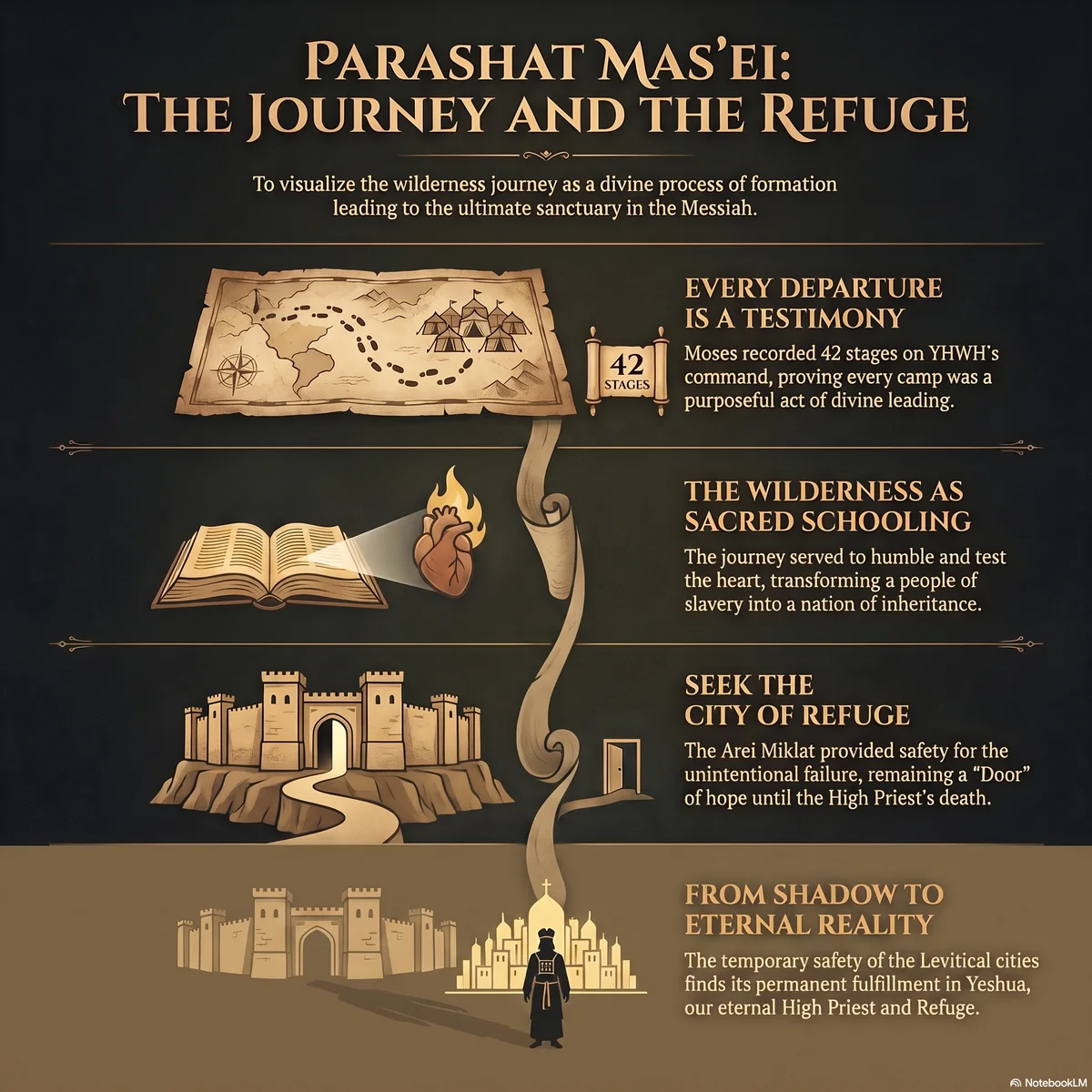
Mas'ei is the hinge between the wilderness and the land — the book of Numbers closes here, not with a new miracle, but with meticulous administration: a travel record, a judgment, boundaries, cities, and inheritance law. It is precisely in these seemingly dry, administrative closing chapters that the richness of this parasha lies: YHWH is just as faithful and present in recording campsites as in the miracles that preceded them. The God who led Israel for forty years is the same God who fixes the boundaries of the land, divides the priestly cities, and establishes a refuge for those who have failed unintentionally. Nothing in this parasha is coincidence; everything is preparation for life after the wilderness.
A — Word Study: Masa (מַסָּע) — Departure and Arrival, and the Question "Why the Wilderness?"
Numbers 33:2 uses two words side by side that are often merged in translation: motsa'eihem (their starting points, from yatsa, H3318, "to go out") and mas'eihem (their journeys/stages, from nasa, H5265, "to pull up tent pegs"). Every stage of the wilderness journey is canonically both a departure and an arrival. Moses recorded not only where Israel arrived, but equally where it kept setting out from — the emphasis lies on the movement itself, not only on the final destination. The repeated phrase (three times in two verses) "by command of YHWH" also makes clear: this is no neutral travel administration, but a testimony of purposeful, divine guidance.
Canonicity test (Pshat, with cautious Remez): Numbers 33 lists campsites without the Tanakh itself assigning a spiritual or demonic meaning to every place name. There is a ministry tradition that interprets every name as a specific idol or "territory of captivity" — this is Popular-theological / Remez-speculative, based on extra-biblical sources, not on canonical Hebrew analysis of the place names themselves. What canonically does stand: the text explicitly states that YHWH "executed judgments on the gods of Egypt" at the exodus (Num. 33:4) — the journey itself is thus canonically connected to the unmasking of idolatry, without every campsite needing its own god-name to carry this lesson.
Why not the direct road? Even before Numbers 33, the Torah itself answers the question of why YHWH did not lead Israel directly to the land:
"When Pharaoh let the people go, God did not lead them by way of the land of the Philistines, although that was near. For God said, 'Lest the people change their minds when they see war and return to Egypt.' But God led the people around by the way of the wilderness toward the Red Sea." — Exodus 13:17-18
The detour is thus no makeshift solution from the outset, but deliberate, protective wisdom: a people still shaped inwardly by slavery cannot yet bear a direct confrontation.
The most explicit answer in the Tanakh: Moses himself explains, in his farewell address — which begins in the next parasha, Devarim — the purpose of the entire forty-year journey in canonical, unmistakable language:
"And you shall remember the whole way that YHWH your God has led you these forty years in the wilderness, that He might humble you, testing you to know what was in your heart... And He humbled you and let you hunger and fed you with manna... that He might make you know that man does not live by bread alone, but by every word that comes from the mouth of YHWH." — Deuteronomy 8:2-3
Three canonical functions of the wilderness are named here in so many words: humbling, testing (to reveal what was already in the heart, not to create something new), and fatherly formation — not punishment, but upbringing. Deuteronomy 1:31 adds the image of carrying: "YHWH your God carried you, as a man carries his son, all the way that you went" — carrying strength and testing at once, the tension that characterises the entire Mas'ei journey.
Drash — each wilderness its own lesson: the journey passes not through one, but through several wildernesses, each canonically tied to its own trial: Shur/Etham (the bitter water at Marah, Ex. 15:22-25), Sin (hunger and the manna, Ex. 16), Sinai (the covenant itself), Paran (the spies and the rebellion, Num. 13-14), and Zin (the second water crisis at Meribah, the death of Miriam and Aaron, Num. 20). No arbitrary zigzag, but a succession of ever-new forms of want — each followed by a new revelation of who YHWH is.
Sod — the wilderness as a place of renewed love: alongside discipline, the Tanakh also holds a tenderer layer of the same image. Hosea uses the wilderness not for punishment, but for courtship:
"Behold, I will allure her, and bring her into the wilderness, and speak tenderly to her... And there I will give her vineyards, and make the Valley of Achor a door of hope." — Hosea 2:14-15
Canonically significant: the same wilderness motif that revolves around testing in Numbers is used by the prophet here for enticement to love — YHWH deliberately draws His people away from all distraction, to speak to her heart there anew. Discipline and courtship are not a contradiction, but two sides of the same relationship.
Echo — does He also lead us as a community through wildernesses? The Brit Chadasha explicitly gives the hermeneutical mandate for this, not as free allegory but as a reading pattern designated by the apostles themselves, and speaks emphatically corporately — about "our fathers" and the congregation as a whole:
"Now these things happened as examples for us... Now these things happened to them as an example, but they were written down for our instruction, on whom the end of the ages has come." — 1 Corinthians 10:6, 11
The letter to the Hebrews develops this further with a direct call for "today": "Today, if you hear His voice, do not harden your hearts as in the rebellion... Let us therefore strive to enter that rest" (Heb. 3:7-8; 4:11). Canonically summarised, the pattern of wilderness leading can be recognised as follows: want that exposes a hidden dependence (Deut. 8:2-3), the sense of being carried and tested at once (Deut. 1:31), isolation from familiar voices that leads to renewed intimacy (Hos. 2:14-15), and a continuing call not to harden the heart for as long as the wilderness lasts (Heb. 3:7 – 4:11).
B — The Full Ban on Canaan and the 400-Year Measure
Unlike the partial ban on Midian (see Matot, section C), Numbers 33:50-56 involves a full cherem: the Canaanite population, their temples, images, and high places are to be completely destroyed. This judgment, however, does not come suddenly — it was canonically announced 400 years earlier:
"And they shall come back here in the fourth generation, for the iniquity of the Amorites is not yet complete." — Genesis 15:16
Drash: the same 400-year period during which the Canaanite peoples had the chance to repent was also the period in which Israel was oppressed in Egypt (Gen. 15:13) — YHWH's patience with the one nation and the formation of the other nation ran canonically in parallel. The judgment on Canaan thus comes neither prematurely nor arbitrarily; it is the result of centuries of patience that finally reaches its limit (cf. Revelation 6:10-11, the martyrs who wait until "the number is complete").
Echo (Brit Chadasha, spiritually applied): Ephesians 6:12 teaches the church that its own struggle is "not against flesh and blood" — the literal ban of Numbers 33 is not repeated in the New Covenant as a military program, but is canonically internalised as a call to allow nothing of evil to persist spiritually in one's own life (cf. the severity of Matthew 5:29-30).
C — The Land Boundaries and the Chiasm of the Dead Sea (Num. 34)
The description of the land boundaries in Numbers 34:1-12 strikingly begins not in the north, but in the south, at the wilderness of Zin and the Salt Sea (Dead Sea) — and returns there again via a clockwise route. The Dead Sea is both the starting point and the ending point of the description: a circle that begins and ends at its most barren point.
Sod (Messianic, canonically grounded): Ezekiel 47:1-10 prophesies that when the river flows out from the Temple — at the Messiah's coming — the waters of the Dead Sea will become fresh, "and there will be very many fish" (Ez. 47:9-10). The boundary-circle of Numbers 34 is, in this light, canonically not yet fully closed as long as the Dead Sea remains dead; it only truly becomes "round" when Yeshua, at His coming, makes the land fruitful from Jerusalem (cf. Zech. 14:8).
D — Two and Ten: The Completion of the Pattern from Matot (Num. 34:16-29)
Moses appoints ten new tribal leaders, under the joint leadership of Joshua and the priest Eleazar — twelve together. This number results from Reuben and Gad, who already received their inheritance east of the Jordan (see Matot), falling outside this division, while Joseph is split into Ephraim and Manasseh to compensate for Levi's absent inheritance.
The same 2+10 pattern that first became visible as a seed in Matot (Reuben and Gad standing apart from the rest of the tribes) explicitly returns here in the leadership structure: two chief leaders (Joshua, Eleazar) plus ten tribal leaders. Canonically this is no coincidence, but a recurring divine ordering principle: where a part falls away or comes to stand apart, the number twelve is restored in another way.
Echo (Torah → Prophets → Brit Chadasha): this 2+10 pattern canonically points forward to the later division of the kingdom into two (Judah) and ten (Israel/Ephraim) tribes after Solomon, and their prophetically promised reunification: "I will make them one nation in the land... and they shall no longer be two nations" (Ez. 37:22). The same "ten and two" pattern recurs with the twelve spies (Num. 13-14, ten against two), and in the Brit Chadasha with the twelve apostles, where the place of Judas is again filled to reach twelve (Acts 1:15-26).
E — The Cities of Refuge: Refuge, the Door, and the Death of the High Priest (Num. 35)
Of the 48 Levitical priestly cities, six are specially designated as a city of refuge — a refuge for one who has killed unintentionally (Num. 35:11), so that the avenger of blood (go'el ha-dam, גֹּאֵל הַדָּם) cannot kill him without trial. The fugitive must remain there until the death of the high priest then serving (Num. 35:25, 28) — only then may he return to his inheritance.
Contrast (Questions cycle IV): the city of refuge is no free pass for intentional killing — Numbers 35:16-21 explicitly distinguishes between premeditated murder (no refuge possible, the avenger of blood may kill the offender) and unintentional killing (refuge granted). Grace in the Torah is never blind to the nature of the deed.
Tabernacle projection (Questions cycle IV): if the city of refuge were an object in the Tabernacle, it would be the veil that both separates and provides passage — just like the Door of the Tabernacle itself (Ex. 26:36), which is both boundary and access. Yeshua literally calls Himself this Door (John 10:7-9, see Step 3) — the city of refuge is canonically an early Torah-shadow of the same reality: protection that only holds within the appointed boundaries, and freedom that becomes final only after the death of the High Priest.
The 48 Levitical cities, moreover, lie scattered throughout the whole land, not concentrated around the Temple (Num. 35:1-8) — the Levites themselves, literally scattered among the people, thus formed a "door" to the holy things of God in every tribal territory.
Related Studies on Devar Emet
- Parasha Matot — the preceding parasha; the partial ban on Midian and the first seed of 2+10=12
- Parasha Pinchas — the Covenant of Peace and the eternal priesthood that precedes the cities of refuge
- Appearing — the pilgrimage feasts on which all Israel, even from the scattered Levitical cities, gathers together
Mas'ei asks this week to look back on the journey and forward to the refuge:
1 — Write your own travel record.
Just as Moses, by command of YHWH, recorded the campsites, this week consciously write down three moments when you noticed God causing you to "set out" from a place of bondage or stagnation. Thank Him concretely for each of those moments.
2 — Know your refuge.
Is there a situation in your life where you feel guilty over something you did unintentionally? This week, consciously bring this to Yeshua, the Door and the Refuge, instead of continuing to condemn yourself for something that was not premeditated.
3 — Purify without judging others.
Take one concrete "Canaanite" element in your own life — a habit, medium, or relationship that spiritually defiles you — and this week radically bring it under God's rule, without this leading to judgment of the people around you (Eph. 6:12).
4 — Trace where your grumbling comes from.
Do you notice irritation or conflict this week — with a colleague, a family member, in your congregation? Ask yourself honestly, with James 4:1-2 in mind: does this come from the circumstance, or from an unmet desire within myself? Consciously lay that desire before YHWH before you take it out on someone else.
Numbers 36 closes the book with a refinement, not a revocation, of the right of the daughters of Zelophehad — one last reminder that Torah as living instruction (H8451) always leaves room to carefully work out further what God has already promised.
Avinu Malkeinu — Our Father, our King,
You have seen and recorded every step of our journey, just as You recorded Israel's journey through the wilderness. Thank You that no camp, no detour, has ever fallen outside Your guidance. Where we have failed unintentionally, we thank You that Yeshua is our City of Refuge — the Door through which we may safely go in and out.
Draw the boundaries of our lives as You drew the boundaries of the land: with wisdom, with justice, and with an eye toward the day when everything now dead — like the Dead Sea — will become fruitful and alive again at the coming of the Messiah. Help us, like Israel on the plains of Moab, to stand still with expectation at the threshold of what You have prepared for us.
Baruch Atah YHWH, Giver of the Land and the Refuge. Amen.
- TorahNumbers 33:1-2 (core verse, mas'iem/mots'iem); Numbers 33:3-49 (travel stations); Numbers 33:4 (judgment on the gods of Egypt); Numbers 33:50-56 (command for full ban); Numbers 34:1-12 (land boundaries); Numbers 34:16-29 (appointment of ten tribal leaders, 2+10 pattern); Numbers 35:1-8 (Levitical priestly cities); Numbers 35:6, 11-15 (cities of refuge); Numbers 35:11 (unintentional killing); Numbers 35:16-21 (distinction intent/no intent); Numbers 35:25, 28 (return upon the death of the high priest); Numbers 36:1-13 (refinement of inheritance law of the daughters of Zelophehad, close of the book); Numbers 13-14 (ten against two spies, background pattern); Numbers 20 (Meribah, death of Miriam and Aaron); Numbers 30-32 (Matot, preceding parasha); Genesis 15:13-16 (400-year measure); Exodus 13:17-18 (the detour via the wilderness, not via the Philistines); Exodus 15:22-25 (Marah, the bitter water); Exodus 16 (the wilderness of Sin, manna); Exodus 26:36 (the veil/door of the Tabernacle); Deuteronomy 8:2-3 (humbling, testing, and manna as lesson); Deuteronomy 1:31 (carried as a son).
- ProphetsJeremiah 2:4-28; 3:4 (haftarah); Jeremiah 2:7, 13 (the two evils: forsaking the fountain of living water); Hosea 2:14-15 (the wilderness as a place of courtship and renewed love); Ezekiel 37:15-28 (reunification of Judah and Israel/Ephraim, echo at 2+10=12); Ezekiel 47:1-10 (the river that heals the Dead Sea); Zechariah 14:8 (living water from Jerusalem).
- Writings(no additional Ketuvim references beyond the texts already named in this study).
- Brit Chadasha1 Corinthians 10:6, 11 (the wilderness generation as an example for the church, explicitly applied corporately); Hebrews 3:7-8; 4:11 (call not to harden the heart, "today"); John 10:7-9 (Yeshua as the Door); Hebrews 6:18-20 (fleeing for refuge to the hope, linguistic echo of the city of refuge); Hebrews 7 (Yeshua as eternal High Priest); Ephesians 6:12 (our struggle not against flesh and blood); James 4:1-2 (the source of quarrels and conflict, epithumia as the Greek echo of ta'avah); Matthew 5:29-30 (radical purification, spiritual application of the ban); Acts 1:15-26 (filling out to twelve apostles, echo of the 2+10 pattern).
- Rabbinic/TraditionalNo rabbinic sources used as canonical grounding in this study; the distinction of intent/no intent (section E) comes directly from the Torah text itself, not from later tradition.
- PaRDeSRabbinic hermeneutical framework. Talmud, b. Sanhedrin 67b; b. Chagigah 14b. Kabbalistic Sod-content (Zohar, Sefer Yetzirah) explicitly excluded — Protocol VI.i extension.
- Source materialSubmitted study draft (Devar Emet format, all five aliyot of Mas'ei) — tested against Protocol VI.i. The extended "spiritual territories" map of Numbers 33 (5×9 grid with specific idols per campsite, based on the booklet by Ana Méndez Ferrell) is not retained: this is a non-canonical, extra-biblical interpretive method (Protocol VI.i, Step 1) — instead, the Pshat data of Numbers 33:1-4 (repeated exodus, judgment on Egypt's gods) is canonically retained, expanded with a canonical treatment of "why the wilderness" (Ex. 13:17-18, Deut. 8:2-3, Deut. 1:31, Hos. 2:14-15, and the corporate application via 1 Cor. 10 and Heb. 3-4), at Serge's request, after an originally sober Pshat treatment. The ban theology (Canaan, 400-year principle) is canonically strong and fully retained. The explanation of the land boundaries, the Dead Sea chiasm, and the Messianic application (Ez. 47) has been retained and canonically grounded. The current political application to Gaza/Hamas and the events of October 7, 2023 (Zech. 9) is not processed: this is unvalidated current prophecy interpretation outside the scope of canonical exegesis. The explanation of the cities of refuge, the Door, and the death of the high priest is canonically strong and fully retained, expanded with Hebrews 6 and John 10. From a submitted parasha teaching (transcript, likely Rabbi Monte Judah), James 4:1-2 has been added as a strong, previously unused diagnosis of the grumbling at the travel stations, linked to the already-present ta'avah/Numbers 11 material and 1 Corinthians 10:6. Personal illustrations and testimony from the speaker have not been retained: not Scripture, not a classical source, the speaker's own copyrighted material as a living teacher. The suggestion that the list of 42 travel stations primarily contains a "prophetic clue" was mentioned but not developed by the source itself, and is therefore likewise not processed here.
- ProtocolNumbers 33 treated as a Pshat testimony of YHWH's guidance, not a speculative spirit-map (VI.i, Step 1). Wilderness guidance canonically grounded as a corporate, communal pattern via 1 Corinthians 10:6, 11 and Hebrews 3:7 – 4:11, not as free allegory. Cherem canonically distinguished by context and measure of iniquity, not as blind or automatic judgment (section B). No current political prophecy interpretation included (general caution protocol for unvalidated end-time claims). No use of Zohar, Sefer Yetzirah, or kabbalistic works (VI.i extension). Unfounded "prophetic clue" suggestion not adopted without canonical development (Protocol VI.i, Step 1).