Matot is the plural of matteh — the same word meaning both "staff" (the object) and "tribe" (the family line). In this parasha, Moses does not speak to individuals but to the heads of the tribes (Num. 30:2) — the weight of a spoken word is from the outset tied to the bearing structure of all Israel, not to isolated personal intentions.
Matot follows directly on the Covenant of Peace given to Pinchas (Num. 25) and the preparatory arrangements of the previous parasha: the second census, the inheritance case of the daughters of Zelophehad, and the appointment of Joshua. Where Pinchas ended with the korbanot — the calendar of drawing near to YHWH — Matot opens with another form of drawing near: the spoken word that binds the speaker.
"If a man vows a vow to YHWH, or swears an oath to bind himself by a pledge, he shall not break his word; he shall do according to all that proceeds out of his mouth." — Numbers 30:3
Scope and boundaries: The parasha consists of three clearly delineated movements. First, legislation surrounding vows and oaths, with particular attention to the position of women within the household (Num. 30). Then, the war of vengeance against Midian led by Pinchas, including the division of the spoil (Num. 31). Finally, the request of Reuben, Gad, and half the tribe of Manasseh to settle east of the Jordan (Num. 32) — the first time the promised land is divided, and thus the first visible seed of the later 2+10=12 structure that will be worked out in Mas'ei.
Note: Matot and Mas'ei fall on the same Shabbat this year; according to common practice, only the haftarah of Mas'ei (Jer. 2:4-28; 3:4) is read — see that study. The haftarah discussed below is the classic, independent haftarah of Matot when the parasha is read on its own, and remains relevant to the word-theme of this study.
Jeremiah 1 opens with YHWH's own word concerning Jeremiah, before he was even born:
"Before I formed you in the womb I knew you, before you were born I set you apart; I appointed you as a prophet to the nations." — Jeremiah 1:5
Where Matot teaches humanity about the binding power of its own word, the haftarah shows what it means when YHWH Himself speaks: His word fixes Jeremiah in place before Jeremiah himself even knew of it. YHWH touches Jeremiah's mouth and says, "Behold, I have put My words in your mouth" (Jer. 1:9). The human word of Numbers 30, which binds the speaker as long as he lives, is here mirrored by the divine Word, which stands firm before the speaker is even born.
Jeremiah 2:1-3 closes this haftarah with YHWH's remembrance of Israel's first love in the wilderness — "the love of your betrothal" — a direct bridge to the image of vow and pledge with which Matot opens.
In the Sermon on the Mount, Yeshua builds directly on the teaching of Numbers 30, and sharpens it:
"Again you have heard that it was said to those of old, 'You shall not swear falsely, but shall perform to the Lord what you have sworn.' ... Let what you say be simply 'Yes' or 'No'; anything more than this comes from evil." — Matthew 5:33, 37
Yeshua does not set aside the Torah-instruction of Numbers 30 here; He brings it to its full intent (plēroō, G4137 — see Protocol VI.iii). The Torah already permitted an oath within a culture where lying was widespread; Yeshua's community is called to a word-integrity that makes the oath, as a necessary prop, unnecessary — not because the word becomes less binding, but because every word ought to be as binding as an oath.
James repeats this teaching almost verbatim at the close of his letter: "let your yes be yes and your no be no, so that you may not fall under judgment" (Jas. 5:12). Both texts confirm — rather than weaken — the core rule of Numbers 30: a spoken word carries weight before the face of God, and no one may treat it lightly.
What Numbers 30 grants to the head of a household — the authority to annul a hasty word on the day he hears of it — finds its deepest fulfilment in Yeshua, who calls Himself the Advocate who bears and heals the broken promises of our lives (cf. 1 John 2:1), without lifting our own responsibility for the word we speak.
Paul, in Philippians 3:7-14, describes a life that carries the same irrevocable quality as a neder — not as a formal vow, but as a life-orientation:
"But whatever things were gain to me, these I have counted as loss for the sake of Christ... I press on so that I may lay hold of that for which also I was laid hold of by Christ Jesus." — Philippians 3:7, 12
Paul counts everything he had previously gained as loss, and pursues one goal without possibility of return. This is not canonically a neder in the technical sense of Numbers 30 — Paul is not making a formal vow here — but the quality of irrevocable surrender that a neder theologically embodies becomes visible in a human life: once spoken, no longer made conditional by later circumstances.
A word spoken before the face of YHWH is not a non-binding intention but a binding reality — and justice on earth only comes about when a person takes their own word seriously and leaves judgment to God.
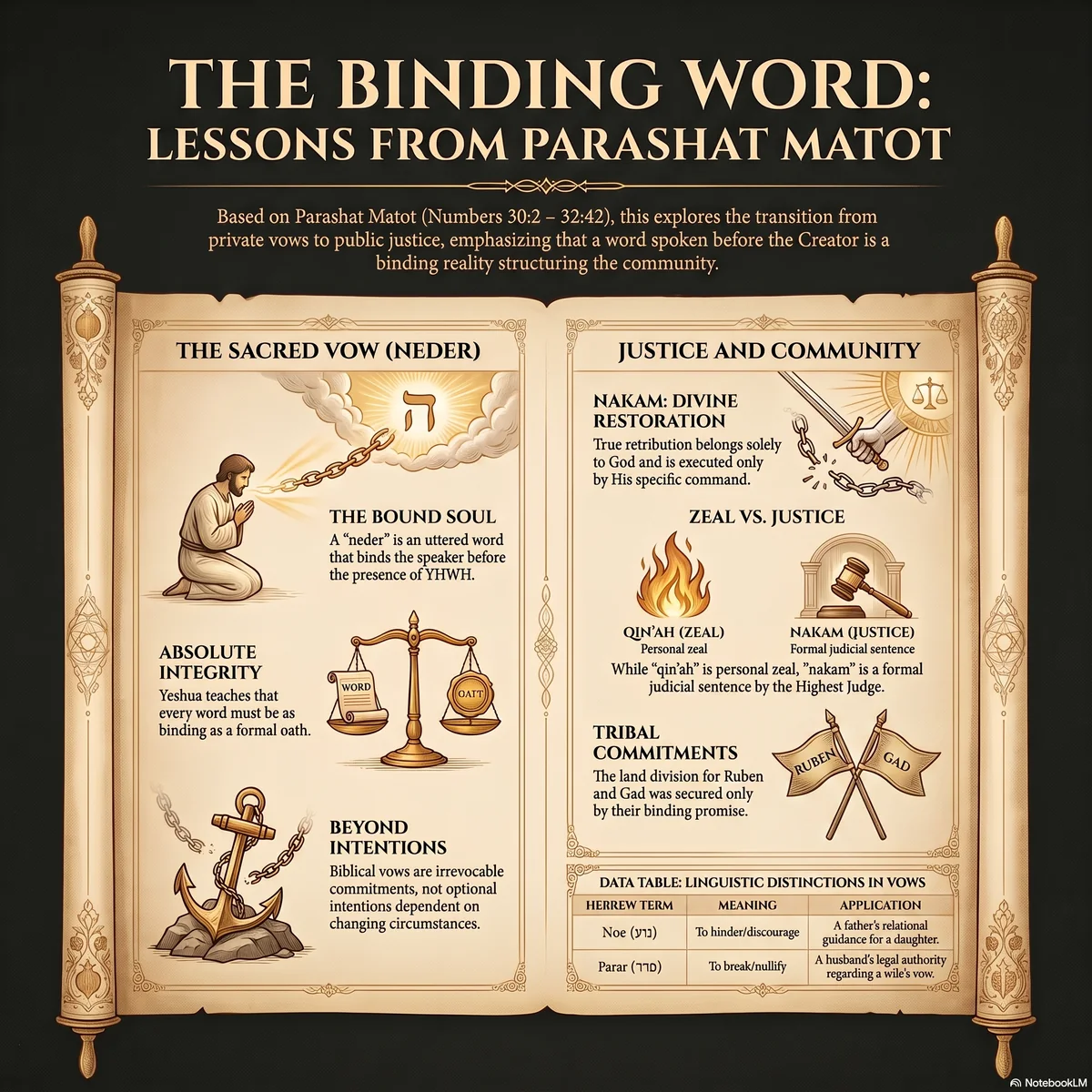
Matot connects three seemingly disparate subjects — vows, war, and land division — with one underlying principle: the weight of spoken and pledged things. A neder binds the speaker (Num. 30). Vengeance (nakam) is a pronouncement that belongs exclusively to YHWH, never to man on his own initiative (Num. 31:2-3, cf. Deut. 32:35). And the request of Reuben and Gad is granted only after they make an explicit promise — they will fight alongside the rest of Israel before settling (Num. 32:16-24), a promise Moses expressly holds them to: "if you will not do so, behold, you have sinned against YHWH, and be sure your sin will find you out" (Num. 32:23).
This is not legalism, but relational integrity: whoever does not take their word to YHWH or to their neighbour seriously undermines the very foundation on which covenant, community, and justice rest.
A — Word Study: Neder (נֶדֶר) and the Two Verbs Noe' and Parar
A neder is a voluntary commitment (for instance, dedicating something to YHWH); a shevuah is an oath that affirms or denies something. Numbers 30 addresses the question of when a head of household can annul such a statement made by a wife or daughter — and consistently uses two different verbs that are often merged into one word in translation ("forbid" or "annul").
Translation loss (Protocol II.iv, applied to new material): the word noe' (נוא, H5106) — used for the father toward his still-unmarried daughter (Num. 30:6, 9, 13) — means "to hinder, discourage, restrain": a relational, formative authority, not an absolute power. The word parar (פָּרַר, H6565) — used for the husband toward his resident wife (Num. 30:9, 13) — means "to break, to nullify": a direct, complete annulment. For the betrothed woman (Num. 30:7-9) both verbs stand side by side — a linguistic signal that her position lies between the two categories. Whoever equates these two words to a flat concept of "authority" loses the canonical distinction between formative influence and full covenant authority.
Vow versus promise — what does and does not hold canonically. A popular explanation claims that a neder, unlike an ordinary promise, is by definition unconditional — "I will do this regardless of what happens." That is not quite accurate: Jacob's neder in Genesis 28:20-22 is explicitly conditional ("If God will be with me... then YHWH shall be my God"), and Hannah's neder in 1 Samuel 1:11 is equally so. A neder can indeed contain a condition. What does canonically hold is something sharper: once the vow is spoken — conditional or not — its fulfilment becomes irrevocably binding, with no room for later revision on account of changed circumstances. Deuteronomy 23:22-24 and Ecclesiastes 5:3-4 say this in so many words: "When you make a vow to YHWH your God, do not delay to pay it... It is better that you should not vow than that you should vow and not pay." The distinction from an ordinary pledge (a business contract, for instance) is thus not the presence or absence of conditions, but the irrevocability of fulfilment once the condition — if there is one — has been met.
B — Nakam (נָקָם) versus Qin'ah (קִנְאָה): The Distinction Pinchas Already Signalled
Numbers 31:2-3 explicitly calls the war against Midian nikmat B'nei Yisrael ("the vengeance of the Israelites") and, through Moses, nikmat YHWH ("the vengeance of YHWH") — two names for the same act, because the people act on YHWH's express command, not on their own initiative.
Contrast (Questions cycle IV): nakam is canonically emphatically not the same as qin'ah, the word that qualified Pinchas's act in the previous parasha (Num. 25:11, H7068). Qin'ah is the fiery, exclusive devotion of a covenant partner; nakam is the formal vindication that a judge — in this case the highest Judge — pronounces and carries out. Both flow from the same character of God (His love for His people makes both His qin'ah and His nakam necessary), but they function differently canonically: qin'ah is relational intensity, nakam is judicial pronouncement.
Echo (Torah → Prophets → Brit Chadasha): Deuteronomy 32:35 lays down the canonical rule: "Vengeance is mine, and recompense" — directly linked to "the time when their foot shall slip" (v. 35) and "for YHWH will vindicate His people" (v. 36). Paul quotes this verse verbatim in Romans 12:19: "never avenge yourselves... for it is written, 'Vengeance is mine, I will repay,' says the Lord" — followed by the call to feed one's enemy (Rom. 12:20, Prov. 25:21-22). The canonical pattern is airtight: nakam is never entrusted to man as a private prerogative, only as delegated execution on express divine command — as with Israel against Midian.
C — The Partial Ban (Cherem) on Midian, and the Distinction from Canaan
Numbers 31 does not apply a full cherem (חֵרֶם, H2764) as later against the Canaanite nations (see the study Mas'ei, section B) — the young Midianite women not involved in the seduction at Peor are allowed to live (Num. 31:18). This is canonically significant: cherem in the Torah is not a fixed, uniform category, but a specific, targeted judgment fitting the nature and extent of the offence committed — in this case, the seduction to idolatry through Balaam's counsel (Num. 31:16, referring back to Num. 25:1-9 and the previous parasha, Balak).
Drash: the distinction between Midian (outside the promised land, partial ban, specifically targeting the perpetrators) and Canaan (inside the promised land, full ban, see Mas'ei) teaches that God's judgment is never blind or automatic — it is always precisely calibrated to what has actually happened and to the place YHWH has assigned to a nation.
D — Reuben and Gad: The First Seed of 2+10=12
Numbers 32 marks the first time Israel's inheritance is divided: Reuben, Gad, and half the tribe of Manasseh request and receive their inheritance east of the Jordan, outside the core of the promised land (Num. 32:33). Moses agrees only under the explicit, binding promise that they will first fight alongside their brothers to take the land to the west (Num. 32:20-24) — again the theme of this parasha: a word that binds, this time at the tribal level.
Echo (forward-pointing to Mas'ei and the Prophets): this early split — two tribes (plus a half) standing apart from the other ten — is the first visible seed of the pattern that becomes more explicit in Mas'ei (twelve leaders eventually consisting of ten plus two, Num. 34:16-29) and that ultimately leads to the historical division of Judah and Israel/Ephraim after Solomon, and their prophetically promised reunification (Ezekiel 37). What in Matot still looks like a practical land division canonically carries the first outlines of a much larger story.
Related Studies on Devar Emet
- Parasha Pinchas — the preceding parasha; the Covenant of Peace and the qin'ah against which nakam is contrasted in this study
- Parasha Mas'ei — the next parasha; the full ban on Canaan and the completion of the land boundaries
- Parasha Balak — Balaam's plot that is finally settled in Numbers 31
Matot asks this week for honest weight to be given to our own words:
1 — Take stock of an open item.
Is there a promise, pledge, or "I'll do it" that you have not yet fulfilled — to God, to your family, to a colleague? Pick one out and either fulfil it this week, or honestly say that you cannot or should not keep it. Leave no words wandering unattended.
2 — Let your yes be yes.
This week, pay conscious attention to how often you commit to something without really thinking it through. Practise the principle of Matthew 5:37: promise less, but fully deliver on what you say.
3 — Leave judgment to YHWH.
Where you experience injustice this week, practise the distinction from section B: don't let the sense of injustice have room to seek its own revenge, but consciously lay it down before the Judge to whom nakam belongs (Rom. 12:19) — and actively look for a concrete act of kindness toward whoever has wronged you.
In Jewish tradition, on Erev Yom Kippur the Kol Nidrei prayer is recited, in which one asks God to annul the unintended vows of the past year — Rabbinic-Traditional, not a canonical Torah practice, but a striking yearly reminder of the weight of Numbers 30.
Avinu Malkeinu — Our Father, our King,
Your own Word stands firm in the heavens, and You made us in Your image — including our capacity to speak and to bind ourselves by what we say. Forgive us for the words we have spoken lightly and the promises we have left unfulfilled. Teach us to let our yes be yes and our no be no, so that no open items remain between us and You, and between us and our neighbours.
Where we have experienced injustice, help us not to seize vengeance ourselves, but to entrust it to You in confidence — You, who judge righteously and whose patience has spared our own lives. Thank You that Yeshua, our Advocate, carries and heals the broken promises of our lives, just as He forever heals the broken Vav of the Covenant of Peace.
Baruch Atah YHWH, Giver of the Word that is truth. Amen.
- TorahNumbers 30:2-17 (vows and oaths); Numbers 30:3 (core verse); Numbers 30:6, 9, 13 (noe' and parar); Numbers 30:7-9 (the betrothed woman); Numbers 31:1-12 (vengeance on Midian); Numbers 31:2-3 (nikmat B'nei Yisrael / nikmat YHWH); Numbers 31:7-18 (execution and partial ban); Numbers 31:13-24 (purification after battle); Numbers 31:16 (Balaam's counsel as cause); Numbers 31:25-41 (division of spoil); Numbers 32:1-42 (Reuben, Gad, and half-Manasseh); Numbers 32:16-24 (the promise to fight); Numbers 32:20-24, 33 (conditions and allocation); Numbers 25:1-9, 11 (background of Baal-Peor, previous parasha); Genesis 15:13-16 (400-year measure, forward-pointing to Mas'ei); Genesis 28:20-22 (Jacob's conditional vow); Deuteronomy 32:35-36 (vengeance belongs to YHWH); Deuteronomy 23:22-24 (irrevocability of the vow); Deuteronomy 13:16 (ban and burnt offering, forward-pointing to Mas'ei); 1 Samuel 1:11 (Hannah's conditional vow).
- ProphetsJeremiah 1:1-2:3 (haftarah, independent reading of Matot); Jeremiah 1:5 (the word's predestination); Jeremiah 1:9 (God's words in Jeremiah's mouth); Jeremiah 2:2-3 (the love of the betrothal).
- WritingsProverbs 25:21-22 (feeding the enemy, background to Rom. 12:20); Ecclesiastes 5:3-4 (better not to vow than to vow and not pay).
- Brit ChadashaMatthew 5:33-37 (oaths and word-integrity); James 5:12 (parallel to Matt. 5:37); Romans 12:19-20 (quote of Deut. 32:35, leaving vengeance to God); 1 John 2:1 (Yeshua as Advocate, application); Philippians 3:7-14 (irrevocable surrender as a life-orientation, not a formal neder but the same quality).
- Rabbinic/TraditionalKol Nidrei prayer on Erev Yom Kippur — cited solely as tradition, not as canonical Torah practice (Protocol VI.i, Step 2).
- PaRDeSRabbinic hermeneutical framework. Talmud, b. Sanhedrin 67b; b. Chagigah 14b. Kabbalistic Sod-content (Zohar, Sefer Yetzirah) explicitly excluded — Protocol VI.i extension.
- Source materialSubmitted study draft (Devar Emet format, all five aliyot of Matot) — tested against Protocol VI.i and processed. The linguistic analysis of noe' and parar is canonically strong and fully retained. The explanation of nakam versus the qin'ah of Pinchas (parallel to Num. 25) has been retained and developed with canonical cross-references (Deut. 32, Rom. 12). The culturally-applied explanation of the roles of husband and wife within the household has been reduced to its canonical core (the distinction between the authority of a father and a husband) without carrying over the broader contemporary application. The extended numerological sequence around the years 1517-1867-1917-1967-2017 (Jonathan Cahn) and the linked 430/500-year cycle is not retained: this is popular-theological historical numerology, not canonical Hebrew Gematria, and lacks the required exact thematic anchoring (Protocol III). The jubilee principle (Lev. 25) behind the 1/50th part is retained canonically, without the modern-year sequence. From a submitted parasha teaching (transcript, likely Rabbi Monte Judah), the claim "a vow has no conditions" has been corrected against Genesis 28 and 1 Samuel 1 (both show conditional vows) — the canonically sound core (irrevocability of fulfilment, Deut. 23, Eccl. 5) has been retained. Philippians 3:7-14, linked to Matot by the same source, has been added as an analogy. Personal testimony and illustrations from the speaker (the chicken/pig image, the calling narrative, the aerospace anecdote) have not been retained: not Scripture, not a classical source, the speaker's own copyrighted material as a living teacher.
- Protocol"Vengeance" (nakam) is canonically distinguished from qin'ah (analogous to II.iv, applied to a new concept pair, see section B). Neder/shevuah treated as binding categories, not as non-binding intentions (analogous to VI.ii.b). No use of Zohar, Sefer Yetzirah, or kabbalistic works (VI.i extension). Numerological historical sequences without canonical Gematria grounding rejected (Protocol III, "Validation" step). Popular-theological overgeneralisation ("no conditions") corrected against canonical counter-examples before inclusion (Protocol VI.i, Step 1).