The name Pinchas has no demonstrable three-letter Hebrew root in the Tanakh — the canonicity check (Protocol VI.i, Step 1) shows this is an Egyptian loanword, comparable to the name of his forefather Putiel (Ex. 6:25), whose in-laws likewise carry Egyptian name-roots. The popular pictographic explanation "mouth of bronze" is therefore extrabiblical comparison material, not canonical Hebrew word analysis, and is named here strictly as such — not as grounds for interpreting his act. The canonical ground of this parasha lies not in his name, but in the word YHWH Himself uses to qualify his act: qin'ah (see Step 5).
Pinchas is the son of Eleazar, the son of the priest Aaron (Num. 25:11) — a third-generation priest, neither a prophet nor a judge appointed by Moses. The parasha opens directly after the crisis at Shittim: Israel had intermingled with the Midianite and Moabite women and bowed down to Baal-Peor (Num. 25:1-9), triggering a plague that killed 24,000 Israelites.
"Pinchas, the son of Eleazar, the son of Aaron the priest, has turned back My wrath from the Israelites, in that he was jealous with My jealousy among them (be-kan'o et-kin'ati), so that I did not consume the Israelites in My jealousy. Therefore say: Behold, I give him My covenant of peace." — Numbers 25:11-12
Scope and boundaries: From this turning point the parasha shifts from crisis to preparation for entry into the land: the second census (Num. 26), the inheritance ruling and the legal case of the daughters of Zelophehad (Num. 27:1-11), the appointment of Joshua as Moses' successor (Num. 27:12-23), and a detailed overview of the daily, weekly, monthly, and festival offerings — the korbanot (Num. 28-29). The generation that died in the wilderness is here literally replaced by a generation that will enter the land.
The haftarah mirrors Pinchas against the prophet Elijah. Rabbinic tradition (among others, the Midrash) holds that Elijah is the spiritual successor of Pinchas — label: Rabbinic/Traditional, not a canonical identity claim. What is canonically established: both figures use, literally, the same Hebrew stem to qualify their actions.
"I have been very jealous (kano kineiti) for YHWH, the God of hosts." — 1 Kings 19:10
This uses the exact same stem as the description of Pinchas' act — be-kan'o et-kin'ati, "when he was jealous with My qin'ah" (Num. 25:11). Where Pinchas acts against the Baal-Peor worship in the camp, Elijah acts against Baal worship under Ahab and Jezebel. The overarching theme is holy qin'ah versus the silence or compromise of the majority.
The haftarah also shows the other side: God ultimately does not reveal Himself in the storm or the fire, but in the sound of a gentle whisper (1 Kgs. 19:12) — a correction of the human tendency to let holy zeal spill over into bitter isolation and self-pity ("I alone am left," 1 Kgs. 19:10, 14).
In John 2, Yeshua cleanses the Temple. The disciples immediately recall the Scripture: "Zeal (qin'ah) for Your house has consumed me" (Ps. 69:10; John 2:17) — the same word-field as Numbers 25. Yeshua acts within the blueprint of Pinchas and Elijah: He cannot bear the desecration of the holy space.
The Greek plēroō (G4137) means "to bring to full meaning," not "to close out and set aside." Yeshua's holy qin'ah — unlike with Pinchas — does not bring death upon the offender; He carries the consequence Himself, to seal Brit Shalom permanently. This is not a replacement of the pattern of Numbers 25, but its deepest fulfillment (cf. Protocol VI.iii).
In Romans 11, Paul cites Elijah, who complains that he alone is left. Paul corrects this from covenant reality: God has always preserved a remnant (she'ar) by grace — not through human qin'ah, but through electing faithfulness. Brit Chadasha shows that true qin'ah for Torah and kingdom is no longer expressed through the physical sword, but through radical devotion that lays down one's own life for the purity of the community.
John explicitly notes twice that this happens around Passover (John 2:13, 2:23) — Yeshua's holy qin'ah does not fall at an arbitrary moment, but literally on a moed, exactly the yearly rhythm laid out in Numbers 28-29 (see Step 5, section H).
Rabbinic/Historical: the Second Temple, in which Yeshua acts here, no longer had the Ark of the Covenant and therefore no visible Shekinah in the Holy of Holies (Mishnah Yoma 5:2) — a widely recognized historical fact, not recorded as such in the Tanakh itself. This sharpens His statement "destroy this temple, and in three days I will raise it up" (John 2:19): not an announcement of repair to the existing building, but of an entirely new, bodily bearer of God's presence (John 2:21) — canonically fulfilled when believers themselves are called "the temple of God" (1 Cor. 3:16).
Holy qin'ah is not a discharge of human anger, but the act of someone whose heart beats to the same rhythm as God's heart — and that is precisely what makes the Covenant of Peace possible.
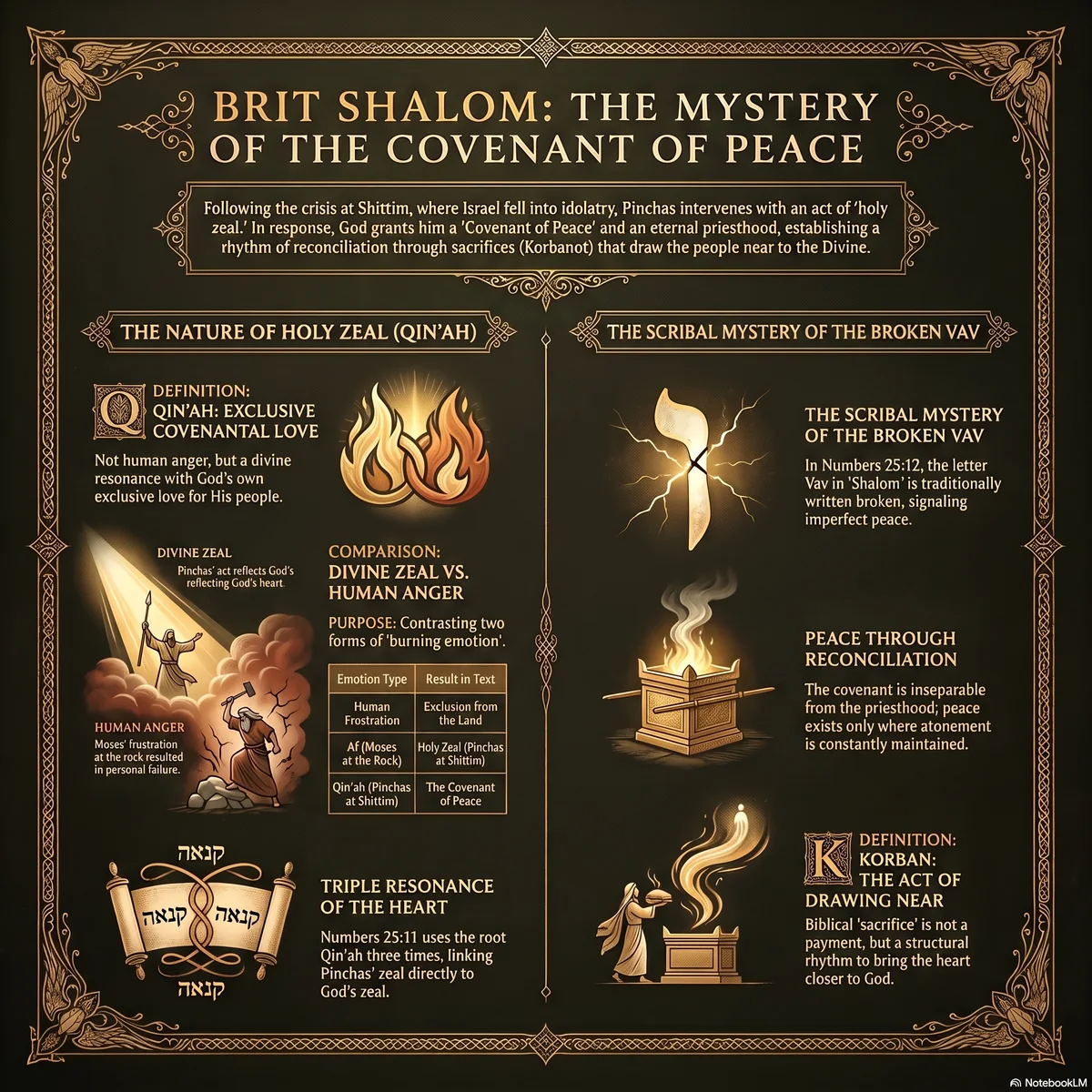
The central revelation is the mystery of the Brit Shalom given to Pinchas in response to an act that at first glance looks violent. Peace in God's kingdom is not passive tolerance of evil. When the boundary between the holy and the profane blurs — as at Shittim — it activates the destructive plague of sin. No one stands up for God except Pinchas: Moses does not point out the leaders as YHWH commands (Num. 25:4-5), but addresses the offenders among the people half-heartedly. Pinchas alone dares to put his hands on the leaders themselves (Zimri, Cozbi) — and with that, the plague stops.
God was satisfied with one person who could feel with Him. He so wanted to feel love for the people again that, because of one devoted person, He turned back His judgment on the entire nation. This is not a license for human anger — it is a lesson in what happens when one heart is truly joined to the heart of YHWH.
A — Word Study: Qin'ah (קִנְאָה)
Qin'ah is often translated "zeal," "jealousy," or "envy" — a translation loss when heard as selfish jealousy. YHWH calls Himself El Kanna, a qin'ah-God (Ex. 20:5), in the context of the second commandment against idolatry: it concerns exclusive faithfulness within the marriage relationship between YHWH and Israel, not human insecurity. Idolatry in this frame is literally adultery. Used three times in Numbers 25:11 — Pinchas' qin'ah, God's qin'ah, the same qin'ah — indicating that his heart, in that moment, resonated completely with the Heart of YHWH.
Contrast (Question Cycle IV): qin'ah is not a synonym for human af (anger, H639) as in Moses' outburst at the rock (see section C). Qin'ah is relational-exclusive in character; af is a physiological emotion that can be either justified or degenerate. What Pinchas carried was the former — grounded in God's own declaration (Num. 25:11), not in his own reading of the moment.
B — The Broken Vav in Shalom, and the Eternal Priesthood (Num. 25:12-13)
In the Masoretic Torah scroll, the word Shalom (שָׁלוֹם) in Numbers 25:12 is traditionally written with a broken letter Vav (ו) — Rabbinic/Traditional, a scribal tradition, not a canonical variant of the base text. The common explanation within this tradition: peace achieved through the sword or human intervention carries a "broken" character — whole, but scarred. The Vav, the letter of connection between heaven and earth, is intact enough to carry peace, but not the full, seamless wholeness the Scripture ultimately promises.
Sod (Messianic, Scripturally grounded): the complete healing of that Vav becomes canonically visible only in the Brit Chadasha, where Yeshua Himself carries the cost of judgment (John 2; cf. Isa. 53:5, "the punishment that brought us peace") — no human being need grasp the spear again to avert judgment.
Verse 13 is rarely read apart from verse 12, yet canonically belongs with it inseparably: the same divine speech continues directly, "it shall be to him and to his descendants after him a covenant of a perpetual priesthood" — with the reason explicitly stated: "because he was jealous for his God and made atonement (וַיְכַפֵּר, va-yechaper) for the people of Israel." Shalom in verse 12 is therefore not a separate reward alongside the priesthood of verse 13 — it is its fruit. What stopped the plague was not the act as violence in itself, but that the act functioned as kipper (atonement) — the same verb the Torah uses for sacrificial blood (Lev. 17:11, "it is the blood that makes atonement by the life"). Peace that endures is therefore never given in the Torah apart from a priestly ministry that carries it.
Olam (עוֹלָם) here does not mean "eternal without interruption" in the abstract, but "continuing from generation to generation" — hence the text explicitly adds "him and his descendants after him." The same word canonically recurs in Psalm 110:4 (see below), demonstrably linking the two texts through shared vocabulary, not coincidental gematria.
Echo (Torah → Prophets → Brit Chadasha): this pattern — shalom and priesthood bound inseparably together — recurs canonically in two explicit places. Zechariah 6:12-13 describes the Tsemach (the Branch) who will build the Temple, will sit on His throne, and "shall be a priest on His throne; and the counsel of peace shall be between them both" (עֲצַת שָׁלוֹם, atzat shalom) — kingship, priesthood, and shalom again indivisibly joined, now applied messianically. Psalm 110:4 then uses literally the same word "olam" as Numbers 25:13: "You are a priest forever (לְעוֹלָם, le-olam), after the order of Melchizedek." Melchizedek himself is "king of Salem" (מֶלֶךְ שָׁלֵם, Gen. 14:18) and "priest of God Most High" — Salem (שָׁלֵם) shares the three-letter root ש־ל־ם with Shalom (שָׁלוֹם), not a coincidental sound-alike but a demonstrably shared root. Hebrews 7 canonically carries this line forward to Yeshua as eternal Priest-King after the order of Melchizedek (see also The Position of the Soul for a further treatment of the Melchizedek order).
Drash: Numbers 25:12-13 is thus the first place in the Torah where peace and a perpetual priesthood are literally bound together in a single covenant declaration. Shalom in Scripture is never merely the absence of conflict — it is what remains when atonement is permanently carried by a priestly office.
C — The Arc Chukat → Balak → Pinchas: Leadership Failure and the Repeated Third
These three parashot are not three isolated events but one continuous arc around the question: who rises up when YHWH's honor is at stake?
| Parasha | Leadership Moment | Nature of the Failure / Action |
|---|---|---|
| Chukat | Moses strikes the rock at Meribah (Num. 20:11) | Human af (frustration/anger) instead of speaking as commanded — Moses himself is barred from entering the land. |
| Balak | Balaam cannot curse Israel (Num. 22-24), later advises the seduction through the women (Num. 31:16) | The attack shifts from outside (cursing) to inside (seduction) — Baal-Peor is literally the execution of Balaam's counsel. |
| Pinchas | Moses again falls silent before Zimri (Num. 25:6); Pinchas seizes the spear | Holy qin'ah, grounded in God's own declaration — the restoration comes not from the official leader, but from a priest's son who acts as a third party. |
The pattern is sharp: three times over, it is not Moses who keeps the covenant intact at the critical moment. The contrast between Chukat and Pinchas is the sharpest: at the rock, human anger fails (Moses strikes in impatience, against the explicit command to speak), while at Pinchas, holy qin'ah saves the people. Two forms of fiery emotion, with opposite outcomes — because one springs from human frustration and the other from covenant faithfulness that literally mirrors God's own words (Num. 25:11). Balaam's plot from Balak finds here its second and final act: not a separate sin, but the outworking of what was sown in Balak.
D — Tabernacle Projection
If Pinchas' act were an object in the Tabernacle, it would be the bronze laver (Ex. 30:18) that stands between the Tent and the altar of burnt offering — the place where the priest had to purify himself before approaching the holy, on pain of death. Pinchas acted precisely on the boundary between the camp (profane, intermingled with Baal-Peor) and the community of YHWH (holy) — the exact function of the laver: making the boundary between clean and unclean visible and inescapable.
E — PaRDeS Synthesis Table
| Level | Outworking in Parashat Pinchas |
|---|---|
| Pshat (Literal) | Pinchas pierces Zimri and Cozbi with a single spear-thrust; the plague stops; YHWH gives him a Covenant of Peace and the priesthood remains in his line. |
| Remez (Hint) | The broken Vav in Shalom (Num. 25:12, Rabbinic/Traditional) points forward to a peace not yet fully whole — a hint resolved only in the Brit Chadasha. |
| Drash (Ethical) | Leaders who stay silent when YHWH's honor is violated share in the responsibility (cf. Jas. 3:1). Silence or going along with the majority is not the way of the Lord (Ex. 23:2). |
| Sod (Secret/Messianic) | Yeshua Himself carries the qin'ah for God's House (John 2:17; Ps. 69:10) and absorbs the death penalty rather than imposing it — the complete healing of the broken Vav, the definitive Brit Shalom. |
F — The Korbanot: The Rhythm After the Crisis (Num. 28-29)
The English "offering" carries a connotation of loss or payment — a translation loss. Korban literally means "that which draws near/brings close": not a price YHWH receives, but a means by which the giver is himself brought near to Him. Directly after Pinchas' act — itself a form of "drawing near" for God's honor — Numbers 28-29 follows with a complete calendrical overview of korbanot, as if the text wants to structurally underpin the answer to Shittim: not one exceptional act of zeal, but a sustained rhythm of drawing near.
| Type | Frequency | Composition |
|---|---|---|
| Tamid (Num. 28:3-8) | Daily — morning and evening | Lamb + solet (fine flour) with oil + nesech (wine) |
| Shabbat (Num. 28:9-10) | Weekly | Doubling of the tamid — two additional lambs |
| Rosh Chodesh (Num. 28:11-15) | Monthly | Two bulls, one ram, seven lambs + solet + a goat as sin offering |
| Passover / Unleavened Bread (Num. 28:16-25) | Annual — 7 days | Daily two bulls, one ram, seven lambs |
| Yom HaBikkurim / Shavuot (Num. 28:26-31) | Annual — 1 day | Two bulls, one ram, seven lambs + new grain offering |
| Yom Teruah / Yom Kippur (Num. 29:1-11) | Annual — 2 days | One bull, one ram, seven lambs per day + atonement goat on Kippur |
| Sukkot (Num. 29:12-38) | Annual — 7+1 days | Descending 13→7 bulls (total 70), rams, lambs; eighth day: one bull set apart |
Drash: tamid comes literally from the same stem as "continual, perpetual" (H8548) — not incidental devotion, but a structure that brings the people back to the nearness of YHWH afresh every day, precisely the opposite of the compromise-moments at Shittim.
Sod (Brit Chadasha echo, Heb. 10:1-14): the endless repetition of the tamid — never completed, every morning and evening again — marks canonically exactly what the Brit Chadasha identifies as incomplete about the repetition-system itself (Heb. 10:1-4): it could never definitively remove sin, only sustain remembrance. Yeshua's "once for all" (Heb. 10:10, G2178 ephapax) is not an abolition of the korban-principle (drawing near to God), but its fulfillment (plēroō, VI.iii): the drawing-near is no longer repeated because it has been accomplished.
G — The Census: The Sons of Reuben and the Generation That Counts (Num. 26)
Numbers 26 counts a people of whom, apart from Joshua and Caleb, no one is left who was also counted in Numbers 1 (Num. 26:64-65) — canonically explicit. The two totals lie strikingly close together (603,550 versus 601,730), yet this is an entirely different generation. This is the first pshat layer: not a continuous count of the same people, but proof that the judgment on the wilderness generation (Num. 14:29-35) has fully run its course, precisely at the hinge-moment right after Pinchas' act.
All four names are called, in every one of the four canonical listings without exception, "the sons of Reuben." No text attributes Hezron or Carmi to Judah.
| Name | Root (canonical) | Layer of Meaning |
|---|---|---|
| Hanoch | חנך, chanak (H2596) — to dedicate, train up (cf. Prov. 22:6) | Devotion/formation from the outset |
| Pallu | פלא, pala (H6381) — to make distinguished, to set apart | Separation, the striking/the breach |
| Hezron | חָצֵר, chatser (H2691) — enclosed settlement, court | Settlement, structure, boundary |
| Carmi | כֶּרֶם, kerem (H3754) — vineyard | Fruit, yield |
A supplied source analysis assumed that Hezron and Carmi are actually sons of Judah, with Hanoch and Pallu forming a "witness" pairing tied to Judah's two sons. The canonicity check (VI.i, Step 1) rejects this: Genesis 46:9, Exodus 6:14, Numbers 26:5-6, and 1 Chronicles 5:3 all name all four names, without exception, "the sons of Reuben." Judah's own line (Gen. 46:12) has, through Perez, its own, identically-named Hezron (ancestor of Boaz and David, Ruth 4:18-19) — a different person with the same name, not the same person. Carmi does not appear anywhere in Judah's patriarchal list; the later Carmi of Joshua 7:1 (grandfather of Achan) is a separate, unrelated mention. The "2 Reuben + 2 Judah" reading is therefore a naming confusion, not a canonical structure, and is not adopted here.
Remez-speculative: read as a sequence, the four roots tell a recognizable line — devotion, separation/breach, settlement, fruit. The census itself tells no story in that form; this is a homiletical pattern laid over the names, not exegesis of the texts themselves, and is therefore explicitly labeled Remez, not the settled meaning of the census.
Drash: precisely the tribe that forfeited its birthright through instability (Gen. 49:3-4, "unstable as water"; 1 Chr. 5:1) is here, directly after Pinchas' steadfastness, counted first and named first. The text places no blame, but lets the contrast stand: instability versus the steadfast qin'ah that just saved the people.
Echo (Torah → Brit Chadasha): Reuben loses the birthright to another (1 Chr. 5:1-2) — a canonical pattern that repeats (Isaac not Ishmael, Jacob not Esau) and ultimately leads to Colossians 1:15 and Romans 8:29, where Yeshua Himself is called "the firstborn" — not by biological order, but by God's appointment.
H — Brit Shalom and the Moadim: Peace for the Nations
Notably, in the very same literary unit in which YHWH promises Pinchas the Covenant of Peace, the full overview of the three pilgrimage feasts follows directly — Passover, Shavuot (Yom HaBikkurim), and Sukkot (Num. 28:16-29:38). Brit Shalom does not stand apart from the moadim; it is embedded, in the same parasha, in the yearly rhythm in which all Israel — and ultimately the nations — appear before YHWH (cf. Appear, on Ex. 23:17 and Deut. 16:16).
Over the seven days of Sukkot the bull offerings descend from 13 to 7 (13+12+11+10+9+8+7): a canonical, directly addable total of 70 — not an added number, but the sum of the text itself. No other moed brings such a large, descending series.
Rabbinic/Traditional: the Talmud explicitly links these 70 bulls to the 70 nations (b. Sukkah 55b: "these seventy bulls, to what do they correspond? To the seventy nations"). This is a Talmudic reading, not a canonical statement of the Torah itself — Numbers 29 itself names no 70 nations. Moreover, the number "70 nations" is itself a traditional tally of the names in Genesis 10, not a number Genesis 10:32 literally states; that text says only that from them "the nations spread abroad on the earth after the flood."
Sod/Echo (canonically confirmed in the Prophets): what comes together in Numbers 29 and the Talmudic reading becomes canonically explicit in Zechariah 14:16-19: in the future, the surviving nations will themselves go up yearly to keep Sukkot, on pain of drought if they stay away. Brit Shalom, promised to a single priest within Israel, thus stands — via the moadim with which it is literally interwoven in the same text — already from Numbers 25 in a line that ultimately embraces the nations. See also Shavuot and The YHWH Feasts for the broader moed-structure.
I — The Daughters of Zelophehad: Justice Within the Structure (Num. 27:1-11)
Mahlah, Noah, Hoglah, Milcah, and Tirzah — five daughters of Zelophehad (צְלָפְחָד, H6765, tribe of Manasseh, Num. 26:33) — come forward because their father died without sons, threatening his name and inheritance with disappearance from Israel. Moses brings their case before YHWH (Num. 27:5) — and YHWH answers not with a correction, but with a direct confirmation: ken (כֵּן, "rightly, correctly"). This is canonically one of the few places where YHWH Himself literally vindicates a human legal appeal, and the ruling subsequently becomes lasting halacha (Num. 27:8-11).
Drash: this connects to the broader pattern of this parasha (see the table in section C): like Pinchas, the daughters of Zelophehad act where the existing structure falls silent — not by overturning it, but by letting it speak to its full intent. Torah as living instruction (H8451, VI.ii.b) shows its own nature here: not a rigid law code, but direction that can grow in relational response to justice.
Echo (Torah → Ketuvim): Job 42:15 closes the book of Job with a canonical parallel: Job's daughters explicitly receive an inheritance "among their brothers" — again a moment in which daughters, against common practice, are included in inheritance rights.
The case is further refined in Numbers 36 (just outside the boundaries of this parasha): the daughters must marry within their own tribe to keep the inheritance within Manasseh — not a withdrawal of the right, but its practical embedding within the tribal structure.
Further Studies on Devar Emet
- Parasha Balak — the preceding parasha; Balaam's plot that finds its outworking here
- Parasha Chukat — Moses' anger at the rock as a contrast point with Pinchas' holy qin'ah
- The Position of the Soul — the boundary between holy and profane that Pinchas' act marks
- Shavuot — the omer-path and the solet symbolism behind the korbanot
- The YHWH Feasts — the full moed-structure within which Numbers 28-29 stands
- Appear — the three pilgrimage feasts on which Israel appears before YHWH
Pinchas asks this week not for passive observation, but for a discerning form of action:
1 — Housecleaning in your own tent.
Identify today one concrete "Midianite influence" in your own life — a compromise, a habit, or a media source that blurs the boundary between holy and profane in your thinking. Take a deliberate, defined step to restore that boundary.
2 — Speaking instead of staying silent — but tested.
Where the leaders of Israel looked on and Moses stayed silent, Pinchas acted. If you notice this week that YHWH's honor is being openly discredited in your family, work, or community, do not stay silent out of fear of people. First test your motive against Psalm 139:23-24 ("search me, O God, and know my heart") — qin'ah always remains paired with a humble, correctable heart, never with being right for its own sake.
3 — The warning against lukewarmness.
A greater danger than misplaced passion is lukewarmness (Rev. 3:14-16). Ask yourself honestly: does Yeshua find fiery devotion in me, or has my faith become so comfortable that there is no longer room for His love to reach me?
One last, side lesson: God holds leaders accountable for the conduct of the community they serve (Jas. 3:1). Whoever stays silent where speech is required shares in that responsibility — not as a call to unauthorized intervention, but as a call never to take one's own calling and position lightly.
Avinu Malkenu — Our Father, our King,
God of Abraham, Isaac, and Jacob, God of the covenant. We thank You for Your living Word that sharpens and purifies us. Grant us the qin'ah of Pinchas — not the spirit of human anger or self-righteousness, but the fiery, devoted love that flows from a heart beating to the same rhythm as Yours.
Cleanse our hearts of every compromise with Baal-Peor in our own time. Search us and know our hearts; test us and see if there is any harmful way in us. Let us not grow lukewarm, but let us burn for what You love and grieve over what grieves You. We pray for the wholeness of Your Brit Shalom in our lives, our families, and Your community — sealed by the reconciling work of Yeshua, our Messiah, who heals the broken Vav for good.
Baruch Atah YHWH, Giver of the Torah and Giver of Shalom. Amen.
- TorahNumbers 25:1-9 (Baal-Peor, preceding); Numbers 25:6 (Zimri before Moses' eyes); Numbers 25:7-8 (the act of Pinchas); Numbers 25:10-13 (the Covenant of Peace); Numbers 25:11-12 (central text); Numbers 25:13 (the perpetual priesthood); Numbers 25:14-18 (identity of Zimri and Cozbi); Numbers 26 (the second census); Numbers 26:5-6, 64-65 (the sons of Reuben; the changed generation); Numbers 27:1-11 (the daughters of Zelophehad); Numbers 27:5-7 (ken benot Tzelofchad dovrot); Numbers 27:12-23 (appointment of Joshua); Numbers 28-29 (the korbanot); Numbers 28:3-8 (tamid); Numbers 29:12-34 (the seventy bulls of Sukkot); Numbers 30:1; Numbers 31:16 (Balaam's counsel as the cause of Baal-Peor); Numbers 36 (inheritance refinement, outside the parasha boundary); Numbers 20:11 (Moses strikes the rock, Chukat); Genesis 14:18 (Melchizedek, king of Salem); Genesis 46:9 (sons of Reuben); Genesis 46:12 (Hezron of Judah, a different person); Genesis 49:3-4 (Reuben forfeits the birthright); Exodus 20:5 (El Kanna); Exodus 6:25 (Putiel, Egyptian naming in the priestly line); Exodus 23:2; Exodus 23:17 (appearing before YHWH); Exodus 30:18 (bronze laver); Leviticus 2:1 (solet); Leviticus 17:11 (the blood makes atonement); Deuteronomy 1:22; Deuteronomy 16:16 (the three pilgrimage feasts); Joshua 7:1 (the other Carmi, Achan's grandfather); Ruth 4:18-19 (Hezron of Judah in the Davidic line); 1 Chronicles 5:1-3.
- Prophets1 Kings 18:46 – 19:21 (haftarah); 1 Kings 19:10,14 (kano kineiti); 1 Kings 19:12 (the gentle whisper); Isaiah 53:5; Zechariah 6:12-13 (Tsemach, priesthood, and the counsel of peace); Zechariah 14:16-19 (the nations and Sukkot).
- WritingsPsalm 69:10 (qin'ah for God's house); Psalm 110:4 (priest forever after the order of Melchizedek); Psalm 139:19-22 (shared anger); Psalm 139:23-24 (search me); Job 42:15 (inheritance for Job's daughters, parallel to the daughters of Zelophehad); Proverbs 22:6 (chanoch, to dedicate/train).
- Brit ChadashaJohn 2:13-22 (Temple cleansing); John 2:13, 2:23 (Passover timing); John 2:17 (citing Ps. 69:10); John 2:19-21 (destroying and raising up in three days); 1 Corinthians 3:16 (believers as the temple of God); Romans 11:1-6 (Elijah and the remnant); Romans 3:31; Romans 8:29 (Yeshua as firstborn); Matthew 5:17 (plēroō); James 3:1 (leaders and stricter judgment); Colossians 1:15 (firstborn of all creation); Hebrews 7:1-17 (the Melchizedek priesthood of Yeshua); Hebrews 10:1-14 (the tamid and the once-for-all offering of Yeshua); Revelation 3:14-16 (Laodicea, lukewarmness).
- Rabbinic/TraditionalMidrashic tradition identifying Elijah with the spirit of Pinchas — cited strictly as tradition, not as canonical fact (Protocol VI.i, Step 2). Masoretic tradition of the broken letter Vav in Numbers 25:12 (Ba'al HaTurim tradition) — likewise labeled Rabbinic/Traditional, not canonical. Talmud, b. Sukkah 55b (the 70 bulls of Sukkot against the 70 nations) — explicitly labeled as a Talmudic reading, not a canonical Torah statement; the number "70 nations" is itself a traditional tally from Genesis 10, not a literal Torah number. Mishnah Yoma 5:2 (absence of the Ark and the Shekinah in the Second Temple) — a widely recognized historical-rabbinic fact, not recorded as such in the Tanakh itself.
- PaRDeSRabbinic hermeneutical framework. Talmud, b. Sanhedrin 67b; b. Chagigah 14b. Kabbalistic Sod-content (Zohar, Sefer Yetzirah) explicitly excluded — Protocol VI.i extension.
- Source MaterialSupplied study outline (Devar Emet format, Parasha–Prayer sections) and supplied thematic deepening on qin'ah, Moses' failure, leadership responsibility, and the warning against lukewarmness (Rev. 3) — checked against and processed under Protocol VI.i. Supplied analysis on the sons of Reuben (Hanoch, Pallu, Hezron, Carmi) — canonicity-checked; the 2+2 division with Judah it assumed did not hold up canonically and was corrected during processing (see section G); the root meanings and the Remez pattern were retained, with labeling. Supplied teaching-service transcript (Erev Shabbat, Pinchas) on John 2 — the Passover timing and the historical absence of the Ark/Shekinah in the Second Temple were adopted (Step 3); the description of the scourge as a nine-stranded instrument with bone fragments was not adopted for lack of historical grounding for the first century; the extensive end-times/political section of the transcript was not processed for lack of textual relation to the parasha. Supplied document on the letter Shin and the numeric value 300 (Gen. 5:22, Gen. 45:22) — not adopted: linking Enoch's "walking with God" to "resurrection" is canonically incorrect (Enoch did not die and rise, but was taken, Gen. 5:24), and the claim "5 = grace" is a popular-theological numerology convention without canonical grounding.
- Protocol"New covenant" not applicable in this study — the Covenant of Peace (Brit Shalom) is a separate covenant, running from Numbers 25 onward, not a reformulation of Brit Chadasha (VI.ii.a remains relevant for Brit Chadasha references in Step 3). "Obey" → qin'ah is not an obedience category but a relational one (II.iv). The name "Pinchas" canonicity-checked and labeled extrabiblical (VI.i, Step 1). "Offering" → korban (H7133, from karav, to draw near) is a translation loss when read as payment rather than drawing near (section F). The 2+2 Reuben/Judah reading from the source material was retroactively corrected prior to publication (VI.i, Step 1). Gematria/numerology from supplied material declined for lack of thematic grounding (Protocol III) and canonical inaccuracy (the Enoch/resurrection point). No use of Zohar, Sefer Yetzirah, or kabbalistic works (VI.i extension).