Purifying removes uncleanness. Sanctifying goes further: it is not merely the absence of a stain, but a positive, active devotion — a setting-apart for YHWH's presence and use. Where the previous study drew the line between clean and unclean, this study draws the line between chol (the common) and kodesh (the devoted) — and shows who ultimately crosses that line.
This study follows the Hebrew root קדשׁ (qadash, H6942) through three verb stems — the Hebrew conjugation patterns that indicate who performs the action and how: hitpael (reflexive — a person does it to themselves), piel (the subject actually brings the action to completion — here YHWH), and niphal (a mutual encounter). The central question is not "how do I become good enough," but "how does someone who is chol in themselves become kodesh — without perishing when they meet YHWH?"
After this study you understand:- You know the difference between kodesh (the positively devoted) and tahor (the negatively not-unclean), and why these are two separate, complementary movements.
- You recognize the root קדשׁ in its three verb stems — hitpael, piel, niphal — and what each reveals about the relationship between human devotion and God's action.
- You understand why Ezekiel 36:21-27 places sanctification before human capacity: first the heart of flesh and the Ruach, then the walking in Torah-direction.
- You can recognize the translation trap in which "being holy" is reduced to moral perfection by one's own strength — a popular-theological misconception the text itself contradicts.
- You see how sanctification works on two levels — the people as a whole (Ex. 19:6) and the individual through devotion and offering (Lev. 1-5, Num. 6) — without these two contradicting each other.
- You understand why Hebrews 12:14 connects sanctification directly to being able to see YHWH — and what that means for the Kallah who enters the Holy of Holies.
Read Leviticus 11:44-47 and Ezekiel 36:22-27 aloud. Notice who, in each passage, is the subject of the verb "to sanctify" — you, or YHWH?
Not for your sake, but for My holy Name's sake
Every halachic study begins with God's action, not with human effort. With sanctification that principle is nowhere as explicit as in Ezekiel 36 — a text that directly contradicts what popular piety often makes of it.
"I had compassion for My holy Name... I do not do this for your sake, house of Israel, but for the sake of My holy Name... And I will sanctify My great Name."
Ezekiel 36:21-23 CanonicalThis is the first and most important correction to every achievement-oriented reading of sanctification: YHWH begins. Not because Israel deserved it, and not because Israel had the strength for it itself — the occasion is His own Name, which had been profaned among the nations by the people (Ezek. 36:20-23). Sanctification is first and foremost something YHWH does to Himself, with the people as the place where that becomes visible.
"I will sprinkle clean water on you, and you shall be clean... Then I will give you a new heart and put a new spirit within you. I will remove the heart of stone from your flesh and give you a heart of flesh. I will put My Spirit within you. I will cause you to walk in My statutes."
Ezekiel 36:25-27 CanonicalNotice the order: clean water (purifying — the previous study), then a new heart and the Ruach, and only after that the walking in Torah-direction. The base text contains no conditional "if you first make yourselves ready, then I will..." — it is an unbroken series of "I will... I will... I will..." Four times in a row, YHWH is the subject. The heart of flesh is not an incidental detail but the very condition for being able to enter the process of sanctification at all — see Heart-Torah — From Stone to Heart, which works out the same transition from Jeremiah 31:33 in further depth.
In some applications, a prior human "readiness" is added to this passage — as if the person must first open themselves before God can act. The Hebrew text itself knows no such condition here: Ezekiel 36:25-27 is grammatically a series of sovereign, one-sided acts of God. That is no small matter — it is precisely the core of the hope this text offers to a people that cannot restore itself (cf. Ezek. 37, the dry bones). Misinterpretation · no grammatical condition in the base text
PaRDeS — Remez: The same text, Ezekiel 36:26-27, also forms the foundation of the Shavuot study on Devar Emet — there approached from the covenant-renewal perspective (Jeremiah 31:33, the Torah from stone to heart). Here we approach the same verse from sanctification: not a new covenant, but one and the same promise from which both the walk (Shavuot) and the being-set-apart for YHWH (sanctify) spring from the same source — the Ruach. Canonical · Ezek. 36:26-27
קדשׁ (qadash) — to set apart, not: to make perfect
The root קדשׁ (qadash, H6942) primarily means: to set apart, to devote to a specific use. The noun קֹדֶשׁ (kodesh, H6944) and the adjective קָדוֹשׁ (kadosh, H6918) share this root. The counterpart is not "sin" but חֹל (chol, H2455) — the common, the everyday. Leviticus 10:10 fixes this distinction as a core priestly responsibility: distinguishing between kodesh and chol, between tamé (unclean) and tahor (clean).
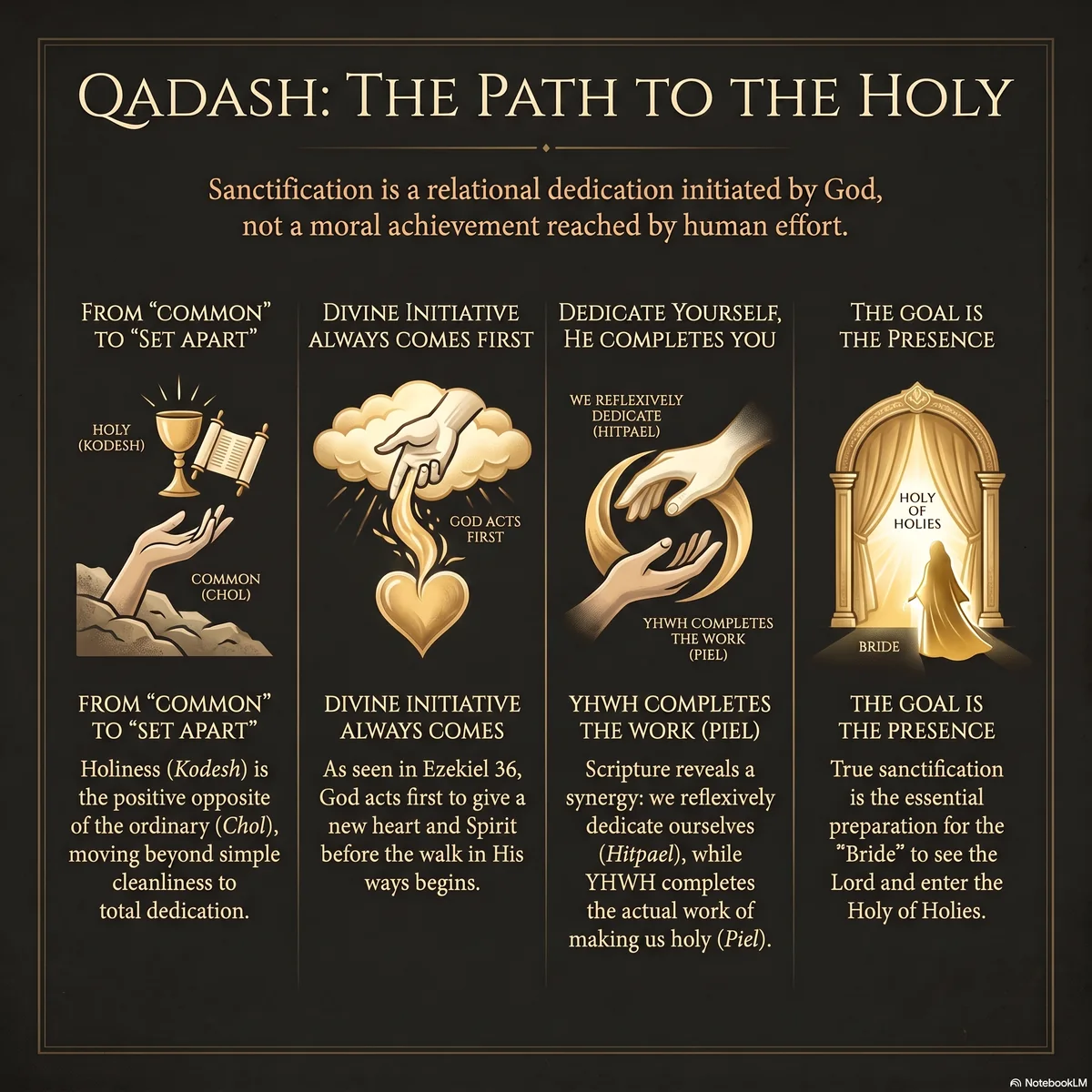
This study focuses specifically on the verb: קָדַשׁ (qadash). A single verse in Leviticus shows how rich this verb is, since it occurs in two different stems within the same sentence.
"Consecrate yourselves therefore (וְהִתְקַדִּשְׁתֶּם) and be holy, for I am YHWH your God... I am YHWH who sanctifies you (מְקַדִּשְׁכֶם)."
Leviticus 20:7-8 H6942 · Canonical"Consecrate yourselves" (hitqaddishtem) is in the hitpael — a reflexive verb form: a person does something to/with themselves. "Who sanctifies you" (mekaddishchem) is in the piel — the verb form indicating that the subject actually brings the action to completion — with YHWH as the grammatical subject: He is the one who actually completes it. This is precisely the point already made above: it is about devotion (the hitpael movement), not about an achievement the person accomplishes by their own strength (the completion, in the piel form, belongs to YHWH). One root, two movements, in this order — not as contradiction but as cooperation in which the person devotes themselves and YHWH sanctifies.
PaRDeS — Pshat/Remez: Leviticus 10:3 adds a third stem: וְנִקְדָּשׁ (venikdash, niphal) — "I will be sanctified by those who come near Me." This is spoken directly after the death of Nadab and Abihu, who approached with unauthorized fire (Lev. 10:1-2). The niphal form shows that sanctification is also an encounter-event: at the border between kodesh and chol, YHWH sanctifies Himself visibly to whoever approaches — to blessing when it happens on His terms, to judgment when it does not. Canonical · Lev. 10:3
The same law returns a generation later — not at the altar, but in the transport of the Ark itself.
"And when they came to Nachon's threshing floor, Uzzah put out his hand to the ark of God and took hold of it, for the oxen stumbled. Then the anger of YHWH was aroused against Uzzah, and God struck him there for his error; and he died there by the ark of God."
2 Samuel 6:6-7 CanonicalPaRDeS — Remez: The error begins before Uzzah's hand ever moves: the Ark stood on "a new cart" (1 Chr. 13:7) — precisely the method the Philistines had used to send the Ark back earlier (1 Sam. 6:7-8), instead of on the shoulders of the Kohathites with carrying poles (Num. 7:9). This is no rabbinic addition but an intra-canonical echo: Israel here copies a pagan solution for transporting the holy. Uzzah's reflex to grab the Ark is the final step of an error that already began with the choice of cart. Canonical · 2 Sam. 6:6-7 · 1 Chr. 13:7 · 1 Sam. 6:7-8 · Num. 7:9
The Talmud reads Uzzah's error as a category mistake, not a lack of piety: "The Ark carried its own bearers — how much more could it carry itself!" (b. Sotah 35a). Uzzah's reflex to steady the Ark assumed that the holy needed his strength to remain upright — precisely the reverse of what is true. This is rabbinic interpretation of a canonical event, not a canonical statement in itself. Rabbinic/Traditional · b. Sotah 35a
The positive counterpart of purifying — not the same pattern in reverse
Purifying (tahor, H2889) and sanctifying (kadash, H6942) are two separate, complementary movements — not synonyms. Purifying removes a stain: it brings someone from tamé (unclean) to tahor (clean) — a zero point, a neutral state. Sanctifying goes beyond that zero point: it sets apart for a specific use, a specific presence. Being clean is a condition for sanctification, but not the same thing as sanctification.
One verse connects both movements in the same sentence, and thereby functions as the natural bridge between this study and the previous one:
"...that He might sanctify her, having cleansed her by the washing of water with the word."
Ephesians 5:26 CanonicalPaul here uses both hagiasē (sanctify) and katharisas (cleanse) — in that order: first cleanse, then sanctify. That is exactly the structure of these two studies on Devar Emet.
"I am the true Vine, and My Father is the Vinedresser. Every branch in Me that bears no fruit He takes away; and every branch that bears fruit He prunes, that it may bear more fruit."
John 15:1-2 CanonicalPaRDeS — Remez: The Greek "prunes" is καθαίρει (kathairei) — the same root as καθαρός (katharos, "clean") in Ephesians 5:26 above. Pruning and cleansing are here literally the same word. What matters is who gets pruned: not the branch that bears no fruit (that is taken away), but precisely the branch that already bears fruit — cleansing/pruning is therefore not a condition for acceptance, but an ongoing work of the Vinedresser in one who is already joined to the Vine. That is the same order as Ezekiel 36 and Ephesians 5:26-27: first the union, then the pruning/cleansing, aimed at more fruit — no self-improvement project, but the work of the Vinedresser on what is already His possession. Anyone who wants to see the heart here as a garden being pruned finds firmer canonical ground for that in John 15 and Song of Songs 4:12 ("a garden enclosed," of the bride) than in the harvest-saying of Matthew 9:37-38, where the Greek θερισμός (therismos) specifically means "harvest" — people coming to faith (cf. John 4:35), not a pruning image. Canonical · John 15:1-2 · Eph. 5:26
The most common popular-theological distortion is that "becoming holy" is read as sinless perfection the believer must achieve by their own strength — a checklist of behavior. The base text itself contradicts this twice: Leviticus 20:8 explicitly places the completion with YHWH ("I am the One who sanctifies you"), and Ezekiel 36:26-27 places even the new heart and the Ruach before the ability to walk in the Torah-direction. Sanctifying is first and foremost relational-positional (set apart, devoted), not primarily moral-achievement. Translation loss · relational weight reduced to moral achievement
The counter-image: mixed worship (2 Kings 17)
If sanctifying is setting apart for one exclusive devotion, the Tanakh also gives a concrete historical counter-image: a people that kept fearing YHWH, and at the same time served other gods. The text itself does not call that half-hearted piety, but names it directly: Baal-worship.
"So they feared YHWH, and from among themselves they appointed priests of the high places... So they feared YHWH, and also served their own gods, according to the manner of the nations."
2 Kings 17:32-33 CanonicalPaRDeS — Remez (Symmetry): The formula "they feared YHWH" sounds twice in this chapter (v. 32, 33) — and is flatly contradicted in verse 34: "To this day they do according to the former manner; they do not fear YHWH." This repetition-and-reversal is not a contradiction in the text but a literary chiasm that itself demonstrates the problem: the same people can say "fear" (yare, H3372) with one breath and deny the content of that reverence with the other, by sharing it with other gods. Canonical · 2 Kings 17:32-34
The chapter names this shared devotion with a word that has already fallen earlier in the same context.
"And they forsook all the commandments of YHWH their God, and made for themselves molded images, two calves; and they made an Asherah, and worshiped all the host of heaven, and served Baal."
2 Kings 17:16 Canonical2 Kings 17:32-34 shows that the danger to sanctification is not only total apostasy, but divided devotion: part for YHWH, part for the gods of the surrounding nations. The text does not place that in a separate, milder category — it calls it by the same name as full idolatry: Baal-worship (v. 16). Sanctifying (H6942, to set apart) therefore stands opposed to division, not only to replacement. Translation loss · "a bit of both" does not exist in the base text
A third counter-image: sanctification as instrument (1 Samuel 13)
Where 2 Kings 17 shows what divided devotion does, and Uzzah what unauthorized approach does, Saul shows a third boundary: seizing an office that is not his, under the pressure of pragmatic necessity.
"Then Saul said, 'Bring a burnt offering here to me, and peace offerings.' And he offered the burnt offering. Now it happened, as soon as he had finished presenting the burnt offering, that Samuel came..."
1 Samuel 13:9-10 CanonicalSaul does not wait for Samuel, who as prophet was authorized to bring or oversee the offering (1 Sam. 10:8). The people are scattering, the Philistines are massed for battle — and Saul reaches for what seems effective. This is not a touching-problem as with Uzzah, but an office-problem: sanctification has not only a boundary of distance, but also a boundary of authority. Compare "a kingdom of priests" below — mediation is a function, not a position free for the taking.
Samuel's answer (1 Sam. 13:13-14) does not condemn Saul's fear or his wish to plead for YHWH's favor, but specifically the impatience that led him to cross a boundary that was not his to cross. As with Uzzah, intention is no mitigating factor within the halachic logic of sanctification: instrumentalizing a ritual for pragmatic or political success desecrates the ritual itself, regardless of the need that preceded it. Translation loss · good intention as a license to cross the boundary
PaRDeS — Drash: These three counter-images — divided devotion, unauthorized approach, unauthorized office — together draw the boundary of what sanctifying is not: a boundary that works primarily as protection (Ramban calls this perishut, separation — the same root as "set apart" with which this entire study opens). But a boundary alone is not the goal. In his commentary on Leviticus 19:2, Ramban warns against the naval birshut ha-Torah — "a scoundrel within the bounds of the Torah": someone who formally violates no boundary at all, yet within those boundaries still gives themselves over entirely to excess. Guarding boundaries is necessary but not sufficient — the next section shows how the same root קדשׁ is also an active movement: not only separation from the profane, but the devotion of the everyday. Rabbinic/Traditional · Ramban on Lev. 19:2
Yeshua's call stands in the middle of the same line
"Be holy, for I am holy" is not a new requirement that begins with Yeshua — it is a literal quotation from the Torah, repeated three times in Leviticus, that Peter cites directly.
Yeshua Himself places the same two movements we already found in Leviticus 20 side by side in His high-priestly prayer — God's action and the human place within it:
"Sanctify them by Your truth; Your word is truth... And for their sake I sanctify Myself, that they also may be sanctified by the truth."
John 17:17,19 CanonicalYeshua prays "sanctify them" (YHWH as the acting subject, just like the piel in Lev. 20:8) and explicitly connects this to the Word as the means. At the same time He "sanctifies" Himself — the same root, now applied to Him, as the basis for the sanctification of His own.
"By that will we have been sanctified through the offering of the body of Jesus Christ once for all... For by one offering He has perfected forever those who are being sanctified."
Hebrews 10:10,14 CanonicalPaRDeS — Remez: The Greek verb in Hebrews 10:14 (τοὺς ἁγιαζομένους) stands in the present passive participle: "those who are being sanctified" — an ongoing process, not a single completed act. That is the same structure as the Hebrew hitpael/piel combination in Leviticus 20:7-8: a positionally completed fact (the offering, once for all) and an ongoing process (those being sanctified) exist side by side without contradiction. Canonical · Heb. 10:14
Paul finally names this as the explicit will of God, and prays for its full extent:
"For this is the will of God: your sanctification... Now may the God of peace Himself sanctify you completely, and may your whole spirit, soul, and body be preserved blameless at the coming of our Lord Jesus Christ."
1 Thessalonians 4:3; 5:23 Canonical"May God Himself sanctify you" is a prayer, not an instruction for self-effort — precisely the synergy Leviticus 20:7-8 already established: the person devotes themselves, YHWH completes.
Why does growth stall? Hearing that does not grow into understanding
If sanctification is a synergy — the person devotes themselves, YHWH completes — the question remains why that devotion fails to arrive for so many believers. Yeshua Himself gives the diagnosis, and it follows exactly the pattern of hearing → seeing → understanding → bearing fruit that runs through this entire study path.
"But he who received seed on the good ground is he who hears the word and understands it (syniōn), who indeed bears fruit and produces: some a hundredfold, some sixty, some thirty."
Matthew 13:23 CanonicalThe distinguishing word is not "hears" but "understands" (syniōn) — the same as the Hebrew biynah, the name of Study Walk 3 on Devar Emet, "The Understanding." Verse 19 states it in mirror image: whoever hears the word and does not understand it loses it immediately. And verse 22 describes exactly the problem you have named: the thorny ground also hears the word, but cares and temptation "choke" it before it can grow into understanding — and thus into fruit. It is not the seed that fails, but the process that is interrupted.
"For though by this time you ought to be teachers, you need someone to teach you again the first principles of the oracles of God... for everyone who partakes only of milk is unskilled in the word of righteousness... but solid food belongs to those who are mature, who by reason of use have their senses exercised to discern both good and evil."
Hebrews 5:12-14 CanonicalPaRDeS — Remez: "Exercised" is the Greek γεγυμνασμένα (gegymnasmena, from gymnazō — to train through repeated physical exercise, the root of our word "gymnastics"). Understanding, then, does not come from receiving more information, but from actually practicing what has been heard — a trained practice, not cognitive assent. James says it even more directly: whoever looks into "the perfect law, the law of liberty" and continues in it — not turning away again as a forgetful hearer — is blessed in what they do (Jas. 1:22-25). Canonical · Heb. 5:14 · Jas. 1:22-25
It is tempting to read this as: the more fully you "accept" the Torah-directions, the further you get — but that reintroduces exactly the achievement framework section ③ already rejected. More precisely: shema (hearing/orienting) that does not grow into shamar (guarding/actually practicing) stalls before biynah (understanding) — not because a threshold of "enough obedience" must be reached, but because understanding in Scripture arises structurally through practiced doing, not through additional cognitive assent. See Hear — Understanding the Voice of YHWH, where this shema/shamar distinction is worked out. Translation loss · "acceptance of stipulations" instead of practiced observance
Four concrete levels at which Scripture shows "sanctify"
In the Tanakh, sanctification is never only an inner feeling — it takes concrete, observable form at various levels: time, the people as a whole, the priest, and the individual believer who devotes themselves voluntarily.
PaRDeS — Remez: Already at Sinai itself, before the Tabernacle existed, YHWH establishes a threefold access structure (Ex. 19:12-13,22-24; 24:1-2,9-11): the people must remain at a distance behind a marked boundary, the priests and seventy elders may sanctify themselves and approach further and see, and Moses alone goes all the way into the cloud. This is not a one-time arrangement for that one mountain, but the pattern that the Tabernacle — outer court, the Holy Place, the Holy of Holies — and later this study itself follows: access to God's presence is graded according to the measure of sanctification, not according to descent or office as such. Canonical · Ex. 19:12-13,22-24 · Ex. 24:1-2,9-11
That graded pattern means something important that the step-by-step structure of these studies must not obscure: nowhere does it say you must be 100% clean before you may enter the kodesh space. Even in the outer court, the ordinary Israelite faced only an entry threshold — tahor, not actively unclean — not priestly or high-priestly perfection. The same logic recurs in the Brit Chadasha: where the Jerusalem council in Acts 15:20,29 sets four minimum conditions for Gentile believers — not full Torah observance up front, but a threshold to belong — this functions as the type-image of that same outer-court access: an entry standard, not an end point (see also the Purify study). The training continues after the threshold, not before it.
For the kodesh space in the deepest sense — the Holy of Holies itself — the answer is even sharper. Access there is not granted on the ground of completed self-purification, but on the ground of blood:
"Let us then approach the throne of grace with confidence... Let us draw near with a true heart in full assurance of faith, having our hearts sprinkled from an evil conscience and our bodies washed with pure water."
Hebrews 4:16; 10:19,22 Canonical"Let us approach" is in the present tense, as a standing invitation — not a reward after completed training. And the order is telling: first the true heart and the access, then the description of heart-cleansed-and-body-washed as what belongs with it — the same order as Ezekiel 36:25-27 above, where the new heart and the Ruach come before the walking, not after.
PaRDeS — Remez: This makes the process circular, not a one-time gate you pass through. 2 Corinthians 3:18 describes it this way: "we all... are being transformed... from glory to glory" — an ongoing spiral, not a gate you walk through once. Paul says it even more directly of himself: "not that I have already attained, or am already perfected... but I press on" (Phil. 3:12-14). The numbered steps in these studies are therefore a teaching sequence — a way of learning it — not a ladder you must fully climb before the next rung becomes valid. You are already inside through the blood; the training is what takes place afterward, ongoing. Canonical · 2 Cor. 3:18 · Phil. 3:12-14
"And God blessed the seventh day and sanctified it (vaykaddesh), because in it He rested from all His work" (Gen. 2:3). The very first use of the verb qadash in Scripture concerns not a place or a person, but time — see the Shabbat Covenant study. The same anchoring recurs in the YHWH Feasts (Lev. 23): Yom Teruah ("a shabbaton," Lev. 23:24), Yom Kippur ("a shabbat shabbaton," Lev. 23:32), and both the first and eighth day of Sukkot ("a shabbaton," Lev. 23:39) are explicitly designated with the same word as the weekly Shabbat. Sanctification of time is therefore not a standalone weekly matter, but a recurring rhythm that runs through the entire annual cycle of the moadim.
"You shall be to Me a kingdom of priests and a holy nation" (Ex. 19:6). Before even a single offering has been brought, YHWH already speaks this destiny over all Israel at Sinai — a collective identity, not an individual merit. Korah later invokes (Num. 16:3) this very text to claim that collective holiness equals priestly function for everyone — an inference the text itself does not make (see the Korach study).
"A kingdom of priests" is not an honorary title but a function: a kohen (priest) is a mediator — someone who approaches on behalf of others (see the kohen concept). That mediating function takes concrete shape in the Torah in the offering, and does so at two levels: tribe and people. That it is not a position free for the taking, Saul learned first-hand (③, 1 Sam. 13): bringing the burnt offering without priestly authority cost him the kingdom.
At the dedication of the altar (Num. 7:1-89), each tribal leader (nasi), each on his own day, brings the exact same offering — twelve identical gifts for twelve tribes. No tribe is missing and none receives more: sanctification of the altar happens through twelve separate, representative acts of offering, not through one collective gesture.
At the national level this goes further still. The fixed burnt offerings (Num. 28) and the offerings of each of the moadim (Num. 29) are brought by the priests on behalf of the whole community — not by individuals for themselves. At Sukkot specifically, the bull offerings decrease over seven days from thirteen to seven (Num. 29:12-34), seventy bulls in total. Zechariah confirms canonically that Sukkot has a dimension for the nations: "everyone who is left of all the nations... shall go up from year to year... to keep the Feast of Tabernacles" (Zech. 14:16-19) — whoever stays away receives no rain. Canonical · Num. 29:12-34 · Zech. 14:16-19
The Talmud explicitly connects the number seventy to the seventy nations of Genesis 10: "To what do these seventy bulls correspond? To the seventy nations" (b. Sukkah 55b) — Israel's priestly offering-service during Sukkot is thus interpreted as mediation for the benefit of the nations, not at their expense. This is a rabbinic interpretation of a canonical datum (the number seventy is canonically fixed in Num. 29), not a canonical statement in itself — hence labeled separately. See also the Pinchas study, which treats the same seventy bulls of Numbers 28-29. Rabbinic/Traditional · b. Sukkah 55b
So the circle closes: sanctification at the personal level (the Nazirite, below) ends in an offering; sanctification at the tribal level (Num. 7) ends in an offering; sanctification at the national level (Num. 28-29) ends in an offering on behalf of the nations. "A kingdom of priests" therefore does not mean that Israel is set apart for itself, but that it is set apart in order — as priest — to approach on behalf of the tribes and ultimately on behalf of the nations.
At the priestly ordination (Ex. 29:1-9; Lev. 8:1-13), anointing oil is used and blood is applied to the right earlobe, right thumb, and right big toe of Aaron and his sons (Lev. 8:23-24). It is not only the heart in an abstract sense that is devoted, but concretely: hearing (ear), acting (thumb), walking (toe). Sanctification concerns the whole person, down to the extremities.
That it is precisely the foot that is anointed connects to another recurring pattern: "Take your sandals off your feet, for the place on which you stand is holy ground" (Ex. 3:5) — repeated to Joshua at Jericho (Josh. 5:15). Unshod feet touching the sanctified ground directly, without any layer between — the same thought applied to the big toe in priestly ordination: the walk itself, not only the heart, is set apart. See also Territory of Israel, where the same image of holy ground concerns the land itself. A related but textually distinct image is the voluntary servant of Exodus 21:5-6, who out of love for his master becomes permanently bound in service, and whose ear — not his foot — is pierced at the doorpost; both texts share the motif of a body part permanently, irreversibly devoted, but they are not the same ceremony.
"All the days of his separation he is holy (kadosh) to YHWH" (Num. 6:8). The Nazirite vow (Num. 6:1-8) is the most explicit form of voluntary, temporary personal sanctification in the Torah — apart from tribe or office, open to any Israelite, man or woman. At the end of the period the Nazirite brings specific offerings (Num. 6:13-17): sanctification at the personal level, like at the national level, is concluded with an act of offering.
These levels do not contradict one another but build on each other, within the graded access structure already laid down at Sinai: the rhythm of time (Shabbat and the moadim), the collective identity expressed in offerings on behalf of tribe and people (the people as a kingdom of priests), the priestly mediation (Aaron, down to the foot that touches holy ground), and the personal, voluntary devotion that likewise culminates in an offering (the Nazirite) — each of these is canonically demonstrable, without needing a speculative system of interconnections.
Without sanctification no one will see the Lord
Here the reason comes to light why sanctification is one of the most far-reaching subjects in this entire study path — it is not an incidental behavioral trait, but the condition for the most intimate encounter Scripture knows.
"Pursue peace with all people, and holiness, without which no one will see the Lord."
Hebrews 12:14 CanonicalThis text connects sanctification directly to being able to see YHWH — and thereby to a tension that runs through all of Scripture. To Moses YHWH says: "You cannot see My face, for no man shall see Me and live" (Ex. 33:20). The same tension returns eschatologically, now resolved: "For now we see through a glass, darkly, but then face to face" (1 Cor. 13:12); "they shall see His face" (Rev. 22:4), in the New Jerusalem where "the tabernacle of God is with men" (Rev. 21:3).
PaRDeS — Sod: If sanctification were an object in the Tabernacle, it would not be one of the objects in the Holy Place, but the Holy of Holies itself — the space behind the veil where the Ark and the mercy seat stood, where YHWH promised to meet Moses (Ex. 25:22). In the Old Covenant that space was accessible to one priest, one day a year (Lev. 16), precisely because no one could enter without complete sanctification and remain alive. That is the destination this study has been working toward: the Kallah — set apart and waiting, as the matzav study describes State I, the Neshama-soul — who no longer stands outside the veil, but meets YHWH face to face without perishing. Not because she earned it, but because Ezekiel 36:25-27 comes true: clean water, a heart of flesh, His Ruach — and only then the walking. Canonical · Heb. 12:14 · Ex. 33:20 · 1 Cor. 13:12 · Rev. 22:4
That path to the veil is itself a journey with stopping places — precisely the image of parasha Mas'ei, where every waystation in the wilderness marks a separate step in the sanctification of the people. That same matzav study places the crossing at Kadesh-Barnea at the center (Num. 13-14; Josh. 5:10-12): the place where Israel first refused to trust the land — and with it the sanctification that belonged to it. The journey does not end at the border, but at the encounter itself.
This week, choose one habit, conversation, or use of time that you know is "chol" — not sinful, just ordinary — and consciously devote it to YHWH: begin it with prayer, or replace it once with something directly aimed at His presence. This is not about removing something unclean (that was the previous study), but about setting apart something ordinary. Write down what you chose, and what it did to you to let "chol" consciously become "kodesh."
- Leviticus 20:7-8 names both "sanctify yourselves" (your devotion) and "I sanctify you" (God's completion). Which of these two do you emphasize more in practice — and what changes if you hold them in this order?
- Ezekiel 36:25-27 gives the new heart and the Ruach before the ability to walk in God's directions. Where in your own life are you still trying to "walk" before you have truly accepted the gift of the new heart?
- Hebrews 12:14 connects sanctification to seeing YHWH. What does it do to your longing for that encounter, knowing that the process leading there does not depend on your strength but on His devotion to His own Name?