Remembrance in Hebrew is not a passive memory. זָכַר (zakhar, H2142) is a verb that begins in the body — you reorient yourself, you turn around, you act. YHWH gave Israel a tangible system to set this remembering in motion anew each day: tassels at the hem of their clothing. Not as an ornament. Not as a religious status symbol. But as an anti-straying mechanism that the base text explains its own purpose: "so that you do not follow after the desires of your heart and your eyes."
This study opens that instruction from the roots — what remembering really is, how the tzitzit carries that remembering, and what happens when someone in utter despair reaches for the hem of the Messiah. From Numbers 15 through Malachi 3 to Matthew 9 — one unbroken line of focus as an act of faith.
After this study you will understand:- You know the Hebrew root zakhar (H2142) and the distinction between passively retaining and actively remembering as reorientation.
- You understand why the tzitzit instruction in Numbers 15 is an anti-straying system, not a religious decoration.
- You recognise the difference between mitswah (tzitzit), minhag (tallit form), and masóret (tradition) — and why that distinction gives you freedom to walk honestly.
- You can explain why the woman with the bleeding grasped the kanaph, and how Malachi 3:20 announced that moment in advance.
- You know what remembering as a daily movement looks like — not as a duty, but as the active returning to who YHWH is.
Read the texts below slowly — not as study but as orientation. Ask yourself: what helps me remember daily who YHWH is — and how easily do I stray?
The instruction that explains its own purpose
In Numbers 15 there is a rare instruction: YHWH not only gives the mitswah but immediately explains why. That is not self-evident in the Torah. Here he does it explicitly, in three steps.
וְהָיָה לָכֶם לְצִיצִת וּרְאִיתֶם אֹתוֹ וּזְכַרְתֶּם אֶת-כָּל-מִצְוֹת יְהוָה וַעֲשִׂיתֶם אֹתָם וְלֹא-תָתוּרוּ אַחֲרֵי לְבַבְכֶם וְאַחֲרֵי עֵינֵיכֶם
"And you shall have tassels, so that when you see them you remember all the mitswot of YHWH and do them — and do not follow after the desires of your heart and your eyes."
Numbers 15:39 · Canonical · H2142 · H6734 · Num. 15:37–40The three-step sequence is literally in the text: see → remember → do. It is a deliberate chain. The seeing of the tzitzit activates the remembering (uzekhartem, from zakhar, H2142). The remembering leads to acting (va'asitem otam). And the acting prevents straying (lo taturu acharei levavkhem ve'acharei einekhem) — literally: "you shall not wander after your heart and eyes." The root tur (H8446) describes the wandering of a scout who looks in every direction without an anchor. The tzitzit is that anchor.
The text does not end at "remember." It ends at "do." In Hebrew reality, remembering is never completed as long as the action is absent. This is exactly the difference between passively retaining and actively zakhar: the remembering is only complete when the body follows. The tzitzit is therefore not a symbol of knowledge — it is a starter button for the walk.
Context: directly after forgetting
The tzitzit instruction in Numbers 15:37–41 is not placed here by accident. Directly before it (Num. 15:32–36) is the story of a man who gathered wood on the Sabbath. He was put to death. The editorial logic is sobering: the man forgot what was holy. The tzitzit is the canonical answer to that forgetting. YHWH does not say: "Remember this well." He provides a tangible system: tassels at the corners of your clothing, visible every day, designed to reorient you before you stray. Canonical · Num. 15:32–40
Zakhar — remembering as physical reorientation
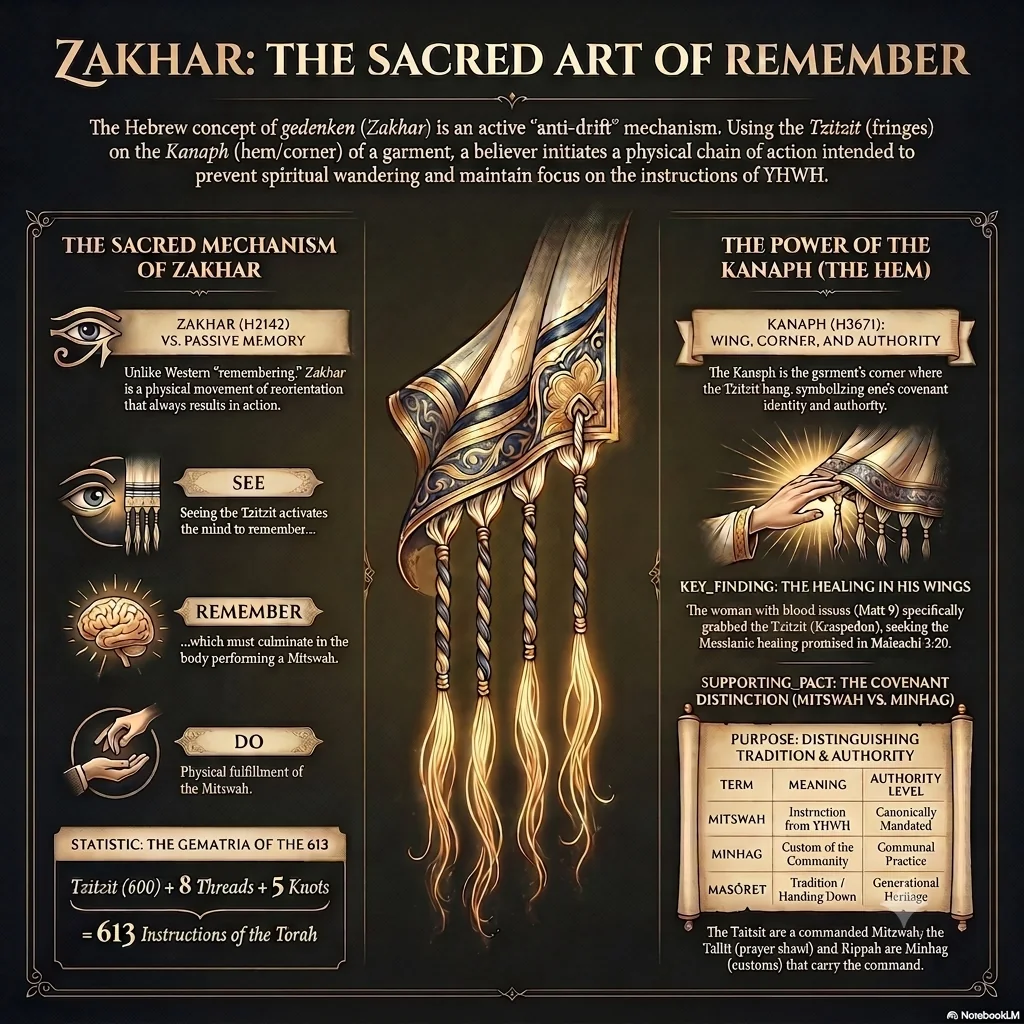
Translation Loss · זָכַר (H2142) — Western Bible translations render zakhar as "remember" or "recall." That is not wrong, but the loss is considerable: in Hebrew, zakhar is always a movement that activates action. "Remembering" in English suggests a mental state. Zakhar describes a reorientation of the entire person: the body turns around, the feet change direction, the hands begin to act. Translation Loss · H2142
Corrective formulation: never use only "remember" or "think of" as a translation for zakhar. Always restore the action dimension: "remembering that issues in doing" or "reorienting toward YHWH."
Contrast: shakach (H7911) is likewise not passive forgetting — it is releasing orientation, which leads to straying. The pair zakhar/shakach describes the choice between walking with direction and wandering without an anchor (tur, H8446). Canonical · H2142 · H7911 · H8446
Tzitzit and the three-layer distinction
Anyone walking Messianically with garment symbols gets stuck if this distinction is absent: not everything Messianics wear is a mitswah. Yeshua criticised religious leaders who placed their traditions above the mitswot (Mark 7:8) — the same mistake can be made in the reverse direction: rejecting traditions because they are "not literally in the Bible" when they are a legitimate expression of canonical mitswot.
The tzitzit: zakhar in portable form
The word tzitzit (H6734) is related to tsits (H6731) — to blossom, to sprout. Same root as the flowers on the golden frontlet of the high priest: "Holiness to YHWH" (Ex. 28:36–38, 39:30). The tzitzit brings priestly symbolism to everyone's clothing: all Israel is a kingdom of priests (Ex. 19:6). Every believer is a carrier of holiness at their hem. Canonical · H6731 · Ex. 28:36
The four corners of the garment are also the four directions of the wind — in prophetic use the arba kanfot ha'aretz, the four corners of the earth (Isa. 11:12). Whoever wears tzitzit is literally surrounded by the Torah, whichever way they look. It is not a reminder of one mitswah but a system that guards the entire life orientation.
Gematria: the tzitzit carries 613
The traditional way of knotting is not arbitrary — the numbers are the message. The calculation is canonically grounded through the Hebrew letter values of the word itself:
Whoever sees the tzitzit sees 613. The tassel is a living number that asks every day: am I still oriented toward the full life-structure of YHWH, or am I following my own heart? Gematria · reinforcing evidence alongside Num. 15:38–40
The Torah prescribes a blue cord (tekhelet, H8504) — traditionally obtained from the murex trunculus snail. In rabbinic Judaism, knowledge of the exact colour was lost; since then all tzitzit are white. Messianics who restore the blue cord carry a testimony in portable form: the Messiah has come and the restoration has begun. Blue is the colour of the sky — every time you see the cord, you look upward. That is zakhar. Canonical · Num. 15:38 · H8504
The conditional structure — YHWH's promise in remembering
Numbers 15:40 formulates the conditional promise explicitly: "So that you remember and do all My mitswot — and be holy to your God." The conditional chain is: zakhar (remember) → asah (do) → qadosh (be holy). Holiness is not the starting point but the fruit of remembering. YHWH ties his promise of holiness to walking in the tzitzit-memory — not to the performance of the religious act. Canonical · Num. 15:40 · H6942
Deuteronomy 8:11–14 mirrors the other side: if you forget YHWH (shakach) by keeping none of his mitswot, you become proud of your own work and forget who gave you the abundance. The conditional promise runs in two directions: zakhar → blessing, shakach → loss of orientation. The tzitzit is designed to stand exactly in that pivotal moment — at the moment when the desire of the eye pulls and the heart threatens to stray. Canonical · Deut. 8:11–14
Zakhar is not silent
Western spirituality has internalised remembering: meditation, inward prayer, silence. All of that has value — but zakhar in the Torah is always embodied. The Shema asks: bind them as a sign on your hand, let them be an emblem on your forehead, write them on the doorposts of your house (Deut. 6:8–9). The memory systems of the Torah are always also physical. Remembering works through the eye, the hand, the door — through the daily reality of the body. The tzitzit fits exactly into that logic.
"Bind them as a sign on your hand, let them be an emblem on your forehead… write them on the doorposts of your house and on your gates."
Deuteronomy 6:8–9 — zakhar as physical architecture Canonical · Deut. 6:8–9The kippah and the tallit: how minhag carries the mitswah
The word kippah is related to kapporeth (H3727) — the lid of the Ark, the mercy seat. The kippah says: my authority and atonement come from YHWH, not from myself. The Yiddish name yarmulke is a contraction of yare melek — reverence for the King. The high priest always wore a headband with "Holiness to YHWH" — priests are always covered. The kippah is the halachic expression of that principle for every believer who wants to remember: my head is under his authority. Canonical · Ex. 28:36–38
White in colour — the white refers to Isaiah 1:18: "though your sins are like scarlet, they shall be white as snow." Whoever puts on the tallit remembers their forgiveness. The stripes on the tallit are the boundary lines YHWH draws anew each day — separation, distinction, grace that is new every morning (Lamentations 3:22–23). Many stripes = much grace. It is not decoration but a visual announcement of who YHWH is. Canonical · Isa. 1:18 · Lam. 3:22–23
Yeshua taught: "Go into your inner room, close the door, and pray to your Father in secret" (Matt. 6:6). The tallit is the portable inner room — you draw it over your head and create a private space with YHWH, wherever you are. In Jewish tradition this is called lihitatef — to wrap oneself. Remembering as an act of withdrawal: briefly shutting everything out and holding YHWH as the sole horizon.
When halacha is freedom, not duty
The question is never: must I wear this? The mitswah is the tzitzit — not the kippah or the specific form of the tallit. Whoever wears the tzitzit without understanding wears an empty ornament. Whoever wears them with understanding of zakhar wears a working system that asks every day: am I still oriented toward YHWH, or am I wandering? That is halacha in the deepest sense: not a list of things you must do, but a life-structure that helps you walk where you want to walk. Canonical · Num. 15:39–40
The kanaph — hem, wing, corner of the garment
In the Hebrew Scripture kanaph (H3671) is one word for three related realities: the wing of a bird, the hem of a garment, and the corner of the earth. It is exactly the word for the corner from which the tzitzit hangs. Whoever grasps the hem of someone's garment grasps their kanaph — their authority, their protection, their covenant identity. And the prophet Malachi promises that the Messiah will come with healing in his kanaph.
וְזָרְחָה לָכֶם יִרְאֵי שְׁמִי שֶׁמֶשׁ צְדָקָה וּמַרְפֵּא בִּכְנָפֶיהָ
"But for you who fear My name, the Sun of righteousness shall rise — with healing in its wings (bekhanafèha)."
Malachi 3:20 (Heb.) / 4:2 (most English translations) · Canonical · H3671 · Mal. 3:20Bekhanafèha — in its corners/wings/hem. The Messiah who comes with healing in the hem of his clothing. That is not a poetic image: it is a prophetic characteristic. And it is exactly what the woman with the bleeding recognised.
Twelve years of bleeding. Twelve years tamé (unclean) — excluded from the temple, from community, from touch. She had spent everything on physicians. No improvement. She heard about Yeshua and said to herself: "If I can just touch his hem (kraspedon, G2899), I shall be healed."
Kraspedon is the Greek word the Septuagint uses for the tzitzit in Numbers 15:38. She did not merely grasp a corner of his clothing. She grasped his tzitzit — the sign of the Torah that Yeshua perfectly embodied. She grasped the 613. She grasped the Man who fulfilled the kanaph of Malachi 3:20. She acted deliberately and consciously.
Yeshua stopped. "Who touched Me?" The disciples were astonished — the crowd pressed in from every direction. But Yeshua distinguished her touch as faith, not accident. And he said: "Daughter, your faith has saved you. Go in peace." Not: your deed saved you. Not: the magic of the hem. Her faith directed at who he was — a faith that brought her to the hem. Canonical · Matt. 9:20–22 · G2899
Zechariah prophesies about the end times: "In those days ten men from all the nations and languages will grasp the kanaph (hem/wing) of a Jewish man and say: We will go with you, for we have heard that God is with you."
Ten men — the number of the fullness of the nations — grasp the hem of one Jewish man. They know: that man stands in connection with YHWH. They grasp his kanaph not to manipulate him but to stand in that connection. It is the eschatological image of Grafting In (Rom. 11:17) as a walk-movement: the nations acknowledge by their grasp that the covenant is Israel's, that the tree was not planted by them, and that they are invited along. Remembering who YHWH is always leads toward the covenant people and toward the core of his salvation plan. Canonical · Zech. 8:23 · H3671
On the threshing floor Ruth asks Boaz: "Spread your kanaph over your maidservant, for you are a kinsman-redeemer (go'el)." The word kanaph is again the hem/wing — and Ruth uses it as a marriage proposal in covenant language. She is not asking for his hand but for his protection, his covering, his covenant identity spread over her life.
Boaz recognises the depth of her request: "Blessed are you by YHWH, my daughter. You have shown more kindness (chesed) than before." The hem of the garment here is covering, protection, covenant community. Remembering as a verb in Ruth's case: she remembers the covenant of YHWH with his people — and acts on that knowledge by binding herself to the go'el. Canonical · Ruth 3:9 · H3671
Saul had not carried out YHWH's instruction. Samuel turns to leave. Saul seizes the hem (kanaph) of his garment and tears it. Samuel immediately interprets it as a prophetic sign: "YHWH has torn the kingdom of Israel from you today and has given it to your neighbour who is better than you."
Tearing the kanaph is an act that visibly breaks the covenant. The garment hem is authority and covenant in one. Whoever tears the hem tears the relationship. This is the negative of all the other witnesses: zakhar is not only grasping toward the hem in faith — it is also refusing to tear the hem. Every time you see the tzitzit and orient yourself toward YHWH, you choose not to tear the garment. Canonical · 1 Sam. 15:27–28 · H3671
Four scenarios, one movement. Ruth grasps in trust. The woman grasps in desperation. The nations grasp in recognition. Saul tears — and loses the kingdom. The kanaph is each time the place where covenant and action meet. And the tzitzit hangs precisely at that place: not somewhere on your clothing, but at the kanfot — the corners. YHWH has hung the memory system at the covenant place.
VIII · The Monday-morning Test — Practical Application
Zakhar is not what you know — it is what you look toward when you wake up in the morning.
The tzitzit are designed for the moment when your eyes open and the day starts to pull at you. What draws your attention first when you open your eyes? The phone? The agenda? The worry? YHWH provided a system: look at the tassels first. Remember. Then do. The sequence is not arbitrary — it is the difference between a day you control and a day that controls you.
Concrete this week: Take one moment per day — morning or afternoon — in which you deliberately stop, touch the tzitzit or be still for a moment, and lay down one thought: I remember You. You are my direction, not what my eyes are drawn to. That is zakhar. Not a pious feeling — a movement from the head back to the source.
- Zakhar is not passive retention but active reorientation that issues in action. What have you understood until now by "remembering"?
- The distinction mitswah–minhag–masóret gives freedom: you can walk honestly without confusing everything. Have you in the past mixed up mitswot and traditions?
- The garment symbols are not religious status signs but working memory systems. How does that change your view of people who do or do not wear them?
- The woman with the bleeding grasped the hem in desperation — and was saved by her faith, not by the object. How do you think about tangible acts of faith?
- Start with the tzitzit — the only mitswah of the three. Look for a simple tallit katan (undergarment with tassels) or a tallit for prayer. Do not begin with the form but with understanding zakhar.
- Learn the blessing formula when putting it on: "Baruch Atah YHWH, Elohénu Melech haolam, asher kidshanu b'mitswotav v'tzivanu l'hitatef b'tzitzit." — Blessed are You, YHWH our God, who has sanctified us with his guidance and called us to wrap ourselves in the tzitzit.
- If someone asks why you wear these symbols: begin with zakhar — remembering as active focus. Tell them it is a reminder that works, not a performance that impresses.