The reason is in the text — and it is not health
The most common explanation for the food laws is health hygiene — pork is dirty, shellfish contain bacteria. But that is not the reason YHWH gives. Leviticus 11 closes with the actual ground:
"For I am YHWH your God; therefore consecrate yourselves and be holy, for I am holy. And you shall not make yourselves unclean with any swarming creature that crawls on the earth. For I am YHWH who brought you up from the land of Egypt to be your God; thus you shall be holy, for I am holy."
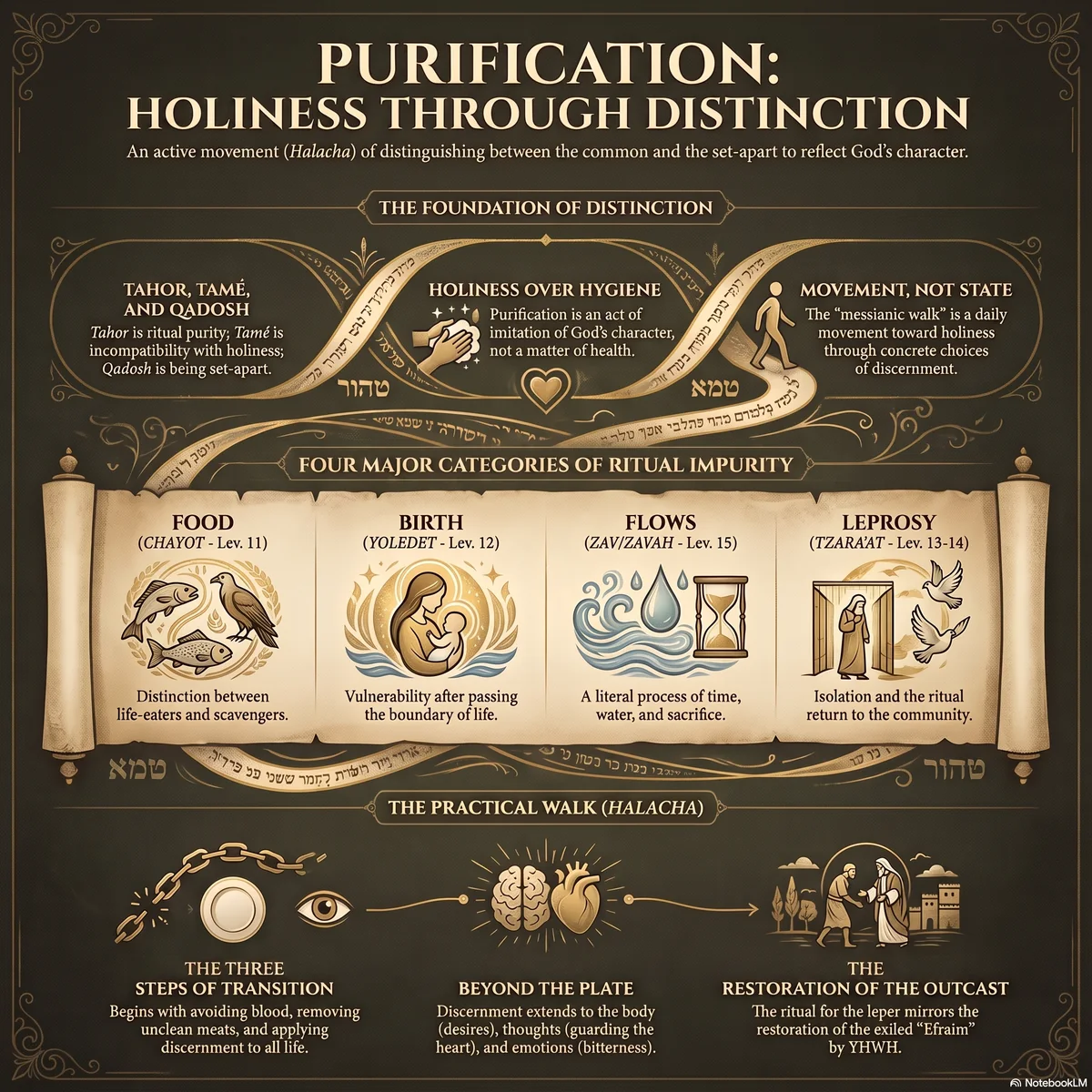
Leviticus 11:44–45 Canonical · H6918It is not about your health. It is about your holiness — your likeness to who YHWH is. The call is twofold: consecrate yourselves (reflexive verb — an active deed) and be holy (state as a consequence). This is the core of the halachic approach: purification is something you do, not only something you are. The Messianic walk is the movement toward holiness — day by day, through concrete choices of distinction.
Clean and unclean does not begin with Leviticus 11. It begins at creation. Noah already knew the distinction — he took seven pairs of clean animals and two pairs of unclean (Gen. 7:2). That was long before Moshe, long before the Jewish people. The distinction clean/unclean is baked into the creation order — not invented by a priestly class. The Torah of Sinai codifies what already existed; it does not create it. Note also the asymmetry: of clean animals seven pairs, of unclean animals one pair. The abundance belongs to the clean — sacrifice and food come from the same source. Canonical · Gen. 7:2
Three categories — with simple criteria
The pattern behind unclean animals: they are generally scavengers living on the dead material of creation — the "waste collectors" of land, sea, and air. Shrimp are the cockroaches of the sea. Pigs eat everything including carcasses. YHWH reserves as food the animals that live on the living, not on the dead. This is a theological distinction, not a dietary recommendation.
The four categories of uncleanness in the Torah
Leviticus 11–15 describes four main categories of uncleanness. They are not arbitrary but reflect a coherent theology of the boundary between life and death, between holy and common.
Animals, fish, birds, and insects — Leviticus 11. The clean are identified by characteristics of closure and like-kind: split hoof + chewing cud; fins + scales. The unclean mix categories or live at the boundary of life and death.
A woman who gives birth is tamé for 7 days for a son (40 days total separation), 14 days for a daughter (80 days). Then purification offerings. The uncleanness is not a punishment but describes the vulnerability after passing through the boundary of life — and the liturgical return to the community.
Both man (zav, H2100) and woman (zavah). The normal monthly cycle makes tamé until evening; a continuing discharge requires 7 purification days after it stops, plus offerings (Lev. 15:28–30). Purification here is literally a process of time, water, and sacrificial act.
The most extensive category: two chapters for diagnosis, isolation, and purification rite. The person with skin disease is put outside the camp — tamé, calling: unclean, unclean (Lev. 13:46). The purification rite (Lev. 14:1–7) combines two birds, cedar wood, crimson, and hyssop. The Sod of this category is the deepest layer — see section ④.
Blood — the first and deepest instruction
The first instruction about food in the entire Bible stands in Genesis 9:4 — after the flood, before the Torah of Sinai: "Only you shall not eat flesh with its life, that is, its blood." Blood is the carrier of life. Life does not belong to us — it belongs to the Creator. Canonical · Gen. 9:4
A clean animal only becomes food if it is also slaughtered kosher: the throat is cut so the heart can pump the blood from the body — the blood returns to the earth. A strangled animal retains its blood in the body. This principle was already known to Noah, to Abraham; Moshe merely confirmed it. Canonical · Lev. 17:13–14
Three NT texts that are cited — and what they actually say
Whoever seriously begins walking in the Torah-guidance will inevitably encounter three texts used to "abolish" the food laws. Each of the three deserves a careful reading.
The sentence "thus he declared all foods clean" appears in many Bible translations in brackets — and that is exactly where it belongs. Manuscript research shows that this sentence is not in the earliest Greek manuscripts but is a later addition by non-Jewish copyists. Yeshua's point in Mark 7 is: what defiles a person is what comes out of his heart. That is not a statement about food laws but about the source of moral defilement. Translation Loss · interpolation
YHWH shows Peter unclean animals and says: "Kill and eat." Peter refuses. YHWH says: "What God has made clean, you must not call unclean." Immediately afterwards Cornelius arrives — a Roman. Peter himself explains the vision: "God has shown me that I should not call any person common or unclean." The vision is about people, not about food. Peter says this explicitly in verse 28. Canonical · Acts 10:28
The Jerusalem Council sets minimum requirements for Gentile believers: (1) abstain from things sacrificed to idols, (2) from sexual immorality, (3) from what is strangled, and (4) from blood. Three of the four are directly drawn from the food laws — the basic requirements that apply also to the sojourner (Lev. 17). Jacob adds: "for Moshe is read every Sabbath in every city." It is an entrance standard, not the endpoint. Canonical · Acts 15:20,29
The common church reading holds that Yeshua, Peter, and Paul abolished the food laws. But none of the three texts says that. The abolishment reading is popular-theological — it fits an already existing paradigm but is not in the text. Whoever reads the texts without a predetermined conclusion finds the laws not abolished but deepened. Popular-theol.
One thing needs to be said before the three steps below, to prevent a misunderstanding: these steps are not a ladder to earn a true heart before YHWH. It is the other way around. "Let us draw near with a true heart in full assurance of faith, having our hearts sprinkled clean from an evil conscience and our bodies washed with pure water" (Heb. 10:22) — the true heart and access to God come first, as a gift; the purifying of body and life is what follows from that, not what forces it. You want to purify yourself because you have already received a true heart for Yeshua — not to earn one. See also the Sanctify study, where this is developed further. Canonical · Heb. 10:22
Three steps for a practical transition
The bride who appears before the King is flawlessly prepared. The portrait of Ephesians 5:26–27 — without spot or wrinkle, holy and blameless — is not spiritually vaguer than the Levitical purity rules. It is their fulfilment. The bride who has gone through the purification process has learned to make distinction — also in the food she chooses, also in the body she preserves as Temple of the Ruach HaKodesh. The Messianic walk begins at the table. Canonical · Eph. 5:26–27
Beyond the table: body, thoughts, and emotions
The discernment that begins at the table does not stop there. 1 Thessalonians 5:23 names three areas to be kept "blameless": spirit, soul, and body. Purification is the process that learns to apply that same discernment to all three — what must be removed before there can be any further consecration.
This does not mean grief itself is wrong. Ecclesiastes 3:4 names "a time to mourn" alongside "a time to dance" — both have their place. For the captive woman taken as bride, a concrete, bounded period is set: "a full month" she may mourn her parents before the next step follows (Deut. 21:13). David ends his mourning the moment his child dies — not before: "Now he is dead. Why should I fast? Can I bring him back again? I shall go to him, but he will not return to me" (2 Sam. 12:22–23). And Paul distinguishes believers not by the absence of sorrow, but by not grieving "as others do who have no hope" (1 Thess. 4:13). Grief has a place and a limit — not a lifelong residence. Canonical · Eccl. 3:4 · Deut. 21:13 · 2 Sam. 12:22–23 · 1 Thess. 4:13
Scriptural mirrors — and the hidden depth of skin disease
Miriam: skin disease as a consequence of presumption
In Numbers 12, Miriam is struck with tzara'at after she and Aaron spoke against Moshe. YHWH leaves the tent. Miriam is suddenly white as snow — tamé, expelled outside the camp for seven days. Moshe prays for her: El na refa na la — God, please heal her (Num. 12:13). YHWH answers and heals her after the purification period. Tzara'at functions as a period of return and reorientation — not as definitive rejection. Canonical · Num. 12
Naaman: the bath in the Jordan
Naaman the Syrian — a powerful general, and a leper. The prophet Elisha sends him to the Jordan: immerse seven times. Naaman is furious; he expected more ceremony. His servants persuade him. He obeys and becomes clean (tahor). Naaman is a non-Israelite. His healing through immersion in the waters of Israel is a type that resonates deeply in the pattern of Ephraim — see the Sod below. Canonical · 2 Kings 5
The woman with the bleeding
Twelve years tamé, excluded from community. She touches the hem of Yeshua's garment — his tzitzit, the sign of covenant faithfulness (Num. 15:38). Yeshua does not become tamé by being touched: He reverses the direction. The purification goes not from her to Him but from Him to her. This portrait of Yeshua as the Purifier who reverses the movement is decisive: He is not afraid of the unclean — He heals it. Canonical · Matt. 9:20–22
Skin disease as a portrait of Ephraim — and YHWH as the Healing King
The person with skin disease is put outside the camp (Lev. 13:46). He calls: tamé, tamé. He is visibly marked, expelled, cut off from the community of Israel. This image resonates in the prophets. Hosea 8:8 describes Ephraim — the northern house of Israel, the ten tribes — as "swallowed up among the nations." Hosea 9:17: "they shall be wanderers among the nations." Ezekiel 37 depicts the separate houses as dry bones — dead, scattered, given up.
Ephraim is the leper outside the camp. Scattered among the nations. Sometimes no longer knowing who he is or where he comes from. The feasts forgotten. The Torah-guidance faded. The covenant signs erased.
But Scripture does not leave Ephraim there. Hosea 14 is a call to return: Shuva Yisra'el ad YHWH Elohecha — return, Israel, to YHWH your God (Hos. 14:2). And YHWH's answer: "I will heal their apostasy, I will love them freely" (Hos. 14:5). The verb is rapha (H7495) — the same root as YHWH Rapha (Ex. 15:26): I am YHWH your Healer. Canonical · H7495 · Ex. 15:26
The purification rite for the person with skin disease in Leviticus 14:1–7 is strikingly specific: two living clean birds, cedar wood, crimson, hyssop. One bird is slaughtered over living water. The living bird is dipped in the blood of the slaughtered one and then released into the open field. The image: one dies so that the other can fly free. Death and life brought together in one rite. The blood of the one who died purifies the one who was expelled. This is a type of the deepest act of purification that Scripture knows — the High Priest and the sacrificial lamb at once, bringing the blood by which the outcast returns to covenant position.
In Luke 17:11–19 ten lepers are cleansed — nine Jews and one Samaritan (half-blood Ephraimite). Only the Samaritan returns. Yeshua: "Were there not ten cleansed? But the nine — where are they? Were none found to return and give glory to God except this foreigner?" (Luke 17:17–18). Ephraim, the outcast — returned. Not because he is strong but because YHWH Rapha speaks over him: tahor. Clean. Home. Canonical · Luke 17 · Hos. 14
- What argument have you heard before with which the food laws were abolished? How do you view that now?
- What do you eat every day — and with what awareness do you make that choice? Does this reflect that you are set apart?
- Is there something in your walk that you recognise as tamé — but for which you have not yet gone through the purification process?
- Purification costs something: time, water, intention. What would it mean for you to deliberately complete that?
- After the YHWH feasts, purification, appearing — what is the central insight you take away?
- Do you recognise something of the leper outside the camp in your own story? What is your first step back?
- How do you explain to someone why you no longer eat pork?