There is a fundamental difference between understanding love and loving. The word study on love gives the definition, the depth, the covenant dimension. But 1 John 3:18 asks a different question: how does that understanding become reality in my daily existence? How do I walk in it?
This study positions loving in deed and truth as the modus operandi of the life of faith — the continuous way of moving through life from the love of God as ground. Not as performance. As a running style.
After this study you will understand:- How love (chessed as source), loving (ahavah as action) and walking (halacha as way) are three distinct but inseparable layers
- What the difference is between love in words and love in "deed and truth" — and why that difference changes everything
- What the heart as seat of authority means, and how Jeremiah 31 connects with John 3 and Paul
- How Abraham, the Hebrew servant and Yeshua are concrete models of loving in deed
- Why the mitswot are not a burden but the life structure within which love takes form
- What the second mile teaches us about the difference between obedience from compulsion and surrender from love
This study builds on concepts worked out in the word study Love. It is recommended to read that first — especially the sections on the distinction between ahavah and chessed, the Paleo-Hebrew letters, and the Triangle of Love. Without that foundation, part of this study may feel incomplete.
- 1 John 4:19 We love because He first loved us.
- John 14:21 Whoever has My commandments and keeps them, he it is who loves Me.
- John 15:10 If you keep My commandments, you will abide in My love.
- 1 John 3:18 Let us not love in word or talk but in deed and in truth.
- Jer. 31:33 I will put My law within them and write it on their hearts.
"Little children, let us not love in word or talk but in deed and in truth."
1 John 3:18 · יוֹחָנָן הָרִאשׁוֹןLove is not a feeling. In the Hebrew world of thought there is no word for an emotion that is passive. אַהֲבָה — ahavah, love — is always movement, always toward someone. John holds up a mirror to us directly: loving with words alone is not loving. The question is: what is it then?
But before we get to the deed, we must understand the order. For whoever treats loving as a performance — something you do to satisfy God — has missed the foundation. Loving flows from love received. The source always precedes the stream.
Three Layers — Ground, Embodiment and Walk
To understand loving you must place it in a larger framework. The Bible works with three distinct but inseparable layers that together describe how the life of faith is structured:
| Layer | Concepts | Function | Key verse |
|---|---|---|---|
| The Ground / Source | Love חֶסֶד / אַהֲבָה | The existential foundation; the driving force behind everything. God's love as the ground on which you stand — not something you earn but something you receive. | Jeremiah 31:3; 1 John 4:19 |
| The Condition | Sin, guilt, grace, reconciliation | The assessment of the relational status. The acknowledgment of the gap between who you are and what God intends — and the grace that bridges it. | Romans 3:23; 6:14 |
| The Response / Action | Forgiving, reconciling, loving | The ongoing movement from the new reality. Loving is the modus operandi — the walk that flows from the source. Not the condition for grace, but its fruit. | 1 John 3:18; Col. 1:9–10 |
Love is the identity of the relationship. Loving is the activity of that identity. In the Bible the identity does not really exist without the activity: you know a tree by its fruit. But the fruit does not grow from effort — it grows from the health of the root.
Loving does not begin with you. 1 John 4:19 is one of the most underestimated verses in the Renewed Covenant: "We love because He first loved us." The order is irreversible. You love as a response to a love that was already active before you answered it.
This is the chessed — the covenant faithfulness of God that does not wait until you are good enough. It goes before. It goes further. It returns when you fail. Whoever sees loving as the condition for God's love is building on sand. Whoever sees loving as the response to God's love is building on rock.
Read more about the depth of chessed and ahavah in the word study Love — Ground and Definition. Here we continue with the question: what do you do with it?
Loving in Truth — The Inward Dimension
John connects loving in truth directly to something surprisingly intimate: the state of your heart before God. In 1 John 3:19–21 he writes:
"By this we shall know that we are of the truth and reassure our heart before him; for whenever our heart condemns us, God is greater than our heart, and he knows everything. Beloved, if our heart does not condemn us, we have confidence before God."
1 John 3:19–21This is the promise that follows loving in deed and truth: a heart that rests before God. Not because you never fail — but because you walk in the direction of His truth. The heart that is aligned with God's will is not attacked by the conscience. And whoever stands before God with a calm heart has boldness — parrèsia in Greek: literally "daring to say everything." The heard access to Him.
Proverbs 4:23 underlines this: "Keep your heart with all vigilance, for from it flow the springs of life." The heart is the seat of authority — the place from which life flows outward. A heart formed by God's truth gives life further. A heart filled with what the world puts in it gives death further.
John 8:31–32 gives the promise: "If you abide in my word, you are truly my disciples, and you will know the truth, and the truth will set you free." The "springs of life" from Proverbs are the freedom God promises — not as a sudden event, but as the fruit of a lifetime of remaining in His Word.
This is the line: God's Torah written in the heart (Jer. 31:33) → the conscience witnessing through the Holy Spirit (Rom. 9:1) → a heart without condemnation → boldness before God → heard prayer (1 John 3:22). It is one movement from within outward.
But — and this is essential — loving in truth does not mean giving a human interpretation to what "love" is. It means learning to understand what God Himself says in His Word about what loving looks like. Not taking out half the verses you like and ignoring the other half. The whole Word. Yeshua is clear about this in John 18:37: "Everyone who is of the truth listens to my voice." You do not determine truth yourself. You listen to it.
With Deed — The Outward Dimension
Deed and truth are inseparably connected. Whoever does deeds without grounding them in God's truth does them from self-righteousness. Whoever knows the truth but lets it lead to no deeds has no living truth. John 3:21 connects both: "But whoever does what is true comes to the light, so that it may be clearly seen that his works have been carried out in God."
The deeds God asks are not something you achieve in your own strength. Exodus 35:10 shows how it works in the Tabernacle: "Let every skillful craftsman among you come and make all that the LORD has commanded." Wisdom of heart — not effort of will. The Spirit of wisdom equips the believer for the deeds God has in mind.
Colossians 1:9–10 is the prayer Paul speaks over the congregation: "that you may be filled with the knowledge of his will in all spiritual wisdom and understanding, so as to walk in a manner worthy of the Lord, fully pleasing to him: bearing fruit in every good work and increasing in the knowledge of God."
Four outcomes of a walk in truth: walking worthily, pleasing Him, bearing fruit, growing in knowledge. It is not a performance list — it is an organic description of what grows when the root is healthy.
Colossians 1:12 adds the thanksgiving: "giving thanks to the Father, who has qualified you to share in the inheritance of the saints in light." God equips. Not us. The deeds are the fruit of His equipping, not the proof of our own dedication.
Isaiah 2:3–5 — The end-time prophecy of the walk: "Many peoples shall come, and say: 'Come, let us go up to the mountain of the LORD... that he may teach us his ways and that we may walk in his paths.' For out of Zion shall go forth the Torah, and the word of the LORD from Jerusalem... O house of Jacob, come, let us walk in the light of the LORD."
"Torah" here renders the Hebrew תּוֹרָה — instruction and direction, not a legal code. The prophecy does not describe a world under legal compulsion but a world that voluntarily rises toward the source of direction. Many peoples rise. Walking in God's ways is the endpoint of salvation history — and it begins now, in small steps, in daily dedication. Whoever walks in God's love today walks in the direction of what the prophets saw.
Two Inseparable Words
John uses two words that together form a key: deed and truth. They are not available separately. You cannot do deeds in your own strength and call that truth. And you can know the truth without it ever leading to deeds — but then it is also not living truth.
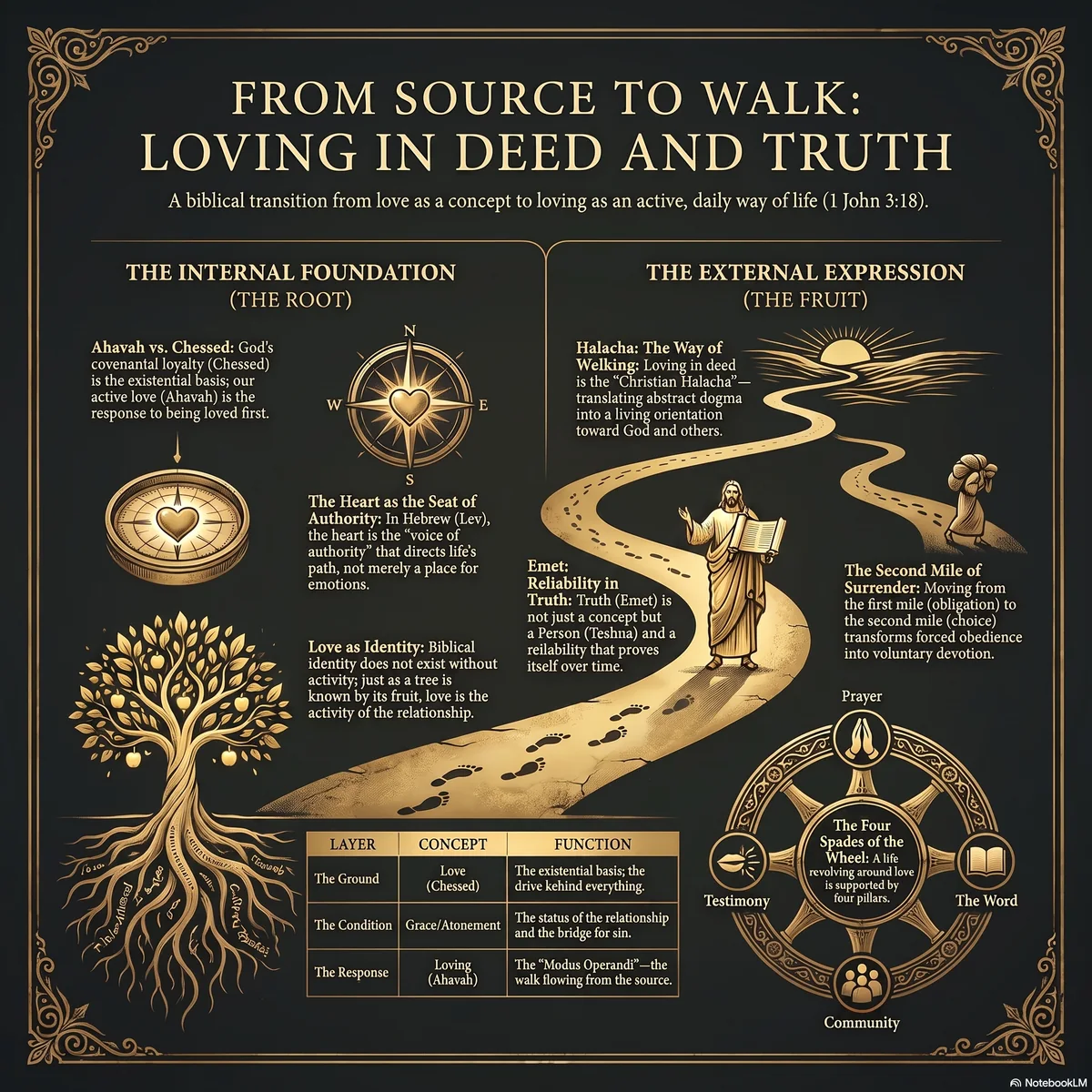
Truth in Hebrew thought is never merely a concept — it is a person and a way. Yeshua says: "I am the way, the truth and the life." (John 14:6). With that He positions Himself as the definition of emet. Loving in Him is therefore by definition loving in truth.
Translation loss: "in truth" vs. "sincerely." Some translations render the Greek alētheia in 1 John 3:18 as "sincerely" or "genuinely." But that misses the Hebrew depth of emet. "Sincerely" suggests a state of mind — you truly mean it. Emet suggests reliability that proves itself over time. Loving in emet means: acting in a way that makes the love of God credible and tangible for the other. It is not about your intention. It is about what the other sees.
The Heart as Seat of Authority
John writes something unexpected in the verses that follow: he says our heart can sometimes condemn us — but that God is greater than our heart (1 John 3:20). This seems contradictory. Why does he speak of a heart that condemns if he has just called for love in deed?
The answer lies in the Hebrew meaning of the heart. In Paleo-Hebrew the heart — לֵב (lev) — is written with Lamed and Bet. Lamed means: the voice of authority, the staff that leads. Bet means: house, tent, inner space. The heart is therefore: the voice of authority that dwells within you.
The heart is not primarily the seat of emotions — it is the seat of authority. Whose voice do you listen to within? That is the crucial question. Jeremiah 31:33 promises that God will write His Torah in the heart — not as an external rule, but as an inner authority that speaks from within. This is the direct line from Jeremiah 31 to John 3 to Paul: God's Torah moves from external command to inner desire. → See the elaboration in Drash: Paul and the 15 characteristics of love
Paul confirms this in Romans 9:1: "I am speaking the truth in Christ — I am not lying; my conscience bears me witness in the Holy Spirit." The conscience — that which witnesses together — is the Ruach HaKodesh speaking from within through the heart. Not as accuser, but as guide.
Halacha — More than Rules
The Hebrew word for "walking" — הָלַךְ (halach) — is the root word of the halacha: the Jewish teaching about how you live. Literally: the way; the going. In rabbinic tradition the halacha is not primarily a set of prohibitions, but a description of how a person moves through life in a way that fits who they are: child of the living God.
Loving in deed and truth is the halachic expression of Christian faith. It is the concretizing of ahavah — from source to stream. Where the word study on love describes what love is and on what it rests, loving describes how that love moves in daily existence. → See Ahavah vs. Chessed in the word study Love
Paul prays for the congregation in Colossae that they "may be filled with the knowledge of his will in all spiritual wisdom and understanding, so as to walk in a manner worthy of the Lord" (Col. 1:9–10). Walking — that is the halacha. And the knowledge of His will is not abstract doctrine but a living orientation: toward the other, toward God.
Love is the identity of the relationship. Loving is the activity of that identity. But activity without identity is legalism. And identity without activity is an illusion.
Love versus Loving — The Distinction
There is a subtle but crucial distinction running throughout the Bible that is barely visible in our common translations:
| Concept | Character | Analogy |
|---|---|---|
| Love — אַהֲבָה | Conceptual, covenantal, the source. "God is love." Acknowledging the principle. Necessary but incomplete. | The root of the tree |
| Loving — לֶאֱהֹב | Active, visible, the fruit. Making emet visible: acting in a way that makes the love of God credible and tangible for the other. | The fruit on the tree |
You could say that love functions as the covenantal basis — the covenant — while loving is the execution of that covenant. Precisely as chessed is the covenant faithfulness that is always present, and ahavah is the active movement within it. The tree cannot exist without being able to bear fruit. And the fruit does not grow without the tree. → Read the full definition of ahavah in the word study Love
The Key Verses — God's Heart's Desire and His Promises
In a cluster of verses, Yeshua expresses as concretely as possible what His heart's desire is and what stands in return. These are not peripheral verses — they form the core of what it means to walk within the chessed. And they are conditional: something stands in return.
John 14:21 — The key to His revelation:
"Whoever has my commandments and keeps them, he it is who loves me, and he who loves me will be loved by my Father, and I will love him and manifest myself to him."
This verse makes or breaks the understanding of what walking within the chessed means. Yeshua connects the guarding of His mitswot directly to: (1) being loved by the Father, (2) being loved by the Son, and (3) the personal revelation of Yeshua to you. Whoever lets this verse sink in understands that the mitswot are not a burden you carry — they are the door through which God reveals Himself. And whoever ignores them closes that door from within.
John 15:10–11 — Abiding in His love and its fruit:
"If you keep my commandments, you will abide in my love, just as I have kept my Father's commandments and abide in his love. These things I have spoken to you, that my joy may be in you, and that your joy may be full."
Two promises stand here as the result of walking in the Torah-directives: abiding in His love — the permanent state of covenant connection — and full joy. Not a temporary feeling, but an enduring fruit. Yeshua places His own walk as the example: He remained in the Father's love by guarding and cherishing (שָׁמַר — shamar, H8104) the Torah-directives. In this He shows us that keeping the mitswot is not a degradation but pastoral care for what is precious — the path to the deepest joy there is.
John 14:15 adds the logic in three words: "If you love me, you will keep my commandments." It is not a threat. It is a diagnosis: if the love is genuine, guarding the mitswot follows naturally — not as legal obligation but as the natural movement of someone who cherishes what they love.
1 John 3:22 — Heard prayers: "And whatever we ask we receive from him, because we keep his commandments and do what pleases him." This is the conditional promise that makes many uncomfortable — but that John sets down without circumlocution. It is not that God only wants to hear our prayers when we are good enough. It is that a walk in the mitswot opens the frequency on which God and humanity speak with each other. Whoever deliberately lives outside the Torah-directions places themselves outside the covenant space within which prayer has its natural home.
These are not isolated verses that you can ignore because they are uncomfortable. They form a coherent picture: whoever loves Me keeps My Torah-directives, abides in My love, receives full joy, and prays from covenant connection. Whoever cuts away the Torah-directives and holds onto the promises reads only half of the Word.
Abraham — The Portrait of Loving
Scripture gives us in Abraham a detailed portrait of what loving in deed and truth concretely means. Genesis 26:5 gives the summary of Abraham's life in one verse:
"Because Abraham obeyed my voice and kept my charge, my commandments, my statutes, and my laws."
Genesis 26:5 — The Hebrew terms are: mitswot (directions from relationship), chukkim (life rhythm), mishpatim (directing judgments) and Torah (instruction). The western translation "commandments" and "laws" reduces this rich terminology to juridical categories.But what did Abraham do? Scripture shows that his love for God expressed itself in concrete, tangible deeds — building altars, calling on God, showing hospitality, pleading for others, giving tithes, keeping the peace, and ultimately giving up his own son. This is not a cloud of feelings. This is a life of oriented deeds.
Abraham's halacha — seven deeds of loving:
1. Departing on God's word — "So Abram went, as the LORD had told him." (Gen. 12:4) Obedience before understanding. Movement before certainty.
2. Building altars — "There he built an altar to the LORD." (Gen. 12:7) Making the place of encounter concrete. Loving creates space for God.
3. Pleading for others — "Perhaps ten will be found there?" (Gen. 18:32) Loving also means interceding before God even for the enemy.
4. Giving tithes — "And Abram gave him a tenth of everything." (Gen. 14:20) Love that knows no sense of ownership.
5. Keeping the peace — "Let there be no strife between us." (Gen. 13:8) Loving chooses the relationship above being right.
6. Showing hospitality — receiving three strangers as divine visitors (Gen. 18:1–5). Loving opens your home.
7. Giving up his son — "Take your son... and offer him." (Gen. 22:2) The ultimate act of loving: surrender to God above surrender to the fruit of your love.
The Hebrew verb for loving — אָהַב (ahav) — has in Proto-Hebrew a vivid meaning: movement and giving breath to the other. Love is giving breath. Giving life. Placing your existence at the service of the existence of another. This is exactly what Yeshua did: He gave His breath — literally His life breath — so that we might live.
Voluntary Surrender — The Second Mile
Yeshua introduces a principle in Matthew 5:41 that says everything about what loving in deed truly is: "And if anyone forces you to go one mile, go with him two miles." In the context of the Roman Empire this was a direct reference to the military compulsion that soldiers could exercise over citizens.
The first mile is obligation. The second mile is choice. And precisely in that second mile — that freely chosen mile — the ahavah reveals itself. Imposed obedience is transformed into voluntary dedication. This is the movement from slave to son, from law to love — not by leaving the Torah, but by embracing it from within.
In Exodus 21:2–6 stands the image of the Hebrew servant who is free to leave after six years, but voluntarily chooses to remain — because he loves his master. His ear is pierced as a sign of eternal faithfulness. This is the image of the believer who no longer serves from compulsion, but from love. Yeshua is the ultimate fulfillment of this image — His hands and feet were pierced, not because He had to, but because He wanted to.
Luke 1:6 — Walking blamelessly despite failures: Of Zechariah and Elizabeth, Luke writes: "And they were both righteous before God, walking blamelessly in all the commandments and statutes of the Lord."
This is not a portrait of people without failures. Zechariah openly doubts when the angel announces the birth of John — and is struck dumb as a result (Luke 1:20). Elizabeth lives for years in the shame of barrenness. And yet: righteous. Blameless. Walking in the Torah-directives.
Walking blamelessly does not mean being without sin. It means that the direction of your life is consistently and visibly oriented on God — that when you stumble, you return. The walk is the pattern over time, not the performance on a single day. Zechariah and Elizabeth were the channel through which John was born, who prepared the way for the Messiah. A blameless walk opens the way for God's action — even when you personally waver.
The Wheel of Righteous Deeds
The love John describes is not arbitrary — it has structure. God stands at the center. From that center run four spokes: prayer (vertically upward), the Word (vertically downward), community (horizontally toward believers), and witness (horizontally toward the world). Together they form the wheel of a life that turns on ahavah.
Joshua at the Jordan — loving as obedient movement: In Joshua 3 stands one of the most concrete images of loving in deed. The people stand at the Jordan. God gives three instructions: move when you see the Ark, keep a distance of 2000 cubits, consecrate yourselves. And two promises: you will know the way you are to go, and you will see wonders (Josh. 3:4–5).
The distance of 2000 cubits — the Hebrew eleph (אֶלֶף) — is not merely a measure. It is also the word for "a group of people under one leader," etymologically related to the ox (aleph). God does not want the people to touch the Ark — He wants them to follow Him while beholding His wonders. Loving is: giving God space to perform His wonders, while you remain in motion on His word.
Practice — Loving as Daily Discipline
How do you practice ahavah? The tradition gives us the daily rhythm of the Shema as the foundation. Deuteronomy 6:5 says: "You shall love YHWH your God with all your heart and with all your soul and with all your might." This is not an instruction for a special occasion — it is a daily calibration.
But Scripture immediately adds (6:6–7): "And these words that I command you today shall be on your heart. You shall teach them diligently to your children, and shall talk of them when you sit in your house, and when you walk by the way." Love for God becomes concrete in the small gestures of daily life: the way you relate to your family, your colleagues, the stranger you encounter.
"For this is the love of God, that we keep his commandments. And his commandments are not burdensome."
1 John 5:3 — "commandments" translates entolai (Greek), the rendering of Hebrew mitswot: directions from relationship, not juridical obligations.The mitswot are not a burden — they are the life structure of love. Just as a musician needs notes to make music, love needs the mitswot to take form. Not as a cage, but as an instrument. Galatians 5:23 confirms this: "Against such things there is no law." The fruit of the Spirit — love, joy, peace, patience — is not an alternative to the Torah. It is the Torah's deepest expression. → See the 15 characteristics of love according to Paul in the word study Love
Whoever walks from love as source automatically lives in the direction of the Torah-directives. Not because external compulsion moves them — but because their heart already knows the direction. This is the promise of Jeremiah 31: God's Torah written in the heart. From external command to inner desire. From the first mile to the second.