The reason is in the name — and the name was not self-chosen
Glorifying does not begin with a song the human mind invents, but with a name YHWH gives. When Leah bears her fourth son, she does not speak a pious formula but a factual acknowledgment:
הַפַּעַם אוֹדֶה אֶת־יְהוָה — "This time I will acknowledge/confess YHWH." Therefore she called his name Judah (Yehudah).
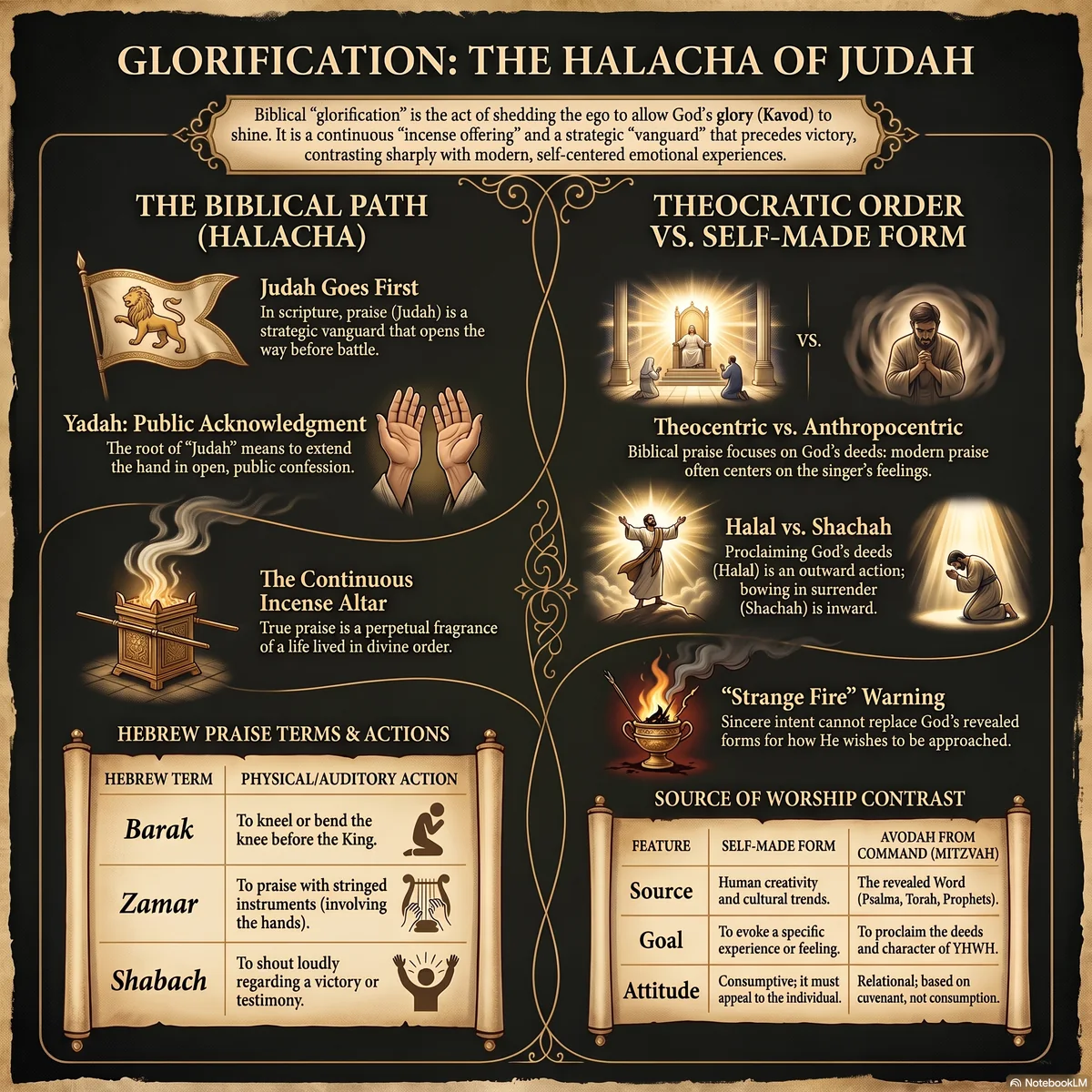
Genesis 29:35 Canonical · H3034Translation loss — "praise" in Genesis 29:35. Odeh is the Hiphil of yadah (ידה, H3034), etymologically connected to yad (hand). Its root meaning is not "praise" in the sense of aesthetic exaltation, but: to stretch out the hand, to acknowledge openly — a public confession before others, not primarily an inward feeling of admiration. Translation Loss · H3034
"Praise" produces two losses here. First, the hand-gesture nuance disappears: yadah is outward-facing acknowledgment, not an interior experience of praise. Second, the wordplay with Yehudah is lost — Leah's statement only works if odeh retains its root sense of "I will acknowledge/confess"; that is what echoes in the name Yehudah (and later Yehudi, "Jew"). "I will praise" makes that wordplay unintelligible. Restoration: odeh = "I will acknowledge/confess," not "I will praise."
This is not an afterthought — the name Yehudah (יְהוּדָה) literally consists of the verb odeh ("I will acknowledge/confess," from the root ידה, H3034) with the Name of God built into it. The tribe from which the Messiah comes carries the open, confessing acknowledgment of YHWH as its genetic code, not as an external addition. Canonical · Gen. 49:8
Glory is theocentric, not anthropocentric. Psalm 100:2 states the order sharply: "Serve YHWH with gladness, come before His presence with singing." The gladness is not a mood to be worked up but the logical consequence of who He is. The Psalms sing predominantly about YHWH and His deeds — not about the singer's inner state.
Amos 5:23 is the prophetic correction against praise detached from justice and righteousness: "Take away from Me the noise of your songs... but let justice run down like water." Praise without Torah direction — without a walk — is, according to the prophets, not praise but noise. Canonical · Amos 5:23–24
Tabernacle projection — the continual incense
If glorifying were an object in the Tabernacle, it would not be the Ark — that is the sign of covenant — but the golden altar of incense, which stood before the veil and on which incense burned without interruption (Ex. 30:1–8). Bread and blood are offered once or periodically; incense is continual. Hebrews explicitly connects this to praise:
"By Him therefore let us offer the sacrifice of praise to God continually, that is, the fruit of our lips, giving thanks to His name."
Hebrews 13:15 Canonical · G2378Glorifying is not a Sunday incident but a continual offering — the counterpart of the unbroken incense. This is the foundation the rest of this study builds on: glorifying is not an activity scheduled apart from the walk, but the fragrance that continually rises from a life standing in the Tabernacle's order.
Translation loss: "glorify" is not a single word in Hebrew
Why this study is called "Glorify" and not "Praise." "Praise" describes mainly an activity; "glorify" describes a direction — transferring weight/glory (kavod) from the self to YHWH. That maps more precisely onto the Hebrew halal (הלל, H1984): not primarily "expressing a feeling," but making someone else shine by pushing one's own self back. This is not a synonym for singing-to as such — singing-to can be either glorifying (attention moves toward Who He is) or self-made form (attention stays on what I feel and how I myself shape it; see the Avodah section in §③). The title "Glorify" makes that distinction visible in the title itself: this is not about the act of singing-to, but about what happens to the self during that singing.
Western translations compress at least seven distinct Hebrew verbs into the single word "praise." That is translation loss: each verb describes a different movement of body or voice, not an interchangeable feeling. Translation Loss
All seven of these verbs are canonically demonstrable with a Strong's number — none of them is a translation imposed later. Canonical
Translation correction — Psalm 22:4, "Thou that inhabitest the praises of Israel" / "You who are enthroned on the praises of Israel." This beloved phrasing is an interpretive embellishment, not a literal translation. The Hebrew reads: יוֹשֵׁב תְּהִלּוֹת יִשְׂרָאֵל — yoshev tehillot Yisrael, literally "He who sits/dwells/is present [amid] the praises (tehillot) of Israel." There is no word for "throne" (kise) and no word meaning "upon" in the sense of sitting on top of something. Translation Loss
Still, the translation is not simply wrong — yoshev does carry a royal connotation when its subject is YHWH as King (cf. Ps. 9:7, "YHWH shall endure/sit forever"). The image of being "enthroned on" praise captures a real royal element, but adds a literal throne-image the source text does not give. What the text actually says is more intimate: YHWH dwells, is present in the midst of — surrounded by — the tehillot of His people. It is not a throne of applause that bears Him up, but a presence that takes up residence where His people confess Him.
The practical conclusion still holds, and is exactly what the translation — despite its imprecision — rightly conveys: it pleases Him when this happens according to His will. Not because praise literally carries or elevates Him, but because He lets Himself be found, lets Himself dwell, in the midst of the sincere tehillot of His people — which returns us to the distinction in the Avodah section (§③): presence that is invited by glorifying done according to His will, not presence forced by volume or atmosphere.
Contrast — Halal is not Shachah
The halacha of Judah holds an essential distinction that collapses in English because both "praise" and "worship" are used interchangeably:
| Concept | Direction | Character | Key Text |
|---|---|---|---|
| Praise — הָלַל / יָדָה | Outward, audible | Making God's deeds, character, and faithfulness known. Extraverted, proclamatory. | Ps. 145:4 |
| Worship — שָׁחָה | Inward/downward, silent | Shachah — prostrating oneself. Not proclamation but surrender; can occur in complete silence. | Gen. 22:5; Ps. 95:6 |
Halal and Shachah are both canonically attested (H1984; H7812) — they are not synonyms but two complementary movements: praise enters the gates with thanksgiving (Ps. 100:4), worship bows down once inside the most holy place. Canonical · H7812
Applied translation-trap check (Protocol II.iv): Just as shema (orienting) and shamar (guarding) are wrongly both reduced to "obey," halal (proclaiming) and shachah (prostrating) are wrongly both reduced to "worship." Step 3 of the protocol requires this distinction be named explicitly: whoever sings, proclaims (halal); whoever falls silent and bows, worships (shachah). Both are needed — neither replaces the other.
Paleo-Hebrew root — what do the letters of הלל tell?
Halal (הלל) consists of Hey-Lamed-Lamed. Hey is the pictograph of a window/raised arm — to see, to reveal, to breathe. Lamed is a shepherd's staff — authority, leading, lifting upward. The doubling of Lamed intensifies: not "to lead" but "to repeatedly and forcefully lift up and reveal." Remez-Speculative · pictographic
This is a Remez layer on the letters themselves, not settled doctrine — but it does align with the Pshat meaning of halal: to shine, to radiate, to make the light of something visible by lifting it up. Compare the overlap with hilel (morning star, Isa. 14:12) — the same image of "radiant uplift."
Root study — Yadah and Yehudah: wordplay or linguistic kinship?
The text of Genesis 29:35 itself makes the wordplay: odeh (אוֹדֶה, I will acknowledge/confess, Hiphil of ידה) and Yehudah (יְהוּדָה). This is not a Remez we are imposing — Scripture makes the connection explicit by linking the naming directly to the verb. Canonical · Gen. 29:35 The wordplay only works when odeh retains its root sense of "open acknowledgment" — the name Yehudah (and later Yehudi, "Jew") carries that acknowledgment literally within it, not a general notion of "praise."
BDB places ידה (H3034, to praise/confess) as possibly related to יָד (H3027, hand) — the gesture of the outstretched hand in acknowledgment or casting. This connection is not linguistically certain; it is presented here as a supporting observation, not as conclusive proof. Remez-Speculative · linguistic
Gematria validation — no forced connection
In keeping with Protocol III, gematria was investigated and used only where it reinforces an already-existing thematic link. For towdah (תּוֹדָה = 400+6+4+5 = 415) and halal (הָלַל = 5+30+30 = 65), no meaningful numerical cross-reference to other key terms was found that meets the validation requirement. No gematria claim is therefore presented beyond the already-canonical wordplay of Genesis 29:35 — in keeping with the rule that a numerical link without thematic anchoring is left out, not forced.
Judah goes first — the halachic pattern of movement
In the Torah, glorifying is not the closing act of a gathering but the vanguard of a movement. When the camp of Israel sets out, the standard of Judah goes first:
"And the standard of the camp of the children of Judah set forward first."
Numbers 10:14 CanonicalThe same pattern repeats after Joshua's death: when asked who shall go up first against the Canaanites, YHWH answers unambiguously, "Judah shall go up" (Judg. 1:2). Canonical · Judg. 1:1–2 Glory (Yehudah) does not come after the battle as celebration — it opens the way before it.
This is the halachic core: walking in glorifying does not mean waiting until circumstances feel glorious, but letting glorifying function as a trailblazer. Just as the Ark went before the people at the crossing (Josh. 3), proclaiming YHWH's deeds goes before the experience of His victory.
The three liturgical layers — labeled canonical versus rabbinic
Scripture itself organizes large blocks of Psalms functionally. The names of these categories are rabbinic-traditional; the Psalms themselves are entirely canonical. Canonical · Psalm textRabbinic-Traditional · category names
| Block | Hebrew term (Rabbinic-Traditional) | Psalms | When / Function |
|---|---|---|---|
| The Song of the Sea | שִׁירַת הַיָּם | Exodus 15 | The first canonical Shirah after a great deliverance — the archetype of praise as response to a completed act. |
| The Hallel | הַלֵּל | Psalm 113–118 | Sung at the Moedim (Pesach, Shavuot, Sukkot). This is what Yeshua sang before going to the Mount of Olives (Matt. 26:30). |
| The Great Hallel | הַלֵּל הַגָּדוֹל | Psalm 136 | A fixed refrain runs through the whole song: "For His mercy endureth for ever." Fitting for Friday evening/Shabbat opening. |
| The Songs of Ascent | שִׁירֵי הַמַּעֲלוֹת | Psalm 120–134 | Songs of the ascent to Jerusalem — fitting for Shabbat afternoon or a deliberate moment of "going up" within the week. |
| The Hallelujah Block | פְּסוּקֵי דְזִמְרָא | Psalm 145–150 | Every Psalm from 146 onward opens and closes with Hallelujah — a movement from personal praise (145) to cosmic praise (150). Fitting as a morning rhythm. |
| Supplication & Repentance | תְּפִלּוֹת וּתְשׁוּבָה | Psalm 6, 32, 38, 51, 102, 130, 143 | The seven penitential psalms — for times of crisis, guilt, or self-examination. Glory without this layer becomes one-sidedly triumphant. |
| Royal & Zion Psalms | מִזְמוֹרֵי מֶלֶךְ | Psalm 2, 24, 45, 48, 72, 89, 110 | Affirm royal and Messianic authority (the Son of David). Fitting for reflecting on Yeshua as King out of Judah. |
| The Temple's Daily Psalms | שִׁיר שֶׁל יוֹם | Sun 24 · Mon 48 · Tue 82 · Wed 94 · Thu 81 · Fri 93 · Sat 92 | The Levitical weekday assignment (Mishnah Tamid 7:4). Psalm 92 itself carries the heading "A Psalm or Song for the sabbath day." |
The Psalm numbers and their text are, in every one of these rows, Canonical. The category name and — specifically for the Daily Psalms — the assignment of a Psalm to a fixed weekday are Rabbinic-Traditional (Mishnah Tamid 7:4): a later liturgical ordering of canonical material, not a biblical instruction itself. Psalm 92 is the exception — the heading "for the sabbath day" stands in the canonical text itself.
Practice rhythm — how do you live this out? A halacha only becomes a walk once it has a fixed place in the week. One possible rhythm, built entirely from canonical Psalm text:
• Every morning: one Psalm from the Hallelujah block (145–150) — a fixed starting point, no improvisation required.
• In prayer need or under conviction of guilt: reach for one of the seven penitential psalms (6, 32, 38, 51, 102, 130, 143) rather than skipping that layer.
• On Shabbat: Psalm 92 (the canonical Shabbat song) and possibly one of the Songs of Ascent (120–134).
• At the Moedim: the Hallel (113–118) — the same block Yeshua sang before Gethsemane.
• At a breakthrough or deliverance: Psalm 136 — every line closes with "His mercy endures forever," a fixed response form you can speak together with others.
This rhythm is a proposal, not a regulation — the halacha of glorifying is a path you walk, not a law you check off.
Warning — replacement-praise in today's practice
The halacha of Judah stands in sharp contrast with patterns that have become ingrained in contemporary Western praise culture. These are not judgments of individual people or songs, but labeled pattern-recognition under Protocol VI.i — meant to test the walk, not to condemn.
Four recurring patterns Popular-Theological
- Anthropocentric shift. Biblical praise is theocentric — Psalm 145–150 names YHWH, His deeds, and His character, not the singer's emotional state. When "I feel," "I experience," and "my heart" structurally outweigh the Name and the deeds of YHWH, that inverts Psalm 100:2 — no longer serving Him, but stirring up a feeling about Him.
- Spiritualizing Zion, Jerusalem, and Israel. When a song about the "walls of Jerusalem" in practice means one's own heart, or "Israel" is read as "the church," a concrete, literal promise to the physical people and land is appropriated by another party. This touches the principle of Emet — truth in the mouth (Ps. 145:18) — and is the hallmark of what this study calls replacement-praise.
- The absence of Lament. See the table above: a third of the Psalter consists of supplications, laments, and penitential psalms. A praise culture that is predominantly triumphant and emotionally positive lacks the framework Scripture itself provides for suffering, exile, and guilt — and so becomes unusable precisely when it is needed most.
- Praise detached from the walk. Amos 5:23–24 (above, in the Foundation) is the oldest warning against exactly this pattern: song without justice is not praise but noise. When praise becomes a bounded block — twenty minutes at a fixed moment — disconnected from the Torah-direction of the rest of the week, the prophets' judgment repeats itself.
None of these four patterns is unique to one movement, songbook, or generation — they are timeless, and can occur as readily in a traditional liturgy as in a modern gathering. The criterion in this study is not musical style but direction: theocentric or anthropocentric, literal or spiritualized, with or without Lament, connected to or detached from the walk.
Avodah — who decides the form of service?
The crossroads many believers discovering the Hebrew roots struggle with is this: if a song is directed straight at YHWH or Yeshua, how can the form still be wrong? The answer lies not in the Who, but in the how. The Hebrew root for this is avodah (עֲבוֹדָה, from the root עבד, abad, H5647).
This changes the question. Not: "is this song sincerely directed at YHWH?" — but: "who decides the form in which I approach?" The Torah gives a sharp answer through two warning examples.
Strange fire — Nadab and Abihu (Leviticus 10:1–2). Aaron's sons offered incense "before YHWH, which He commanded them not" — their offering was sincerely directed, but self-designed. Scripture calls this esh zarah (strange fire), and the judgment is immediate. Canonical · Lev. 10:1–2
The golden calf — Exodus 32:5. Aaron did not call the people to worship a foreign god — he called for "a feast to YHWH," but in a self-made form shaped after Egyptian models. The Name was correct; the form was self-made. Canonical · Ex. 32:5
In both cases, the orientation toward YHWH was sincere. The problem lay in the form: deciding for oneself how to approach, instead of receiving how YHWH wishes to be approached. This pattern is referred to in this study as self-made form — not a biblical term with a Strong's number, but a descriptive summary of the pattern in Leviticus 10 and Exodus 32. Descriptive term · not a biblical concept
| Self-made form | Avodah out of mitzvah | |
|---|---|---|
| Source | Human creativity, atmosphere, cultural trend | The revealed Word — Psalms, Torah, Prophets |
| Goal | Stirring up an experience or feeling | Proclaiming YHWH's deeds and character |
| Focus | What I bring, how I myself shape Yeshua | Who He is according to His own revelation |
| Posture | Consumptive — it must appeal to me | Relational — out of covenant, neither compulsion nor consumption |
This connects to Yeshua's own words in John 4:24: whoever worships YHWH "must worship Him in spirit and in truth" — not in a self-chosen form, but in accordance with what He actually is. Canonical · John 4:24
This is the same movement as the distinction between love and loving: love is the root, the covenant principle; loving is the fruit, its visible execution. Glorifying stands to loving as activity to activity, not as identity to identity — both are halacha, the way an already-existing relationship moves, not a substitute for that relationship. Whoever glorifies without acting in love repeats the pattern of strange fire in another form: the right words, without the underlying walk. → See the love/loving distinction in the halacha study Loving in Deed and Truth
Historical context (outside the canon, labeled with care): the early Messianic community lived in a Greco-Roman environment saturated with cultic ecstasy, and kept its distance from it by anchoring itself in synagogue order — hearing the Parashat HaShavua, fixed prayers, and the structure Paul points to with "let all things be done decently and in order" (1 Cor. 14:40, Canonical). The fixed blessing formula "Baruch Atah YHWH, Eloheinu Melech HaOlam" and the name Hamotzi for the blessing over bread (cf. Matt. 26:26) are Rabbinic-Traditional — the exact wording as we know it was fixed in later tradition, and it cannot be established with historical certainty that every first-century gathering already used that literal formula. The underlying principle — a fixed, received form of blessing rather than a spontaneous, self-chosen prayer — is indeed in keeping with Avodah as covenant service, not consumption.
Remez — a chiastic movement in Psalm 145–150. The block opens with David's personal praise (145: "I will extol Thee, my God, O King") and closes with the cosmic call that all that has breath praises YHWH (150:6). Between those two poles lies creation (147–148), summoned as witness. The axis of this block is not a single verse but a direction of movement: from one heart to every breath. This is a literary observation about the canon's sequence, not a doctrinal claim — labeled as such. Remez-Speculative · literary structure
Echo — from the Red Sea to the throne
The pattern "praise after deliverance" runs through the entire canon: Exodus 15 (Torah) after the crossing; the Psalms (Prophets/Writings) as the abiding liturgy of that same deliverance; and Revelation 15:3–4, where the victors literally sing "the song of Moses... and the song of the Lamb." Canonical · Rev. 15:3–4 Three canonical layers, one pattern — this is Echad: the unity of Scripture explaining itself.
"Great and marvellous are thy works, Lord God Almighty; just and true are thy ways, thou King of saints. Who shall not fear thee, O Lord, and glorify thy name? for thou only art holy: for all nations shall come and worship before thee; for thy judgments are made manifest."
Revelation 15:3–4 CanonicalThis "song of Moses and of the Lamb" is therefore not a new, unknown text — it is substantively the same refrain as Exodus 15:11 ("Who is like unto thee, O YHWH, among the gods?") and Psalm 145 (greatness, righteousness, fear, the Name glorified). The two titles — Moses and the Lamb — point to one and the same song, because it sings the same content: YHWH's great and righteous deeds, now finally acknowledged by all nations. It is thus the eschatological completion of exactly the pattern this study follows: Halal and Yadah, from the Red Sea to the throne, going on singing the same song.
Applied Protocol VI.i check on rabbinic-liturgical material:
- The Siddur prayers (Modeh Ani, Avinu Malkeinu, Adon Olam, Oseh Shalom) are valuable as illustrations of Jewish prayer practice, but are Rabbinic-Traditional, not canonical. They are not used in this study as a biblical basis, only mentioned for contextualization where relevant.
- Shema Yisrael (Deut. 6:4) is, by contrast, canonical — it is Scripture text itself, not a later addition.
Leah — glorifying before the fulfillment of her longing
Leah is not commended for a feeling but for an acknowledgment: after three sons in which she repeatedly longed for Jacob's love, at the fourth she shifts to pure Yadah — independent of whether her longing is ever fulfilled (Gen. 29:31–35). Canonical · Gen. 29:35
Miriam and the women — Towdah with the tof
Immediately after the Song of the Sea, Miriam takes the timbrel and leads the women in dance and praise — an immediate, bodily response to a completed deliverance, not a rehearsed liturgy (Ex. 15:20–21). Canonical · Ex. 15:20–21
David before the Ark — Zamar without regard for status
When the Ark enters Jerusalem, David dances "with all his might" before YHWH (2 Sam. 6:14) — that verse uses the verb karar (to whirl/dance), not zamar. The parallel account adds the musical layer: David appoints Levites with "instruments of music... with cymbals, psalteries, and harps" for the Ark's procession (1 Chr. 15:16,28) — this is the canonical anchor text for zamar in this episode. Canonical · 1 Chr. 15:16,28 Michal's contempt for David's dance (2 Sam. 6:16,20) marks the contrast between Saul-like praise — concerned with status — and Davidic praise, which gives up the ego. Canonical · 2 Sam. 6:14–16
Jonah from the depths — Towdah as a promise before deliverance
From the belly of the fish, before he is delivered, Jonah already vows a towdah-offering: "But I will sacrifice unto thee with the voice of thanksgiving" (Jonah 2:9). Thanks is spoken here as trust, not as a reaction to an already-visible outcome. Canonical · Jonah 2:9
Yeshua and the Hallel before Gethsemane. "And when they had sung an hymn, they went out into the mount of Olives" (Matt. 26:30). The Messiah does not sing a new, comfortable song at the heaviest moment of His earthly path — He moves within the canonical Hallel (Ps. 113–118) of His people. Glory here literally goes before the road of suffering, exactly the pattern of Numbers 10:14: Judah first. Canonical · Matt. 26:30
Paul and Silas in prison. At midnight, with torn backs and shackled feet, they sing hymns to God — before the earthquake, before any deliverance is visible (Acts 16:25). The same halachic pattern: glory as trailblazer, not as reaction. Canonical · Acts 16:25
- Of the seven — yadah, towdah, barak, halal, tehillah, zamar, shabach — which movement does your body or voice rarely or never make? What would it cost to do that one this week?
- Jonah spoke towdah from inside the fish, before his deliverance. Where in your life would glorifying as trust — not as reaction — fit?
- Do you need audible proclamation of what YHWH has done (halal), or quiet surrender and prostration (shachah)? Both are halacha — neither replaces the other.
- Hebrews 13:15 calls praise a continual offering "by Him." Is your glorifying a weekly moment, or a continual fragrance in your daily walk? What would continuity concretely mean?
- Think of a song you often sing. Is it about YHWH and what He has done, or mostly about how you feel? Is Zion/Jerusalem/Israel meant literally in it, or silently spiritualized?