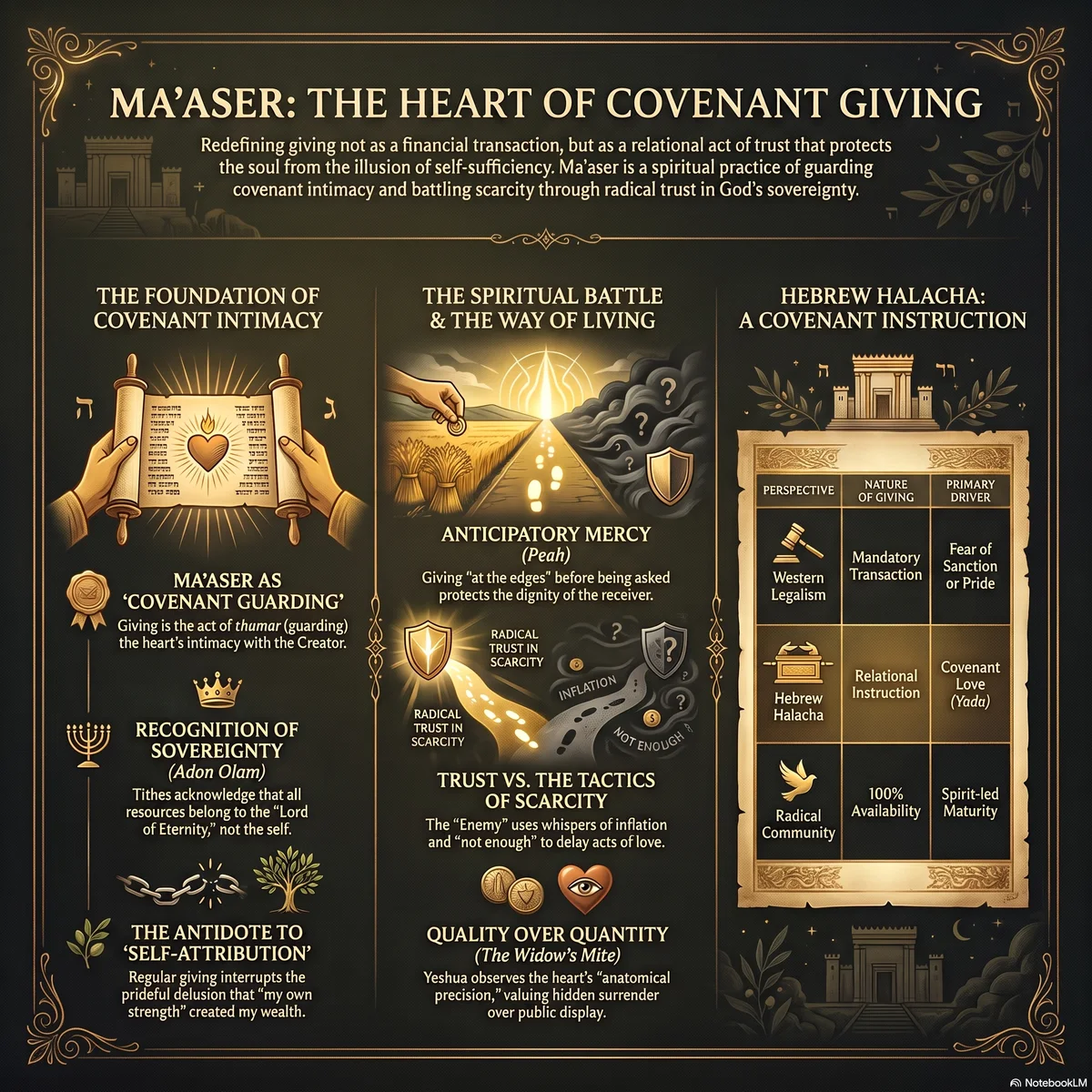
Ma'aser (מַעֲשֵׂר, H4643) — the tenth part. This concept is inseparably linked to the Hebrew root asar (עֶשֶׂר, H6240), meaning "ten," but pictographically pointing to wealth, abundance, and the gathering of separate parts into a unity. In Western theology, tithing is often narrowed down to a legal obligation or a financial transaction to secure blessing. In the Hebrew worldview, however, it is an act of pure love: it is the guarding (shamar) and cherishing of the covenant relationship with YHWH, so as to deepen intimate covenant connection (yada) with Yeshua.
A halachic study is a study of action: it examines not merely the theory behind a mitzvah, but asks: "How do I concretely walk this out?" This study uses an in-depth PaRDeS analysis to uncover the layers of ma'aser, corrects the Western translation loss, exposes the pull toward religious outward display (Pharisaic behavior), and shines a sharp light on the battlefield of our finances. For it is precisely in the territory of money and possessions that the enemy intensifies his attacks — through fear, delay, and the illusion of false security — to tear us away from the Source of Life, while in the renewed covenant the Spirit drives us toward a radical, joyful community in which every lack melts away.
After this study you will understand:- You know ma'aser (H4643) as the tenth part, and understand how this concept already functioned as a relational covenant foundation before the Sinai legislation.
- You understand that everything belongs to Adon Olam (the Lord of eternity), and that finances are the ultimate territory of radical surrender rather than false security.
- You recognize the Western translation loss whereby mitzvot (relational directives) have been reduced to legal obligations or manipulative reward systems.
- You recognize the tactical attacks of the Sonei (hater) and Ojev (enemy) through whispers of delay, inflation-fear, and scarcity thinking.
- You understand the Torah principle of anticipatory mercy (Leviticus 19:9-10) — protecting brothers and sisters from humiliation in advance.
- You recognize the danger of Pharisaic behavior and understand Yeshua's instruction about the left and right hand as a call to intimacy in secret.
- You can apply the four layers of the PaRDeS method to the principle of tithing to see its Messianic and metaphysical depth.
- You understand how the radical sharing of possessions in the first community (Acts 2 and 4) is the ultimate, Spirit-driven maturation of the ma'aser principle.
- You can articulate why heavenly treasures far outweigh evaporating earthly riches in light of eternity, Mark 12, and 1 Corinthians 9:7.
This study assumes that giving flows from love, not duty. If that foundation isn't yet clear to you, we recommend first reading Loving — in Deed and Truth: without that foundation, ma'aser quickly becomes a detached financial rule again instead of a fruit of covenant love.
Then read the verses below attentively, and pay attention to the relational context in which tithes and firstfruits are given: is it fear of lack, the urge to be seen by others, or a hidden act of pure love and trust of heart?
-
Halachic Study — Tithing in the Renewed Covenant
- ① Foundation — The Ownership of Adon Olam
- ② Understanding — The PaRDeS Analysis, Root Study, and Gematria
- ③ Halacha — The Struggle, Compassion Beforehand, and Pure Kavanah
- ④ Deeds — Testimonies of Surrender, Contrasts, and the Gaze of Yeshua
- ⑤ Reflection — The Monday Morning Test of Pure Devotion
Everything Belongs to Him
The foundation of tithing in the Torah lies not in human need or in the needs of a religious organization, but in the sovereign status of creation. Leviticus 27:30 plainly states to whom the tenth part belongs. It is not a human possession that we generously "donate" or "give away" — it is a recognition of what is already Holy. Everything belongs to Adon Olam — the Lord of eternity.
וְכָל-מַעְשַׂר הָאָרֶץ מִזֶּרַע הָאָרֶץ מִפְּרִי הָעֵץ לַיהוָה הוּא קֹדֶשׁ לַיהוָה
"And all the tithe of the land, of the seed of the land or of the fruit of the tree, is the LORD's; it is holy to the LORD."
Leviticus 27:30 · Canonical · H4643 · YHWHThe mitzvah reminds the believer that every breath, every capacity to work, and every cent that comes in is a pure blessing. Finances are the ultimate territory of radical surrender to YHWH. This stands diametrically opposed to the false security that man tries to amass or build from his own strength, intellect, and flesh.
This false security receives a concrete name and an explicit warning in the Torah. Moses confronts the people, just before entering the land, with the precise movement of the heart that prosperity provokes:
וְרָם לְבָבֶךָ וְשָׁכַחְתָּ אֶת־יְהוָה אֱלֹהֶיךָ ... וְאָמַרְתָּ בִּלְבָבֶךָ כֹּחִי וְעֹצֶם יָדִי עָשָׂה לִי אֶת־הַחַיִל הַזֶּה
"...then your heart is lifted up, and you forget YHWH your God... and you say in your heart, 'My power and the might of my hand have gained me this wealth.'"
Deuteronomy 8:14, 17 · Canonical · H3581 (koach)Moses is not describing an isolated character flaw, but a predictable pattern: satisfaction — fine houses, growing herds, increasing silver and gold (Deut. 8:12-13) — leads an unguarded heart into a quiet shift from grateful dependence to self-attribution. The antidote YHWH gives immediately afterward is not a ban on prosperity, but a duty to remember:
וְזָכַרְתָּ אֶת־יְהוָה אֱלֹהֶיךָ כִּי הוּא הַנֹּתֵן לְךָ כֹּחַ לַעֲשׂוֹת חָיִל לְמַעַן הָקִים אֶת־בְּרִיתוֹ
"But you shall remember YHWH your God, for it is He who gives you power to get wealth — that He may establish His covenant."
Deuteronomy 8:18 · Canonical · H2142 (zakhar) · H3581 (koach)This verse exposes the anthropological reason behind ma'aser, alongside the ownership status of Leviticus 27:30. Setting aside the tenth part before the rest is used (see also Remez, ② Understanding) is a structural, repeated form of zakhar — it functions as a built-in interruption of exactly the movement of heart Deuteronomy 8:17 describes: the creeping conviction that "my power and the might of my hand" is the source of the wealth. Where Leviticus 27:30 establishes whose it is, Deuteronomy 8:17-18 explains why the heart must continually be reminded. Canonical · Deuteronomy 8:11-18
To prevent man from delaying this surrender — and thereby giving the heart time to harden into the self-sufficiency of Deuteronomy 8:17 — the Torah also draws a hard line in Exodus:
מְלֵאָתְךָ וְדִמְעֲךָ לֹא תְאַחֵר
"You shall not delay to offer the first of your ripe produce and of your juices."
Exodus 22:29 (Hebrew numbering: 22:28) · Canonical · FirstfruitsIn the Torah's directives we see that the tithe is given a threefold destination to sanctify society: the Ma'aser Rishon (for the Levites who carried out the tabernacle service), the Ma'aser Sheni (to be consumed during the moadim in God's presence), and the Ma'aser Ani (for the poor, the widow, and the orphan). This threefold division itself is a Mishnaic systematization (Tractates Ma'aserot / Ma'aser Sheni) of the canonical material in Leviticus 27, Numbers 18, and Deuteronomy 14 — the destinations themselves are canonical, while the naming and exact division are Rabbinic/Traditional. The mitzvot surrounding tithes and firstfruits are not heavy legal obligations, but a loving life structure that keeps the heart from hardening and keeps the covenant relationship with God and neighbor pure.
The mitzvot around tithing show that matter and spirit are not separated in Hebrew thought. By treating the tenth part as "Holy to YHWH," the remaining ninety percent is cultivated into a space of blessing and covenant connection. Leviticus 27:32 · H6944
"The generous soul will be made rich, and he who waters will also be watered himself."
Proverbs 11:25 · Canonical · H1293 (berakah)Proverbs 11:24-25 canonically confirms the pattern already linguistically indicated in the root asar/osher (see ② Understanding): true wealth (osher) arises not by holding on, but by giving out. This is not gematria speculation but a direct, independent scriptural confirmation of the Remez link between the two roots.
The Depth — In-Depth PaRDeS Analysis
To grasp the true spiritual dimension of tithing, we break the concept open through the four traditional levels of interpretation:
Pshat (פְּשָׁט) — The Literal Level
The concrete obligation within the agrarian society of Israel. The faithful setting-aside of an exact tenth part of the land's produce (grain, wine, oil). It served the material upkeep of the temple service (the Levites and priests without their own inheritance), the care of the marginalized (widows, orphans, foreigners), and the financing of the pilgrim feasts (moadim) (Deut. 14).
Remez (רֶמֶז) — The Hint or Allusion
The "tenth" functions as a constant hint toward the letter Yod (י), which carries the numerical value 10. The Yod is the smallest letter and pictographically symbolizes the hand — the working, forming hand of the Creator. The structural setting-aside of the tenth is the built-in hint that material reality is not autonomous but rests in His Hand.
Drash (דְּרַשׁ) — The Ethical Lesson
The training of the soul. Tithing is a mitzvah designed to radically break the illusion of absolute autonomy and the drive to possess. It forces a choice: do I trust the false security of the flesh, or Adon Olam? Moreover, it purifies our righteousness (Tzedakah): it trains us to break with outward display and to guard the intimate, hidden gaze of the Father. See also: Torah on the Heart — on how the Torah moves from outward compliance to a written reality in the heart, exactly the pattern visible here with ma'aser.
Sod (סוֹד) — The Mystical, Messianic Secret
The cosmic and eschatological dimension. Tithing represents the principle of the Firstfruit. Yeshua HaMashiach is the ultimate Firstfruit and the true Tenth, sown into the earth to bring the fallen creation back into the perfect unity (Echad) of the Father. When we, under the renewed covenant, set aside our tithe in secret, we align our material reality with this cosmic offering of Yeshua. Physical labor is transformed into heavenly worship and deep relational intimacy (yada).
Along the same lines: the setting-apart of the first/tenth part before the remainder is used shows a structural resemblance to the setting-apart of the Bride during the Erusin period before the full union of the Nissuin (see the studies Heavenly Wedding and Position of the Soul). This link is explicitly labeled here as speculative: it is a Remez/Sod consideration, not a canonical conclusion, and must not be presented as doctrine.
Translation Loss · מִצְוָה (Mitzvah) vs. Law — Western translations often reduce the mitzvot around tithing to "laws" and "commandments" within a legal-hierarchical frame. This activates fear-driven compliance to avoid sanctions, or legalistic pride. In Hebrew semantics, a mitzvah (from tsavah, H6680) is, however, a relational directive — the concrete life expression of a love relationship. Tithing is not taxation under pressure, but an act of guarding and cherishing (shamar, H8104) the covenant. Translation Loss · H6680 · H8104
Echo toward the priesthood of Melchizedek: Abraham gives the tithe to a priest who appears without a genealogy (Gen. 14:18-20). Hebrews 7:8-9 itself already reasons typologically further: Levi, not yet born, gives the tithe to Melchizedek "in Abraham" — which places the priesthood of Melchizedek demonstrably above the Levitical tithing system. Canonical · Hebrews 7:8-9 This connection is a valuable, stand-alone Remez layer; there is currently no separate study on the priesthood of Melchizedek to refer to.
Anticipatory Mercy: The Way of Living
Within the halacha, giving is not incidental, one-off relief. The Torah models a lifestyle of permanent generosity and compassion for the brother and sister who have less. This comes through magnificently in the laws of the edge of the field:
וּבְקֻצְרְכֶם אֶת-קְצִיר אַרְצְכֶם לֹא תְכַלֶּה פְּאַת שָׂדְךָ לִקְצֹר
"When you reap the harvest of your land, you shall not wholly reap the corners of your field... you shall leave them for the poor and for the stranger."
Leviticus 19:9-10 · Pe'ah (Rabbinic/Traditional, Mishnaic tractate) — concept canonical, term MishnaicThe deep ethical layer of this mitzvah is breathtaking: the poor person does not have to knock, beg, or plead with the farmer. The farmer leaves the edges standing in advance. You give beforehand so that there is no need for humiliation. It is a system that protects the dignity of the needy. There is respect and mercy built in beforehand, woven into the daily economic routine. This is the true spirit of ma'aser.
The Struggle for the Beforehand — The Attacks of Sonei and Ojev
As soon as a believer decides to walk in this halacha, the spiritual struggle intensifies. The Sonei (שׂוֹנֵא, H8130 — the hater/adversary) and the Ojev (אֹיֵב, H341 — the enemy) do not always attack with outright denial, but with refined, psychological sabotage. The attack targets the breaking of Kavanah (pure intention) through the following whispers:
- The Spirit of Delay: "This doesn't quite work right now. Next month is better, once the big bills are paid." This is the direct violation of Exodus 22:29 ("you shall not delay"). Delay is the most effective way to smother a trusting response of the heart without ever having to say an explicit "no."
- The Voice of Inflation and Scarcity: "Everything keeps getting more expensive. Life has already become unaffordable. You have to be realistic." The enemy exploits economic reality to shift the eye from Adon Olam (the Owner) to the circumstances.
- The Fear Dynamic Around Reserves: "We barely have any savings left. If you give this away now, you'll plunge your family into a ravine." Here the lie is fed that your savings are your true protector, instead of YHWH.
- The Generational Lie: "What will the children inherit then? You have to build for your descendants." The adversary disguises fear of lack as parental responsibility, while the greatest inheritance for a child is a living foundation of trust in God.
The Sonei tries to make you believe that by giving you lose something. Scripture, however, states that earthly riches hoarded outside the covenant inevitably evaporate. What use is it if a man dies and leaves behind his treasures? In the grave it is worth nothing:
"Do not lay up for yourselves treasures on earth, where moth and rust destroy... but lay up for yourselves treasures in heaven... For where your treasure is, there your heart will be also."
Matthew 6:19-21 · Canonical · Heavenly TreasuresWhen you hear these whispers, recognize them immediately as a tactical attack to keep you in the grip of Mammon. Victory over the Ojev is achieved by acting directly, without delay, and with a cheerful heart.
The Mirror — The Question Cycle (Reasoning Flow)
At its core it is not a financial transaction; it is a state of being and a fundamental act of realignment. By consciously setting aside the tenth part, a person actually declares that he is not a slave to Mammon but an intimate steward in the kingdom of YHWH. It activates the existential recognition that the earth and its fullness belong to the Lord.
It is absolutely not a ransom or a way of materially blackmailing God ("I give so He'll fatten my bank account") — this reduces the Most High to a cosmic contract partner. Nor is it cold, slavish duty-fulfillment (abad as slavish coercion rather than devoted care) Translation Loss · H5647, or religious theater to be seen by others. See also: Loving — in Deed and Truth, where this distinction between devoted service and slavish coercion is worked out thoroughly.
Yeshua puts this sharply in Matthew 6:3: "Do not let your left hand know what your right hand is doing." In Hebrew idiom, the right hand stands for the pure act of righteousness (Tzedakah) and surrender, while the left hand symbolizes calculation, ego, and self-administered honor. Pharisaic behavior misuses the mitzvah to gain status. True covenant intimacy thrives only in secret (baster, H5643). Whoever trumpets his gifts has already received his reward; whoever sows in secret draws the gaze of the Father. Translation Loss · H5643
Ma'aser prophetically mirrors the Table of the Bread of the Presence (Shulchan Lechem haPanim). On this golden table, twelve loaves were continually displayed before the direct presence of God, symbolizing the twelve tribes. Although this bread was the direct result of human agricultural labor (sowing, harvesting, milling, baking), it was placed in the Holy Place as an acknowledgment that God is the ultimate Provider. Tithing functions exactly the same way: it brings the fruit of our daily labor directly into the hidden, holy presence of the King.
A second, preceding object reinforces this image: the bronze altar in the courtyard (Exodus 27:1-8) is the first object an Israelite touches upon entering — before the washbasins, before the Holy Place. No one enters the Tabernacle without first setting aside something of his own possession (the sacrificial animal). Tithing functions the same way in daily life: setting aside the first part as the gateway to nearness with God, not as penance afterward.
The Bridge to Rejoicing of Heart (Simcha) & the Unsought Reward
When the mitzvah is stripped of legalistic coercion and Pharisaic outward display, the Torah builds a breathtaking bridge to rejoicing of heart. In Deuteronomy 14:23 and 26, YHWH gives the explicit instruction that the Ma'aser Sheni (the second/festival tithe) may be converted to be consumed: "...and you shall eat before the LORD your God... and you shall rejoice, you and your household." Giving in the Kingdom is directly tied to Simcha (שִׂמְחָה, H8057) — supernatural, royal joy.
God rewards unasked. He seeks no cold transactions or manipulative motives, but Kavanah (pure, upright intention of heart). When the heart is wholly free of fear and pride, the Father responds with a spontaneous, overwhelming outpouring of blessing. You do not give in order to receive or to force abundance; the abundance is the natural, generous response of a Bridegroom delighting in the pure covenant faithfulness of His Bride.
The Echo Through Scripture: The pattern resonates without interruption. Abraham gives voluntarily (Gen. 14), Jacob wrestles with his vow (Gen. 28), the Torah codifies the joy (Deut. 14 / Lev. 27), Malachi prophesies about the test of trust (Mal. 3), Yeshua purifies the motive in the Sermon on the Mount (Matt. 6), and the apostles in Acts bring the ultimate transcendence of possession. The unity of Scripture (Echad)
Six scenarios of relational surrender and contrasts of the heart
When Abraham returns from victory, he meets Melchizedek, king of Salem and priest of God Most High (El Elyon). Melchizedek brings bread and wine — a prophetic foreshadowing of the meal of the renewed covenant. Abraham's response is purely relational: "And he gave him a tithe of all." There was as yet no written law. Abraham's ma'aser was a spontaneous, loving act of worship to seal his covenant relationship. Canonical · Genesis 14:20
In sharp contrast to Abraham's mature, spontaneous surrender, we see a very different posture of heart in his grandson Jacob in Genesis 28. After his encounter with the ladder reaching to heaven, Jacob makes a highly conditional vow: "If God will be with me, and will keep me... and will give me bread to eat... then the LORD shall be my God... and of all that You give me I will surely give a tenth to You." Jacob is still operating in the transactional model here: he is negotiating with God. His ma'aser functions here as the closing clause of a contract. This scenario shows how a person may grow from an anxious, calculating transaction toward eventual, unconditional intimacy of heart (Yada).
Yeshua corrects the religious leaders sharply, not because they faithfully tithe their smallest herbs (mint, dill, cumin), but because they have completely missed its essence: justice, mercy, and faithfulness. He brings the mitzvah to its full, deepest meaning (plēroō / rabbinic equivalent male'). He does not abolish the tithe, but rescues it from the grip of the cold, legal performance system (hypo nomos) and places it back into the living covenant space of the Spirit and inner integrity (en nomos). Translation Loss: "Fulfill" means to bring to its deepest intention, not to close it out See also: What Does the Law Bring and The Law Fulfilled — for the full treatment of the hypo nomos / en nomos distinction only touched on here.
In Malachi 3, YHWH confronts His people with their withholding of the tithe, using the root qava (קָבַע, H6906 — to rob/defraud, Mal. 3:8-9), covenant language that characterizes withholding the tithe as actively robbing YHWH. This testifies to a deep fear of lack that undermines the covenant relationship itself. But right after, He makes a unique offer:
וּבְחָנוּנִי נָא בָּזֹאת אָמַר יְהוָה צְבָאוֹת אִם לֹא אֶפְתַּח לָכֶם אֵת אֲרֻבּוֹת הַשָּׁמַיִם
"...and try Me now in this, says the LORD of hosts, if I will not open for you the windows of heaven..."
Malachi 3:10b · Root: בָּחַן (Bachan — H974)The root bachan specifically means testing the purity of gold. Although man is elsewhere strictly forbidden in the Torah to test God (Deut. 6:16), YHWH makes a breathtaking, pastoral exception with the ma'aser: "I know how deeply the fear of lack sits in your being. But just do it. Test My character. Discover how trustworthy I truly am. Do not be afraid of inflation or scarcity." Fearful people hoard; covenant children share. Opening the windows of heaven is not a mechanical automatism, but the restoration of unhindered, intimate covenant exchange (yada).
An extraordinarily revealing moment takes place in the temple: "And Yeshua sat down opposite the treasury and watched (theōreō) how the crowd put money into the treasury." The Greek theōreō does not mean a passing glance, but to analyze and penetrate with deep, almost anatomical precision. Yeshua observed not only what people gave, but especially how they gave.
Many threw in much, with loud, outward fanfare — classic Pharisaic behavior aimed at being seen. But then a poor widow comes and throws in two small coins (a single quadrans). Yeshua calls His disciples and explains the heavenly halacha: this woman has given substantially more than everyone, for she gave out of her lack, her whole livelihood. This scenario proves that our Master keeps the ledger of the heart. He is not impressed by outward display, but measures the depth of surrender.
The most breathtaking evidence of how the Spirit brings the ma'aser principle to maturity is seen directly after Shavuot. Believers were no longer driven by fear or the minimal counting-rules of the law, but by an explosion of love: "Now the multitude of those who believed were of one heart and one soul; neither did anyone say that any of the things he possessed was his own, but they had all things in common." They brought the proceeds of their sold houses and lands and laid them at the apostles' feet.
This is the ultimate triumph over the Sonei and the whispers of scarcity. Where the Torah, with the tithe (10%), laid a fundamental basis to protect the heart, the Spirit in the Renewed Covenant breaks the boundary wide open to 100% radical availability. This was the perfect outworking of "anticipatory mercy" (Lev. 19): they distributed according to each one's need, "so that there was not a needy person among them." Fear of the future evaporated in the glory of the heavenly community.
The Fruit — The Monday Morning Test
VIII · Practical Application & Heart-Check
Tithing under the renewed covenant (berit chadasha) calls for a radical heart-check on Monday morning. When the paycheck arrives or the profit is calculated, the Sonei opens fire immediately. The voices whispering that life is too expensive, that there are no savings, or that the children's inheritance is at risk, must be silenced at once by an act of direct, trusting action. Whoever responds without delay (Exodus 22:29) — not out of fear of punishment, but out of loving trust that Adon Olam can be trusted — breaks the spell of Mammon and settles accounts decisively with two destructive mechanisms: fear (which leads to contractual hoarding) and pride (which leads to Pharisaic showing-off). Both find their canonical antidote in Deuteronomy 8:17-18 (see ① Foundation): zakhar — the active remembering that YHWH gave the power to gain wealth — breaks the creeping thought "my power has gained me this wealth" before that root can take hold. Translation Loss · "obeying" suggests duty-under-sanction; what is meant here is shamar — guarding/cherishing the covenant relationship (Protocol II.iv)
Acts reminds us that we are not called to anxiously mark out the minimal boundaries of the law, but to live from Koinōnia — a kingdom culture in which possessions have lost their absolute grip on the heart. Our Master still figuratively sits across from the treasury of your life; He intently watches (theōreō) the active movement of your hands. When you give beforehand, with respect and compassion (Leviticus 19:9-10), you help build a community where there is no humiliation and no one needs to go without.
Concrete step: Turn the transferring or setting-aside of your ma'aser into a moment of conscious victory and hidden intimacy. Declare: "Adon Olam, everything I have is a blessing from You. I refuse to bow to the false security of my bank account or savings. I reject the whispers of fear and delay. In the spirit of the first community, I declare that my possessions are not my own, but available for Your kingdom. My descendants rest in Your hand. I test Your faithfulness with joy and rest fully in Your generous, fatherly heart." Then direct this portion specifically toward supporting living Torah teaching, caring for the needy within the community, and building up His Kingdom.
- Which of the four whispers of the Sonei (delay, inflation, lack of savings, inheritance) do you recognize fastest in your own thoughts?
- How does the Acts model (sharing everything so that no one lacks) shed a wholly new light on the traditional 10%-boundary of tithing?
- Looking at the contrast between Abraham and Jacob, do you ever recognize in yourself the tendency to bargain conditionally with God?
- Do you recognize in yourself the subtle temptation of the "left hand" — the built-in need for others to know how generous you've been?
- To what extent did money unknowingly function for you as a "false security" instead of a territory of total surrender to YHWH?
- How does 1 Corinthians 9:7 help you see that a gift arising out of fear or "reluctance" completely misses the spiritual mark?
- How does the Acts scenario correct the idea that possessions are your own sovereign right within the kingdom of Yeshua?
- How does the scenario of the poor widow help you understand that God is not impressed by outward quantity, but looks for the depth of inner surrender?
- Had you ever understood the mitzvah of tithing as a vulnerable, loving invitation from the Father to test His character (bachan), rather than a threatening obligation?