Journey 4, The Fruit, carries the Hebrew label פְּרִי (Peri, "fruit") — but that is the noun form, the result. The verb behind it, which explains how fruit comes to be, is פָּרָה (parah, H6509, H6529): "to be fruitful, to bring forth." This study opens the journey that runs from Rebekah through Jacob to Judah, with the foundation that underlies it all: fruit is never self-generated — it is a received mandate.
This same word that God speaks over fish and birds at creation (Gen. 1:22), and afterward over humanity (Gen. 1:28), He repeats literally to Jacob — Rebekah's own son — at Bethel (Gen. 35:11). From creation to covenant line, it is one and the same blessing.
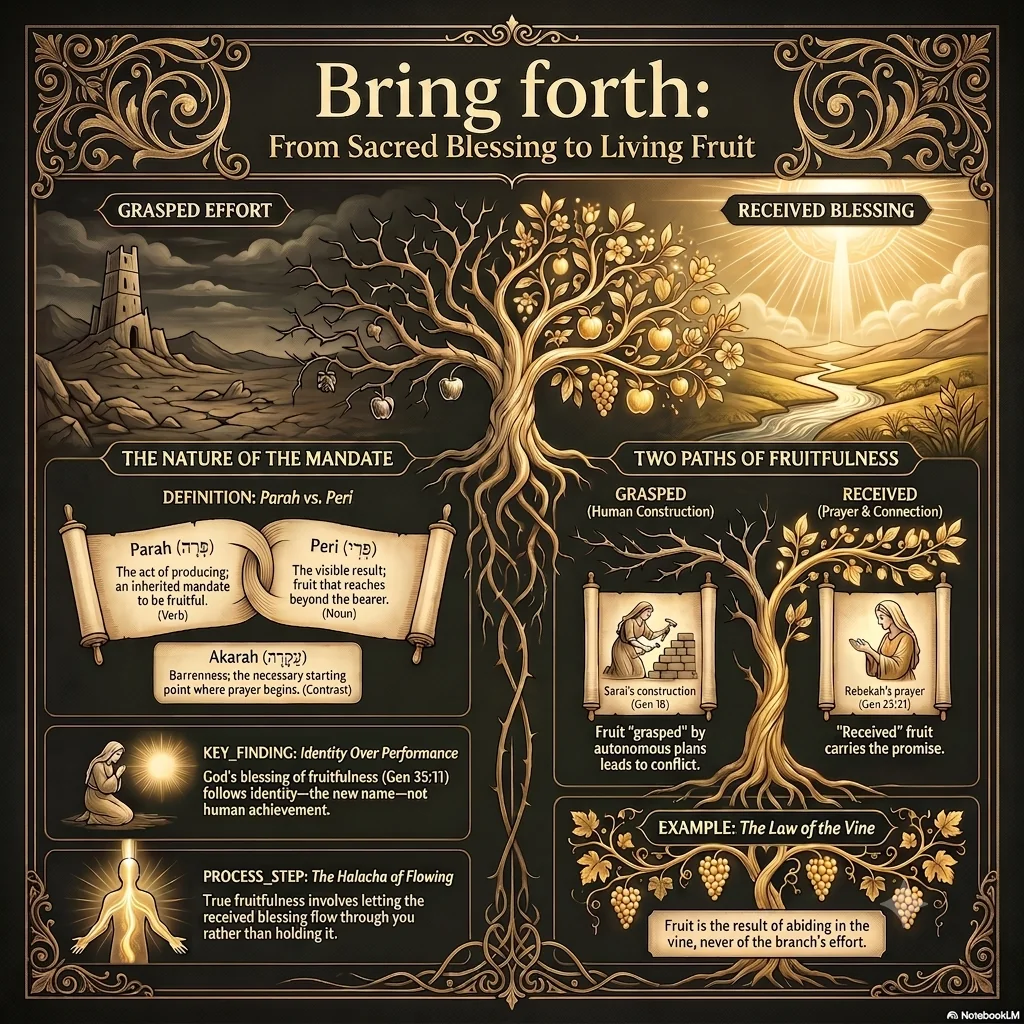
After this study you will understand:- You can explain the difference between parah (the verb, a received mandate) and peri (the noun, the visible result — the title of the journey itself).
- You recognise how the creation mandate of Genesis 1:28 is repeated literally to Jacob at Bethel (Gen. 35:11), directly within Rebekah's own line.
- You understand why Genesis 25:21 opens with barrenness (akarah) — fruit that comes through impossibility, not through effort.
- You recognise the distinction between grasped fruit (Hagar, Gen. 16) and received fruit (Rebekah, Gen. 25:21) — the same pattern as in Know (Gen. 3 versus Gen. 4:1).
- You see how Joseph's blessing (Gen. 49:22, "ben porat Yosef") stands in the same chapter as the Judah blessing — and how that connects Bring Forth and Glorify.
- You know how bringing forth takes practical shape as halacha: fruit that flows on, not held back.
Read the texts below slowly. Note the repetition of the same command across the generations — that repetition is itself already a message.
Be fruitful — the mandate that precedes everything
Before there is any question of merit, achievement, or even of mitswot, God already speaks a blessing over fruitfulness — at creation itself, before humanity has done anything at all.
וַיְבָרֶךְ אֹתָם אֱלֹהִים וַיֹּאמֶר לָהֶם אֱלֹהִים פְּרוּ וּרְבוּ וּמִלְאוּ אֶת־הָאָרֶץ
"And God blessed them, and God said to them: Be fruitful (peru) and multiply (u-rvu), and fill the earth."
Genesis 1:28 · Canonical · H6509 · H7235 · Gen. 1:28Note the order: first vayevarech — "and He blessed" — only then the word. Fruitfulness here is not a command demanding obedience under threat of sanction, but a blessing humanity already carries before anything is asked of it. God speaks the same formula even earlier — over fish and birds, in Genesis 1:22 — before humanity even exists. Fruitfulness, then, is not a human invention but a pattern anchored in creation itself.
Repeated to Jacob — the same mandate, a new name
What sounds general at creation is personally repeated at Bethel — directly to Rebekah's own son, just after his name has been changed.
"And God said to him: I am God Almighty (El Shaddai); be fruitful and multiply (pereh u-rveh); a nation, indeed a company of nations, shall be from you, and kings shall come out of your loins."
Genesis 35:11 · Canonical · H6509 · Gen. 35:11This blessing follows directly on the name change of verse 10: "your name shall no longer be called Jacob, but Israel shall be your name." Fruitfulness here follows identity, not achievement — first the new name, then the mandate for that name to bear fruit. This is exactly the same line Rebekah's own family already spoke at her departure: "Our sister, become thousands of ten thousands" (Gen. 24:60). In this whole history, fruitfulness is never individual merit — it is a blessing repeated from generation to generation.
From achievement to reception
Translation Loss · פָּרָה (H6509) — "Being fruitful" quickly becomes, in the western, popular-theological reading, prosperity theology: many descendants, much possession, much success as proof of God's favour. Translation Loss
Parah describes something different: an active verb of passing on, not of holding on. The blessing in Genesis 1:28 and 35:11 is not aimed at what the recipient accumulates, but at what reaches on through him — "a nation, indeed a company of nations, shall be from you."
Restoration: do not read "being fruitful" as individual prosperity, but as a mandate to transmit — fruit that by definition extends beyond the one who receives it.
The three layers of Bringing Forth
The Contrast: Grasped versus Received Fruit
One generation before Rebekah, exactly the same choice plays out as in Know (Genesis 3 versus Genesis 4:1) — but here around fruitfulness itself.
"And Sarai said to Abram: ...go in, I pray, to my maid; it may be that I shall be built up from her (ibaneh mimenah)."
Genesis 16:2 · Canonical · Gen. 16:2Sarai grasps at fruit with a self-made plan — "I shall be built up," a human construction instead of a received blessing. The result is not the promised fruit, but a lasting source of conflict (Gen. 16:4–6; 21:9–10). Compare this with Isaac: "Isaac pleaded with YHWH for his wife, because she was barren; and YHWH let Himself be entreated, and Rebekah his wife conceived" (Gen. 25:21). No construction, but prayer. No self-made solution, but reception.
This is the same pattern already uncovered in Know regarding yada: grasped fruit (Hagar, autonomously engineered) ends in division; received fruit (Rebekah, entrusted in prayer) ends in the promise that carries onward. Two generations apart, the same lesson. Canonical · Gen. 16:1–6, 25:21
Fruit that is not held back
The halacha of parah is not: gather as much fruit as possible for yourself. It is: let the received blessing flow on — exactly as Rebekah herself already did, before she even knew she would become the mother of a nation.
At the well, she does not merely give Eliezer water to drink, but offers on her own initiative to draw water for his ten camels as well (Gen. 24:19–20) — a task taking days, offered before it was even asked for. This is parah in its smallest, most everyday form: abundance that is not held back but passed on immediately.
Yeshua repeats exactly the same principle in Greek: "As the branch cannot bear fruit (karpon) of itself, unless it abides (meno) in the vine, so neither can you, unless you abide in Me... for without Me you can do nothing." Fruit is never the result of the branch trying harder — it is the result of remaining connected. This is parah in messianic form.
Halachic application: three concrete exercises
1 · Recognise the source before you count the fruit. Before crediting yourself for a success or a result, name aloud where it came from. This is not false modesty but the halacha of Genesis 1:28: first the blessing, only then the word.
2 · Test: am I building, or am I receiving? When you are under pressure to force a result, test yourself against Genesis 16 versus 25:21: am I choosing a self-made shortcut, or am I first laying the impossibility down in prayer?
3 · Pass it on before it is complete. Connect to the study Giving: Rebekah's abundance at the well preceded everything that followed. Sharing fruit is not a conclusion but a beginning.
Testimonies of Bringing Forth
Through four generations — Rebekah, Jacob, Joseph, and the Messiah Himself — the same pattern repeats: fruit received before it can be borne.
Rebekah's own history of fruitfulness begins not with fruit, but with its opposite: "for she was barren (akarah)." Isaac does not pray in her place but on her behalf — and YHWH lets Himself be entreated.
The fruit that follows (Jacob and Esau) is therefore received from the very first moment, not produced. This remains the pattern for the rest of this journey. Canonical · Gen. 25:21
Rebekah's own son receives at Bethel the same blessing spoken at creation: "I am God Almighty; be fruitful and multiply." This happens directly after his name is changed to Israel.
So the circle closes: the mandate that preceded all human action at creation is here personally repeated to the man whose name the people will carry. Canonical · Gen. 35:9–11
In Jacob's closing blessing over his twelve sons, directly preceding the blessing over Judah (Gen. 49:8–12), stands this word over Joseph: "Joseph is a fruitful bough (ben porat), a fruitful bough by a well; its branches run over the wall."
Porat stands, in the tradition of translators and interpreters, in direct kinship with parah — a deliberate wordplay naming Joseph's fruitfulness explicitly, in the same chapter where the study Glorify treats the Judah blessing. Bring Forth and Glorify thus stand literally side by side in the source text. Canonical · Gen. 49:22
The final witness shifts the image from offspring to spiritual fruit, but the halacha remains identical: "He who abides in Me, and I in him, bears much fruit; for without Me you can do nothing."
From Genesis 1 to John 15, the core is unchanged: fruit is never proof of one's own strength, but proof of connectedness. Canonical · John 15:4–5
From Rebekah's barrenness to Joseph's fruitful bough to the vine of Yeshua: the line is unchanged. Fruit is never forced — it is received, and only then passed on.
VIII · The Monday-morning Test — Practical Application
Bringing forth is not an achievement to check off at the end of the week — it is the question of whether what you pass on this week is received or forced.
On Monday morning, the temptation to force results lies close at hand: hitting a target, repairing a relationship, pushing through a project — Sarai's "perhaps I shall be built up" in modern dress. The halacha of parah asks for a different order: first acknowledge what is impossible, then pray as Isaac did, and only then act.
This week, concretely: Name one area where you are currently forcing instead of receiving. Lay it down once, deliberately, in prayer this week before acting further — and, regardless of the outcome, pass on something you already have to someone else, as Rebekah did at the well.
- The difference between parah (a received mandate) and self-generated fruit. Where in your own life do you recognise the difference?
- The mandate of Genesis 1:28 precedes all human action. Does that change how you view your own "fruitfulness," in whatever form?
- Fruitfulness is not proof of one's own effort or merit — Rebekah's history begins with barrenness, not with success.
- Grasped fruit (Hagar) and received fruit (Rebekah) sometimes look the same in the short term, but bear entirely different fruit in the long term.
- Choose one area this week where you are "building" (Gen. 16) instead of "praying" (Gen. 25:21), and change the order.
- Pass something on before it feels complete or "earned" — just as Rebekah did at the well.