In the thematic walk of hearing → seeing → understanding → bearing fruit, seeing forms the indispensable bridge between listening and understanding. But not all seeing is equal. Where Rebekah lifted her eyes and saw Isaac with a first physical perception (רָאָה, ra'ah, H7200), the Scriptures lead us one step deeper. There is a kind of looking that is not fleeting but intense, contemplative and prophetic: חָזָה (chazah, H2372) — to behold.
This is the root behind chozeh (the seer) and chazon (the prophetic vision). Beholding is the deliberate fixing of the heart's gaze on the reality of YHWH. King David names it his highest life goal in Psalm 27:4: beholding the loveliness (no'am) of YHWH. From the covenant meal on Mount Sinai to its fulfillment in Joseph and the Messiah — chazah is the deepening of a glance into a lasting posture of life.
After this study you will understand:- You know the fundamental difference between the Hebrew verbs ra'ah (physical noticing) and chazah (contemplative/prophetic beholding).
- You understand what David means by beholding no'am YHWH (the loveliness of YHWH) in Psalm 27:4.
- You recognise how the root chazah forms the basis for chozeh (seer) and chazon (prophetic vision).
- You can explain how the elders of Israel beheld YHWH on Mount Sinai (Exodus 24:11) and what this means for the messianic covenant meal.
- You understand why Exodus 24:11 (chazah) and Deuteronomy 4:12,15 (no form seen) do not contradict each other, and how the cherubim on the kapporet (Exodus 25:20) embody this in lasting form.
- You recognise the distinction between true and false beholding (Ezekiel 13, Micah 3, Balaam in Numbers 24) — chazah is a capacity, not an automatic virtue.
- You know how chazah takes practical shape as halacha: directing your inner gaze amid the noise of the world.
Read the texts below slowly. Do not let the words merely pass through your mind, but ask yourself: where is the gaze of my heart fixed each day?
One thing have I asked of YHWH
In Psalm 27, David formulates the absolute core of his spiritual life. In the middle of a world full of enemies, conflict, and threat, he does not first seek strategic advantage or physical safety. He reduces his entire existence to one single desire.
אַחַת שָׁאַלְתִּי מֵאֵת-יְהוָה אוֹתָהּ אֲבַקֵּשׁ שִׁבְתִּי בְּבֵית-יְהוָה כָּל-יְמֵי חַיַּי לַחֲזוֹת בְּנֹעַם-יְהוָה וּלְבַקֵּר בְּהֵיכָלוֹ
"One thing have I asked of YHWH, that will I seek: that I may dwell in the house of YHWH all the days of my life, to behold the loveliness of YHWH (lachazot beno'am YHWH) and to inquire in His temple."
Psalm 27:4 · Canonical · H2372 · H5278 · Ps. 27:4The key phrase uses the verb lachazot (לַחֲזוֹת), an infinitive of chazah (H2372). David is not asking for a fleeting glance at the ark or a one-time emotional experience. He is asking for a permanent dwelling in which his eye may rest uninterrupted on no'am YHWH — the Loveliness, Beauty, and Grace of the Creator.
Beholding (chazah) is not passive watching in the Hebrew world of thought. It is an act of the will. It is the anchoring of your inner perception in the reality of YHWH, until His loveliness flows through and transforms your whole being. Where the heart beholds, there it is shaped.
The promise for the righteous
The prophet Isaiah draws this line further by connecting beholding to a sanctified walk. Beholding is not only the privilege of the psalmist — it is the promise for those who walk in YHWH's ways:
"Your eyes shall behold (techezeinah) the King in His beauty; they shall see (tir'enah) a land of far distances."
Isaiah 33:17 · Canonical · H2372 · H7200 · Isa. 33:17The source text here is surgically precise: it is chazah (techezeinah, H2372, 3rd pers. fem. pl.) that is applied to the King himself, and the ordinary ra'ah (tir'enah, H7200) that suffices for the far-off land. Two different verbs in a single breath — the source text itself preserves the distinction this study unfolds: the land is seen, the King is beheld. Whoever beholds the King in His perfect reign loses the fear of the storms of the age. Beholding the King frees a person from the confinement of the self.
From Ra'ah to Chazah: The deepening of the gaze
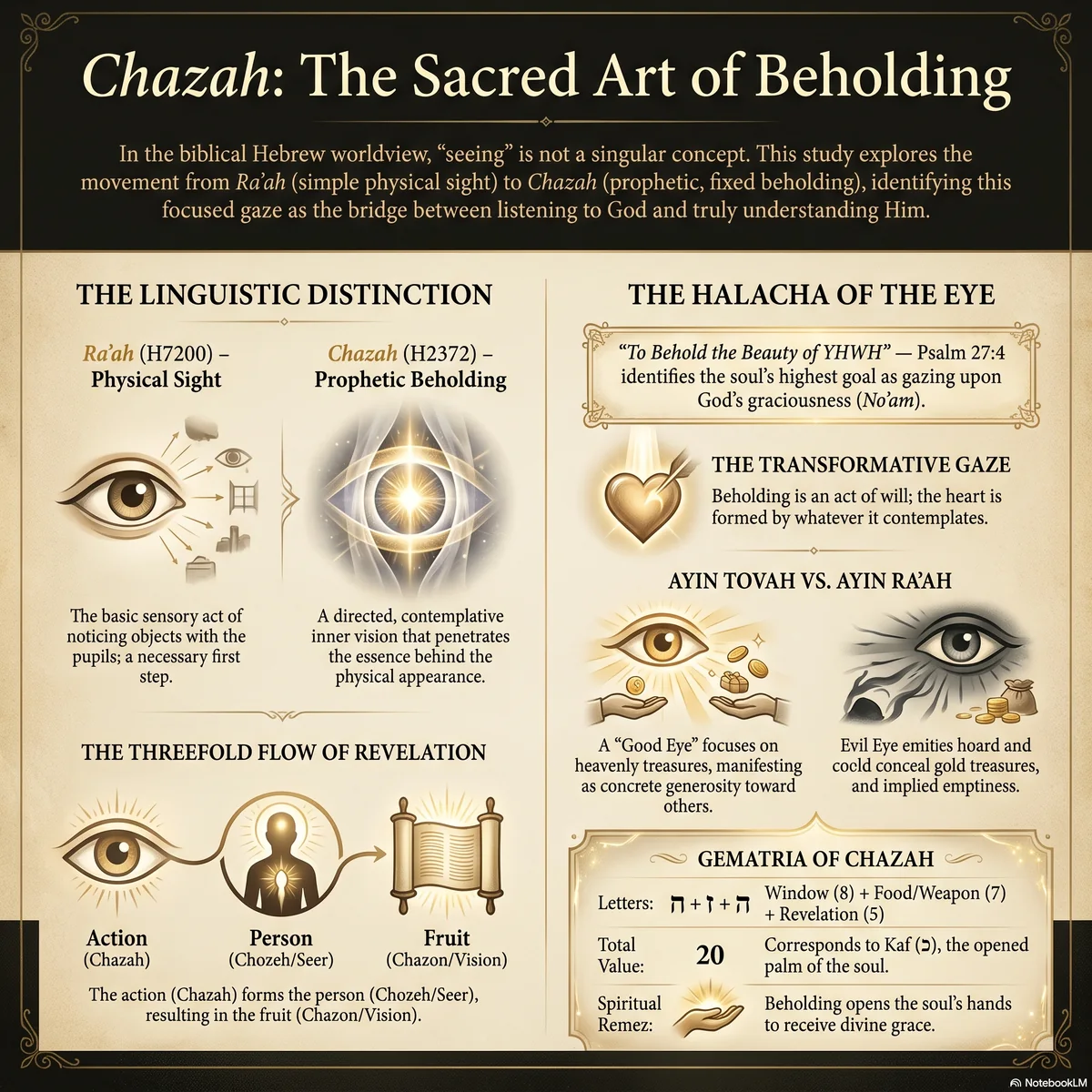
Translation Loss · חָזָה (H2372) versus רָאָה (H7200) — In our western translations, verbs such as see, behold, perceive, gaze are often used interchangeably. This loses the sharp distinction present in the Hebrew source text. Translation Loss · H2372
Ra'ah (H7200) is ordinary, physical seeing — noticing objects with the pupils. Every sighted person performs ra'ah. But Chazah (H2372) describes fixed, contemplative, inward, prophetic perception. It is penetrating to the essence behind the appearance.
Restoration: for chazah, do not simply use "see" — choose "behold," "gaze prophetically," or "fix with spiritual focus."
The three derivatives of Chazah
To understand the reach of the root חזה, it helps to see how the Torah and the Prophets deploy this root across the whole line of revelation:
Gematria & Structure of Chazah
The letter value of the root also points to the gathering of grace and life:
The value 20 corresponds to the letter Kaf (כ) — pictographically the open palm of the hand. As an associative image: whoever beholds (chazah) opens the hands of the soul to receive the revealed grace of YHWH. This is not independent proof but a reinforcing consideration alongside the already canonically grounded textual line above. Gematria · Speculative Remez · reinforcing, not load-bearing
The Contrast: when beholding deceives
Chazah is not automatic holiness. The root itself is morally neutral — it is a capacity, not a virtue. The Prophets explicitly warn of a chozeh who looks with the same intensity, but at the wrong object.
"They have envisioned emptiness (chazu shav) and lying divination..."
Ezekiel 13:6 · Canonical · H2372 · H7723 · Ezek. 13:6–9Here chazah is paired with shav (H7723, emptiness, falsehood) instead of with no'am YHWH. Same direction of gaze, same intensity — but fixed on a self-made reality instead of on YHWH. Micah confirms this pattern: "Therefore it shall be night to you, without vision (chazon); darkness to you, without divination... the seers (chozim) shall be ashamed." Canonical · H2374 · Mic. 3:6–7
Even Balaam is described in almost identical terms as a true chozeh — and the text repeats the pattern twice, in both his first and second oracle:
"...the oracle of the man whose eye is opened (shetum ha-ayin), the oracle of him who hears the words of God, who beholds the vision of the Almighty (machazeh Shaddai yechezeh), falling down, with eyes uncovered (nofel u'galuy eynayim)" (Numbers 24:3–4, H8365, H2372).
In the second oracle, the text adds a third verb to the same pattern: "...who hears the words of God, and knows the knowledge of the Most High (v'yode'a da'at Elyon), who beholds the vision of the Almighty..." (Numbers 24:16, H3045/H1847). Balaam hears (shama), knows (yada), and beholds (chazah) — three spiritual capacities at once, fully intact, with his eyes literally uncovered. And yet his heart remains fixed on reward, not on YHWH. This tension between an opened eye, real knowledge, and a wrongly directed heart is further explored in the study on Parasha Balak. That yada stands here beside chazah — and proves equally morally neutral — is developed further in the study Know. Canonical · Num. 24:3–4, 15–16
The conclusion is sharp: it is not the intensity of the gazing that sanctifies, but the object on which the eye is fixed. This is precisely the halachic task worked out in the next step.
Beholding is a choice of the walk
Halacha is walking the way of YHWH's instruction. Many assume that halacha is only about the actions of hands and feet. But the Torah teaches that the walk begins with the governing of the eye. In Numbers 15:39 we saw that following after one's own heart and eyes leads to straying. Chazah is the halachic counter-movement: it is the sanctifying of the gaze. Canonical · Num. 15:39
If you do not deliberately choose what you behold, the world will fill your perception with idols, fear, and desire. Halacha means: I do not set worthless things before my eyes (Ps. 101:3), but direct my gaze to the King.
From Hearing to Seeing to Doing
In the wider study walk we see how the spiritual senses connect to one another. First comes hearing (Shema) — accepting YHWH's voice. Out of hearing arises the space to see purely (Chazah). And whoever beholds what is holy and beautiful will walk, as a matter of course, in step with the Spirit.
"My eyes are ever toward YHWH, for He will pluck my feet out of the net."
Psalm 25:15 — The gaze determines the freedom of the feet Canonical · Ps. 25:15Guarding the Gates of the Eye
Before the Sermon on the Mount, this distinction already stands in the Tenach itself. Proverbs calls the person who is good of eye (tov-ayin) blessed — he shares his bread with the poor (Prov. 22:9). Deuteronomy warns against the opposite: "let your eye not be evil (v'ra'ah eyncha) against your poor brother" as the year of release draws near (Deut. 15:9) — the evil eye that calculates instead of gives.
Yeshua builds on this in the Sermon on the Mount: "The lamp of the body is the eye; if therefore your eye is single, your whole body shall be full of light." A good eye (ayin tova) is an eye fixed on the treasures of heaven — an eye that chooses chazah. An evil eye (ayin ra'ah) is led by envy and calculation. Beholding is the daily cleansing of the eye of the heart — and its fruit, from Proverbs to Matthew, is always concrete: generosity. Canonical · Matt. 6:22–23
Halachic application: three concrete exercises
1 · The gaze before the screen. Before you open a phone or news source in the morning, speak Psalm 27:4 aloud first. Whoever beholds the King first will not be filled unfiltered by whatever the world offers.
2 · The eye that gives, not calculates. When you receive a request for help, test yourself against Proverbs 22:9 before you answer: is my eye good (sharing) or evil (calculating)? This is chazah becoming visible in the hand.
3 · The tzitzit-gaze. Connect this halachic line to the already-built study Remember: where zakhar uses the gaze to return to the mitswot, chazah goes one step deeper — not only returning, but remaining at rest in what is beheld.
Testimonies of Spiritual Beholding
Throughout the canon we see how the encounter with YHWH is repeatedly marked by the verb chazah. These are the founding moments in which humanity sees the veil of the natural pushed aside.
Moses, Aaron, Nadab, Abihu, and seventy elders of Israel climbed Mount Sinai. And there the unthinkable happened: they saw the God of Israel, and under His feet was a paved work like a sapphire stone, as clear as the sky itself.
The text says explicitly: "And upon the nobles of the children of Israel He laid not His hand: also they beheld God (vayechezu et-haElohim), and did eat and drink." Here chazah is linked to the covenant meal. Without dying, they were allowed to behold His glory because the blood of the covenant had been sprinkled over them. Beholding and fellowship (eating and drinking) belong inseparably together. Canonical · Ex. 24:11
Sod — the apparent tension with Deuteronomy 4. Moses warns Israel firmly: "you saw no form (lo re'item kol-temunah) on the day YHWH spoke to you at Horeb" (Deut. 4:12, 15 — H8544, temunah). This seems to contradict Exodus 24:11, where the elders did behold God. The source text resolves this itself: Deuteronomy 4 uses ra'ah (ordinary seeing) in combination with temunah (a depicted form, the basis of the graven-image prohibition in Deut. 4:16) — while Exodus 24:11 uses chazah. The elders did not behold a form that could be imitated; they beheld a glory that eludes every depiction. This is precisely what makes chazah fundamentally different from seeing a form — and precisely this that safeguards the second commandment. Canonical · Deut. 4:12,15 · H8544 · H7200
Immediately after the beholding at Sinai (Exodus 24) follows the blueprint of the Tabernacle — and within it, the most intimate piece of furniture: the kapporet, the mercy seat on the ark. Two cherubim of hammered gold spread their wings over the kapporet, "and their faces shall look one to another; toward the kapporet shall the faces of the cherubim be."
If a concept were to be an object in the Tabernacle, this is it: the cherubim embody in lasting gold what David voices as life's purpose in Psalm 27:4. Their gaze never departs from the place of atonement. No chazah-verb literally appears in this verse — this is therefore not a linguistic but a typological connection (Remez): the architecture of the sanctuary itself freezes the posture of the beholding heart into lasting form. Canonical · Ex. 25:20 Typological connection · Remez
In the midst of his deepest physical and emotional breakdown, Job cuts a path through the darkness. He speaks prophetic words that echo through the ages:
"And though after my skin worms destroy this body, yet in my flesh shall I behold God (echezeh). I myself shall behold Him, and my own eyes shall see Him, and not another." Job uses the root chazah twice. His hope in the Redeemer (Go'el) is grounded in the certainty that he will ultimately behold YHWH personally. Canonical · Job 19:26–27
In the Aramaic sections of Daniel, the root chaza (the Aramaic counterpart of H2372) is the key word for the prophetic beholding of the heavenly throne room. Daniel says: "I beheld (chazeh haveth) in the night visions, and behold, one came with the clouds of heaven like a Son of man..."
Daniel's prophetic beholding opens a window onto the messianic kingship of Yeshua. Whoever practises chazah sees beyond the kingdoms of this world (the beasts from the sea) and sees the Son of man who receives dominion. Canonical · Dan. 7:13
In the New Testament the Greek verb theaomai (G2300) is the direct translation of the posture of chazah. John writes: "That which was from the beginning, which we have heard, which we have seen with our eyes, which we have beheld (etheasametha) and our hands have handled, of the Word of life..."
John does not merely say they glimpsed Yeshua passing by. He uses theaomai — the Greek equivalent of chazah: they beheld Him intensely, penetratingly and contemplatively as the full revelation of the Father. Canonical · 1 John 1:1
From Sinai to the letters of John, the thread is clear: those cleansed by the blood of the covenant receive the grace to behold God. No longer at a distance in fear, but in the intimate fellowship of the Word made flesh.
VIII · The Monday-morning Test — Practical Application
Chazah is not pious theory — it is the choice of what you let your mind rest on as the work week begins.
On Monday morning, hundreds of stimuli storm at you: emails, news reports, the pressure of the workplace. If your gaze stays stuck at the level of ra'ah, you are overwhelmed by circumstances. But whoever practises the halacha of chazah deliberately pauses before reacting. You fix the eye of your heart on the King on His throne.
This week, concretely: Before a busy task or a difficult conversation, choose 60 seconds of silence. Close your physical eyes and speak the words of Psalm 27:4 aloud: "One thing have I asked of YHWH: that I may behold His loveliness." Notice how your perspective shifts from human fear to heavenly rest.
- The difference between ra'ah (physical registering) and chazah (spiritual, fixed beholding). Which of the two dominates your daily engagement with the Scriptures?
- Beholding YHWH's loveliness (no'am) requires setting apart time and silence. Where in your weekly schedule is space reserved for this beholding?
- Spiritual sight is not a gift for a select elite of "seers," but a calling and promise for every child of God who walks in the covenant.
- Beholding is not an escape from reality, but precisely the anchoring in the only true, eternal reality of God's kingdom.
- Clean the gates of your eyes. Is there content (media, conversations, images) that clouds your inner gaze and hinders beholding YHWH? Step away.
- Pray each morning with the words of Psalm 119:18: "Open my eyes, that I may behold wondrous things out of Your Torah."