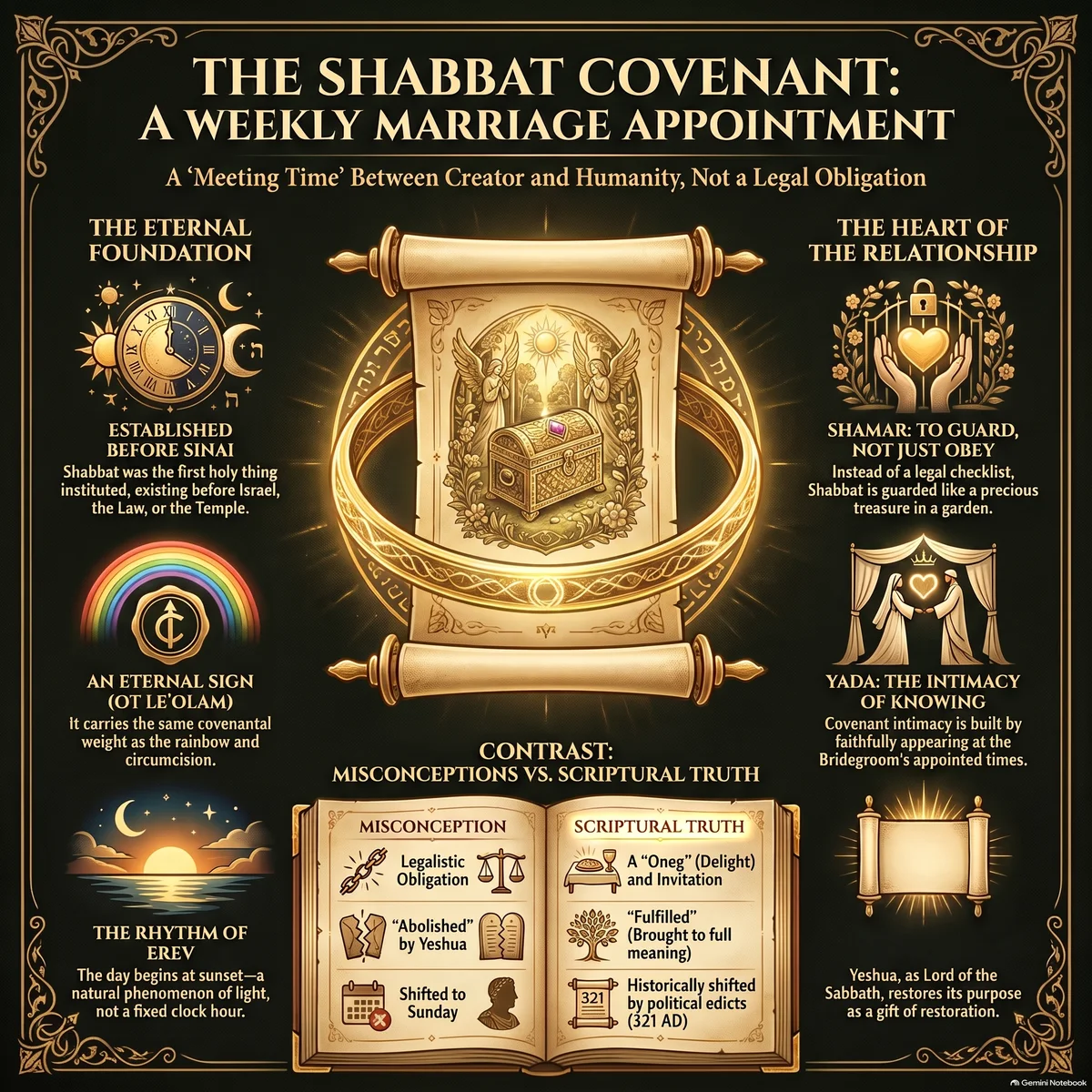
The Shabbat is not a Jewish tradition that happens to also appear in the Tenach — it is the first holy thing YHWH ever instituted, before there was an Israel, a Sinai, or a temple. Genesis 2:1–3 places the Shabbat at creation itself, for all of humanity. Exodus 31:16–17 calls it an ot le'olam — an eternal sign — carrying the same covenant weight as the rainbow after the flood. This study asks not only what the Shabbat is, but which relationship it represents: a weekly appointment between the Bridegroom and His people, not a legal checklist.
This study uncovers four layers that disappear in both the legalistic and the replacement-theology reading: the Shabbat as a creation-ground prior to Sinai, the relational weight of shamar as opposed to juridical obedience, Yeshua as the Lord of the Sabbath who explains the gift rather than abolishing it, and the Yada-intimacy built by showing up at the appointed time.
After this study you understand:- You know the canonical ground of the Shabbat (Gen. 2:1–3; Ex. 20:8–11; Ex. 31:16–17) and why it was instituted before Sinai and before Israel existed as a nation.
- You understand the difference between shamar (to guard, to cherish) and the juridical-hierarchical "obedience" through which Western translations color the Sabbath command.
- You can explain why "fulfill" (plēroō) in Matthew 5:17 does not mean "abolish," and why this applies directly to the Sabbath command.
- You recognize Yeshua's self-designation as "Lord of the Sabbath" (Mark 2:27–28) as confirmation, not abolition.
- You understand the Yada-intimacy line: how faithfully showing up on the Shabbat builds covenant intimacy — and what it costs when it is absent.
- You know the canonical anchor for the start of a new day (erev, Gen. 1:5) and why this is a phenomenon, not a fixed clock hour — including the limits of that question at high latitudes.
- You know what the Monday morning after Shabbat concretely means for your walk.
Read the four Scripture passages below slowly — preferably aloud. Before reading, ask yourself: what connects these texts? Which pattern do they repeat?
The canonical textual ground
וַיְכַל אֱלֹהִים בַּיּוֹם הַשְּׁבִיעִי... וַיְבָרֶךְ אֱלֹהִים אֶת־יוֹם הַשְּׁבִיעִי וַיְקַדֵּשׁ אֹתוֹ
"And on the seventh day God finished His work... and God blessed the seventh day and sanctified it."
Genesis 2:2–3 Canonical · H7676Before Sinai, before Israel as a nation
The Shabbat is not first mentioned in the Sinai legislation — it already stands in Genesis 2, before the fall, before Abraham, before there was a nation Israel. When critics claim the Shabbat was "only for the Jews," they overlook the very first chapter in which it appears: no nation yet existed when God blessed and sanctified it. The manna rhythm in Exodus 16 — before the Sinai legislation of Exodus 20 — confirms that the seven-day pattern already functioned as a known given, not a new introduction. Canonical · Gen. 2:1–3 · Ex. 16:22–30
Translation loss · "Only for the Jews" — The assumption that the Shabbat is an exclusively Jewish practice that does not concern non-Jewish believers reverses the text. Isaiah 56:6–7 speaks explicitly to the "foreigner who joins himself to YHWH" and promises him a place on the holy mountain because he guards (shamar) the Shabbat. The Shabbat was given to humanity at creation — not exclusively to Israel at Sinai. Popular-theol. · corrected
When does the day begin? Erev as a phenomenon, not a clock hour
Genesis 1:5 sets the pattern: "and there was erev, and there was boker — one day." The day's beginning is tied to erev — the phenomenon of the transition into darkness — not to a fixed clock hour. Leviticus 23:32 repeats this for Yom Kippur: "from erev to erev," again with erev as the anchor, not a number. Canonical · Gen. 1:5 · Lev. 23:32
Some teachers point to the evening sacrifice, offered at "the ninth hour" (Ex. 29:39), as evidence for a fixed starting point around 6:00 pm. But the ninth hour was not a fixed clock hour in antiquity — daylight was divided into twelve proportional hours (confirmed in John 11:9), which shift by season and latitude. A variable, latitude-dependent hour cannot prove a fixed, universal clock hour. The main line remains: the Shabbat begins at sunset on Friday, tied to the erev-phenomenon itself. Popular-theol. · 6:00 pm thesis unsupported
At high latitudes, where sunset is not usable as a daily marker (polar summer/winter), both rabbinic and Messianic communities commonly follow the day-night rhythm of the nearest location with a normal cycle. This is an exception rule for an exception situation — not a replacement of the erev-principle itself. Practice · common solution, not explicitly worked out canonically
One line through three witnesses
The Shabbat is not an isolated Torah statute. It runs as a recognizable line through the Prophets, and in the Brit Chadasha is neither abolished nor replaced — but explained by the Creator Himself.
Genesis 2:1–3 (creation) → Exodus 16 (manna rhythm, before Sinai) → Exodus 20:8 (zachor — remember) → Exodus 31:16–17 (eternal ot). Four moments, one continuous line: the Shabbat is not a statute introduced at Sinai, but an already-existing pattern reaffirmed at Sinai and anchored in the covenant sign. Canonical · Gen. 2:1–3 · Ex. 16 · Ex. 20:8 · Ex. 31:16–17
Isaiah 56:6–7 explicitly opens the Shabbat to the foreigner who joins himself to YHWH. Isaiah 58:13–14 links the Shabbat to oneg — delight, pleasure — as the intended state, not as a burden: "if you call the Sabbath a delight... then you shall delight yourself in YHWH." Jeremiah 17:21–27 uses the Shabbat as a covenant test for the generation before the exile. Canonical · Isa. 56:6–7 · Isa. 58:13–14 · Jer. 17:21–27
Mark 2:27–28 — Yeshua calls Himself "Lord of the Sabbath" right after first establishing: "the Sabbath was made for man, not man for the Sabbath." This is not a relativizing of the Shabbat, but a restoration of its original, beneficial purpose against a rigid system of application. Canonical · Mark 2:27–28
Matthew 5:17–19 — plēroō (to fulfill) means to bring to its full meaning, not to abolish, per Protocol VI.iii. Yeshua states beforehand: "do not think that I have come to abolish the Torah or the Prophets... not one jot or tittle will pass away." Canonical · Matt. 5:17–19
Acts 15:19–21 — the Jerusalem decision places three minimum requirements on non-Jewish believers (Lev. 17–18: no idolatry, no blood, no sexual immorality) and adds that Moses "has been preached in every city from ancient generations, being read in the synagogues every Sabbath" — an indication that the practice of Sabbath gathering was assumed to continue as a given, not something newly imposed. Canonical · Acts 15:19–21
Acts 20:7–11 — "on the first day of the week... to break bread" begins, in Hebrew calendar reckoning, on Saturday evening after sunset: a havdalah meal at the close of the Shabbat, not a Sunday worship service. Canonical · Acts 20:7–11
Hebrews 4:9–10 — "there remains a Sabbath rest for the people of God." The Greek text here uses sabbatismos, a unique form specifically referring to Sabbath rest — not a generic word for "rest." Canonical · Heb. 4:9–10
Yeshua — Creator of the Shabbat, Lord of the Shabbat
The Messianic core of the Shabbat is not a relativizing, but a declaration of ownership. The One who instituted the Shabbat is the same One who explains it.
When the Pharisees criticized Yeshua's disciples for plucking grain on the Shabbat, He did not respond by relativizing the Shabbat, but by restoring its purpose: "the Sabbath was made for man, not man for the Sabbath. So the Son of Man is Lord even of the Sabbath." A claim of lordship presupposes ownership — no stranger declares himself lord over someone else's institution. Yeshua here claims the same creative authority as the God who rested in Genesis 2. Canonical · Mark 2:27–28
Plēroō (πληρόω) — to fully expound, to bring to full meaning — is the rabbinic maleʾ (מָלֵא), as opposed to batel (בִּטֵּל) — to nullify, to declare void. Yeshua states beforehand that one should not think He came to abolish. The Shabbat, as part of the Ten Words, falls under what remains "until heaven and earth pass away." Translation loss · VI.iii
Every moed (appointed time) YHWH gives carries the same character: an appointment between two parties who love each other. The Shabbat is the most frequent of all these appointments — weekly, not annual. It functions as the recurring marriage appointment of the Bridegroom with His people: not check-in points, but invitations to be present.
"Will you be there at the appointed time — not because you must, but because you know Me?"
Every Shabbat is a repeated question, not a repeated obligation. The Bridegroom fixes His appointment; the Bride answers with presence.
Yada — the intimacy of knowing
Yeshua said: "I never knew you." Yada (יָדַע, H3045) is not the Western, intellectual "knowing that someone exists." It is the term for the most intimate marital union.
"Adam knew (yada) Eve his wife, and she conceived."
Genesis 4:1 Canonical · Gen. 4:1 · H3045How do you maintain that intimacy in a covenant? By showing up at the appointed times. The Shabbat and the annual feasts are the marital dates the Bridegroom has fixed with His Bride. Whoever is not present builds no yada. Canonical · H3045 · H4150
Matthew 25 — the parable of the ten virgins. Five were foolish. While they are away at the wrong moment, the Bridegroom comes at the appointed time. The door closes. When the foolish virgins knock outside: "Lord, Lord!" the Bridegroom answers: "Truly, I do not know you." The same words as in Matt. 7:23. They were not there at the appointed times. Canonical · Matt. 25:12
Three misunderstandings that crowd out the testimony
The popular-theological reading: The Shabbat is a list of forbidden actions, enforced under threat of sanction — a test of obedience, not an invitation.
The Scriptural contrast: The command uses shamar — to guard, to cherish — not a term for compliance under command. Isaiah 58:13–14 explicitly links the Shabbat to oneg, delight, as the intended outcome, not fear of transgression. Canonical · Isa. 58:13–14
Anomia (ἀνομία, G458) — Torah-lessness. Yeshua's warning "I never knew you, depart from Me, you who practice lawlessness" is not a warning against legalistic behavior, but against the absence of the relational yada that comes from faithful presence at the appointed times. Canonical · Matt. 7:23 · G458
The popular-theological reading: Yeshua's coming "fulfilled" the Shabbat in the sense of closing it out — the believer now has a better, spiritual rest that makes the weekly Shabbat unnecessary.
The Scriptural contrast: This reading confuses plēroō with batel. Matthew 5:17–19 already rules out this reading itself: Yeshua warns beforehand against exactly this interpretation. Creation (Shabbat), redemption (Passover), and restoration (the Kingdom) are three distinct works of YHWH — one does not replace another, any more than apples replace oranges. The Shabbat commemorates creation; that work is not undone by the work of redemption. Translation loss · plēroō ≠ batel
Acts 15 confirms this from another angle: the Jerusalem decision places minimum requirements from Leviticus 17–18 on non-Jewish believers, and in doing so assumes that the weekly reading of Moses in the synagogues — the Sabbath gathering — is a continuing, self-evident practice, not an expiring system. Canonical · Acts 15:19–21
The popular-theological reading: The church has traditionally observed Sunday instead of the Shabbat in honor of the resurrection — this would be a shift willed by God.
The historical contrast: It is historically documented that the earliest followers of Yeshua continued to guard the Shabbat. Emperor Constantine issued the first empire-wide edict prescribing Sunday rest in 321 AD, partly for political motives (distancing from the Jewish people, aligning with existing sun-worship in his realm). The Council of Nicaea (325 AD) further confirmed this course. Historical · Codex Theodosianus XVI · Council of Nicaea
The New Testament itself places the resurrection on "the first day of the week" — the day after the Shabbat, not in place of it. Acts 20:7 describes a havdalah gathering at the close of the Shabbat lasting deep into the night, not a Sunday worship service as later developed. Canonical · Acts 20:7–11
PaRDeS — four layers of the Shabbat
"Remember the Sabbath day, to keep it holy. Six days you shall labor and do all your work, but the seventh day is a Sabbath to YHWH your God. On it you shall not do any work." The literal ground is a day of rest, instituted after the pattern of creation itself, applying to the whole household including servants, animals, and the foreigner within the gates. Canonical · Ex. 20:8–11
Seven is consistently the number of completion in Scripture (creation, Shavuot's 7×7 count, the sabbatical year, the jubilee). The eighth day — the day after the seventh — is repeatedly the day of new beginning: circumcision on the eighth day (Lev. 12:3), the resurrection on the first day of the week. The weekly Shabbat is a miniature of this rhythm: every completed seventh day opens the way to a new beginning. Canonical · Lev. 12:3
Alongside the canonical core, both Jewish and Messianic homes have practices to mark the beginning and end of the Shabbat: lighting candles at its entry (traditionally understood as creation and redemption, sometimes with a third candle for restoration), and the havdalah ceremony ("separation") at its close. These practices are nowhere prescribed as commandment in the Torah — they are human, recognizable markers of a divinely given rhythm. Rabbinic/Traditional · not a canonical commandment
This freedom is deliberate: Scripture specifies the what (rest, sanctification, remembrance) but leaves much of the how to personal and communal expression. Consistency in one's own standard — not perfection in form — is what Scripture asks. Canonical principle · Gal. 5:1
Hebrews 4:9–10 speaks of a Sabbath rest (sabbatismos) that remains for the people of God — not as a replacement of the weekly Shabbat, but as its deepest destination: the rest in which YHWH Himself dwells forever with His people. Every weekly Shabbat is a foretaste — repeated forty-seven times a year — of the rest that comes when the Bridegroom brings His Bride home for good. Canonical · Heb. 4:9–10
Exodus 31:13 stands in the same divine-speech block as the eternal covenant sign of verses 16–17: "that you may know that I am YHWH who sanctifies you." The same reciprocity described in the Sanctify study — man who sanctifies himself (Lev. 11:44, hitpael) and YHWH who sanctifies (Lev. 20:8, piel) — is already anchored here in the Shabbat itself. Whoever sets everything aside to set that day apart for YHWH is, in that same gesture, equipped and taught by Him — not as a reward afterward, but as the direct consequence of sitting down to listen. Setting the day apart (man toward YHWH) and the sanctifying of man (YHWH toward man) are two sides of the same weekly movement. Canonical · Ex. 31:13 · H6942
Reflection questions
Questions for personal reflection or group study
- If the Shabbat is an invitation from the Bridegroom, do I approach it as an appointment with someone I love, or as a task to check off?
- Yeshua calls Himself Lord of the Sabbath right after saying the Sabbath is for man — not the other way around. Where in my own Shabbat practice has form become more important than the rest it was meant to give?
- The term shamar means to guard and cherish. If I'm honest: do I cherish the Shabbat, or do I endure it?
- Yada is built by showing up faithfully. Which week this month did I miss the appointment — and what held me back?
- Constantine shifted the day of rest for political reasons, not because Scripture asked for it. Which habits in my own faith life are inherited traditions I have never held up against the text itself?
The speakable testimony
Speakable faith — for when it is asked
"When I guard the Shabbat, I am not commemorating a law I must check off, but an appointment the Creator of heaven and earth made with humanity at creation itself. Yeshua called Himself Lord of that Sabbath — not to abolish it, but to show what it was for: rest, not burden. Every week the question is the same: will I be there at the appointed time, not because I must, but because I want to be known?"