The people have cast the calf. Moses has smashed the tablets. And just before YHWH has new tablets hewn, something happens that the rest of Scripture will keep quoting: He passes Moses by and proclaims over Himself who He is — not in abstract terms, but in thirteen descriptive words that continue to echo through Psalms, Prophets, and finally the Renewed Covenant.
This study does not read that proclamation apart from what precedes it — the sin and Moses' intercession that come before it are not background but the key — and follows its trail into Galatians 5, where the same character is no longer proclaimed over YHWH, but becomes visible as fruit in whoever walks by His Spirit.
After this study you will understand:- You know the lead-up of Exodus 32-34 — the golden calf, Moses' intercession on the ground of the covenant, and the proclamation itself — as one continuous movement, not as isolated texts.
- You recognise the thirteen elements of Exodus 34:6-7 in Hebrew, their Strong's numbers, and the nuance western translations often flatten.
- You can explain why this proclamation is repeated throughout the Tanakh (Numbers, Psalms, Joel, Jonah, Nehemiah) and what that repetition means.
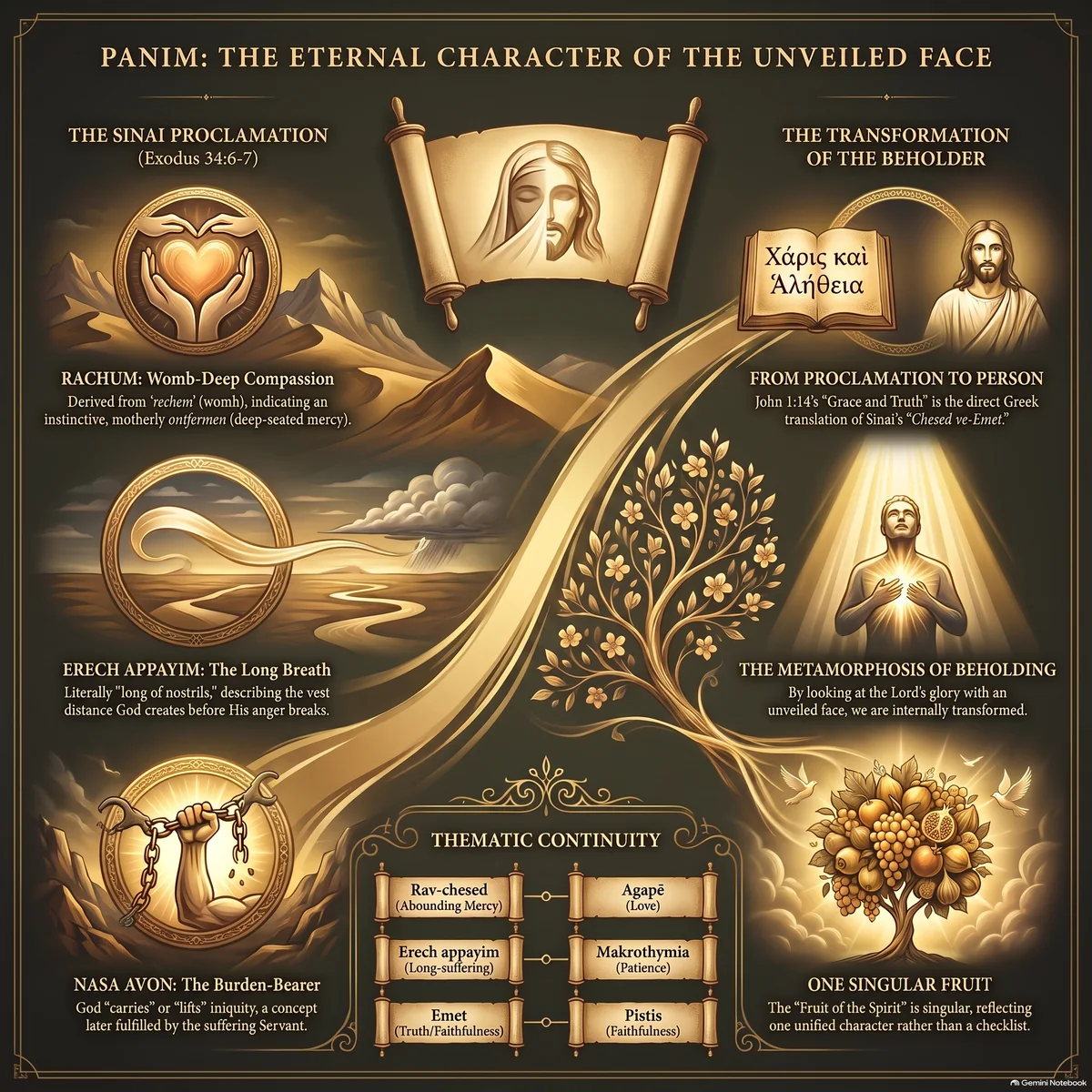
- You see the direct line from Exodus 34:6-7 to 2 Corinthians 3:18 and Galatians 5:22-25 — not as an application laid onto the text, but as a connection the text itself makes.
- You understand why "the fruit of the Spirit" is singular in Greek, and what that means for how you read the nine qualities.
Read Exodus 32 through 34 in one sitting, without pausing at the golden calf — let the tension of that chapter carry through to the proclamation in 34:6-7. Then read Galatians 5:16-25 in the same long breath.
The Lead-Up — A People Who Break the Covenant
While Moses receives the tablets of the covenant on the mountain, the people below cast a golden calf and declare: "This is your god, Israel, who brought you up out of the land of Egypt" (Ex. 32:4). YHWH's response is not neutral: "Now therefore let Me alone, that My wrath may burn hot against them and I may consume them" (Ex. 32:10). The word for wrath here is אַף (aph, H639) — literally "nose," the place where fast, heavy breathing becomes visible. Remember this word: it returns two chapters later, at the very heart of the proclamation itself.
The Intercession — Chesed as the Ground for Pleading
Moses does not plead on the basis of Israel's merit — there is none — but on the basis of the covenant itself: "Remember Abraham, Isaac, and Israel, Your servants, to whom You swore by Your own self" (Ex. 32:13). That is חֶסֶד (chesed, H2617) in action: no appeal to what the people deserve, but to what YHWH Himself has promised. The result: "So YHWH relented from the harm which He said He would do to His people" (Ex. 32:14) — וַיִּנָּחֶם (vayinachem, from nacham, H5162). This is not human indecision on YHWH's part; rather, the text shows that an appeal to the covenant actually turns wrath aside — precisely the pattern that Exodus 34:7 will shortly capture in language as notser chesed, "chesed that is guarded/held back."
New Tablets, Hidden Face
Moses then asks something no one had asked before: "Please, show me Your glory" (Ex. 33:18). YHWH's answer sets its own boundary: "I will make all My goodness pass before you, and I will proclaim the name of YHWH before you… but you cannot see My face, for no man shall see Me and live" (Ex. 33:19-20). Moses is placed in a cleft of the rock; YHWH's hand covers him until the passing is complete (Ex. 33:22-23). What may be seen is not the Face itself but what passes by — the proclamation, not a vision.
"Then YHWH passed before him and proclaimed: YHWH, YHWH, God, merciful and gracious, slow to anger, and abounding in steadfast love and faithfulness…"
Exodus 34:6-7Canonicity Check — "Thirteen Attributes"
Important before the root analysis begins: the count of "thirteen" (Sheloshah-Esreh Middot, literally "thirteen measures/attributes") does not appear numbered in the text itself — this is a Rabbinic-Traditional framing device (Talmud, b. Rosh Hashanah 17b), still recited during the Selichot prayers to this day. The underlying Hebrew text of Exodus 34:6-7 is, of course, fully Canonical — only the division into exactly thirteen is a later, clearly labelled reading aid, not a Biblical self-numbering.
The Roots — Cluster by Cluster
This proclamation is not spoken once and then left behind. It is quoted again throughout the entire Tanakh — sometimes in full, sometimes in a single phrase — each time at moments when YHWH's character is put to the test once more.
Repeated Through Torah, Prophets, and Writings
| Text | Context | What is quoted |
|---|---|---|
| Numbers 14:18 | Moses pleads again, after the spies' rebellion | Erech appayim, rav-chesed, nosei avon — quoted almost verbatim |
| Psalm 86:15 | David in distress | Rachum ve-channun, erech appayim, rav-chesed ve-emet |
| Psalm 103:8 | Hymn of praise for forgiveness | Rachum ve-channun, erech appayim, rav-chesed |
| Joel 2:13 | Call to return, not to outward mourning | Full formula, as a summons to trust His character |
| Jonah 4:2 | Jonah's anger over Nineveh's rescue | The same formula — now as an accusation, not as praise (see ④) |
| Nehemiah 9:17 | National confession after exile | Full formula, as the explanation for why the people were not consumed |
This is not a loose collection of coincidental echoes — it is a fixed, recognisable formula Israel carried through generations as the answer to the question, "who is YHWH when we disappoint Him again?"
2 Corinthians 3:18 — The Same Veil, This Time Removed
Paul reaches back to precisely this episode. After the proclamation, Moses veils his face whenever he does not speak with YHWH, because the afterglow of the encounter frightens the people (Ex. 34:29-35). Paul reads that veil as an image of a darkened understanding — and sets the opposite against it:
"But we all, with unveiled face, beholding as in a mirror the glory of the Lord, are being transformed into the same image from glory to glory."
2 Corinthians 3:18The Greek verb here is metamorphoumetha (G3339, "to be transformed in form") — the same word as the transfiguration on the mountain (Matt. 17:2). What Moses once experienced from the outside — a face that passed by and an afterglow that remained — here becomes an inner process: whoever keeps beholding is themselves changed into that image. This is no application laid onto the text by this study; Paul himself deliberately quotes this same Exodus episode.
Galatians 5:22-25 — One Fruit, Not a Checklist
The Greek word for "fruit" in Galatians 5:22 is karpos (G2590) — singular. Not "the fruits of the Spirit" but "the fruit," with nine descriptive elements within it. The same movement as Exodus 34:6-7: not thirteen loose virtues to tick off, but one character with thirteen visible facets. The language differs — Hebrew there, Greek here — but the shape of the revelation is identical.
| Exodus 34:6-7 (Hebrew) | Galatians 5:22-23 (Greek) |
|---|---|
| Rav-chesed / rachum | Agapē (G26) — love |
| Erech appayim | Makrothymia (G3115) — patience/longsuffering |
| Rav-chesed | Chrēstotēs (G5544) — kindness |
| Emet | Pistis (G4102) — faith/faithfulness |
| Notser chesed | Egkrateia (G1466) — self-control |
✧ Remez, not a Pshat equation — this is not a word-for-word translation table; the Hebrew and the Greek are not synonyms. What is in view is a substantive, thematic Echo — the same character recognisable in two languages and two testaments — deliberately not presented as lexical identity.
John 1:14 — Chesed ve-Emet, Chen kai Alētheia
One connection, however, is lexical, not merely thematic: "And the Word became flesh and dwelt among us… full of grace and truth" (John 1:14). "Grace and truth" (charis kai alētheia, G5485 + G225) is the fixed Greek rendering of exactly the Hebrew word pair chesed ve-emet from Exodus 34:6. John is not vaguely citing a Biblical mood here — he uses the exact word combination of the proclamation to say who Yeshua is.
John 1:14 is not a stand-alone verse — it is the hinge of this whole study. Where Moses could not see YHWH's face and live, John writes: "No one has ever seen God; the only-begotten Son… He has made Him known" (John 1:18). The pattern of Exodus 33-34 — the Face that cannot be directly beheld, yet passes by and makes itself known — is reversed in Yeshua: the Face becomes visible and lasting, not passing.
Rachum and Channun, Visible in Flesh
The first two elements of the proclamation — motherly compassion (rachum) and unearned favour (channun) — have not remained abstract. The Greek verb for Yeshua's being moved at sickness, mourning and hunger (e.g. Matt. 9:36; 14:14; 15:32) describes a literally gut-deep reaction — the same weight as rechem, the root of rachum. What Exodus 34:6 proclaims as a character trait, the Gospel shows as repeated, concrete behaviour.
Nasa Avon — The Most Weighted Word, Fulfilled
Exodus 34:7 says that YHWH "carries" iniquity, transgression and sin (nasa, H5375). Isaiah uses this exact verb for the suffering Servant: "Surely He has borne our griefs and carried our sorrows" (Isa. 53:4) and "He bore the sin of many" (Isa. 53:12, nasa). What in Exodus 34:7 still carried the tension of verse 7b — "He will by no means clear the guilty" — is resolved in Isaiah 53, not by ignoring the tension but by carrying it in a Person: the carrying of sin and the not-clearing of the guilty coincide in the sacrifice, rather than standing against each other.
"He Himself bore our sins in His own body on the tree."
1 Peter 2:24The Metamorphosis Continued — Galatians 5 as the Sequel to 2 Corinthians 3
What already became visible in ② comes together here: 2 Corinthians 3:18 describes the transformation in beholding; Galatians 5:22-25 describes what that transformation concretely yields — the same nine/thirteen character traits, now carried in whoever peripateos (walks, G4043) by the Spirit. This is not two separate doctrines of Paul, but one continuous thought: the Face is beheld (2 Cor. 3), and whoever keeps beholding comes to resemble it (Gal. 5) — not through their own effort but as fruit of the Spirit who dwells in them.
Misreading — "Angry God of the Old Testament"
A persistent popular-theological image sets an angry God of the Old Testament against a loving God of the New. Exodus 34:6-7 refutes this directly, and at the worst possible moment to do so: right after the worst covenant breach so far (the golden calf), and right after YHWH's own announcement that He wished to destroy the people (Ex. 32:10), He proclaims over Himself that He is first rachum and channun, and only after eight elements of grace does He reach the boundary of justice (34:7b). The order itself is the message: grace does not follow justice as a correction, but justice stands at the end of a long line of words of grace.
Translation Loss — "Patient" as a Passive Trait
Erech appayim is usually translated "patient" or "longsuffering" — technically correct, but the weight is lost. The word describes a long distance between provocation and wrath, not the absence of wrath. Jonah's own complaint confirms this sharply: he quotes the formula not out of devotion but out of anger — "Was not this what I said when I was yet in my country?… for I knew that You are a gracious and merciful God, slow to anger, and abounding in steadfast love" (Jonah 4:2). Jonah knew this proclamation so well that he used it against YHWH as an accusation — proof that "patient" here is no vague sentiment but a character trait that produces concrete, predictable, and — for Jonah — precisely unwanted behaviour.
Misconception — Nine (or Thirteen) Separate Virtues to Acquire
As explained in ②, karpos in Galatians 5:22 is singular. A popular-theological use treats the nine elements as a checklist — "work on patience this month, on gentleness next" — to be cultivated separately from one another. That runs against the grammar of the text itself: it is one fruit, arising from one walk with the Spirit (Gal. 5:25), not nine separate projects. The same holds for the thirteen elements of Exodus 34:6-7: it is one character, proclaimed in one breath — not thirteen attributes to be memorised.
Translation Loss — "Law" Where Galatians Says "Spirit"
Galatians 5:18 states expressly: "But if you are led by the Spirit, you are not under the law." This "under the law" (hypo nomon, cf. protocol VI.iii.a) describes a position of legal compulsion, not the Torah itself as problematic. The fruit of Galatians 5:22-25 is no replacement of Torah-instructions with a vague "living from feeling," but precisely what Exodus 34:6-7 already showed: character arising from relationship (en nomos), not from performance (hypo nomon). Whoever reads "law" as the opposite of the fruit misses that the fruit itself is the character the Torah described from the beginning.
Moses' intercession in Exodus 32:11-13 is not an exceptional moment for an exceptional leader — it is the model that notser chesed (34:7) makes concrete: chesed that does not wait passively but is actively held and deployed, precisely when wrath would be the logical response.
- 1 Where in your life — in yourself or in someone else — is there a "golden calf" moment this week: a breach that would justify wrath? Name it concretely, not in general terms.
- 2 Moses pleaded not on the basis of merit but on the basis of the covenant. On what "covenant ground" — a promise, a relationship, YHWH's own character — could you stand, instead of on what someone deserves?
- 3 Which of the nine elements from Galatians 5:22-23 asks most of you this week — not as a virtue to perform, but as fruit to let grow in the beholding? Be honest here, even where it is uncomfortable.
- Can you point to a moment when, after your own "golden calf," you felt YHWH's chesed more strongly than His judgment — not as theory but as something you experienced?
- Which of the thirteen elements of Exodus 34:6-7 do you recognise most clearly in your own life story, and which element remains mostly head-knowledge for you?
- If "the fruit of the Spirit" really is one fruit, not nine separate virtues — what does that change about how you look at your own growth?